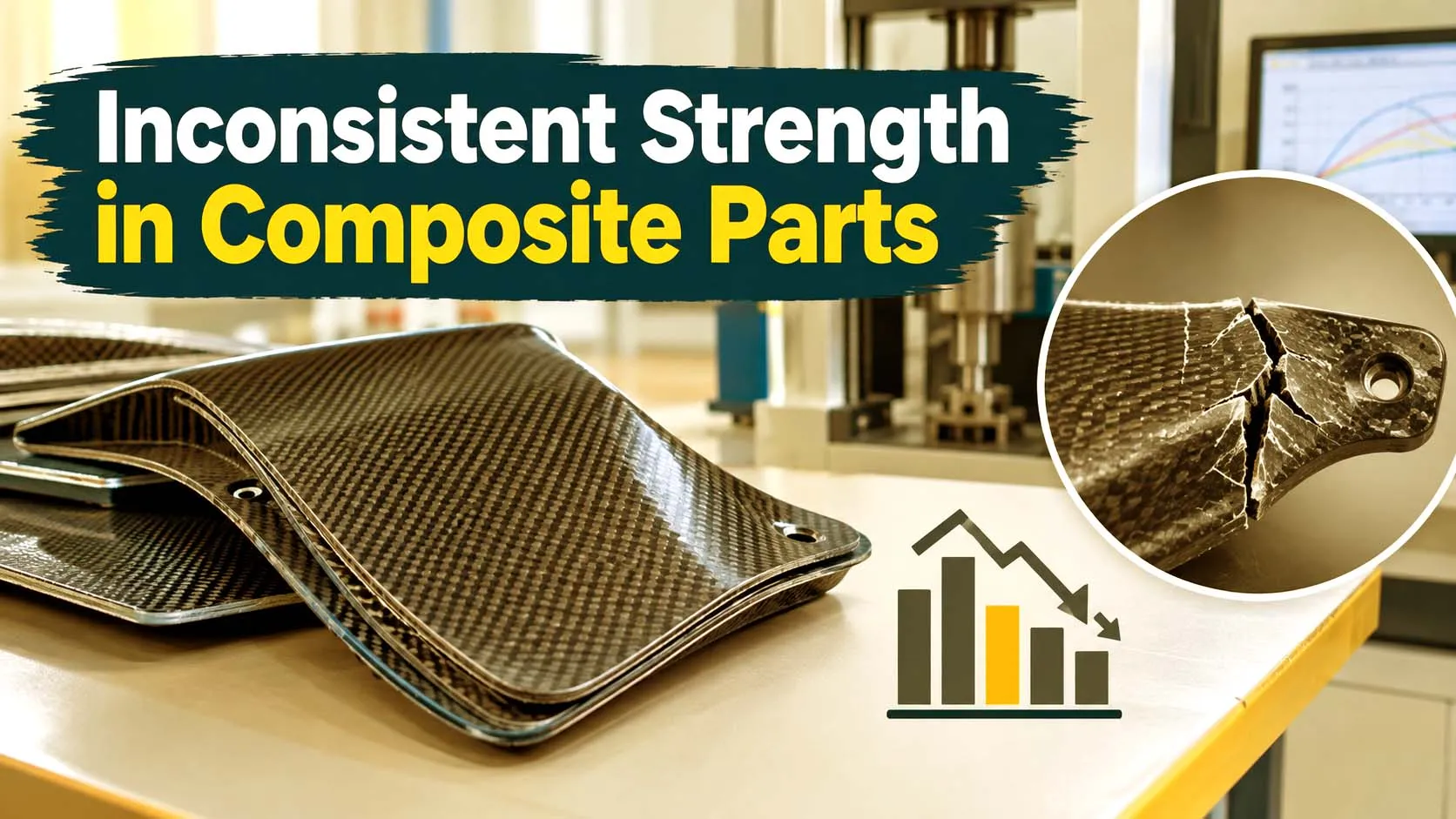


Composite parts are chosen for their high strength, low weight, stiffness, and durability. Yet two parts made from the same material, on the same design, can perform very differently.
Quick answer: Inconsistent strength in composite parts is usually caused by variation in fiber content, voids, fiber misalignment, poor consolidation, contamination, material aging, or uneven curing. It is rarely one single problem. The fix is to control the whole process: materials, layup, vacuum, cure cycle, and inspection.
These defects are often invisible from the outside. They can still reduce strength, stiffness, dimensional stability, and service life.
In this article:
- The 9 most common causes of strength variation
- A quick Cause → Effect → Fix table
- How a composite curing oven helps (and where it doesn't)
- Oven vs. autoclave
- How to verify cure and test consistency
- A troubleshooting checklist and FAQ
9 Common Causes of Inconsistent Strength in Composite Parts
1. Variation in Fiber Content and Resin Distribution
The ratio of fiber to resin directly affects mechanical properties. In technical work this is measured as fiber volume fraction, the share of the laminate's volume occupied by fibers.
As a rough guide, aerospace-grade prepreg laminates often target a fiber volume fraction of around 55-65%, while wet layup parts are usually lower. The exact target depends on the material and specification.
Two typical problems:
- Resin-starved areas: too little resin to bind and support the fibers, so load transfer is poor.
- Resin-rich areas: too much resin, so the matrix carries a bigger share of the structure than the fibers.
If these vary from part to part, or from area to area within one part, strength varies with them.
2. Voids, Trapped Air, and Poor Consolidation
Voids are pockets of air or gas trapped inside the laminate. They interrupt the fiber-resin structure and can become starting points for damage under load.
Many structural specifications limit void content to roughly 1-2% or less, and critical aerospace parts often require even lower.
Voids commonly come from:
- Vacuum bag leaks or damaged bags
- Poorly sealed edges or leaking fittings
- Inadequate compaction or pressure
- Improper resin flow
- Air trapped during layup or infusion
- Moisture or volatiles in the material
Tip: Check vacuum integrity before and during processing. A small leak can quietly ruin consolidation across the whole part.
3. Fiber Misalignment and Layup Defects
Fibers carry most of the load, so their direction must match the design. Even small deviations can change how the laminate behaves.
Watch for:
- Fiber misalignment or distorted plies
- Wrinkles and folds
- Incorrect ply orientation
- Unintended gaps
- Excessive overlaps
These defects change local thickness, stiffness, and load paths. Clear ply markings, documented layup procedures, and in-process inspection help prevent them.
4. Uneven or Incorrect Curing
Curing is the stage where the resin cross-links and develops its final properties. It needs to follow a specific temperature-time cycle, not just reach a target temperature.
Problems occur when:
- The cure temperature is wrong
- The hold time is too short
- Heating is too fast or too slow
- Temperature fluctuates during the cycle
- Different areas of the part heat at different rates
- The part is removed before cure is complete
Large and thick parts are the hardest to cure uniformly. One area can be fully cured while another is still below target, which shows up as differences in hardness, stiffness, and strength.
5. Exotherm in Thick Composite Parts
Many thermoset resins release heat while they cure. This is called exotherm.
In thick laminates, that heat can build up inside the part. The core can then run hotter than the oven air around it, which can cause:
- Uneven cure
- Excessive local temperatures
- Residual thermal stress
- Dimensional changes
- Resin degradation
For thick parts, the cure cycle should account for the resin system, laminate thickness, and heat generation, not just the oven setpoint.
6. Incorrect Resin and Hardener Mixing
For two-part systems, the mixing ratio controls the curing reaction. Too much or too little hardener changes the final properties. Incomplete mixing creates local areas that cure differently.
Common causes:
- Inaccurate measurement
- Poor or incomplete mixing
- Wrong processing temperature
- Material used outside its recommended conditions
Weigh components accurately and follow the mixing procedure every time.
7. Prepreg Storage and Material Condition
Prepreg is fiber pre-impregnated with a controlled resin system. Its behavior changes if it is stored or handled incorrectly.
Watch for:
- Wrong storage temperature
- Excessive out-time
- Improper thawing (for example, opening the bag while still cold, which lets moisture condense)
- Use beyond shelf life
The results are changes in tack, resin flow, and cure behavior, all of which affect consolidation and final properties. Follow the manufacturer's storage and handling instructions and keep out-time records.
8. Moisture and Contamination
Moisture, dust, oil, and release-agent residue weaken the bond between resin, fibers, and tooling surfaces. Contamination can enter during handling, tool preparation, layup, mixing, bagging, or storage.
Keep the work area, tooling, reinforcements, and consumables clean and dry.
9. Uncontrolled Cooling and Residual Stress
Cooling matters as much as heating. If a part cools too fast or unevenly, different areas contract at different rates. That can cause warping, residual stress, and property variation, especially in large or complex parts.
A controlled cool-down, with a defined cooling rate, is part of a good cure cycle.
Quick Reference: Cause → Effect → Fix
| Cause | Typical Effect | Main Fix |
|---|---|---|
| Fiber/resin variation | Resin-rich or resin-starved zones | Control resin content and fiber volume fraction |
| Voids and poor consolidation | Weak points, early damage | Check vacuum integrity, improve compaction |
| Fiber misalignment, wrinkles | Wrong stiffness and strength direction | Standardize layup, mark plies, inspect |
| Uneven or wrong cure | Variation in hardness and strength | Follow the specified cure cycle, monitor part temperature |
| Exotherm in thick parts | Overheating, residual stress | Design the cure cycle for thickness and resin |
| Wrong mixing ratio | Incomplete or altered cure | Weigh accurately, mix thoroughly |
| Prepreg aging or poor storage | Changed flow and cure behavior | Track storage and out-time |
| Moisture and contamination | Weak bonding | Keep materials, tools, and area clean and dry |
| Uncontrolled cooling | Warping, residual stress | Use a controlled cooling rate |
How a Composite Curing Oven Helps With Consistency
A Composite Curing Oven provides a controlled heating environment for curing composite parts. Its job is to deliver a repeatable thermal cycle. It does not correct defects introduced earlier, such as voids, misalignment, or contamination.
Depending on the design, useful capabilities include:
- Programmable temperature and cure cycles
- Controlled heating and cooling rates
- Forced-air circulation
- Good temperature uniformity across the chamber
- Thermocouple inputs to monitor part temperature
- Temperature recording and data logging
- Chamber size suited to the part
- Vacuum ports where the process needs them
Together, these help manufacturers run the same cure cycle from one batch to the next.
Why Temperature Uniformity Matters
If different areas of a part see different temperatures, they do not share the same cure history. Air circulation and good oven design reduce temperature differences inside the chamber. Many cure specifications call for uniformity of around ±5°C or tighter, and oven qualification is often checked against standards such as AMS 2750.
Oven Temperature Is Not Part Temperature
The controller shows the temperature at the oven's control sensor, not the temperature at every point inside the part.
Part temperature can lag or differ because of:
- Thickness: heat takes time to reach the core
- Tooling thermal mass: heavy molds heat slowly and drag part temperature behind the air
- Geometry: complex shapes heat unevenly
- Exotherm: the resin can add its own heat
For critical or thick parts, place thermocouples on the part or tooling and base the cure hold on actual part temperature.
Composite Curing Oven vs. Autoclave
The two are not interchangeable.
| Curing Oven | Autoclave | |
|---|---|---|
| Heat control | Yes | Yes |
| External pressure | No (vacuum bagging only) | Yes |
| Typical use | Prepreg, wet layup, infusion, OOA systems | High-performance structural parts |
| Cost and complexity | Lower | Higher |
Some processes work well with an oven plus vacuum bagging. Out-of-autoclave (OOA) prepregs are designed for exactly this. Other high-performance applications require an autoclave or another pressure-capable process because the material or part specification demands it.
A curing oven is not a substitute for an autoclave when the specification requires external pressure.
The right equipment depends on:
- Resin system and reinforcement
- Part size and thickness
- Required mechanical properties
- Consolidation method and required pressure
- Specified cure cycle
- Industry or customer requirements
How to Verify Cure and Check Consistency
Process control is one half of quality. The other half is checking the result. Depending on the application, common methods include:
- Visual and dimensional inspection
- Ultrasonic or other non-destructive testing (NDT) to find voids and delaminations
- Fiber, resin, and void content analysis, for example per ASTM D3171
- Mechanical coupon testing, including short-beam strength per ASTM D2344/D2344M
- Thermal analysis for cure verification: techniques such as DSC (differential scanning calorimetry) measure the glass transition temperature (Tg) and residual cure, showing whether the resin reached its intended degree of cure
The right method depends on the material, design, industry, and applicable specification.
Troubleshooting Checklist: When Strength Varies
Investigate the whole process, not just the cure:
- Review layup records and fiber orientation.
- Check fiber and resin content.
- Look for voids, dry spots, and resin-rich areas.
- Verify vacuum integrity and consolidation.
- Review resin and hardener mixing procedures.
- Check prepreg storage and out-time records.
- Review the cure temperature and time history.
- Compare oven temperature with actual part temperature.
- Check for exotherm in thick sections.
- Review the cooling rate.
- Use NDT, DSC/Tg, or mechanical tests to find the source.
Frequently Asked Questions
Can a curing oven fix weak composite parts?
No. An oven provides controlled, repeatable heating. It cannot remove voids, fix fiber misalignment, or undo contamination. It helps ensure the cure stage is consistent.
What is a good fiber volume fraction for composites?
It depends on the material and process. Aerospace-grade prepreg laminates often target roughly 55-65%, while wet layup is typically lower. Follow your material and part specification.
Why does the oven show the right temperature but the part is under-cured?
The controller reads the oven air, not the part. Thick sections, heavy tooling, and geometry can make the part lag behind. Use thermocouples on the part to confirm the real temperature.
Do I need an autoclave or is an oven enough?
It depends on the resin system and specification. OOA prepregs and many industrial parts cure well in an oven with vacuum bagging. Parts that require external pressure need an autoclave or similar equipment.
How do I know if my part is fully cured?
Use thermal analysis such as DSC to measure Tg and residual cure, and compare the results with the material's specification.
Conclusion
Inconsistent strength in composite parts comes from many factors: fiber volume fraction, voids, misalignment, poor consolidation, contamination, material storage, exotherm, cooling, and curing. Because these arise at different stages, consistency comes from controlling the complete process.
A Composite Curing Oven plays an important role at the curing stage by providing controlled, repeatable heating. It works best as part of a wider process that includes good material handling, careful layup, vacuum integrity, temperature monitoring, and inspection.
When selecting an oven, match it to your resin system, part size and thickness, cure cycle, temperature uniformity requirements, and production process.
Need help choosing a curing oven for your composite process? Talk to our team about your part size, material, and cure cycle, and we'll help you find the right setup.

























Sign in to leave a comment.