
Who is building India’s data-centre ecosystem — and where do companies such as Sify, Yotta, E2E Networks, ESDS, XtraNet Technologies, Techno Electric, Anant Raj and RailTel fit?
India is entering a major data-centre build-out, driven by cloud adoption, digitalisation and, increasingly, artificial intelligence.
But a data centre is much more than a building filled with servers. It is an ecosystem involving land, power, infrastructure development, data-centre operators, computing and connectivity.
Understanding this value chain is important because the companies benefiting from India's data-centre boom extend well beyond traditional data-centre operators.
1. From land to computing: how does a data centre come together?
At its simplest, the journey looks like this:
Land & Power → Data Centre Development → Data Centre Operations → Cloud & Compute → Connectivity → Customers
Different companies participate at different points, while some — such as Sify, Techno Electric, XtraNet Technologies and RailTel — span multiple parts of the chain.
2. Land, Power & Location
The first requirement is finding the right location.
A data centre needs large parcels of land, reliable power, fibre connectivity and suitable infrastructure. This is one reason Mumbai, Chennai, Hyderabad, Bengaluru and Delhi NCR have emerged as India's major data-centre markets.
This layer also creates an interesting intersection between real estate and digital infrastructure.
Companies to watch
Anant Raj, Adani, Techno Electric, RailTel
Anant Raj is a good example of a traditional real-estate company entering digital infrastructure, while Techno Electric represents the transition from power infrastructure towards data-centre development.
3. Data Centre Development & Infrastructure
Once land and power are secured, the next step is turning the site into a functioning data-centre facility.
This involves:
- facility design and construction
- electrical and mechanical infrastructure
- specialised data-centre architecture
- security and fire systems
- commissioning and integration
- IT infrastructure and facility management
Companies to watch
Techno Electric, L&T, Tata Projects, Sterling & Wilson, NCC, XtraNet Technologies
XtraNet is an interesting addition here because it operates beyond traditional construction. The company provides data-centre and disaster-recovery solutions, infrastructure management, NOC/SOC services and related IT infrastructure, making it more of an integrated technology and infrastructure-services player.
4. The Data Centre Operators
This is the layer most people associate with the industry.
Operators build or lease data-centre capacity and monetise it through colocation, managed services, cloud infrastructure and other digital services.
Major operators
Sify, Yotta, CtrlS, Nxtra by Airtel, STT GDC, NTT, Equinix, AdaniConneX, Princeton Digital Group, Digital Connexion and Colt DCS
There is also a growing group of specialised or emerging players:
ESDS, E2E Networks, Web Werks, Pi Datacenters, Cyfuture and RackBank
The distinction between these companies is important. Some focus primarily on large hyperscale facilities, while others are more focused on enterprise colocation, cloud, managed services or specialised computing.
5. From Data Centre to Cloud & AI Compute
A data centre by itself is only infrastructure.
The real value comes when computing workloads are deployed inside it.
The chain increasingly looks like:
Data Centre → Servers → GPUs → Cloud → AI Compute → Applications
Companies to watch
E2E Networks, ESDS, Sify, Yotta, CtrlS
And on the global technology side:
AWS, Microsoft Azure, Google Cloud, Oracle, NVIDIA and AMD
The rise of AI is particularly important because AI workloads require significantly greater computing capacity and higher power density than traditional workloads.
This is creating a new opportunity around GPU infrastructure and AI-focused cloud services.
6. Connectivity & Edge Infrastructure
A data centre is ultimately a node in a much larger network.
It needs to connect to enterprises, cloud platforms, other data centres and consumers.
Companies to watch
RailTel, Airtel, Jio, Tata Communications, Sify, Vodafone Idea, Tejas Networks and HFCL
RailTel is particularly interesting because its nationwide fibre network gives it a natural position in the emerging edge-data-centre ecosystem.
Its partnership with Techno Electric is an example of how connectivity and data-centre infrastructure can come together.
Instead of putting all computing capacity in a few giant facilities, smaller edge data centres can be deployed closer to users and connected through a nationwide fibre network.
This could become increasingly relevant for 5G, AI inference, IoT and other latency-sensitive applications.
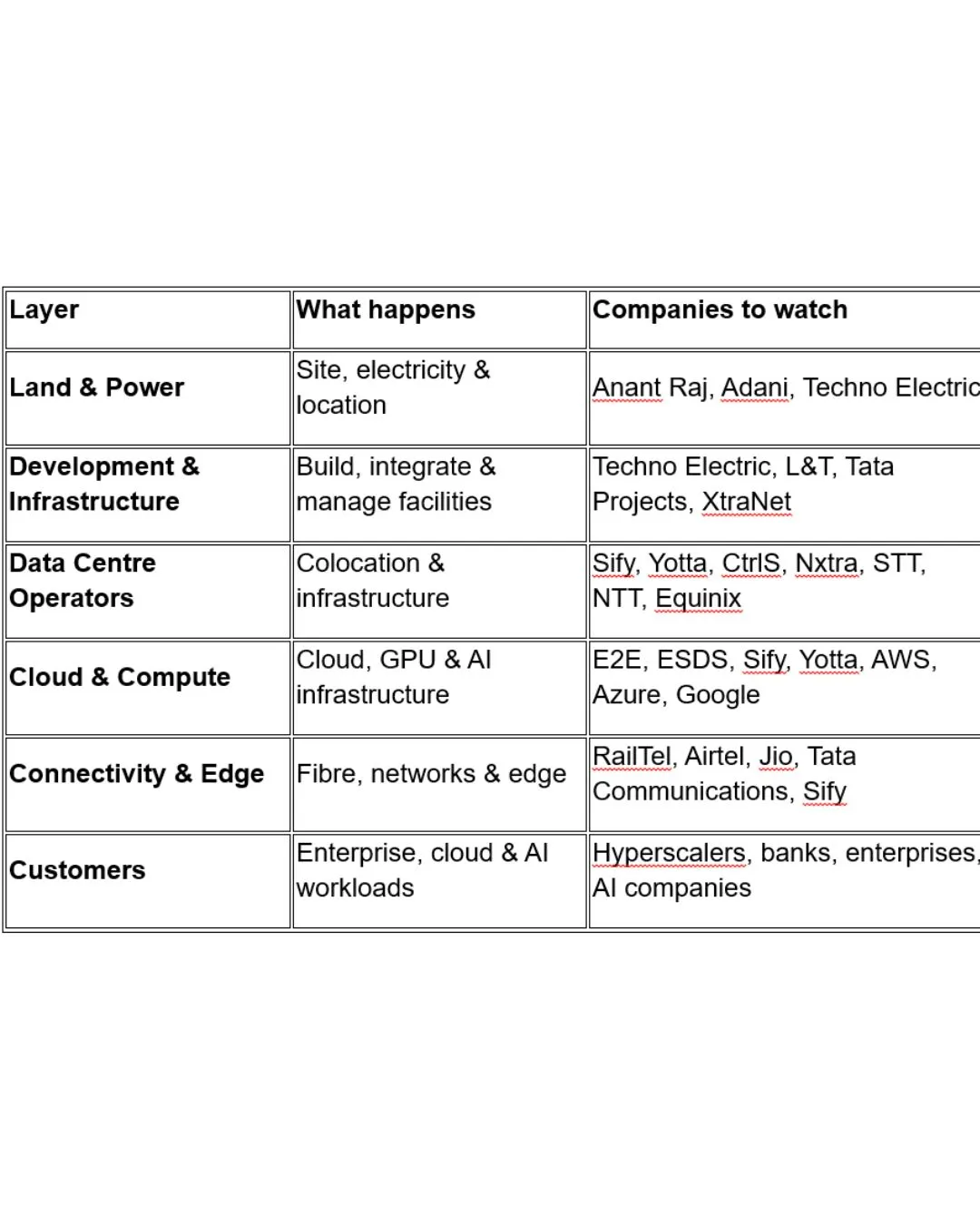
7. Putting the ecosystem together
| Layer | What happens | Companies to watch |
|---|---|---|
| Land & Power | Site, electricity & location | Anant Raj, Adani, Techno Electric |
| Development & Infrastructure | Build, integrate & manage facilities | Techno Electric, L&T, Tata Projects, XtraNet |
| Data Centre Operators | Colocation & infrastructure | Sify, Yotta, CtrlS, Nxtra, STT, NTT, Equinix |
| Cloud & Compute | Cloud, GPU & AI infrastructure | E2E, ESDS, Sify, Yotta, AWS, Azure, Google |
| Connectivity & Edge | Fibre, networks & edge | RailTel, Airtel, Jio, Tata Communications, Sify |
| Customers | Enterprise, cloud & AI workloads | Hyperscalers, banks, enterprises, AI companies |
The boundaries are increasingly blurring.
Sify operates across data centres, cloud and connectivity.
Techno Electric is moving from power infrastructure into data centres and edge infrastructure.
XtraNet Technologies sits across data-centre infrastructure, IT integration, cloud-enabled services and managed operations. Its recent positioning also includes AI-driven infrastructure and digital transformation.
RailTel combines fibre connectivity with an emerging edge-data-centre opportunity.
E2E Networks sits closer to the computing layer, particularly cloud and GPU infrastructure.
Anant Raj brings a real-estate-led approach to data centres.
Yotta and CtrlS combine physical data-centre infrastructure with cloud and compute capabilities.
8. The bigger picture
India's data-centre opportunity is therefore not one industry but an ecosystem.
The first phase of India's digital infrastructure build-out was largely about creating connectivity and storing data.
The next phase is increasingly about processing data.
Cloud computing, AI and GPU workloads are likely to require substantially more infrastructure — creating opportunities not only for data-centre operators but also for companies involved in real estate, infrastructure development, power, connectivity, cloud and computing.
The opportunity is no longer simply to build more data centres.
It is to build the infrastructure that turns land, electricity, networks and computing equipment into digital capacity.



















Sign in to leave a comment.