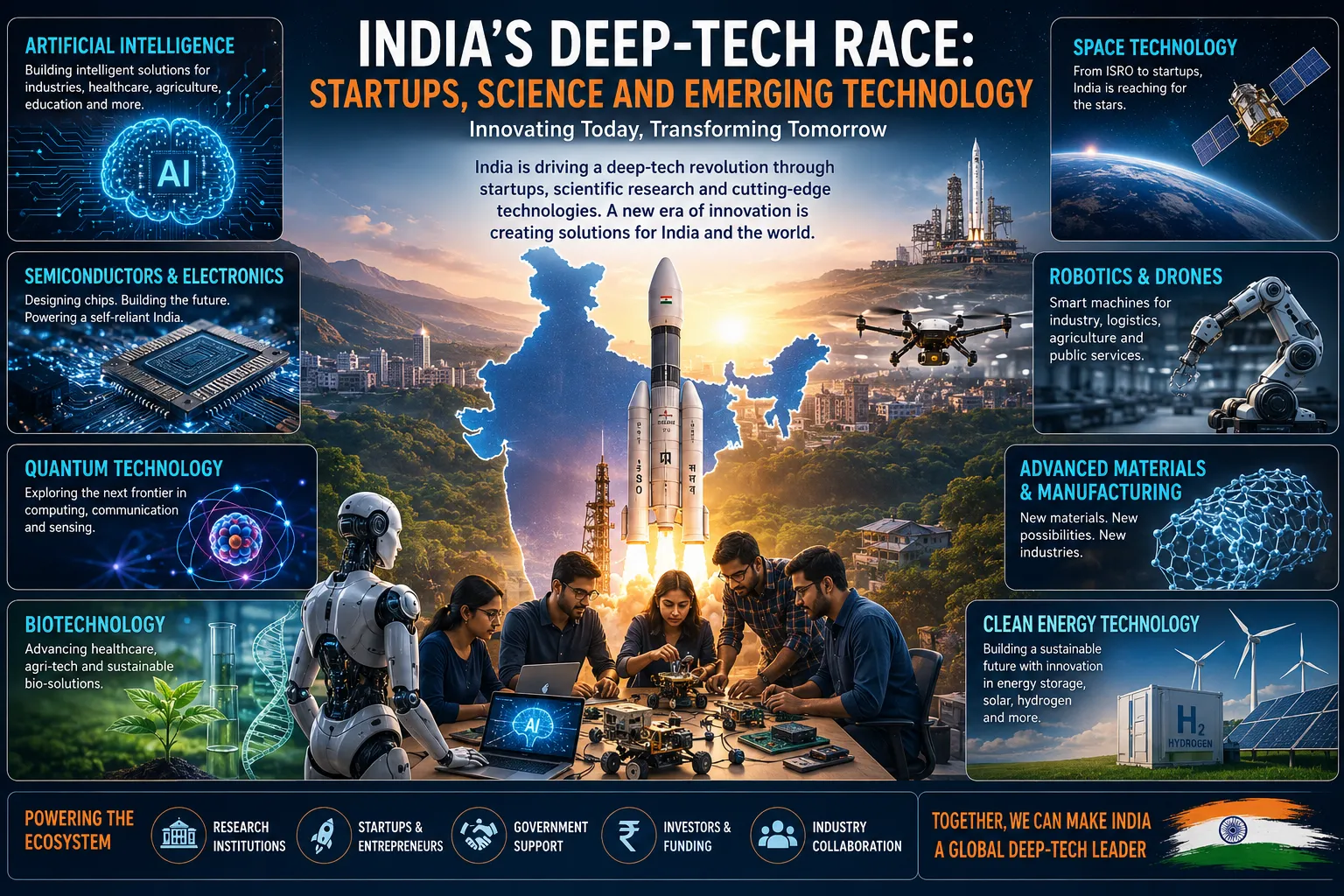

India is entering a new chapter in its technology journey. For decades, the country has built a strong reputation in software services, information technology, and digital innovation. Today, however, the focus is expanding toward deep technology, where scientific research, advanced engineering, intellectual property, and specialised expertise come together to create new solutions.
Artificial intelligence, semiconductors, quantum computing, robotics, biotechnology, space technology, advanced manufacturing, and climate technology are becoming important parts of India's innovation landscape. Government programmes, research institutions, universities, established industries, and startups are increasingly working together to develop technologies that could influence India's economy and global position.
The country's deep-tech journey is still developing, but the combination of scientific talent, entrepreneurship, digital infrastructure, and policy support gives India a significant opportunity to become a stronger global technology player.
Understanding India’s Deep-Tech Opportunity
Deep tech generally refers to technologies based on substantial scientific or engineering innovation. These ventures are different from conventional technology startups because they often require years of research, expensive laboratories, specialised equipment, extensive testing, and large amounts of patient capital before reaching the market.
For India, this sector has strategic importance. Building deep-tech capabilities can create high-value businesses, strengthen domestic manufacturing, improve technological self-reliance, and help Indian companies participate in global technology supply chains.
The National Deep Tech Startup Policy framework identifies deep-tech startups as businesses built around novel scientific or engineering knowledge, with high technical uncertainty and significant potential impact. It also highlights the need for patient capital, intellectual-property protection, talent development, and stronger links between research and commercialisation.
This approach reflects a broader ambition to move from being primarily a technology consumer and service provider toward becoming a creator of globally competitive products and technologies.
Startups Are Becoming Important Drivers of Innovation
India's startup ecosystem is increasingly moving beyond consumer internet businesses and traditional software applications. A growing number of entrepreneurs are working on problems involving aerospace, artificial intelligence, robotics, electronics, biotechnology, semiconductors, clean energy, defence technology, and advanced manufacturing.
Deep-tech startups can be particularly valuable because they often attempt to solve difficult problems that conventional businesses cannot easily address. A company developing an industrial robot, medical device, satellite component, semiconductor technology, or advanced AI system may require a long development cycle, but successful commercialisation can create significant economic and technological value.
The government is supporting this transition through initiatives designed to strengthen research, innovation, incubation, prototype development, technology translation, intellectual-property creation, and startup growth. The Anusandhan National Research Foundation, for example, has been established to encourage private-sector participation and interdisciplinary research.
Funding is another important part of the ecosystem. The Research, Development and Innovation Scheme has a proposed corpus of ₹1 lakh crore over six years to support high-impact research and innovation, including deep technology, artificial intelligence, robotics, quantum technologies, biotechnology, space, energy, and advanced manufacturing.
Artificial Intelligence Is at the Centre of the Race
Artificial intelligence is arguably the most visible area of India's emerging technology strategy. AI has applications across healthcare, agriculture, education, financial services, manufacturing, transportation, and public administration.
India's large population and diverse languages provide an unusual environment for developing AI solutions designed for different social and economic conditions. Technologies that can work effectively across Indian languages and real-world environments could also have applications in other emerging markets.
The IndiaAI Mission is intended to develop a broader AI ecosystem by improving access to computing, supporting data infrastructure, developing indigenous AI capabilities, attracting talent, providing startup support, encouraging industry collaboration, and promoting responsible AI. The mission has an approved outlay of about ₹10,372 crore.
Access to computing is particularly important for startups and researchers. Government information published in 2026 reported that more than 38,000 GPUs had been onboarded for a common AI compute facility, with access being provided to Indian startups and academia at affordable rates.
The opportunity for India is therefore not limited to creating AI-powered applications. Long-term leadership will also require progress in foundational models, AI research, computing infrastructure, specialised chips, datasets, and responsible AI systems.
Semiconductors and Advanced Hardware
Semiconductors are another critical part of India's deep-tech ambitions. Chips are essential for smartphones, electric vehicles, data centres, telecommunications equipment, medical devices, industrial machines, defence systems, and AI infrastructure.
India has traditionally been strong in semiconductor design and engineering talent. The next stage is to develop a broader ecosystem that includes fabrication, assembly, testing, packaging, equipment, materials, research, and talent.
The government's semiconductor initiatives are designed to strengthen these different parts of the value chain. Recent policy developments have placed additional emphasis on chip design, semiconductor manufacturing, equipment and materials, assembly and testing, research and development, and workforce development.
This is a difficult area because semiconductor manufacturing requires enormous capital investment and highly specialised infrastructure. Nevertheless, progress in this field could give India greater control over strategically important technologies while creating new opportunities for domestic and international companies.
Quantum Technology Opens a New Frontier
Quantum technology is another area where scientific research could have long-term economic and strategic consequences. Quantum computing, communication, sensing, and advanced quantum materials could eventually influence cybersecurity, scientific research, healthcare, finance, navigation, and defence.
India's National Quantum Mission provides a national framework for developing capabilities in quantum computing, communication, sensing and metrology, and quantum materials and devices. The mission demonstrates that India's deep-tech strategy is not focused only on technologies with immediate commercial returns but also on emerging fields that may become important in the future.
For startups, the quantum sector offers opportunities to build specialised hardware, software, sensors, communication systems, and supporting technologies. However, progress will depend on sustained scientific research, specialised talent, infrastructure, and collaboration between academic institutions and industry.
Space Technology and New-Age Engineering
India's space sector provides another strong example of the country's scientific and engineering capabilities. The success of India's space programme has created a foundation on which private companies can develop new products and services.
Startups are increasingly exploring launch vehicles, satellites, Earth observation, communications, propulsion systems, and space-based applications. The expansion of private participation is helping connect India's established space capabilities with entrepreneurial innovation.
Space technology also has practical applications on Earth. Satellite-based services can support agriculture, weather monitoring, disaster management, navigation, communications, logistics, environmental monitoring, and urban development.
The Science Behind India’s Technology Future
Startups alone cannot create a successful deep-tech ecosystem. Strong scientific institutions are equally important.
India needs universities and research laboratories capable of producing breakthrough research and developing technologies that can move from laboratories into commercial products. Collaboration among scientists, engineers, entrepreneurs, investors, and industries can shorten this journey.
The ANRF is intended to strengthen this connection by supporting interdisciplinary research and increasing industry participation. Programmes under the foundation are designed to encourage research partnerships and translate scientific discoveries into practical applications.
This relationship between science and entrepreneurship could become one of India's biggest advantages. Researchers can provide scientific breakthroughs, while startups can turn those breakthroughs into products, services, and scalable businesses.
Challenges on the Road Ahead
India's deep-tech ambitions also face several challenges. The first is funding. Deep-tech startups often need substantial investment before generating revenue, making conventional short-term venture capital models less suitable.
The second challenge is talent. Although India has a huge engineering workforce, deep technology requires specialised expertise in areas such as semiconductor fabrication, quantum science, advanced materials, biotechnology, robotics, and hardware engineering.
Commercialisation is another major issue. Scientific discoveries need to move efficiently from research papers to prototypes, manufacturing, intellectual property, and commercial markets.
India also needs stronger private-sector R&D investment and closer industry-academia collaboration. Building advanced technology requires patience because meaningful breakthroughs often take years rather than months.
What the Future Could Hold
India's deep-tech race is ultimately about building long-term technological capability. AI, semiconductors, quantum technology, biotechnology, robotics, space systems, and advanced manufacturing can create new industries while strengthening existing ones.
If India can combine its large talent pool with world-class research, patient capital, effective policies, strong intellectual-property protection, advanced infrastructure, and ambitious entrepreneurs, the country could become an important contributor to the next generation of global technology.
The opportunity is particularly significant because India does not have to compete in every technology on exactly the same terms as established technology powers. It can focus on areas where its engineering talent, domestic market, scientific capabilities, and ability to solve large-scale problems provide distinctive advantages.
Conclusion
India's deep-tech race is transforming the country's innovation landscape. Startups are taking on increasingly complex technological challenges, scientists are working on frontier research, and government programmes are attempting to connect research with industry and commercialisation.
Artificial intelligence can strengthen India's digital economy, semiconductors can expand its hardware capabilities, quantum technology can create new scientific opportunities, while space, biotechnology, robotics, and advanced manufacturing can open entirely new markets.
India is not yet a global leader across every deep-tech field, and significant challenges remain. But the foundations are becoming stronger. With sustained investment in science, talent, research, infrastructure, and entrepreneurship, India has the potential to evolve from a major technology services hub into a global centre for deep-tech innovation.





















Sign in to leave a comment.