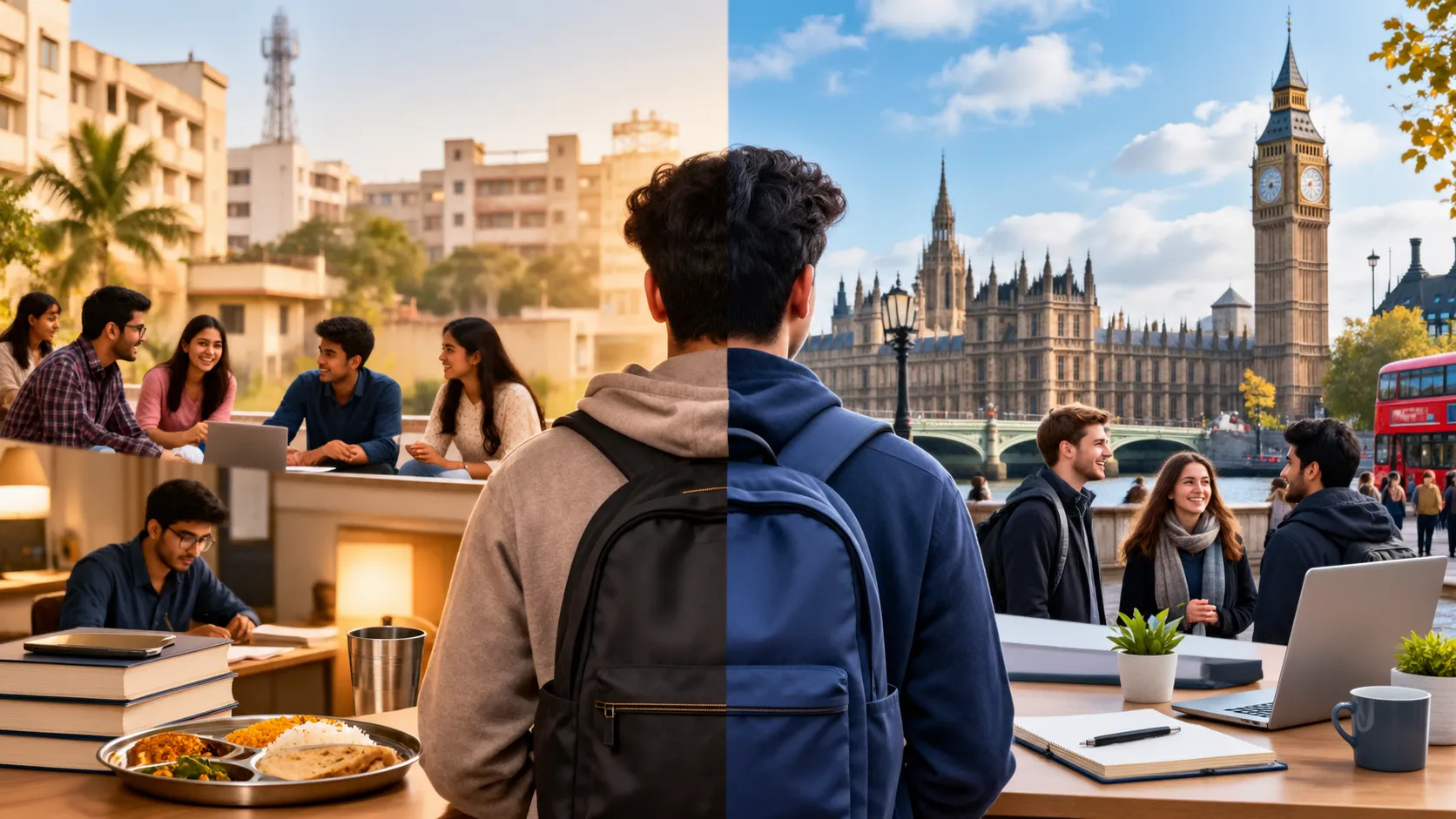

Studying in the UK is not just about attending a foreign university and earning a degree. For Indian students, it can also mean adapting to a completely different lifestyle.
From managing your own meals and finances to travelling independently, working part-time, and communicating with people from different cultures, student life in the UK can feel very different from what many students experience in India.
But which lifestyle is actually better? There is no single answer. Both have their own advantages, challenges, and expectations.
Let’s compare Indian student lifestyle vs UK student lifestyle to understand what Indian students can realistically expect when they move to the UK for higher education.
1. Academic Life: Structured vs Independent
One of the biggest differences is the way students are expected to learn.
In India, students often experience a more structured academic environment. Classes, assignments, attendance requirements, examinations, and teacher instructions can play a significant role in daily student life.
UK universities generally place a strong emphasis on independent learning. Lectures and seminars are important, but students are also expected to read, research, analyse information, and complete assignments independently.
You may have fewer classroom hours than you expected, but that does not necessarily mean less work.
A typical UK student may spend time:
- Attending lectures and seminars
- Reading academic papers and books
- Working on assignments
- Preparing presentations
- Participating in group projects
- Conducting independent research
- Preparing for exams
The major adjustment
In India, students may sometimes wait for teachers to provide detailed direction. In the UK, students are generally expected to take more responsibility for their learning.
In simple terms:
India: "What do I need to study?"
UK: "What do I need to research and understand?"
2. Daily Routine: More Independence in the UK
Student life in India can be closely connected to family routines. Many students live with their parents or relatives, which means meals, household responsibilities, and other everyday tasks may already be taken care of.
For students living independently in the UK, the situation can be very different.
You may need to manage:
- Cooking
- Grocery shopping
- Laundry
- Cleaning
- Bills
- Travel
- University work
- Personal finances
Initially, this can feel overwhelming.
But it can also help students develop practical skills and become more independent.
For many Indian students, moving to the UK is therefore not only an academic transition but also a life-skills transition.
3. Food: From Home-Cooked Meals to Meal Planning
Food is one of the first lifestyle differences many Indian students notice.
In India, students living at home may regularly eat home-cooked meals prepared by their family.
In the UK, students may need to cook for themselves or plan their meals around their schedule.
Indian groceries are available in many UK cities, and students can often find ingredients such as:
- Rice
- Atta
- Dal
- Spices
- Paneer
- Ready-to-eat Indian meals
- Snacks
However, cooking regularly requires planning.
A student might spend part of the weekend buying groceries and preparing meals for the week.
A common change
Instead of asking:
"What's for dinner?"
you may start asking:
"What can I cook with what's left in my fridge?"
Learning a few simple meals before moving abroad can make the transition easier.
4. Social Life: Different, but Not Necessarily Better or Worse
Social life can also feel different.
In India, many students spend significant time with school friends, college friends, cousins, neighbours, and family.
UK universities bring together students from different countries and backgrounds.
You may meet people from:
- India
- The UK
- China
- Nigeria
- Pakistan
- Bangladesh
- Europe
- The Middle East
- Other parts of Asia and Africa
Universities also commonly have student societies and clubs covering interests such as sports, music, culture, entrepreneurship, gaming, photography, and more.
For Indian students, joining societies can be one of the easiest ways to make friends and become part of university life.
At the same time, social interaction may require more initiative. You may need to introduce yourself, join activities, and actively participate instead of waiting for friendships to develop naturally.
5. Transportation: Public Transport Becomes Part of Daily Life
In India, students may rely on family members, two-wheelers, auto-rickshaws, buses, metro systems, or ride-hailing services depending on where they live.
In the UK, public transportation can become an important part of student life.
Students commonly use:
- Buses
- Trains
- Trams in some cities
- Walking
- Cycling
Your university accommodation may be close enough to walk to campus, while shopping, part-time work, and social activities may require public transport.
This also means learning how to plan journeys, check schedules, and manage travel costs.
6. Weather: One of the Biggest Lifestyle Adjustments
For students coming from many parts of India, the UK's weather can take some getting used to.
The UK is known for its changeable weather, and students may experience cold temperatures, rain, wind, and shorter daylight hours during winter.
Indian students may need to prepare for:
- Warm jackets
- Waterproof clothing
- Comfortable shoes
- Layered clothing
- Heating costs
- Shorter winter days
The weather can influence daily routines too.
A short walk to university that feels easy in mild weather may feel very different on a cold and rainy morning.
7. Part-Time Work and Managing Your Time
Many international students in the UK explore part-time work alongside their studies, subject to the conditions of their visa.
This can provide exposure to the workplace and help students develop skills such as communication, teamwork, customer service, and time management.
However, part-time work should not be treated as a replacement for proper financial planning.
Students need to consider:
- Tuition fees
- Accommodation
- Food
- Transportation
- Study materials
- Personal expenses
- Unexpected costs
The key challenge is balancing work and academics.
A student who works part-time still needs enough time for lectures, assignments, revision, and rest.
8. Money Management: A Major New Responsibility
Financial independence is another major difference.
In India, students living with their families may not personally manage every daily expense.
In the UK, students often need to create and follow their own budget.
For example, a monthly budget may include:
| Expense | Examples |
|---|---|
| Accommodation | Rent and related costs |
| Food | Groceries and occasional eating out |
| Transport | Bus/train passes |
| Phone | Mobile plan |
| Study | Books and materials |
| Personal | Clothing, entertainment, etc. |
| Emergency | Unexpected expenses |
Learning to track spending can make a significant difference.
Small expenses can add up quickly, especially when students frequently order food, travel, or shop online.
9. Clothing: Comfort and Practicality Matter
Indian students may also notice differences in everyday clothing.
UK university campuses tend to have a relatively casual environment. Students may attend lectures wearing jeans, hoodies, trainers, sweaters, or other comfortable clothing.
There is generally less expectation to dress formally for ordinary lectures.
However, students may still need formal clothing for:
- Interviews
- Presentations
- Networking events
- Career fairs
- Professional events
The focus is often on dressing appropriately for the situation rather than following one standard student dress style.
10. Festivals and Indian Culture
Moving to the UK does not mean leaving Indian culture behind.
Many UK universities have Indian or South Asian student societies, while cities across the UK also have Indian communities, restaurants, grocery stores, and cultural events.
Students may celebrate festivals such as:
- Diwali
- Holi
- Navratri
- Eid
- Vaisakhi
- Christmas
- Other cultural festivals
For many Indian students, these communities can make the transition abroad feel more familiar.
At the same time, studying abroad provides an opportunity to learn about other cultures and traditions.
11. Family Life: The Biggest Emotional Difference
Perhaps the biggest difference is not academic or financial—it is emotional.
In India, students may be accustomed to seeing their parents and family regularly.
After moving to the UK, students may suddenly be thousands of kilometres away from home.
Simple things can feel different:
- Having dinner with family
- Celebrating birthdays together
- Going home for festivals
- Getting help when you're sick
- Meeting friends from school
- Talking to parents face-to-face
Video calls can help, but they do not completely replace being physically present.
This is why homesickness is something students should be prepared for.
Over time, however, many students develop a new routine and build their own support network.
12. Weekend Life: Exploring a New Country
One exciting difference is the opportunity to explore.
The UK's cities and transport networks can make weekend trips possible for students who want to explore beyond their university city.
Depending on their location and budget, students may visit:
- London
- Manchester
- Edinburgh
- Birmingham
- Liverpool
- Bristol
- Oxford
- Cambridge
- Bath
- Other towns and cities
Weekend life can therefore become a combination of studying, working, socialising, relaxing, and exploring.
Indian Student Lifestyle vs UK Student Lifestyle: Quick Comparison
| Lifestyle Factor | India | UK |
|---|---|---|
| Academic style | Often more structured | Greater emphasis on independent learning |
| Living | Many students live with family | Many international students live independently |
| Cooking | Often family-supported | Students commonly cook for themselves |
| Transport | Mixed depending on city | Public transport and walking are common |
| Social life | Family + established friend groups | International and multicultural |
| Money management | May be family-supported | Greater personal responsibility |
| Part-time work | Varies by student and course | International students may work within visa conditions |
| Weather | Varies widely across India | Often cooler and more changeable |
| Family interaction | Usually more frequent | Mainly calls/video calls when living abroad |
| Independence | Depends on living arrangement | Usually increases significantly |
Is UK Student Life Difficult for Indian Students?
It can be challenging at first, but the difficulty is often about adjustment rather than academics alone.
The first few weeks may involve learning how to:
- Cook
- Budget
- Travel independently
- Manage university deadlines
- Make new friends
- Deal with homesickness
- Adapt to the weather
- Communicate in a different environment
- Balance study and personal life
These are skills that generally become easier with experience.
How Indian Students Can Prepare Before Moving to the UK
A little preparation can make the transition smoother.
1. Learn basic cooking
You do not need to become a chef. Learn a few simple meals that you can prepare quickly.
2. Create a realistic budget
Understand your expected accommodation, food, transport, and personal expenses before you arrive.
3. Improve everyday communication
Academic English is important, but everyday communication matters too. Practise speaking confidently in common situations.
4. Learn to manage your time
University, work, cooking, shopping, social life, and rest all compete for your time.
5. Research your university city
Look into accommodation, transport, supermarkets, healthcare services, campus facilities, and student societies before you arrive.
6. Prepare emotionally
Missing home is normal. Staying connected with family while building a new routine can help.
The Real Difference: Independence
The biggest difference between Indian and UK student lifestyles is often independence.
Studying in India can provide a familiar environment where family, friends, food, and daily routines are often close by.
Studying in the UK can require students to take greater responsibility for their academic work and everyday life.
That can be challenging—but it can also be one of the most valuable parts of studying abroad.
You are not simply earning a degree.
You are also learning how to manage your time, money, responsibilities, relationships, and decisions independently.
Final Thoughts
Indian student lifestyle and UK student lifestyle are not about one being better than the other. They are simply different environments.
For an Indian student planning to study in the UK, understanding these differences before travelling can help set realistic expectations.
The UK experience can bring academic opportunities, international friendships, cultural exposure, and greater independence—but it also requires preparation and responsibility.
The more prepared you are for everyday life, the easier it can be to focus on what you actually moved abroad for: learning, growing, and building your future.

























Sign in to leave a comment.