

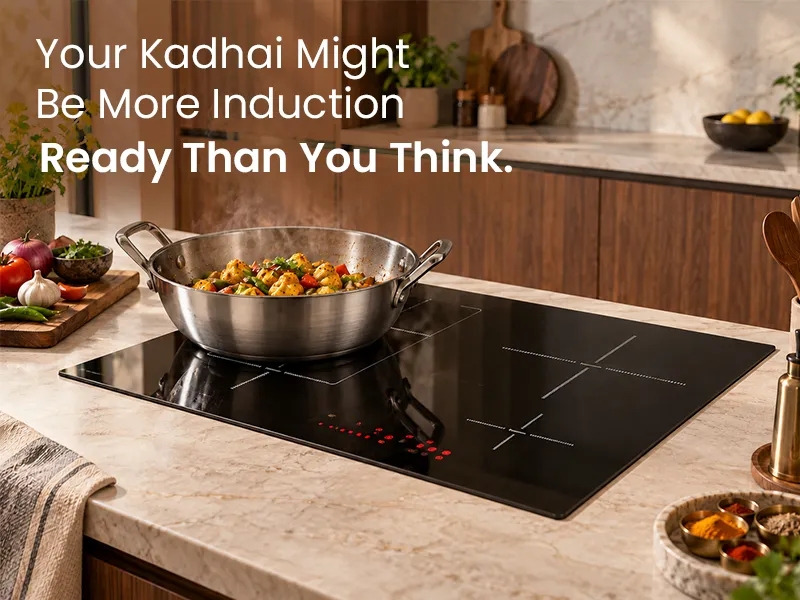
When moving into a contemporary luxury home, one of the first things that catches the eye is often the kitchen. A sleek induction hob set neatly into a premium countertop creates a clean, modern appearance that fits perfectly with today's minimalist interiors.
But once the kitchen is being organised and the cookware is taken out of storage, an important question quickly appears: will the pots, pans, kadhais, pressure cookers, and tawas already owned by the family actually work on an induction cooktop?
The good news is that an Indian kitchen may already have plenty of induction-compatible cookware. There is usually no reason to replace the entire collection immediately. The key is understanding which materials work, which ones do not, and which cookware upgrades are genuinely worth making. This guide explains how to identify suitable vessels and what to look for when buying new cookware.
The 5-Second Magnet Test
The easiest way to determine whether a vessel is compatible with induction cooking is to use an ordinary refrigerator magnet. Place the magnet against the flat base of the pot, pan, pressure cooker, or tawa.
If the magnet attaches firmly to the bottom, the cookware is generally suitable for an induction hob. If the magnet does not stick and slides away, the induction surface will generally not detect the vessel.
This simple test requires no specialist knowledge and can help homeowners quickly sort an existing cookware collection.
An older stainless steel pressure cooker may pass the test and continue to be useful. A traditional cast-iron kadhai will generally respond well to induction, while a brass pital handi will not. The brass vessel can still remain part of the kitchen for serving or traditional presentation, but it will not function directly on an induction surface.
In just a few minutes, an entire cookware collection can be separated into induction-ready and non-compatible categories.
What Works Well on an Induction Hob?
Cast Iron and Carbon Steel
Cast iron and carbon steel are particularly suitable for induction cooking because they contain magnetic material and retain heat effectively. Heavy cast-iron kadhais, skillets, and tawas can maintain consistent temperatures for longer periods.
A cast-iron tawa can be used for making dosas with crisp edges, while a carbon-steel kadhai can be useful for deep-frying snacks, preparing sweets, or cooking dishes that require sustained heat.
Stainless Steel and Tri-Ply Cookware
Modern stainless-steel cookware can also perform very well when it has a magnetic base. Tri-ply cookware is particularly useful because its layered construction helps distribute heat more consistently.
Induction-compatible stainless-steel pressure cookers can handle everyday Indian cooking such as dal, rice, and curries, while tri-ply frying pans can be used for preparing vegetables and other dishes with controlled heating.
These options are often among the best cookware for an induction hob in an Indian kitchen because they combine durability, versatility, and efficient heat transfer.
Which Cookware May Need Replacing?
Pure Aluminium
Traditional aluminium cookware without a magnetic base will not work directly on an induction cooktop. Older lightweight aluminium pressure cookers may therefore remain completely cold when placed on the glass surface.
If the cookware does not have a magnetic stainless-steel base, homeowners may need to replace it with an induction-compatible version or continue using it on a conventional gas stove.
Brass, Bronze, and Copper
Traditional Indian cookware made from brass, bronze, or copper is generally non-magnetic. As a result, these materials do not directly interact with an induction heating system.
A beautifully crafted brass handi used for preparing or serving kheer may still have tremendous cultural and aesthetic value, but it will not heat directly on the induction hob. Copper serving bowls and similar vessels can continue to be used for serving without any issue.
Does Induction Work With a Kadhai?
One of the most common questions from Indian homeowners is whether an induction works with kadhai. The answer is yes, but the shape and base of the kadhai matter.
Traditional round-bottom kadhais are not ideal for induction because only a small portion of their base touches the flat glass surface. This limited contact can reduce heating efficiency and lead to uneven cooking.
A flat-bottom kadhai is a much better choice. Modern cast-iron and tri-ply versions provide a stable base that sits directly against the cooktop while retaining the deeper, sloped walls needed for stir-frying, sautéing, and tossing ingredients.
For homeowners who regularly prepare dishes such as bhindi masala, chicken curry, or fried snacks, a flat-bottom induction-compatible kadhai can provide excellent results.
Large cookware can present another challenge. If a household frequently uses wide handis or large griddles, a hob with flexi-zone technology can provide additional convenience.
Premium induction solutions such as Blaupunkt by Hettich can offer cooking zones that can be combined into a larger heating area. This can be particularly useful when preparing larger meals in an oval handi or wide cookware for family gatherings.
Induction Hob Myths in India: Why Adapter Discs Are Not the Best Solution
One of the recurring induction hob myths in India is that an adapter disc is the ideal solution for making non-magnetic cookware induction compatible.
An adapter disc is essentially a metal plate positioned between the induction surface and a non-compatible vessel. While it can transfer heat to cookware that would otherwise not work, it introduces another layer between the hob and the cooking vessel.
The additional layer can reduce efficiency, increase heating time, and make cooking less responsive. Instead of transferring heat directly into an induction-ready base, the disc itself becomes part of the heating process.
For homeowners designing a premium kitchen, purchasing induction-compatible cookware options in India is generally a more practical approach. Many cookware manufacturers now offer induction-ready pots, pans, pressure cookers, tawas, and kadhais designed to work directly with induction technology.
A Simple Induction Hob Cookware Guide
This induction hob cookware guide can make the transition much easier:
- Test existing cookware: Use a refrigerator magnet against the base of every vessel and keep the cookware that responds to the magnet.
- Choose flat-bottom cookware: Flat bases provide better contact with the induction glass surface, particularly for kadhais and handis.
- Consider stainless steel, tri-ply, and cast iron: These materials are among the best cookware for induction hobs when they have a suitable magnetic base.
- Avoid relying on adapter discs: They can reduce efficiency and responsiveness and remain one of the more persistent induction hob myths in India.
- Consider flexi-zone technology: If large cookware is frequently used, a hob with flexible cooking zones can make the kitchen considerably more versatile.
When purchasing cookware, look for labels such as "induction compatible." Brands including Prestige, Hawkins, Pigeon, and Amazon Basics offer induction-compatible cookware collections in India.
However, labels should not be the only check. Testing the base with a magnet is still useful because cookware can vary by model and construction.
What a Luxury Homeowner Should Consider
A luxury homeowner does not necessarily need to discard an entire cookware collection after installing an induction hob. Many traditional Indian vessels may already be compatible, while others may simply need to be replaced selectively.
For buyers looking for induction-compatible cookware in India, flat-bottom kadhais, tri-ply pans, stainless-steel pressure cookers, and magnetic-base cookware can cover most everyday cooking requirements.
Before putting existing cookware away permanently, perform the magnet test. It may reveal that much of the kitchen is already ready for induction cooking.
If new cookware is needed, prioritise practical compatibility over appearance alone. Flat-bottom kadhais, quality tri-ply pans, and induction-ready stainless-steel pressure cookers can provide a versatile foundation for daily cooking.
A luxury kitchen should not only look refined; it should also perform effortlessly. With the right induction-compatible cookware, a modern induction hob can become a dependable, efficient, and elegant centrepiece of everyday cooking.




















Sign in to leave a comment.