Industrial Dryer Fuel Cost in India: LPG vs PNG vs Diesel vs Biomass Pellets

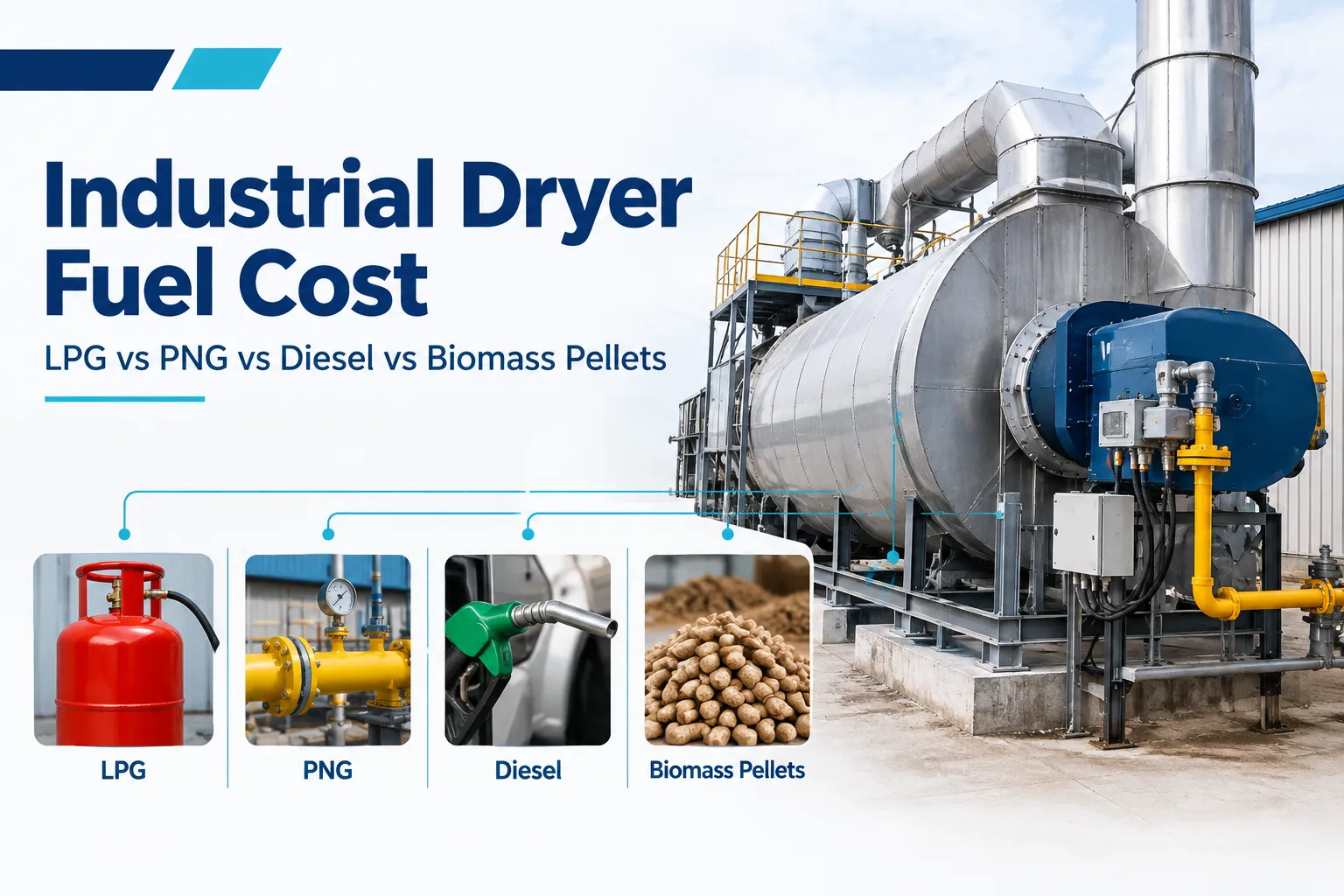
Ask four suppliers for a fuel quote and you will get four different units. LPG comes in rupees per kilogram, diesel in rupees per litre, piped natural gas in rupees per cubic metre, and biomass pellets in rupees per kilogram again. Each number looks reasonable on its own. Put them side by side and nobody can say which is cheaper.
The cheapest rate on the quotation is not always the cheapest heat inside the dryer.
That gap is where industrial dryer fuel cost is won or lost. A fuel that looks expensive per unit may deliver far more heat per unit, and a fuel that looks cheap can cost you in ash, storage and supply risk. This guide shows a simple method to compare them fairly, without quoting a rate that will be out of date next month.
Why the Price Tag Cannot Be Compared Directly
One kilogram of LPG and one kilogram of pellets are sold in the same unit, but they are not the same amount of energy.
Published Indian references put LPG at around 11,900 kcal per kilogram, diesel at roughly 9,000 kcal per litre, and good industrial biomass pellets at about 4,000 to 4,600 kcal per kilogram. Piped natural gas typically carries 9,000 to 10,000 kcal per standard cubic metre (SCM) on a gross basis. A rupee spent on each buys very different amounts of heat, so the price per unit alone says nothing about industrial dryer fuel cost.
Start With Useful Heat, Not the Fuel Price
Compare rupees per lakh kilocalories of useful heat, not rupees per unit of fuel.
The calculation has two steps. First, find the cost of useful heat:
Cost per lakh kcal = fuel price ÷ (calorific value × heater efficiency) × 1,00,000
Second, connect it to the dryer using specific energy consumption (SEC), the heat a dryer needs for every kilogram of water it evaporates. Combine the two:
Fuel needed per kg of water = SEC ÷ (calorific value × efficiency)
Fuel cost per kg of water = fuel needed × fuel price
Add electricity for fans, feeders and ash removal as a separate line. Keep the boundary clear: SEC is the heat needed at the dryer, and efficiency is how well the fuel becomes that heat. Count each once.
Watch the Units Before You Trust the Numbers
Most wrong fuel comparisons go wrong here, before a single rupee is calculated.
Gross and net values get mixed. For natural gas, the net calorific value is about 90% of the gross value. City gas companies bill on energy in MMBtu under regulator rules, and one MMBtu equals 252,000 kcal. If gas is compared on a net basis while LPG is quoted on a gross basis, gas looks roughly 10% dearer than it really is. Pick one basis for every fuel.
A cubic metre is not always the same cubic metre. Indian references quote gas per SCM, measured at 15.56°C, while the BEE fuel tables use normal cubic metres at 20°C. The difference is small, but it matters when the margin between two fuels is small.
Diesel is sold by the litre, but calorific values are often quoted per kilogram. Use the density (roughly 0.83 to 0.85 kg per litre) to convert.
Pellet energy falls as moisture rises. The gap between gross and net value widens with moisture, so use your supplier's lab report, not a catalogue figure.
Efficiency Depends on How the Heat Reaches the Product
A burner's efficiency figure only means something if you know how the hot air is made.
In a direct-fired system, combustion gases mix with the drying air. It is usually more efficient and cheaper to build. In an indirect-fired system, a heat exchanger keeps the flue gas away from the product, which costs some efficiency but keeps the process air clean.
This matters most for biomass. Research on biomass-heated grain dryers reports concern over chlorine and ash in the combustion exhaust, so those designs keep the exhaust away from the grain. For food, spices and pharmaceutical ingredients, indirect heating is the safer starting point.
Ask every supplier for a measured or guaranteed efficiency, and ask whether it is stated on a gross or net basis. Fuel-vendor comparisons often use figures of this order: about 90% for LPG and gas, 88% for diesel and 82% for pellets. Treat them as illustrations, not promises.
A Price-Free Way to Compare the Four Fuels
If you can compare fuels without a single rupee figure, the answer lasts longer than any rate card.
Take these illustrative assumptions: LPG at 11,900 kcal/kg and 90% efficiency, gas at 9,500 kcal/SCM and 90%, diesel at 9,000 kcal/litre and 88%, and pellets at 4,000 kcal/kg and 82%. The useful heat per unit works out to about 10,700 kcal per kg of LPG, 8,550 per SCM of gas, 7,900 per litre of diesel and 3,280 per kg of pellets.
On these assumptions, 1 kg of LPG gives about as much useful heat as 1.25 SCM of gas, 1.35 litres of diesel or 3.3 kg of pellets. That gives you a quick break-even test. Pellets beat LPG only if the pellet price per kilogram is below roughly one-third of the LPG price per kilogram. Against gas, the pellet price must be below about 1/2.6 of the price per SCM. Against diesel, below about 1/2.4 of the price per litre.
One caution: comparison tables published by fuel sellers usually rest on assumed prices. Run the test with your own quotations.
Turning Fuel Into Cost per kg of Water
This is where the fuel choice meets the dryer.
Suppose a dryer needs an SEC of 4,500 kJ per kg of water, which is about 1,074 kcal. On the assumptions above, each kilogram of water removed needs roughly 0.10 kg of LPG, 0.13 SCM of gas, 0.14 litre of diesel or 0.33 kg of pellets.
At 500 kg of water an hour, that is about 50 kg of LPG, 63 SCM of gas, 68 litres of diesel or 164 kg of pellets every hour. Multiply each by your own delivered rate to get the hourly fuel bill, then divide by 500 for the cost per kilogram of water. This is an illustration only. Your SEC, efficiency and rates will differ.
What the Rate Does Not Show
A fuel bill is only part of industrial dryer fuel cost. The rest arrives as risk and labour.
Supply security. In March 2026, a Natural Gas (Supply Regulation) Order was notified after LNG shipments through the Strait of Hormuz were disrupted, and industrial and commercial gas users on city networks were allocated about 80% of their earlier average consumption. However cheap a fuel is, a dryer that stops for want of fuel costs far more.
Handling biomass. Pellet systems need storage space, ash cleaning and burner maintenance. Poor pellets bring smoke, clinker, high ash and feeding problems. Technical guidance puts good pellets at under 10% moisture with low ash, and damp storage during the monsoon is a common cause of trouble.
Switching cost. Moving from a liquid or gas burner to a solid-fuel heater is not a drop-in change. It usually means a different heater, feeder and ash handling. Ask a burner manufacturer what a switch involves before you compare running costs.
Local rules and tax. Approved fuels differ by region, and coal has been banned in the Delhi-NCR industrial belt since 2023. Check the rules with your state pollution control board, and check tax and input-credit treatment with your accountant.
Work Out Your Own Number
The method stays the same. Only the rates change.
Start by measuring your SEC from moisture in and out and the product flow. Then ask each supplier for the delivered rate, the calorific value with its basis, and the heater efficiency. Convert every fuel to the same basis, work out the fuel needed per kilogram of water, and multiply by the rate. Add electricity, ash disposal, labour and storage. Repeat the sum whenever a rate or supply condition changes.
The Number Worth Asking For
Next time you compare fuels, ask for the delivered rate, the calorific value and its basis, and the heater efficiency. Then convert everything to rupees per kilogram of water. Kerone Engineering Solutions Ltd. also looks at the evaporation load, moisture and heat source together when it considers dryer selection, which is the same logic used above. What is your dryer really spending, per kilogram of water, on the fuel you buy today?
Frequently Asked Questions
1. How do I compare industrial dryer fuel cost across LPG, PNG, diesel and pellets?
Convert each fuel to the cost of useful heat: price ÷ (calorific value × heater efficiency). Then work out the fuel needed per kilogram of water from your dryer's SEC and multiply by the delivered rate.
2. Why can't I compare rupees per kg, per litre and per SCM directly?
Each unit carries a different amount of energy. A kilogram of LPG holds nearly three times the energy of a kilogram of pellets, so the price per unit tells you nothing about the cost of heat.
3. What is the difference between GCV and NCV, and which should I use?
GCV includes the heat in the water vapour formed during combustion, and NCV leaves it out. For natural gas, NCV is about 90% of GCV. Use one basis for every fuel, and ask suppliers which basis their efficiency figures use.
4. How do I convert a PNG price from MMBtu to SCM?
Divide the price per MMBtu by the number of SCM in one MMBtu. One MMBtu is 252,000 kcal, so at 8,350 kcal/SCM it is about 30 SCM, and at 10,000 kcal/SCM about 25 SCM. Use the calorific value printed on your gas bill.
5. When are biomass pellets cheaper than LPG or PNG?
When the pellet price per kilogram is below about one-third of the LPG price per kilogram, or about 1/2.6 of the gas price per SCM. These ratios rest on illustrative assumptions, so repeat the calculation with your own calorific values and efficiencies.
6. Can I use biomass for a food or spice dryer?
Direct contact with biomass flue gas is a concern because of chlorine and ash in the exhaust. An indirect system that keeps flue gas away from the product is the safer starting point. Confirm your product's food-safety requirements first.
7. What heater efficiency should I assume?
Use the measured or guaranteed figure from your supplier, and ask whether it is gross or net. Vendor comparisons often assume about 90% for gas-fired systems and 80% to 85% for pellets, but treat those as illustrations.
8. Should I keep a backup fuel?
Consider it if a stoppage would cost more than the backup equipment. The 2026 gas allocation order showed that supply can be cut even when the rate looks attractive. A dual-fuel burner is one option to discuss with your burner supplier.
9. Does switching fuel need a new burner?
Often yes. Moving from gas or liquid fuel to solid biomass usually needs a different heater, feeder and ash handling. Moving between gas and liquid fuels may need burner changes too, so ask the burner manufacturer.
10. How often should I recalculate industrial dryer fuel cost?
Whenever a delivered rate, the fuel quality or the supply arrangement changes. The method stays the same, so a saved worksheet takes only minutes to update.








Sign in to leave a comment.