

Injection molding manufacturers face growing pressure to improve product quality, reduce waste, and control production costs. Industry 4.0 is changing how factories respond through connected machines, AI, robotics, and digital production systems. By linking equipment, materials, and production data, manufacturers can improve process control, identify problems earlier, and build more efficient operations.

1. What Is Industry 4.0 in Injection Molding?
Industry 4.0 in injection molding refers to the use of connected equipment, automation, and data-driven technologies to improve production. Machines collect and exchange information, while software helps engineers and production managers understand operating conditions and make better decisions.
Consider a traditional injection molding workshop. Operators check machines individually, production records may be kept manually, and process adjustments often depend on the experience of a few skilled technicians. This approach can work, but it becomes difficult to maintain consistent oversight when a factory runs dozens of machines, multiple molds, and different material grades.
A connected factory works differently. An injection molding machine can share information such as cycle time, injection pressure, temperature, and operating status with a central production system. These records can then be linked to the mold, material batch, production order, and inspection results.
Several technologies make this possible:
- Industrial Internet of Things (IIoT): Connects machines, sensors, and auxiliary equipment.
- Artificial Intelligence (AI): Analyzes production data to identify patterns, detect abnormalities, and support process optimization.
- Robotics and Automation: Handles part removal, insert loading, inspection, assembly, and packaging.
- Manufacturing Execution Systems (MES): Coordinates production orders, machine performance, and traceability.
- Digital Twins: Connect digital models with real production conditions for monitoring and prediction.
These technologies work best as part of a connected system rather than as isolated investments. A 2025 review of smart-factory concepts in plastics processing also highlights the importance of data collection, communication, automation, and system integration in the plastics industry.
2. How Industry 4.0 Is Applied in Injection Molding
The practical value of Industry 4.0 becomes clearer when we look at what happens on the production floor. Some applications, such as machine monitoring and robotic part removal, are already well established. Others, including AI-driven process control and digital twins, are still developing.
2.1 Smart Injection Molding Machines and Connected Manufacturing
Modern injection molding machines can collect a wide range of production data, including injection pressure, screw position, barrel temperature, cycle time, and machine status.
For process engineers, this information provides a clearer picture of what happens during each production cycle. Instead of relying only on operator observations, they can review actual machine data and identify unusual changes.
For example, a gradual increase in cycle time or an unexpected change in injection pressure may indicate a developing process problem. Identifying the change early gives engineers an opportunity to investigate before a large batch of parts is affected.
Connectivity also extends beyond the injection molding machine. Robots, mold temperature controllers, material dryers, and cooling systems can exchange information through the factory network.
Communication standards help make this possible. EUROMAP 77, based on OPC UA, defines an interface for exchanging data between injection molding machines and MES platforms. This is particularly useful for manufacturers operating machines from different suppliers.
Still, connecting machines is only the starting point. The real benefit comes when production data can be linked to specific molds, materials, orders, and quality results. Without that connection, a factory may collect plenty of information without gaining much insight into why a problem occurred.
2.2 AI-Powered Process Optimization and Quality Control
Injection molding is a process in which several variables influence the final part. Melt temperature, injection speed, holding pressure, cooling time, mold temperature, and material condition all play a role. A change in one setting can affect several product characteristics, which is why finding a stable processing window often requires experience and repeated trials.
AI offers another way to approach this challenge. By analyzing data from multiple production cycles, machine learning models can identify patterns that are difficult to recognize through manual observation alone.
For example, an AI system can compare injection pressure curves, temperature readings, and cycle times to identify conditions associated with short shots, flash, sink marks, or inconsistent part weight. It can also flag process deviations before they become visible quality problems.
In practical terms, AI applications fall into three main categories:
- Defect detection: Identifying unusual process conditions or visible product defects.
- Process recommendations: Suggesting parameter adjustments based on production data.
- Automatic optimization: Adjusting selected parameters within predefined operating limits.
These are different levels of capability. Detecting an abnormal pressure curve does not mean a system can automatically identify and correct the underlying cause.
Reliable automatic optimization requires accurate sensors, sufficient production data, validated models, and a good understanding of the process. Material changes, mold wear, and variations between machines can all affect the results.
AI is therefore best treated as an engineering tool rather than a replacement for process knowledge. It can help engineers narrow down possible causes, compare production runs, and reduce unnecessary trial and error. But understanding material behavior, mold design, venting, cooling, and machine performance remains essential.
2.3 Robotics and Automated Injection Molding Production
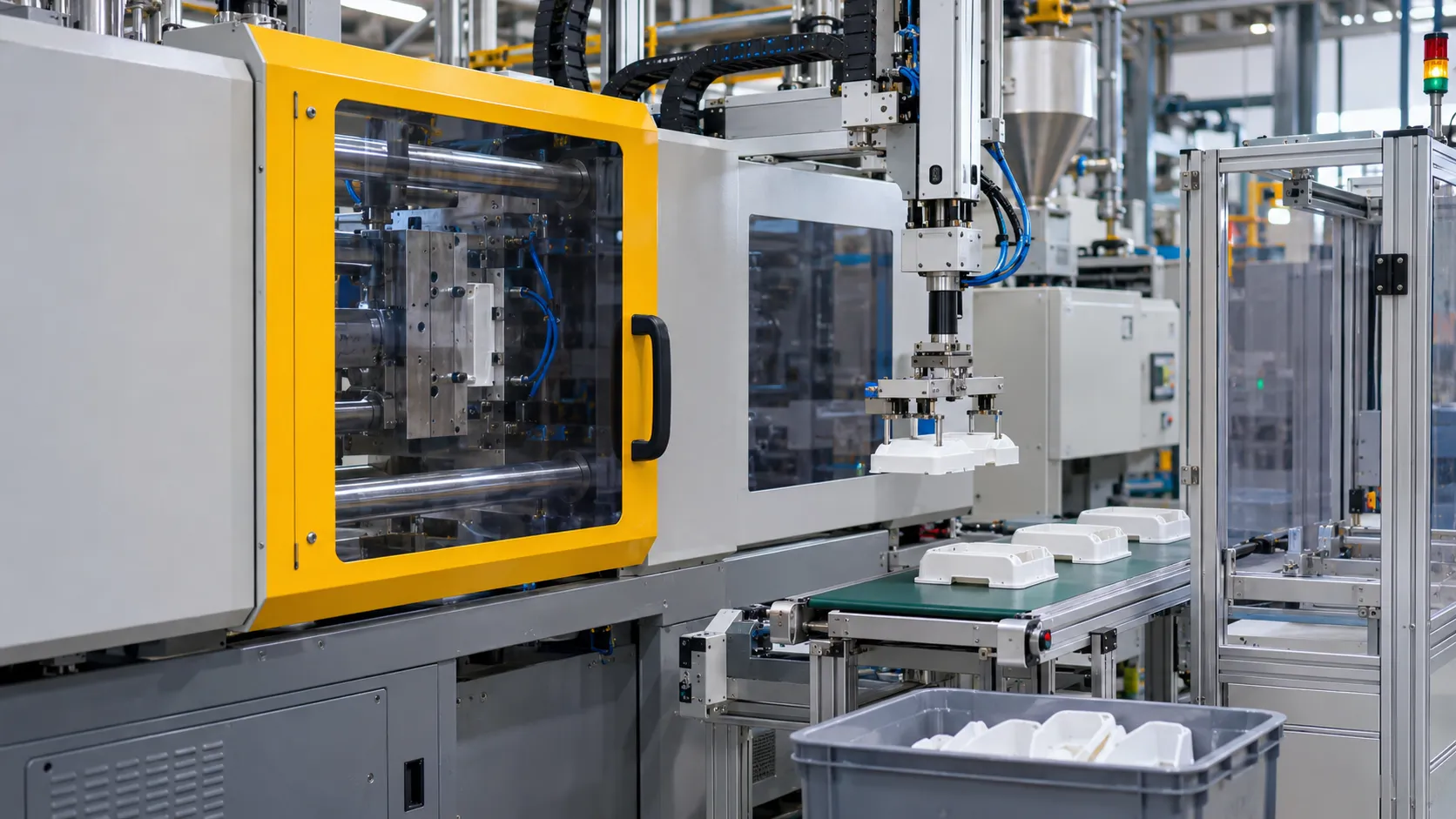
Robots have been part of injection molding production for decades, particularly for removing parts from molds. What is changing is the scope of automation. Instead of handling only one repetitive task, robots are increasingly being integrated into complete production cells.
Common applications include:
- Automatic part removal.
- Metal insert loading.
- In-mold labeling (IML).
- Degating and trimming.
- Automated assembly.
- Machine vision inspection.
- Product sorting and packaging.
Cartesian robots are widely used for fast, repetitive part removal. Six-axis robots offer more flexibility when parts need to be rotated, transferred between stations, or positioned for inspection.
End-of-arm tooling (EOAT) also deserves attention. A robot may have the required speed and accuracy, but poorly designed grippers can still cause scratches, deformation, or unstable handling. The tooling must match the part's geometry, weight, surface finish, and handling requirements.
Machine vision is another important part of this development. Industrial cameras can inspect molded parts for visible defects such as flash, scratches, contamination, and incomplete molding. When combined with robotic handling, they can examine complex parts from different angles.
The broader shift is from automating individual machines to coordinating molding, inspection, assembly, and packaging. When planning these systems, manufacturers need to consider cycle time, integration costs, equipment compatibility, and expected savings. These are also key factors in injection molding factory automation system implementation and ROI.
2.4 MES and Smart Factory Integration
Automating individual machines does not automatically make an entire factory more efficient. A manufacturer with dozens of injection molding machines still needs to coordinate production orders, molds, materials, operators, quality checks, and delivery schedules.
This is where a Manufacturing Execution System (MES) becomes valuable. An MES connects production activities and gives managers a clearer view of what is happening on the shop floor.
Typical functions include:
- Production order management.
- Machine status and output monitoring.
- Mold identification and maintenance records.
- Material batch tracking.
- Quality inspection records.
- Scrap and downtime reporting.
It is also important to distinguish MES from other factory systems. ERP manages business resources and orders, MES manages production execution, SCADA monitors industrial processes, and PLCs control machine operations. These systems can work together, but each has a different role.
For injection molding manufacturers, one of the most useful MES functions is traceability.
Imagine a customer reports a dimensional problem with a batch of plastic components. If production records are properly connected, engineers can identify the machine, mold, material batch, processing conditions, and inspection results associated with that batch. This makes it much easier to investigate the problem and determine whether other production runs may be affected.
Without reliable records, the investigation can quickly become a time-consuming search through spreadsheets, paper documents, and operator recollections.
2.5 Predictive Maintenance and Digital Twins
Unexpected equipment failures can interrupt production, delay orders, and increase operating costs. Traditional maintenance often follows fixed service intervals or takes place after a machine breaks down. Predictive maintenance takes a more proactive approach by using equipment data to identify early signs of deterioration.
Sensors can monitor vibration, temperature, pressure, and electrical current in components such as hydraulic pumps, motors, bearings, and cooling systems. If the system detects unusual patterns, maintenance teams can investigate before a minor issue develops into an unexpected shutdown.
Digital twins extend the use of production data in a different direction. A digital twin is a digital representation of a physical machine, mold, or manufacturing process that is connected to real operating information.
For example, engineers can use a digital model to study mold cooling behavior and compare its predictions with temperature measurements from actual production. This can help them understand temperature distribution, identify potential cooling problems, and evaluate process changes.
However, a conventional simulation is not automatically a digital twin. A useful digital twin needs a meaningful connection to real production data and a model capable of representing changing operating conditions.
Both technologies have considerable potential, but their value depends on sensor quality, model accuracy, and whether the information leads to better maintenance or production decisions. They should be introduced where there is a clear problem to solve, not simply because they are part of the smart factory concept.
3. Key Benefits of Industry 4.0 for Injection Molding Manufacturers
The value of Industry 4.0 should be measured by improvements in manufacturing performance, not by the number of technologies installed.
Better product quality and consistency. Real-time monitoring helps engineers identify process changes earlier. AI and machine vision can also improve defect detection and inspection consistency, particularly in high-volume production.
Higher production efficiency. Connected machines and MES provide better visibility into cycle times, downtime, and output. Automation reduces repetitive handling and helps coordinate downstream operations.
Lower manufacturing costs. Better process monitoring can reduce scrap, while improved scheduling and mold management help avoid unnecessary changeovers and material waste.
Improved traceability. Linking material batches, molds, production orders, and inspection records makes quality investigations faster and more reliable. This is especially important for automotive and medical components.
Better energy performance. Monitoring injection molding machines, dryers, heaters, chillers, and auxiliary equipment helps identify energy-intensive operations. Measuring energy consumption per kilogram of material or per good part provides a more useful basis for comparison than looking only at total factory electricity consumption.
4. Challenges of Implementing Industry 4.0 in Injection Molding
Despite its potential, Industry 4.0 is not always easy to implement. The main challenges are often related to investment, equipment compatibility, data, and people rather than the technology itself.
Initial investment. New machines, sensors, robots, software, and system integration all require capital. Manufacturers need to evaluate the expected return before committing to large investments.
Older equipment. Many factories still use machines from different generations. Some do not support modern communication interfaces. External sensors and industrial gateways can help, but the available options depend on the machine's control system.
Data quality. Incomplete production records, inconsistent machine settings, and disconnected quality systems can undermine digital analysis. Collecting more data does not automatically make that data useful.
Skills gap. Smart manufacturing requires cooperation between injection molding engineers, automation specialists, maintenance teams, and IT professionals. Employees also need suitable training to use new systems effectively.
Cybersecurity. Connecting machines to factory networks introduces additional security risks. Manufacturers need appropriate access controls, network protection, backups, and maintenance procedures without compromising production availability.
A sensible approach is to start with a specific production problem, measure the results, and expand only when the first improvements are proven.
5. Future Trends of Industry 4.0 in Injection Molding
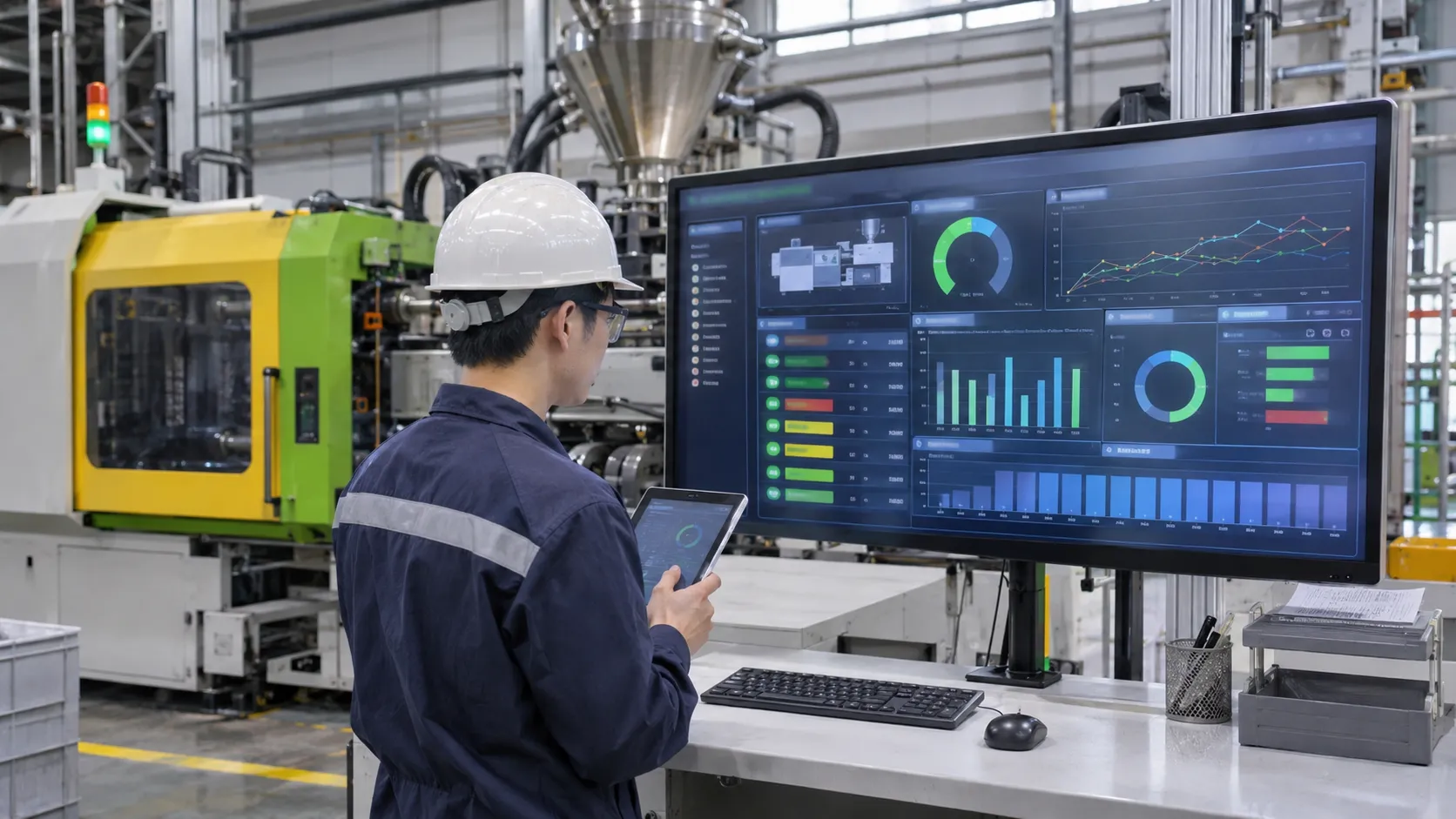
Over the next three to five years, the biggest changes are likely to come from deeper integration of existing technologies rather than an overnight shift to fully autonomous factories.
1. AI-driven process optimization
AI will increasingly move beyond identifying abnormalities and recommending adjustments. More systems will be able to optimize selected processing parameters automatically within validated limits. Engineers will still need to supervise these changes, particularly when working with new materials, complex molds, or demanding product requirements.
2. More integrated automated production cells
Robots will increasingly work alongside inspection systems, assembly equipment, and packaging stations. The focus will shift from automating individual tasks to improving the performance of complete production cells.
3. Wider adoption of MES and connected manufacturing
More manufacturers will connect machine data with production orders, materials, quality records, and maintenance information. This will provide a stronger foundation for factory-wide decision-making.
4. More practical digital twins
Digital twins are likely to gain wider use in specific applications such as mold cooling, temperature monitoring, and process prediction. Their adoption will depend on reliable measurements and accurate models.
5. Greater focus on energy and material efficiency
Manufacturers will pay more attention to energy consumption per good part, scrap rates, and material utilization. These measurements connect environmental goals with everyday production costs.
Overall, injection molding factories will become more connected and better at using production data. However, fully autonomous manufacturing will take longer to achieve and will not be practical for every product or production environment.
6. How Can Injection Molding Manufacturers Start Their Industry 4.0 Transformation?
Manufacturers do not need to introduce every technology at once. A gradual approach is usually more practical and easier to evaluate.
| Stage | Recommended Actions | Main Goal |
|---|---|---|
| 1. Data Collection | Monitor machine status, cycle time, output, and downtime | Build reliable production records |
| 2. Digital Management | Introduce MES, mold tracking, and material traceability | Improve production visibility |
| 3. Intelligent Manufacturing | Apply AI quality analysis, predictive maintenance, and automation | Solve specific production problems |
| 4. Smart Factory Integration | Connect equipment, production planning, quality, and digital models | Coordinate manufacturing operations |
A small injection molding factory might begin by collecting machine status and cycle-time data. A larger manufacturer with an established MES may be ready to introduce AI-based quality analysis or digital twins for selected processes.
The right investment depends on production volume, product complexity, customer requirements, existing equipment, and expected return.
The most effective transformation is not necessarily the most advanced one. It is the one that addresses real manufacturing problems and delivers measurable improvements.
7. Frequently Asked Questions
What is Industry 4.0 in injection molding?
Industry 4.0 in injection molding is the use of connected machines, automation, AI, and digital production systems to improve manufacturing efficiency, quality control, traceability, and factory management.
How does AI improve injection molding?
AI analyzes machine and process data to identify unusual conditions, predict potential defects, and recommend processing adjustments. More advanced systems can automatically adjust selected parameters within predefined limits.
What makes an injection molding factory a smart factory?
A smart injection molding factory connects machines, molds, materials, production orders, and quality systems. It uses shared production data to improve decision-making, traceability, and process control.
Can older injection molding machines be upgraded for Industry 4.0?
Yes. External sensors, data acquisition modules, and industrial gateways can help older machines share production information. The available options depend on the machine controller and the signals that can be accessed.
Is Industry 4.0 suitable for small injection molding manufacturers?
Yes. Smaller manufacturers can start with machine monitoring, digital production records, and material tracking. More advanced technologies can be introduced as production needs grow and a clear business case develops.
Conclusion
Industry 4.0 is not about replacing manufacturing experience with technology. It is about making better use of engineering knowledge, production data, and automation. Injection molding manufacturers that combine these capabilities will be better positioned to improve quality, control costs, and remain competitive as manufacturing requirements continue to evolve.




















Sign in to leave a comment.