
Introduction
Hospitals do not fail because doctors lack skill. Hospitals fail because systems break under pressure. Patients wait too long. Beds stay blocked. Emergency departments overflow. Diagnostics slow down. Nurses burn out. Managers panic. And suddenly, a hospital that looks world-class on paper starts operating like controlled chaos.
This is where the real action happens. Not in boardrooms. Not in brochures. Inside the hospital command centre. Modern healthcare runs on real-time decisions. Every delay costs money, safety, and trust. India’s hospitals already operate at high stress. National health data shows that urban tertiary hospitals often function at 75–90% bed occupancy, while emergency departments see 20–30% patient surges during seasonal outbreaks. Without trained operational leaders, systems collapse fast.
That reality has forced the best hospital management colleges in Kolkata to rethink education. These colleges no longer train students as paperwork administrators. They train them as real-time healthcare controllers. Students learn how to monitor patient flow, manage bed availability, coordinate departments, respond to emergencies, and make decisions under pressure.
This article breaks the illusion that hospital management is a slow, desk-bound job. It takes you inside how hospital management colleges in Kolkata simulate control-room environments and prepare students for operational leadership roles that hospitals desperately need today. If you want to understand how real hospital managers think, act, and lead during chaos, read on.
Understanding the Hospital Command Centre as the Brain of Healthcare Operations
A hospital command centre works like a central nervous system. It connects every department. It tracks movement, pressure points, and risks in real time. Large Indian hospitals now rely on this model because manual coordination no longer works at scale.
In practical terms, the healthcare command centre monitors patient admissions, discharges, transfers, emergency arrivals, ICU availability, diagnostics turnaround times, staffing gaps, and escalation alerts. Every decision flows through this nerve centre.
Government healthcare reports show that hospitals with centralised operational control reduce emergency waiting times by 15–25% and improve bed utilisation efficiency by 10–20%. That improvement does not come from clinical skill alone. It comes from operational intelligence.
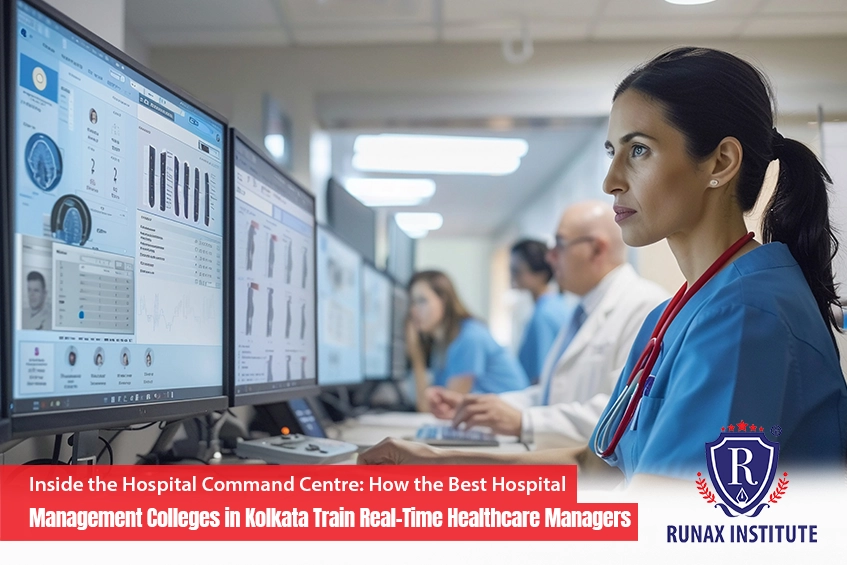
The best hospital management colleges in Kolkata replicate this ecosystem academically. Students train using simulated dashboards that mirror live hospitals. They learn how hospital operations management works minute by minute, not semester by semester.
Instead of reading theory, students practice real-time hospital decision-making. They see how one delayed discharge blocks emergency beds. They see how the diagnostic backlog slows ICU admissions. They understand why hospital leadership is about systems, not authority.
This training mindset prepares graduates for hospital systems management roles where speed, clarity, and coordination decide outcomes.
Simulation-Based Training for Real-Time Decision-Making
Real hospitals do not pause for explanations. Decisions happen fast, often with incomplete information. That reality shapes how hospital management colleges in Kolkata design learning environments.
Simulation labs recreate pressure. Students work with mock hospital administration and control systems that show live patient loads, staffing levels, emergency alerts, and operational bottlenecks. Faculty introduce sudden disruptions like ICU saturation or ambulance overflow.
Healthcare analytics studies show that simulation-based training improves operational response accuracy by 30–40% compared to classroom-only learning. This difference matters in Indian hospitals where patient-to-bed ratios remain high.
Students learn how patient flow optimisation works under stress. They practice prioritising care pathways. They allocate resources logically instead of emotionally. They balance safety with speed.
This approach trains future managers to lead calmly during chaos. It prepares them for real hospital floors where every decision triggers a chain reaction across departments.
Teaching Patient Flow and Capacity Management at Scale
Patient movement defines hospital performance. Poor flow increases mortality risk, staff burnout, and patient dissatisfaction. Indian healthcare infrastructure data shows that delayed discharges alone account for 15–20% of bed blocking in large hospitals. That single issue overloads emergency departments and stretches ICU capacity.
The best hospital management colleges in Kolkata train students to think in flow maps, not isolated units. They study admissions, transfers, diagnostics, treatment cycles, and discharge planning as one connected system.
Students learn hospital capacity planning using measurable indicators like average length of stay, bed turnover ratio, and emergency spillover rates. They understand how seasonal disease patterns impact occupancy.
This training builds managers who solve congestion proactively instead of reacting late. It aligns with modern healthcare service delivery models that demand system-wide thinking.
Integrating Clinical, Administrative, and Support Functions
Hospitals fail at handoffs. Not because people lack intent, but because departments operate in silos. Clinical delays affect housekeeping. Housekeeping delays affect admissions. Admissions delays frustrate patients. This domino effect destroys efficiency.
The best hospital management colleges in Kolkata train students to manage clinical and non-clinical coordination as a single operational fabric. Students learn structured communication protocols and dependency mapping.
Healthcare audits reveal that cross-department coordination failures contribute to up to 30% of operational delays in multi-speciality hospitals. Training managers to anticipate these gaps changes outcomes.
Students practice synchronising nursing, pharmacy, diagnostics, security, and waste management workflows. They understand that leadership is about alignment, not control.
This approach produces professionals ready for operational leadership in hospitals, where coordination defines credibility.
Data Dashboards, KPIs, and Operational Intelligence
Hospitals generate massive data. Most hospitals underuse it. The best hospital management colleges in Kolkata train students to convert data into action. They work with hospital KPI dashboards that track bed occupancy, patient wait times, infection indicators, and service recovery metrics.
Studies in Indian hospital systems show that data-driven operations improve turnaround times by 20–30% when managers act in real time instead of waiting for reports.
Students learn healthcare operations analytics as a decision tool, not a reporting exercise. They identify bottlenecks early. They intervene faster. They improve outcomes visibly.
This training prepares managers for modern hospital resource allocation, where every decision must justify itself with numbers.
Crisis Response and Emergency Command Training
Hospitals face crises without warning. Pandemics, fires, equipment failures, mass casualties, and ICU overloads demand calm leadership.
The best hospital management colleges in Kolkata train students in emergency response management using structured escalation frameworks. Students learn decision hierarchies, command roles, and coordination protocols aligned with NABH operational standards.
Indian emergency preparedness data shows that hospitals with trained command protocols reduce response time by 25% during crises. Training makes the difference.
Students learn how to lead without clinical authority. They manage resources. They communicate clearly. They stabilise systems. This prepares them for real leadership roles in Indian healthcare infrastructure management, where crises are inevitable.
Industry Exposure and Career Readiness Through Live Hospital Environments
Classrooms alone cannot build confidence. Exposure completes training. The best hospital management colleges in Kolkata integrate internships, live postings, and observational roles into learning. Students shadow operations heads. They attend control-room briefings. They participate in audits.
Healthcare workforce studies show that graduates with live operational exposure reach supervisory productivity 30–40% faster than theory-only peers.
This exposure turns knowledge into instinct. Students understand pace, pressure, and accountability. They graduate ready for hospital administration and control systems roles from day one.
Conclusion
Hospitals no longer run on intuition. They run on coordination, data, and speed. The best hospital management colleges in Kolkata recognise this shift. They train students inside simulated command centres where real-time decisions shape outcomes. They focus on operational intelligence, not paperwork.
Graduates leave prepared for leadership roles that demand calm thinking under pressure. They understand patient flow, capacity planning, cross-functional coordination, data-driven action, and crisis response.
This training model produces healthcare managers who do not wait for instructions. They anticipate problems. They control systems. They lead with clarity. In a healthcare system under constant strain, these professionals keep hospitals functioning. That is the real value of command-centre training. That is where modern hospital leadership begins.
Frequently Asked Questions
1. What is a hospital command centre in healthcare management?
A hospital command centre is a central operational hub that monitors patient flow, capacity, staffing, and emergencies in real time.
2. Why do hospital management colleges in Kolkata focus on real-time operations?
Indian hospitals operate under high pressure, so managers must make fast, data-backed decisions instead of relying on theory.
3. How does command-centre training improve career readiness?
It builds confidence, decision-making ability, and system awareness, helping graduates transition faster into leadership roles.
4. Is hospital management more operational than administrative today?
Yes. Modern hospital management focuses on live operations, coordination, analytics, and crisis response rather than paperwork.
5. What roles can graduates pursue after this type of training?
Graduates move into operations executive, capacity manager, quality lead, emergency coordinator, and hospital operations leadership roles.




























Sign in to leave a comment.