

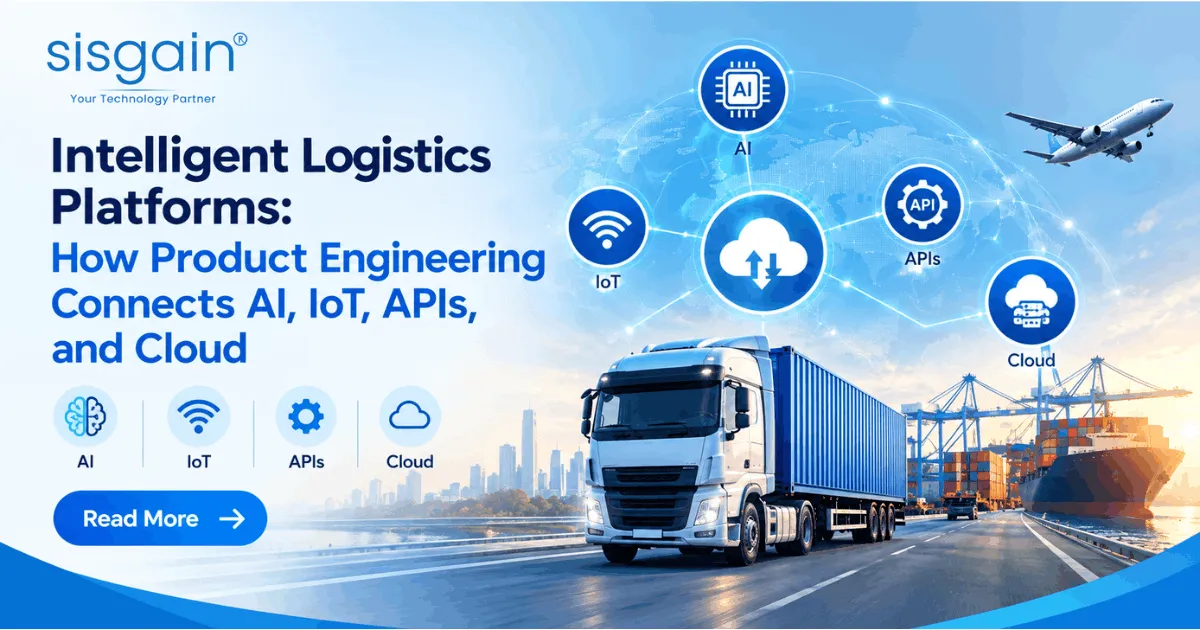
Logistics Is Becoming a Product Engineering Challenge
For years, logistics software meant Intelligent Logistics Platform systems of record: a transportation management system here, a warehouse system there, and spreadsheets filling the gaps. These tools recorded what happened, but they rarely helped teams decide what to do next.
That gap matters more now. U.S. logistics operators run complex transportation networks, multi-site warehousing, fulfillment commitments, and last-mile delivery, often across disconnected tools. They need technology that can process real-time data, predict disruptions, optimize transportation, automate repetitive workflows, and support faster decisions.
That is the difference between conventional logistics software and an intelligent logistics platform. Conventional software stores and displays information. An intelligent platform interprets operational data and helps teams act on it. Getting there takes product engineering, the discipline of combining AI, IoT, APIs, cloud infrastructure, and analytics into one cohesive, scalable product.
Key takeaway: Intelligent logistics is not about adding AI to existing software. It requires engineering the entire product around connected data and operational workflows.
What Is Product Engineering in Logistics?
Product engineering is the practice of designing, building, and continuously improving a software product around user and business needs. Traditional software development often starts from a fixed specification and ends at delivery. Product engineering treats the platform as something that keeps evolving with its users, data, and market.
The lifecycle is broad. It includes product discovery, business and user research, strategy, UX and UI design, architecture, software development, API integration, AI and machine learning implementation, cloud engineering, testing, deployment, monitoring, and continuous improvement.
This matters in logistics because these platforms serve many stakeholders at once: warehouse teams, carriers, dispatchers, drivers, and customers, each with different workflows. They handle large volumes of operational data, react to real-time events, connect to third-party systems, and must adapt when transportation conditions change. A one-time build cannot keep pace with that. Teams looking for end-to-end product engineering services should expect this full lifecycle, not just code delivery.
Why Intelligent Logistics Platforms Are a Business Priority
U.S. logistics businesses face pressure from several directions at once:
- Customers expect real-time visibility and accurate delivery windows.
- Delivery networks are more complex, especially at the last mile.
- Transportation costs and labor constraints squeeze margins.
- Exceptions need faster handling.
- Fragmented technology ecosystems keep data trapped in silos.
Modern AI systems can help here. They can process large volumes of operational information and support planning, forecasting, and decision-making, and logistics organizations are increasingly exploring AI for exactly these purposes, along with automation and real-time decision support.
The core message is simple. Businesses no longer need platforms that merely display information. They need platforms that understand operational data and help teams act on it. Organizations investing in logistic software development services are increasingly asking for this intelligence layer, not just another dashboard.
How Product Engineering Creates Intelligent Logistics Platforms

AI and Machine Learning Integration
Machine learning powers predictive ETAs, demand forecasting, route optimization, delivery-delay prediction, carrier performance analysis, risk identification, and inventory forecasting. Product engineering makes these models useful by embedding them into daily workflows rather than leaving them in a data science notebook.
IoT and Real-Time Data
GPS devices, fleet telematics, sensors, RFID, warehouse devices, temperature monitors, and vehicle data all produce continuous streams. Product engineering connects them and converts raw signals into actionable operational information, such as a temperature deviation flagged before a shipment is compromised.
API-First Architecture
Logistics platforms must integrate with TMS, WMS, ERP, CRM, e-commerce platforms, carrier systems, mapping services, payment systems, and IoT platforms. An API-first approach prevents isolated applications and lets new capabilities plug in without rebuilding what already works.
Cloud-Native Architecture
Cloud-native design supports scalability, high availability, large-scale data processing, multi-location operations, secure infrastructure, and flexible deployment.
Automation and Workflow Orchestration
The most valuable platforms follow a loop: event, detection, decision, action, notification, and learning. For example, a shipment delay is detected, the platform analyzes the cause and recommends an alternative, the dispatcher approves it, and the customer receives an updated ETA. Each cycle also feeds back into the system so future recommendations improve.
From Data Visibility to Intelligent Decision-Making
Traditional logistics software follows a familiar pattern: track, report, react. Teams learn about a problem after it happens and then scramble.
An intelligent platform works differently: monitor, predict, analyze, recommend, act, and learn. Product engineering makes this shift possible by connecting data pipelines, business rules, analytics, and AI models into one system.
Consider a practical scenario. A platform detects severe weather along a route, traffic congestion ahead, the driver's current location, the shipment's priority, and the customer's delivery window. Individually, each signal is just data. Combined, they let the platform recommend a reroute or a proactive customer notification before a delivery fails.
Human approval can remain part of that workflow, especially for high-impact decisions. The goal is not to remove dispatchers from the process. It is to give them better information, earlier, with a clear recommended action.
The Role of Product Management in Intelligent Logistics Products
Engineering alone cannot produce a successful logistics platform. Product management ensures the right problems get solved. Its responsibilities include identifying real logistics problems, defining user personas, prioritizing features, setting the roadmap, measuring business outcomes, coordinating stakeholders, maintaining product-market alignment, and evaluating AI use cases.
That last responsibility is critical. Without it, companies add AI simply because it is available, not because it solves a measurable problem. Strong product management asks whether a use case has clean data, clear business value, and a user who will actually act on the output. Businesses that want this discipline embedded in their programs can explore enterprise product management services.
A phased roadmap keeps ambition grounded:
- Data consolidation
- Visibility
- Predictive analytics
- Workflow automation
- AI-assisted decisions
- Controlled autonomous workflows
Each phase builds on the one before it, which reduces risk and shows value early. A structured approach to product management solutions helps teams sequence these phases against real business priorities.
Key Features of an Intelligent Logistics Platform

Real-time shipment visibility. Shipment tracking, location updates, ETA monitoring, and delivery status in one view.
Predictive analytics. Delay prediction, demand forecasting, capacity planning, and risk identification.
Intelligent dispatch. Automated assignment that accounts for driver availability, route conditions, and delivery priorities.
Fleet intelligence. Vehicle monitoring, driver behavior insights, maintenance prediction, and fuel and utilization analysis.
Warehouse intelligence. Inventory visibility, order prioritization, workflow optimization, and automated alerts.
Exception management. Delay alerts, temperature deviations, route disruptions, missed delivery windows, and escalation workflows so problems reach the right person quickly.
Customer experience. Real-time notifications, self-service tracking, digital proof of delivery, and accurate ETAs that reduce inbound "where is my order" calls.
The value comes from how these features share data. Visibility feeds prediction, prediction feeds dispatch, and exceptions feed learning. A collection of separate modules cannot deliver that.
Product Engineering Architecture for Intelligent Logistics
A simplified architecture looks like this:
- Data sources: GPS, IoT, TMS, WMS, ERP, and carrier APIs↓
- Integration layer: APIs, event streaming, and data connectors↓
- Data platform: cloud database plus data lake or warehouse↓
- Intelligence layer: AI, machine learning, predictive analytics, and business rules↓
- Application layer: dashboards, mobile apps, dispatch tools, and warehouse tools↓
- Automation layer: workflow automation, notifications, recommendations, and AI agents
- Users: operations managers, dispatchers, drivers, warehouse teams, and customers
The architecture should be modular. Businesses rarely have the appetite to replace their entire stack at once, and they shouldn't have to. A modular design lets teams introduce capabilities progressively, such as starting with integration and visibility, then adding prediction, then automation, without rework at each stage.
Security, Scalability, and Governance
Intelligent platforms handle operational and potentially sensitive business information, so security must be an architectural consideration from the start rather than an afterthought. This matters especially for U.S. B2B buyers, who often scrutinize these controls during procurement.
Core practices include identity and access management, role-based permissions, data encryption, API security, cloud security, audit trails, and data governance. Because AI is involved, teams also need model monitoring and validation of AI outputs. Disaster recovery planning and system observability round out the foundation, ensuring the platform stays reliable and problems are visible before customers notice them.
Human-in-the-loop controls deserve special attention. For important AI-supported decisions, such as rerouting high-value freight or changing carrier assignments, the platform should route recommendations through an approver, log the decision, and preserve the reasoning. That protects the business and builds user trust.
Read More - Smart Logistics Technology in 2026: How AI, IoT, and Automation Are Reshaping U.S. Supply Chains
How Logistics Businesses Can Build an Intelligent Platform
A practical path looks like this:
Identify high-value problems. Focus on measurable operational challenges rather than technology for its own sake.
Audit existing systems. Map your TMS, WMS, ERP, CRM, APIs, IoT devices, and databases.
Establish a unified data foundation. Build reliable data pipelines and common data models.
Prioritize AI use cases. Start where data quality and business value are clearly strong.
Build an MVP. Launch a focused product instead of attempting a complete transformation immediately.
Integrate automation. Connect predictions and recommendations to operational workflows.
Introduce controlled AI agents. Allow AI to perform limited tasks with defined permissions and human oversight.
Measure and improve continuously. Track delivery performance, operational efficiency, exception resolution time, forecast accuracy, system adoption, automation rate, and customer experience.
This phased approach also makes intelligent platforms realistic for small and mid-sized logistics businesses, which can begin with a single high-value use case.
Product Engineering and AI: The Future of Intelligent Logistics
Several developments are likely to shape the next generation of platforms: AI-powered logistics copilots, agentic workflow automation, predictive supply chain systems, real-time decision intelligence, digital twins, autonomous dispatch workflows, AI-assisted transportation planning, connected fleet ecosystems, and multimodal logistics platforms.
An important distinction applies. AI-assisted automation is not the same as full autonomy. AI agents should operate within defined permissions, business rules, monitoring, and escalation mechanisms. In practice, that means an agent may draft a reroute, notify a customer, or rebook a slot within set limits, while anything outside those limits goes to a person.
The organizations best prepared for this shift are those building solid foundations now: clean data, open APIs, clear workflows, and strong governance.
Measuring the Business Value of Intelligent Logistics Platforms
Technology adoption alone is a weak measure of success. Businesses should evaluate outcomes:
Product engineering should stay connected to these measures. If a feature doesn't move a metric that matters, it belongs back on the roadmap for reconsideration.

Conclusion
Logistics platforms are moving beyond basic tracking and transaction management. AI, IoT, APIs, cloud infrastructure, analytics, and automation are creating more intelligent operating environments, and product engineering provides the framework for combining them into scalable products. Product management ensures the technology solves meaningful business problems.
The most successful platforms will prioritize integration, security, usability, measurable outcomes, and controlled automation. The future of logistics technology is not simply more software. It is better-engineered products that turn operational data into timely decisions and actions.
Frequently Asked Questions
What is an intelligent logistics platform?
It is a connected system that interprets real-time operational data, predicts issues, and recommends or triggers actions. Conventional logistics software mainly records and displays information.
How does product engineering improve logistics software?
It brings architecture, AI, APIs, cloud, UX, and continuous improvement together so the software evolves with the business instead of remaining a static build.
How is AI used in intelligent logistics platforms?
Common uses include predictive ETAs, route optimization, demand forecasting, exception management, and workflow automation.
Why are APIs important for logistics platforms?
APIs connect TMS, WMS, ERP, carriers, GPS, IoT, and other systems, so data flows freely instead of sitting in isolated applications.
Can small and mid-sized logistics businesses adopt intelligent platforms?
Yes. Phased implementation and MVP-based development let them start with one high-value use case and expand as results justify it.
What is the role of product management in logistics technology?
It covers user research, prioritization, roadmap development, and measuring business outcomes, so the platform solves real problems.
How can businesses prepare logistics platforms for AI agents?
Focus on data quality, open APIs, clear permissions, well-defined workflows, monitoring, security, and human oversight.























Sign in to leave a comment.