

If you line up the top-performing residential projects in any major Indian city right now — the ones with the shortest sales cycles, the highest first-visit conversion rates, the most consistent buyer quality — and look for what they have in common, the answer is not always location or brand or even product.
The common thread, with remarkable consistency, is how they sell.
The projects that are selling fastest in this market are the ones that have built their sales process around interactive real estate tools — not as an add-on to their existing approach, but as the centrepiece of it. They have fundamentally changed the relationship between their product and their buyer, and the results show up directly in their numbers.
What "Interactive" Actually Means in a Sales Context
The word interactive is overused in real estate marketing to the point where it has lost meaning. A website with a gallery that you can click through is not interactive real estate marketing. An animated logo on a brochure is not interactive. Interactive, in the context that matters for sales outcomes, means one specific thing: the buyer is in control of their own experience of the property.
They decide where to go. They decide how long to stay. They decide what to examine. They navigate the space — the unit, the building, the amenity areas, the surrounding neighbourhood — on their own terms, at their own pace, following their own curiosity.
That distinction between controlled experience and self-directed exploration changes everything about how a buyer processes information and reaches conclusions.
Three Reasons Interactive Real Estate Outperforms Traditional Sales Methods
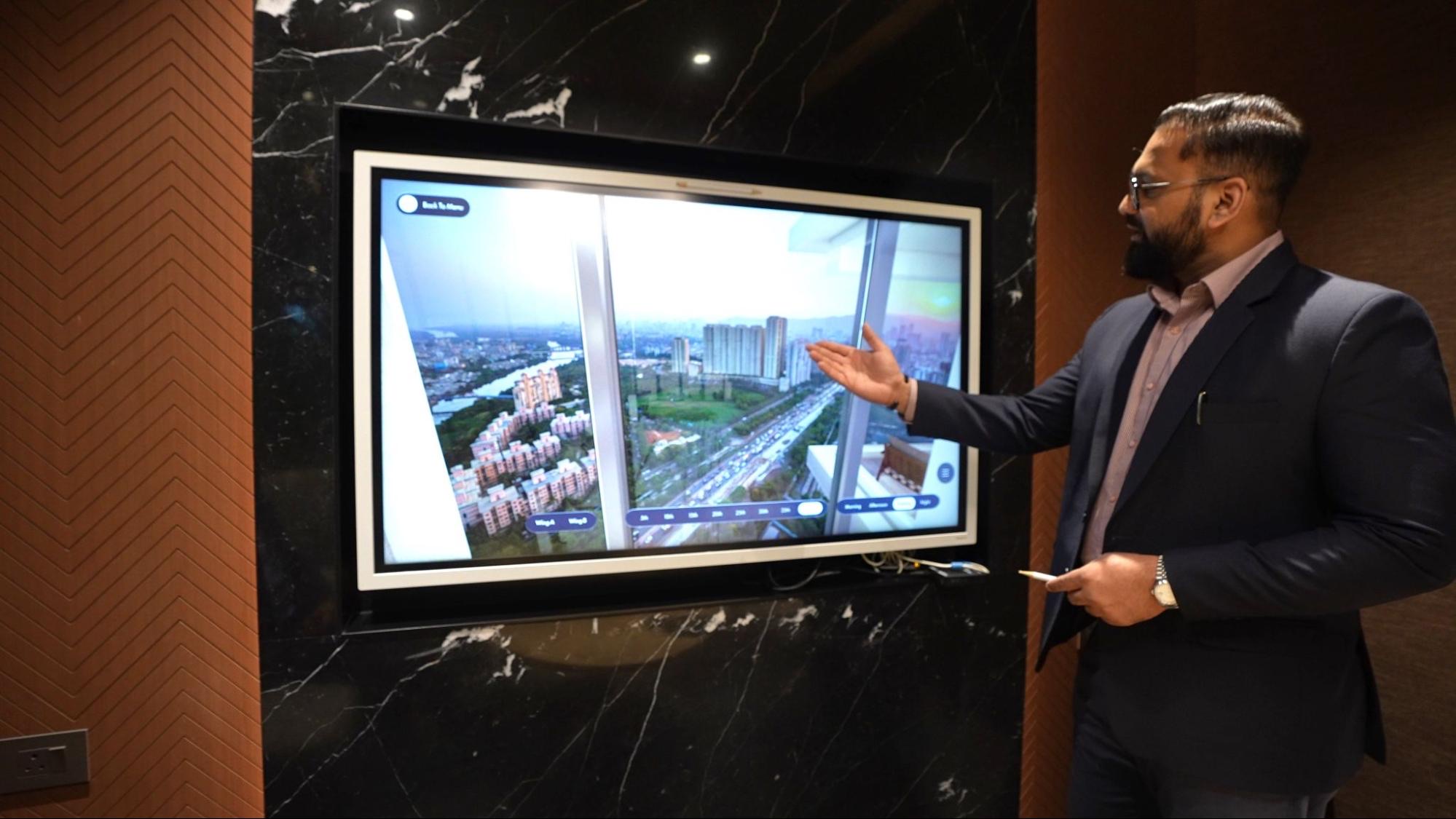
First: information delivered through experience sticks. When a buyer reads that the apartment has a 9.5 foot ceiling, they note it. When they stand inside a photorealistic 3D recreation of the apartment and experience what a 9.5 foot ceiling actually feels like, they remember it differently. The information is no longer abstract data — it is a felt reality. And buying decisions are made from felt realities, not data points.
Second: self-directed buyers qualify themselves. In a traditional presentation, the sales executive controls the flow of information. There is a set path and a set order. In an interactive experience, the buyer goes where they want — which means they naturally spend more time on the aspects that matter most to them. A buyer who spends fifteen minutes exploring the master bedroom and the balcony is telling you something important about what is driving their decision. That intelligence is valuable for the sales conversation that follows.
Third: it removes the credibility gap. Every claim a sales executive makes about a property — the ceiling height, the finish quality, the view — exists somewhere on a spectrum from fully credible to politely doubted. Buyers have been oversold before. Interactive real estate tools sidestep this entirely. When a buyer sees something themselves, the credibility of the experience does not depend on the salesperson. It depends on what they saw, which they trust absolutely.
Case Study: Nahar Valley — Interactive Real Estate at Township Scale
Nahar Valley required V-Estate to think about interactive real estate marketing differently than a single-tower project. The development's complexity — multiple phases, diverse unit types, extensive common infrastructure — meant that the buyer journey through the experience centre needed to be structured enough to prevent overwhelm but open enough to allow genuine exploration.
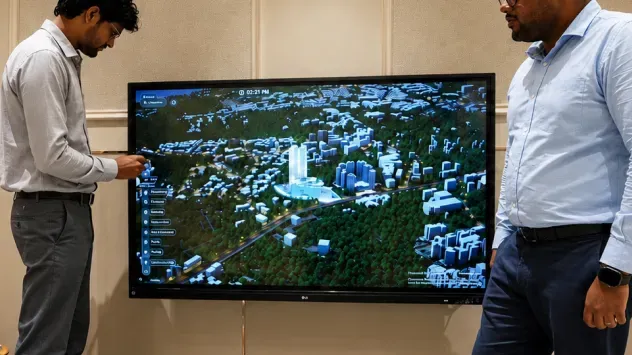
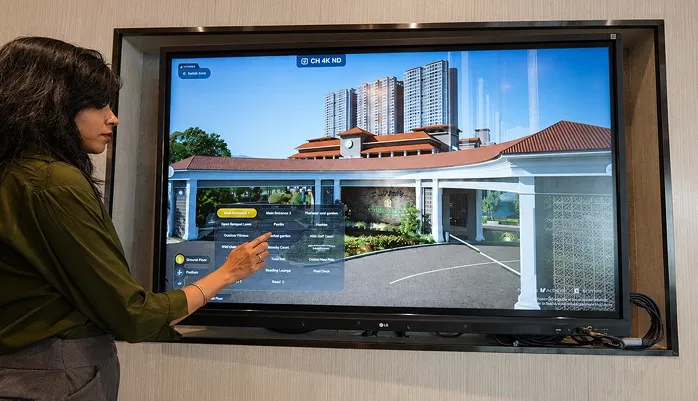
V-Estate's approach for the Nahar Valley experience centre was to build the experience in layers. The buyer started at the township level — an interactive 3D masterplan that gave them the full picture — and then moved progressively into more specific territory: a residential zone, a tower, a floor, a unit.
Each layer answered the questions naturally generated by the previous one. By the time a buyer reached unit-level detail, they were not disoriented by the project's scale. They were oriented within it. They understood where their potential apartment sat within the larger development — which direction it faced, what surrounded it, what was visible from the balcony, how far the clubhouse was from the front door.
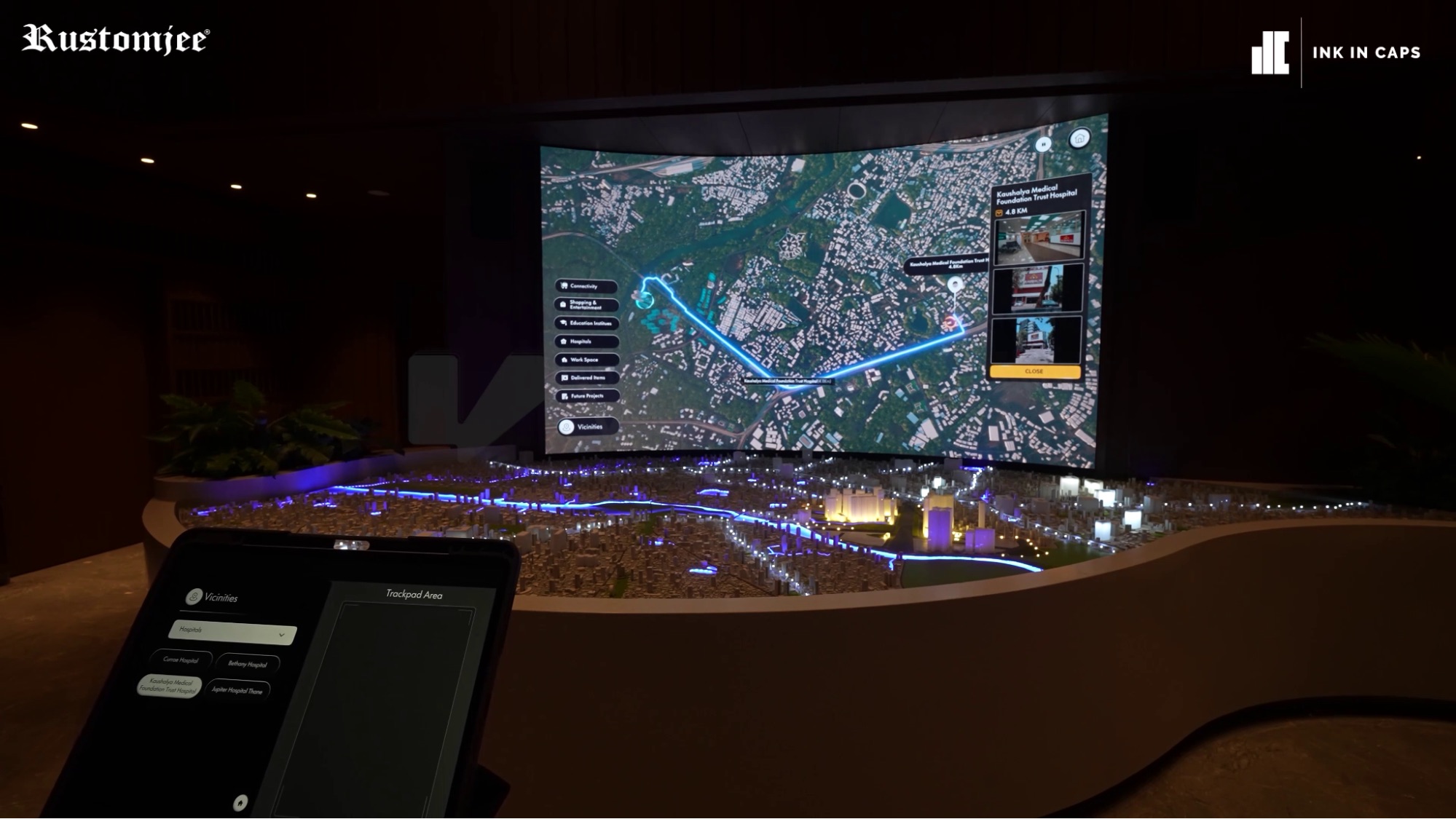
The vicinity mapping element — showing a 5km radius around the project including schools, hospitals, commute routes, and neighbourhood context — was particularly impactful for the first-time buyer segment. These are buyers for whom location practicality is as important as the product itself, and who typically have to ask multiple questions to get a clear picture. The interactive mapping gave them that picture without the interrogation.
The platform ran entirely offline, handling the demanding conditions of a township sales centre during peak weekend periods with complete stability.

The Marketing Application Beyond the Sales Office
Interactive real estate tools are not only valuable in the physical sales environment. The same technology that powers your experience centre can be deployed across your broader marketing operation:
Pre-launch digital campaigns. A teaser interactive walkthrough released before the formal launch date generates a different quality of inquiry than a static render. Buyers who have explored the product digitally arrive at launch events with specific questions rather than general curiosity — which means your team spends less time at the beginning of conversations and more time in the part that matters.
Channel partner enablement. Your broker network cannot send every prospective buyer to your experience centre before the conversation reaches a meaningful stage. Giving channel partners access to the interactive walkthrough means they can take buyers through the product in their own offices, qualifying interest before any visit is scheduled.
NRI and remote marketing. For projects with a significant NRI buyer profile, the ability to conduct a complete, detailed property exploration without a site visit is not a convenience — it is the only viable path to conversion for a large segment of your market.
Post-visit follow-up. A buyer who has been through an interactive walkthrough and leaves without booking can be followed up with a link to the specific unit they spent the most time in. That is a qualitatively different follow-up communication than a brochure PDF.
Where to Start
The most common question developers ask when they understand the case for interactive real estate tools is where to begin. The answer depends on where you are in the project cycle and what your sales environment looks like, which is exactly why V-Estate starts with a conversation rather than a package.
The platform is built to work for projects at different stages — pre-launch, under construction, near-complete — and in different sales environments — physical experience centres, digital channels, hybrid setups.
Explore interactive sales tools from V-Estate and understand what a deployment looks like for your specific project.
Read how to use interactive sales tools in real estate marketing for a more detailed breakdown of the deployment strategy.
The fastest-selling projects in your market are already doing this. V-Estate's interactive real estate platform is built for developers who want to compete on experience, not just product. Book a demo and see the difference.




























Sign in to leave a comment.