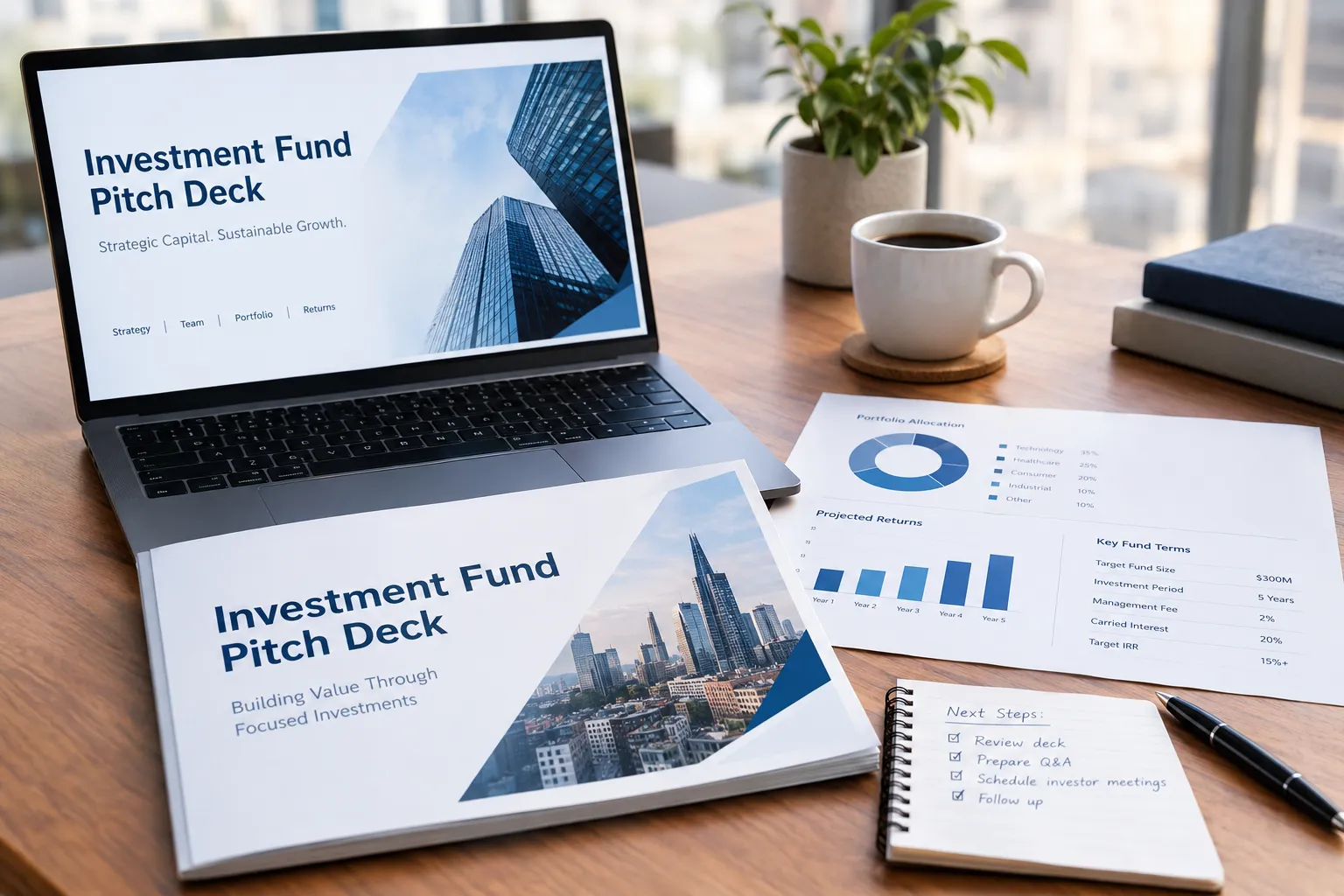


Investment Fund Pitch Deck: A Complete Guide for Fund Managers
Raising capital for an investment fund requires more than an ambitious strategy and a list of potential investments. Fund managers must explain why their approach is credible, how they intend to manage capital, and what makes their team worth backing. A well-prepared presentation helps turn these ideas into a clear, convincing investment proposition.
What should an investment fund pitch deck include?
An investment fund pitch deck is a structured presentation that explains a fund's investment strategy, management team, financial approach, and potential value to prospective limited partners (LPs). It should give investors enough clarity to understand the opportunity, assess the risks, and decide whether to explore the fund further.
1. A clear fund overview
Begin with a concise introduction to the fund. Explain its purpose, target size, investment focus, and the types of opportunities it intends to pursue.
Investors should quickly understand what the fund does and why it exists. Avoid broad statements such as "we invest in promising businesses" without explaining which businesses qualify and what makes them attractive.
A strong overview answers three questions:
- What opportunities does the fund target?
- Which markets, sectors, or investment stages does it focus on?
- Why is this strategy relevant now?
2. Your investment thesis
The investment thesis is the foundation of the presentation. It explains the reasoning behind your strategy and the market conditions that support it.
Describe the trends, inefficiencies, or opportunities that have shaped your approach. Use credible research and relevant examples to support your position. If your fund focuses on early-stage technology companies, for instance, explain the specific market changes that create opportunities and how your team plans to identify promising investments.
The goal is to show that your strategy follows a considered investment philosophy rather than a general interest in a growing sector.
3. The team behind the fund
Investors assess the people responsible for deploying and managing their capital. Your team section should highlight relevant experience, investment expertise, professional networks, and evidence of execution.
Include previous investment outcomes where appropriate, clearly distinguishing realised returns from unrealised performance. If you are launching your first fund, demonstrate relevant experience through prior roles, successful deals, industry knowledge, or a well-defined sourcing process.
Credibility comes from specific evidence, not impressive-sounding job titles alone.
4. Track record and performance
Performance information helps prospective LPs understand how the team has approached investment decisions in the past.
Where applicable, present metrics such as:
- Internal rate of return (IRR).
- Distributed to paid-in capital (DPI).
- Total value to paid-in capital (TVPI).
- Realised exits and portfolio performance.
Explain the reporting period, calculation methodology, and whether figures relate to the current fund, previous funds, or individual investments. Never present projected results as achieved returns.
First-time managers can instead explain their investment process, relevant experience, and how they will evaluate and support portfolio companies.
5. Fund structure and economics
Fundraising presentations should explain the proposed fund size, investment period, expected portfolio construction, management fees, carried interest, and other relevant terms.
Keep the explanation straightforward. Prospective LPs need to understand how capital will be deployed, how the fund will operate, and how returns may be distributed.
Make sure financial assumptions are internally consistent and aligned with the fund's governing documents. Legal and financial professionals should review the relevant disclosures and terms before the deck is distributed.
6. Portfolio construction and risk management
A promising investment thesis is not enough without a practical plan for executing it.
Explain how the fund will allocate capital across investments, manage concentration, reserve money for follow-on opportunities, and respond when an investment underperforms.
Risk management should be specific to your strategy. Discuss relevant market, liquidity, operational, sector, and execution risks, together with the processes used to monitor them. Avoid suggesting that any investment strategy can eliminate risk.
7. A clear fundraising request
Finish with a concise summary of the opportunity and the next step.
Include the fundraising target, current progress where appropriate, expected closing milestones, and how interested investors can request further information. The request should be specific enough to move the conversation forward without creating unnecessary pressure.
How can fund managers make their pitch deck more convincing?
The strongest presentations combine a logical story with reliable evidence and clean visual design.
- Prioritise clarity: Give each slide one main message.
- Use relevant evidence: Support key claims with appropriate data and examples.
- Keep figures consistent: Check financial projections, fund terms, and performance calculations.
- Design for readability: Use charts and tables when they communicate information better than paragraphs.
- Prepare for questions: Keep supporting analysis available for follow-up discussions.
Avoid filling every slide with technical language. Sophisticated investors need meaningful detail, but they also need to understand the central argument quickly.
Frequently Asked Questions
How long should an investment fund pitch deck be?
There is no universal slide count. A focused presentation of around 15 to 25 slides can provide a useful starting point, depending on the fund strategy, audience, and complexity of the opportunity. Prioritise completeness and clarity over a fixed number.
Can a first-time fund manager create a convincing pitch deck?
Yes. First-time managers can demonstrate credibility through relevant professional experience, a clearly defined investment thesis, a disciplined investment process, realistic financial assumptions, and transparent risk management. They should avoid implying that they have a fund track record they do not possess.
Final thought: A fund pitch deck is not simply a fundraising document. It is an opportunity to demonstrate how you think, how you make investment decisions, and how responsibly you intend to manage other people's capital.
Show less


















Sign in to leave a comment.