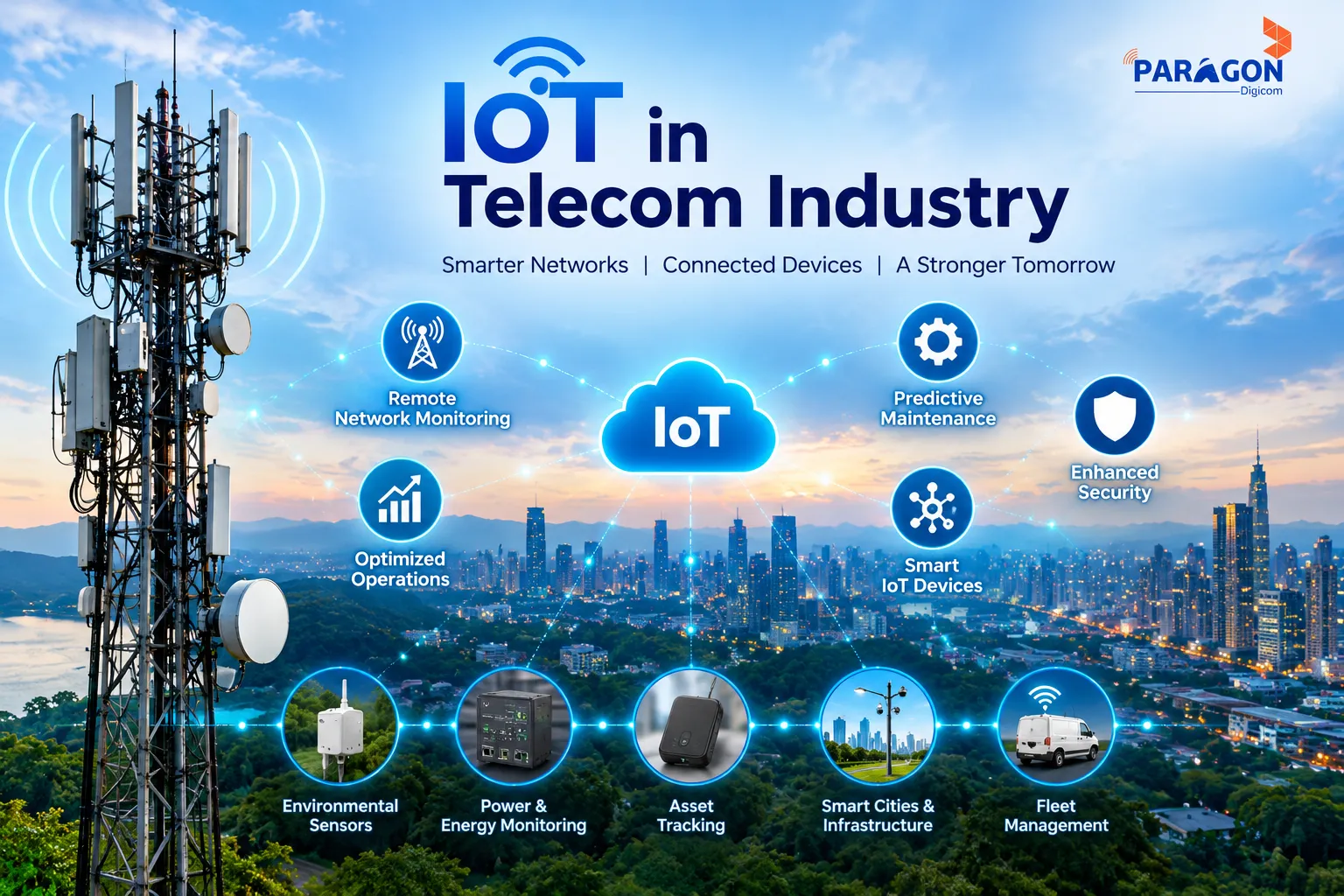

The telecommunications sector is rapidly evolving as connected devices, intelligent networks, and data-driven services become part of everyday operations. One of the technologies contributing to this transformation is the Internet of Things (IoT). The IoT in telecom industry connects devices, sensors, network infrastructure, and software platforms to collect and exchange information in real time.
As businesses increasingly depend on reliable connectivity, telecom companies are exploring IoT to improve network management, automate processes, and create new digital services.
What Is IoT in Telecom?
IoT in telecommunications involves connecting physical devices and assets through cellular, wireless, or other communication networks. These connected devices can continuously generate information that organizations can analyze to understand performance, identify issues, and make operational decisions.
For telecom providers, this can include monitoring towers, power systems, network equipment, batteries, and other infrastructure. Instead of depending entirely on manual inspections, operators can receive data remotely and respond to potential issues more efficiently.
Major Use Cases
One significant application is network and infrastructure monitoring. Sensors can monitor temperature, power consumption, equipment status, and environmental conditions. This information can help operators identify abnormal behavior and investigate problems before they develop into larger service disruptions.
Another important use case is predictive maintenance. Historical and real-time equipment data can be analyzed to identify patterns associated with potential failures. Maintenance teams can then prioritize inspections and servicing based on actual equipment conditions.
IoT can also support asset tracking and remote management. Telecom companies operate infrastructure across numerous locations, making centralized visibility valuable. Connected devices can provide information about equipment status and location without requiring frequent physical inspections.
Role of 5G and Edge Computing
The growth of 5G is creating additional opportunities for connected applications. Different IoT deployments can require different combinations of coverage, capacity, latency, reliability, and power efficiency. Telecom networks therefore play an important role in supporting diverse IoT requirements.
Edge computing can complement these networks by processing selected data closer to connected devices. This approach can reduce the need to send every piece of information to a distant data center and can support applications where timely processing is important.
Benefits for Businesses
The IoT in telecom industry can contribute to better operational visibility, automation, resource management, and data-based decision-making. It may also help organizations identify inefficiencies and respond to infrastructure problems more quickly.
However, successful implementation requires more than connecting devices. Organizations should consider device security, authentication, data protection, interoperability, network management, and the long-term maintenance of connected equipment.
Businesses exploring digital transformation can work with technology providers such as Paragon Digi to evaluate relevant digital and connected-technology opportunities based on their operational requirements.
Future of IoT in Telecommunications
The future of telecommunications will increasingly involve communication between machines, infrastructure, applications, and intelligent systems. As 5G, edge computing, cloud platforms, analytics, and automation continue developing, IoT can become an important component of connected business operations.
Rather than adopting IoT simply because it is a growing technology, organizations should begin with a clearly defined business problem and establish measurable objectives. This approach can make IoT deployments more practical, scalable, and valuable.
Conclusion
The IoT in telecom industry is creating new possibilities for network monitoring, predictive maintenance, asset management, and automated operations. Combined with modern connectivity and computing technologies, IoT can help telecom organizations build more responsive and data-driven infrastructure. A focused strategy that prioritizes security, scalability, interoperability, and measurable outcomes can provide a stronger foundation for long-term IoT adoption.
FAQs
1. What is IoT in the telecom industry?
It refers to connecting devices, sensors, and telecom infrastructure through communication networks so that data can be collected, transmitted, monitored, and analyzed.
2. What are common telecom IoT use cases?
Common applications include infrastructure monitoring, predictive maintenance, asset tracking, remote equipment management, energy monitoring, and automated operations.
3. How does 5G benefit IoT?
5G can support different connected-device requirements, including applications that need high capacity, reliable connectivity, low latency, or large numbers of connected devices.
4. Is IoT security important for telecom companies?
Yes. Connected infrastructure can introduce additional security considerations, making authentication, access control, secure communication, monitoring, and device lifecycle management important.
5. How can a company begin an IoT project?
A company can start by identifying a specific business problem, defining measurable objectives, evaluating connectivity and security requirements, selecting suitable technology, and testing the solution through a controlled deployment.























Sign in to leave a comment.