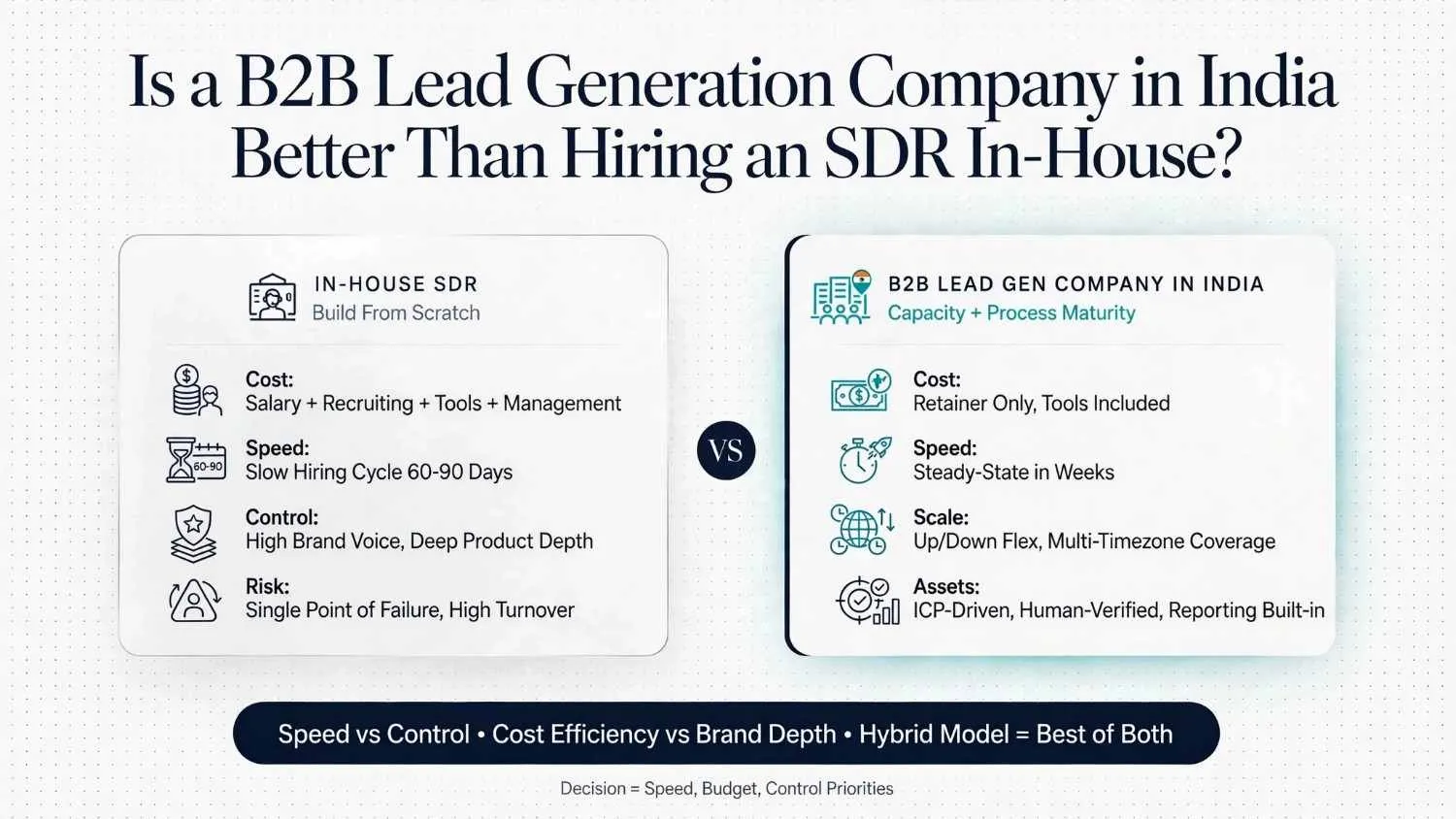

Neither option is universally better — it depends on how fast you need pipeline, how much budget you have for hiring and ramp time, and how much control you need over messaging. A B2B lead generation company in India typically wins on speed and cost efficiency; an in-house SDR typically wins on long-term brand control and product depth.
What "In-House SDR" Actually Means
Hiring in-house means recruiting, onboarding, and managing a sales development representative (or a small team) as direct employees, using your own tools, scripts, and management structure.
This gives you full control over hiring criteria, training depth, and day-to-day priorities. It also means you own every part of the ramp-up curve — sourcing candidates, running interviews, building onboarding materials, and absorbing the productivity dip while a new hire learns your product and market.
Turnover is a real factor here too. SDR roles have historically high turnover across the industry, which means the hiring and ramp-up cost isn't necessarily a one-time expense — it can repeat more often than companies initially budget for.
What a B2B Lead Generation Company in India Actually Offers
An external provider brings an existing team, existing tooling, and an established outreach process, so you're buying capacity and process maturity rather than building it from scratch.
The trade-off is that the team doesn't start with deep product knowledge — that has to be transferred through onboarding, briefs, and ongoing feedback, similar to onboarding a new in-house hire, just compressed into a shorter window.
A capable B2B lead generation company in India typically brings ICP-driven targeting methodology, existing outreach infrastructure (dialers, sequencing tools, verified data sources), and reporting structures already built — assets an in-house team would otherwise need to assemble independently.
Cost Comparison: It's Not Just About Salary
Comparing costs purely on salary versus retainer fee misses most of what actually drives total cost.
In-house costs include:
- Base salary and, in many markets, commission or bonus structure
- Recruiting cost — whether internal time or external recruiter fees
- Tooling costs (dialer, email sequencing platform, data enrichment tools, CRM seats)
- Management overhead — someone needs to coach, review calls, and manage performance
- Ramp-up time where the hire is not yet fully productive, which is a real cost even though it doesn't show up as a separate line item
Outsourced costs typically include:
- A retainer, per-appointment fee, or hybrid pricing structure
- Little to no tooling cost, since the provider generally supplies its own infrastructure
- Lower management overhead, since day-to-day execution management sits with the provider
- A shorter ramp period in most cases, since the team and process already exist — though onboarding to your specific product and ICP still takes real time
Methodology note: These are structural cost categories, not fixed dollar figures — actual totals vary widely by region, seniority level, and scope, and any provider or recruiter quoting a single number without asking about your specific situation should be treated with some skepticism.
Speed to Pipeline: Which Ramps Faster
Outsourced B2B lead generation companies in India generally reach steady-state outreach faster — often within a few weeks — because the team, tooling, and process already exist. In-house hiring typically takes longer end-to-end once recruiting, onboarding, and productivity ramp are all counted.
This isn't a universal rule. A well-resourced company with an existing recruiting pipeline and strong onboarding materials can hire and ramp an in-house SDR reasonably fast too. But for most mid-market companies without dedicated SDR recruiting infrastructure, outsourcing tends to compress the timeline meaningfully.
Where In-House Tends to Win: Control and Product Depth
Control is the strongest, most consistent argument for in-house hiring, and it shouldn't be understated.
An in-house SDR sits inside your team, absorbs product updates in real time, and develops nuanced product knowledge that's harder to fully transfer to an external team, even a skilled one. For companies with highly technical or complex products, that depth of understanding can materially affect how well objections get handled on a call.
Brand voice consistency is also easier to maintain in-house, since there's no translation layer between "how we want to sound" and "how an external team executes that." This matters more for companies where outbound tone is a deliberate part of brand positioning, not just a functional script.
Where Outsourcing Tends to Win: Scalability and Flexibility
Scaling an in-house team up or down is slow — hiring takes months, and reducing headcount has real human and organizational costs beyond just budget.
A B2B lead generation company in India can typically scale outreach volume up or down faster, since capacity adjustments happen at the contract level rather than requiring new hiring or layoffs. This flexibility matters most for companies with seasonal demand, uncertain budget cycles, or a need to test a new market segment before committing to permanent headcount.
Geographic and time-zone coverage is another practical advantage — a provider can often support outreach across US, European, and APAC business hours more easily than a single in-house hire covering one time zone.
Risk Factors on Both Sides
Being honest about risk matters more here than picking a side.
In-house risk:
- Turnover resets the ramp-up curve and repeats the hiring cost
- A single point of failure — if your one SDR leaves, outreach volume drops to zero until a replacement is hired
- Slower to correct course if the hire isn't performing, since replacing an employee is a bigger decision than adjusting a vendor contract
Outsourced risk:
- Provider quality varies significantly — a poorly managed provider can produce high activity with low actual pipeline quality
- Less day-to-day visibility unless the provider offers strong, transparent reporting
- Contract terms can lock in a rigid approach if targeting and pricing structure aren't set up to adapt (a common issue when the ICP shifts — a separate but related consideration)
Neither option eliminates risk. The right question is which risk profile your company is better positioned to manage right now.
A Decision Framework: In-House vs. Outsourcing
In-house SDR tends to make more sense when:
- Your product is highly technical and product depth materially affects conversation quality
- Brand voice and tone in outbound conversations is a deliberate, closely guarded part of positioning
- You have the budget and recruiting infrastructure to hire and retain well, and can absorb ramp-up time without urgency
A B2B lead generation company in India tends to make more sense when:
- You need pipeline moving faster than an in-house hiring cycle allows
- Budget efficiency matters and fully-loaded in-house costs (salary, tools, management overhead) are hard to justify yet
- You want to test a new market segment or ICP before committing to permanent headcount
- You need outreach coverage across multiple time zones without hiring separately for each
The Hybrid Option Most Companies Actually Land On
In practice, many mid-market and enterprise B2B companies don't pick one side exclusively — they combine an in-house team focused on strategy, ICP definition, and closing, with an outsourced B2B lead generation company in India handling outreach volume and initial qualification.
This structure keeps strategic control in-house while letting the outsourced partner absorb the labor-intensive parts of outbound execution. It also reduces the single-point-of-failure risk of relying entirely on one or two in-house SDRs.
The Global Associates works with clients in exactly this kind of hybrid structure — supporting outreach volume and appointment setting while the client's internal team retains ownership of ICP strategy, messaging approval, and closing.
How to Evaluate a B2B Lead Generation Company in India, If You Choose That Route
If outsourcing looks like the right fit, the evaluation criteria matter more than the decision to outsource itself.
- Ask how they define and validate your Ideal Customer Profile before outreach starts, not after
- Ask for segment-level reporting, not just a single blended activity number
- Ask how contract terms handle scaling up, scaling down, or adjusting targeting mid-term
- Ask about data verification practices — human-verified contacts consistently outperform unverified database pulls
- Ask directly what happens if performance underdelivers in the first month, since ramp-up applies to outsourced teams too, just typically over a shorter window than in-house hiring
A provider unwilling to answer these specifically, and instead offering only general reassurance, is a weaker signal than one that walks through their actual process.
Frequently Asked Questions
Is a B2B lead generation company in India better than hiring an SDR in-house?
Neither is universally better. A B2B lead generation company in India generally offers faster ramp-up and lower fully-loaded cost, while in-house SDRs generally offer deeper product knowledge and tighter brand-voice control. The right choice depends on your speed, budget, and control priorities.
How much does it cost to hire an in-house SDR compared to outsourcing?
In-house costs include salary, recruiting, tooling, and management overhead, plus ramp-up time before full productivity.
Outsourced costs are typically a retainer or per-appointment fee with lower tooling and management overhead. Exact totals vary by region and scope, so compare fully-loaded costs, not just salary versus retainer.
How fast can a B2B lead generation company in India start generating pipeline?
Most established providers reach steady-state outreach within a few weeks, since the team, tooling, and process already exist.
This is generally faster than in-house hiring once recruiting and onboarding time are factored in, though a well-resourced internal hiring process can also move quickly.
Does outsourcing to a B2B lead generation company in India mean losing control over messaging?
Not necessarily, but it does require a deliberate onboarding and approval process. Messaging control tends to be easier to maintain fully in-house, which is why some companies choose a hybrid model — keeping messaging approval internal while outsourcing outreach execution.
What is the biggest risk of hiring an SDR in-house instead of outsourcing?
Turnover is a significant risk — SDR roles have historically higher turnover than many other sales roles, and losing your one in-house SDR can drop outreach volume to zero until a replacement is hired and ramped.
What is the biggest risk of outsourcing to a B2B lead generation company in India?
Provider quality varies significantly. A provider without strong ICP targeting, human-verified data, and transparent segment-level reporting can generate high activity with low actual pipeline quality, which is why evaluating process matters more than price alone.
Can a company use both an in-house SDR and a B2B lead generation company in India together?
Yes — this hybrid approach is common among mid-market and enterprise B2B companies, keeping ICP strategy and closing in-house while an outsourced partner handles outreach volume and initial qualification.
Is it cheaper to outsource B2B lead generation to a company in India than to hire in-house elsewhere?
Generally, yes, on a fully-loaded cost basis, largely due to lower regional salary and tooling costs combined with reduced management overhead — but the comparison should always be structured cost-category to cost-category, not a single flat number against another.
How do I know if a B2B lead generation company in India is actually good, versus just cheap?
Ask how they define and validate your ICP, whether reporting is segment-level, how contracts handle scaling and targeting adjustments, and what their contact verification process looks like. A provider offering only volume and price, with no process detail, is a weaker signal.
Should an early-stage startup hire an in-house SDR or outsource to a B2B lead generation company in India?
Early-stage startups with an unproven or shifting ICP often benefit from outsourcing first, since it avoids the sunk cost of hiring and training an in-house SDR against a target profile that may still change significantly.























Sign in to leave a comment.