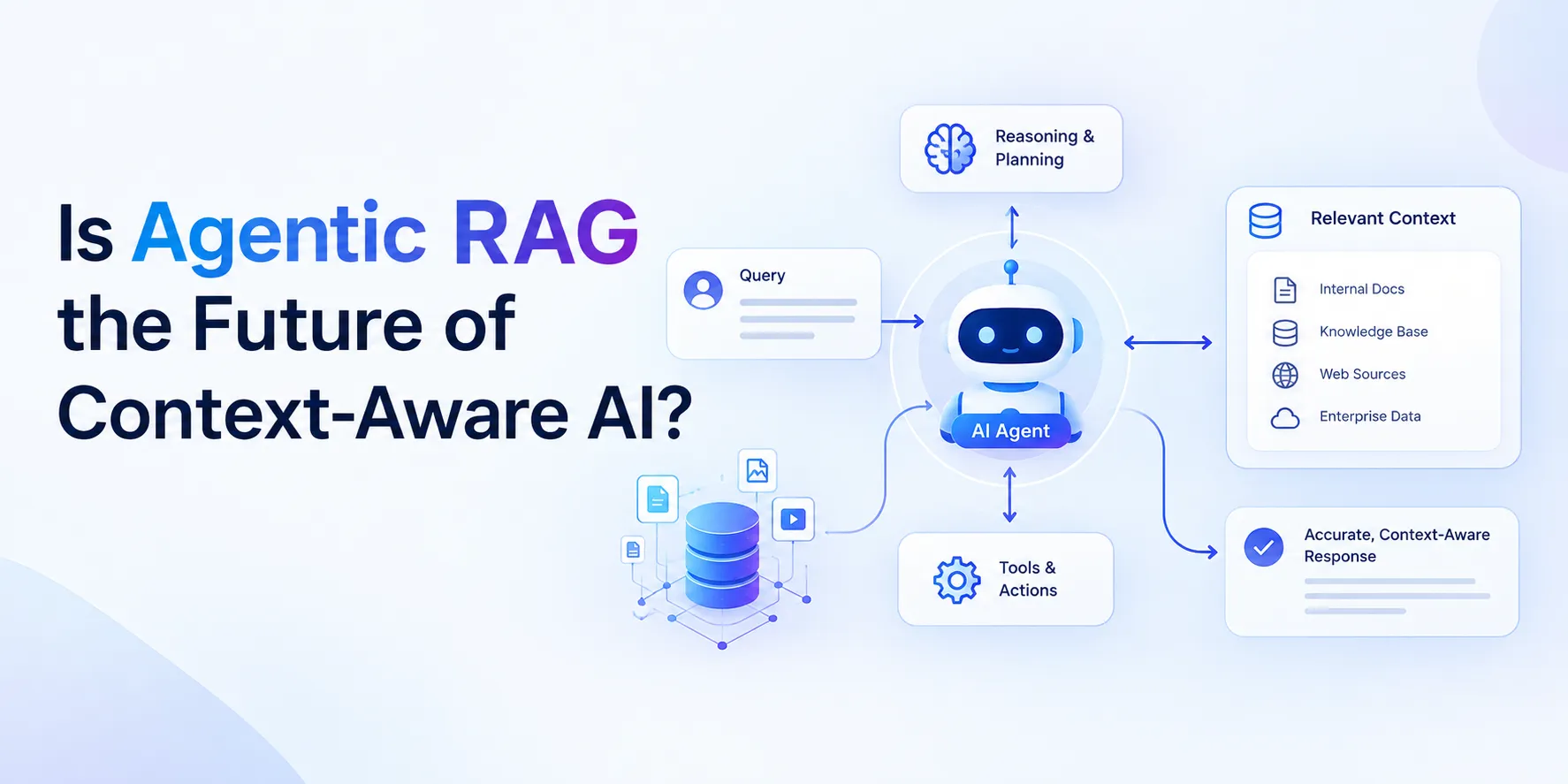

Standard retrieval pipelines operate on a single rigid track. A user submits a query, the system runs a basic similarity search across a vector index, and the top search results get pasted directly into a language model prompt.
That single-step process fails when answering questions across fragmented systems. Enterprise data lives in separate silos: relational databases, software tools, cloud file drives, and internal portals. Asking a complex multi-part question forces a standard system to guess whenever records are scattered, leading directly to missing information or fabricated answers.
Agentic RAG fixes these limitations by pairing information retrieval with autonomous decision loops. Rather than running one blind lookup, an agentic system breaks requests into steps, searches multiple sources, evaluates the findings, and repeats queries until it gathers verified evidence.
How Agentic AI Transforms Information Retrieval
Modern agentic AI replaces one-way pipelines with modular components that coordinate dynamically. Each module handles a distinct stage of the search and reasoning workflow.
Query Planning and Task Decomposition
Planning modules take broad business prompts and break them down into smaller sub-queries. When an employee asks for a cross-department report, the system isolates each factual requirement, plans the search order, and connects the findings step by step. Dividing large requests into targeted steps prevents context confusion and improves answer quality.
Smart Source Routing
Routing components direct each sub-query to the right repository. Financial ledger questions go straight to SQL databases, policy questions go to vector indexes, and current operational requests pull live data from external software APIs. The router evaluates user intent to pick the right retrieval path every time.
Multi-Step Search and Fact Verification
Multi-step retrieval gathers information in cycles. The agent checks initial results, spots missing facts, and runs follow-up searches across connected systems. Built-in evaluation steps grade the retrieved data for relevance and accuracy before drafting a response. When context looks incomplete, the system rewrites search keywords and tries again automatically.
| Feature | Standard Retrieval Pipeline | Agentic Retrieval System |
| Execution Flow | Fixed, single-step lookup | Dynamic reasoning loops with self-correction |
| Data Collection | Single similarity search | Multi-step synthesis across multiple sources |
| Data Types Handled | Isolated vector index | Vector stores, SQL databases, live cloud APIs |
| Error Handling | Returns incomplete or incorrect text | Rewrites queries and validates facts automatically |
| System Output | Static text summaries | Verified answers and automated business workflows |
Engineering teams adopting advanced agentic RAG architectures gain modular control over every retrieval step. Separating query planning from storage queries creates transparent, testable software pipelines.
The Business Value: Moving from Simple Answers to Real Work
Upgrading from passive search to active reasoning delivers practical operational advantages across daily business tasks.
Eliminating Information Bottlenecks
Knowledge workers spend hours hunting down information across separate tools. An agentic system pulls records across repositories, checks for conflicts, and delivers verified briefs in seconds. By validating source data automatically, teams spend less time checking facts and more time executing strategy.
Adapting to Rapid Enterprise Adoption
Industry shifts confirm the quickening move to autonomous workflows. Research from Gartner projects 33% of enterprise software applications will include agentic capabilities by 2028, rising from less than 1% in 2024. The same research projects at least 15% of daily work decisions will run autonomously through agent systems by 2028.
Investing early in scalable retrieval architectures positions companies to automate complex knowledge tasks before competitors catch up.
Reducing Costly Hallucinations
When standard models lack context, they make assumptions. In contrast, agentic workflows use validation agents that compare evidence across internal files. If source documents contradict each other, the system flags the discrepancy rather than guessing an answer.
Real-World Deployments and AI Agent Development
Enterprises deploy AI agents Solutions to automate information-heavy workflows across core departments. Working with a seasoned AI/ML development company helps businesses build systems aligned with their operational goals.
Financial Services and Auditing
Finance teams deploy agent systems to automate internal compliance reviews and credit evaluations. The system checks regulatory rules against internal transaction databases, verifies accounting sheets against public filings, and generates complete audit trails with direct citations.
Customer Support Automation
Customer service teams use agentic pipelines to resolve multi-step customer inquiries. Agentic systems will autonomously resolve a majority of common customer service issues, lowering service operational costs. Agents verify customer identities, check warranty rules, execute refund operations, and update CRM records automatically.
Supply Chain Operations
Operations teams rely on active agents to monitor inventory and prevent supply shortages. Systems track warehouse counts, evaluate supplier lead times, and draft purchase orders when inventory runs low.
Secure Access Controls
Modern AI agent development integrates Fine-Grained Authorization (FGA) to keep sensitive corporate data secure. The retrieval layer filters documents before and after model processing based on user roles. This setup guarantees that agents only retrieve documents each employee has permission to view, maintaining strict privacy compliance.
Building Enterprise-Ready Agentic Services
Launching production-grade agentic AI services requires deliberate design to maintain low latency, cost control, and high accuracy.
| Implementation Step | Focus Area | Success Metric |
| Operational Boundaries | Set loop execution limits, timeouts, and fallback paths | Cost per query, predictable response times |
| Multi-Source Connections | Connect SQL databases, vector search, and third-party APIs | Search accuracy, complete data retrieval |
| Automated Testing | Use synthetic question-answer pairs and benchmark datasets | Answer correctness, tool invocation success rate |
| Data Governance | Enforce role-based access rules and full trace logs | Zero unauthorized data leaks, auditable run logs |
Engineering teams track reasoning steps and tool calls by applying standard agent data plane practices. Continuous testing on synthetic datasets helps developers tune prompt performance, spot edge cases, and maintain system reliability before rolling out updates to business teams.
The Road Ahead for Context-Aware Systems
Agentic RAG marks a major step forward for enterprise software. Moving beyond passive document search gives companies context-aware systems that can reason, verify, and complete complex knowledge tasks autonomously.
Organizations that connect distributed data sources, enforce strict access policies, and build modular reasoning pipelines will turn static files into active business value. Partnering with experienced machine learning engineers provides the technical foundation needed to deploy reliable agentic systems across your business operations.


















Sign in to leave a comment.