

Efficiency Loss Rarely Starts With a Breakdown
That gearbox is running slightly hotter. The conveyor motor is drawing more current. A bearing replaced six months ago is noisy again.
These are not minor maintenance irritations. They are early signs that friction, oil starvation or inconsistent lubrication may already be reducing machine efficiency. A properly engineered lubricating oil system supplies controlled quantities of oil to moving components before heat and wear become expensive failures.
SKF notes that roughly one-third of bearing failures are linked to lubrication problems, including incorrect lubricant selection, wrong quantity and unsuitable lubrication intervals.
And yet, many plants still treat lubrication as a manual task rather than a machine-critical process.
Lubricating Oil System Specifications That Actually Affect Performance
A Lubricating Oil System circulates, meters or delivers oil to bearings, gears, chains, slides and other friction points. Its design depends on operating load, speed, temperature, lubricant viscosity and the number of lubrication points.
Oil-Circulation Systems for Continuous-Duty Equipment
Circulating systems generally use a reservoir, motor-driven pump, filters, pipelines, flow-control components and return lines. Oil reaches the lubrication points, removes part of the generated heat and returns to the tank for reuse.
They suit turbines, heavy gearboxes, rolling mills and other equipment operating for long shifts. In these applications, oil is doing two jobs: separating moving surfaces and carrying heat or contaminants away.
Metered Oil Systems for Controlled Delivery
Metered systems deliver a predetermined oil quantity at selected intervals. They are frequently used on machine tools, conveyors, presses, packaging equipment and automated production machinery.
Too little oil causes metal-to-metal contact. Too much creates leakage, heat, seal damage and unnecessary lubricant consumption.
The Viscosity Detail Buyers Commonly Skip
ISO viscosity grades are based on an oil’s approximate kinematic viscosity at 40°C. For example, ISO VG 32 has a midpoint viscosity of 32 mm²/s, with a recognised range of 28.8 to 35.2 mm²/s.
Buying a pump without checking cold-start viscosity is careless. A unit that handles warm oil during a demonstration may struggle to move the same oil on a cold January morning in North India.
Monitoring and Safety Components
Depending on machine criticality, a system may include pressure switches, level indicators, flow sensors, pressure gauges, filters and electrical controllers.
Here’s the overlooked point: a running pump does not prove that oil has reached the final bearing. A blocked branch line can leave one critical point dry while the motor and controller appear completely normal.
Five Tests for Lubricating Oil Systems Manufacturers
1. Can They Calculate the Required Oil Quantity?
A capable supplier should study bearing size, operating speed, load, working hours and OEM recommendations.
A bad answer sounds like: “This standard pump works for most machines.”
That is not engineering. It is stock clearance.
2. Will They Check Pressure Loss Across the Pipeline?
Pipeline length, tube diameter, bends, elevation and viscosity influence pressure at the farthest point. Ask for the proposed operating-pressure range and line-routing logic.
A bad supplier discusses only pump pressure and ignores what reaches the final lubrication point.
3. Can They Match Components to the Environment?
Steel mills, cement plants and mines expose lubrication equipment to dust, vibration, heat and impact. Electrical and mechanical components must suit those conditions.
“Industrial grade” without an enclosure rating, temperature range or material specification is an empty answer.
4. How Will the System Confirm Oil Delivery?
Pressure switches detect pressure. Flow devices verify movement. Level sensors warn against an empty reservoir. These functions are different.
A bad answer is: “The operator can check it manually.”
That defeats the reason for buying an automatic system.
5. What Happens After Installation?
Ask who supports commissioning, troubleshooting, spare selection and system expansion.
“We handle problems case by case” means there is no defined support process. Buyers usually discover that after production has stopped, when negotiating power is already gone.
How a Lubricating Oil System Protects Plant Margins
Lower Risk of Premature Bearing Damage
Consistent oil delivery helps maintain a separating film between moving surfaces. Since lubrication problems account for around one-third of bearing failures, correcting the delivery process attacks a documented reliability risk rather than merely treating symptoms.
Reduced Friction-Related Energy Loss
Lubricants reduce the energy required to overcome friction between contacting surfaces. That matters across dozens or hundreds of bearings running during every production shift.
The saving at one bearing may look small; the cumulative loss across an entire line does not.
Better Control Over Lubricant Consumption
Manual lubrication is inconsistent. One technician applies too much. Another misses the point because the machine is difficult to access.
Metered delivery controls quantity and frequency, reducing leakage, oil waste and housekeeping costs.
Fewer Dangerous Manual Interventions
Centralised delivery allows lubrication points inside guarded, elevated or high-temperature areas to receive oil without repeated physical access.
Which means maintenance teams spend less time near moving chains, hot housings and difficult platforms.
More Predictable Maintenance Planning
Pressure, flow and oil-level feedback can expose blocked lines, leakage and empty reservoirs before components fail. Maintenance then becomes a planned intervention rather than a midnight breakdown call.
Longer Component-Service Potential
More than 10 billion rolling bearings are produced globally each year, and SKF estimates that about 90% outlive the equipment in which they are installed. Only around 0.5% fail in service, but failures in critical production lines can create severe losses.
The lesson is straightforward: bearings are not automatically short-life components. Poor operating conditions often make them that way.
Lubricating Oil System Suppliers in India: Availability Still Matters
Industrial users searching for Lubricating Oil Systems Manufacturers in India should evaluate more than quoted price. Response distance, spare availability and the supplier’s ability to understand local operating conditions affect the real cost of ownership.
A Faridabad-based manufacturer has practical access to major industrial belts across Delhi NCR, Haryana, Rajasthan, Uttar Pradesh and Punjab through established road-freight routes. For plants elsewhere in India, accurate drawings and remote technical coordination become even more important because correcting tube routing after dispatch is harder than most buyers expect.
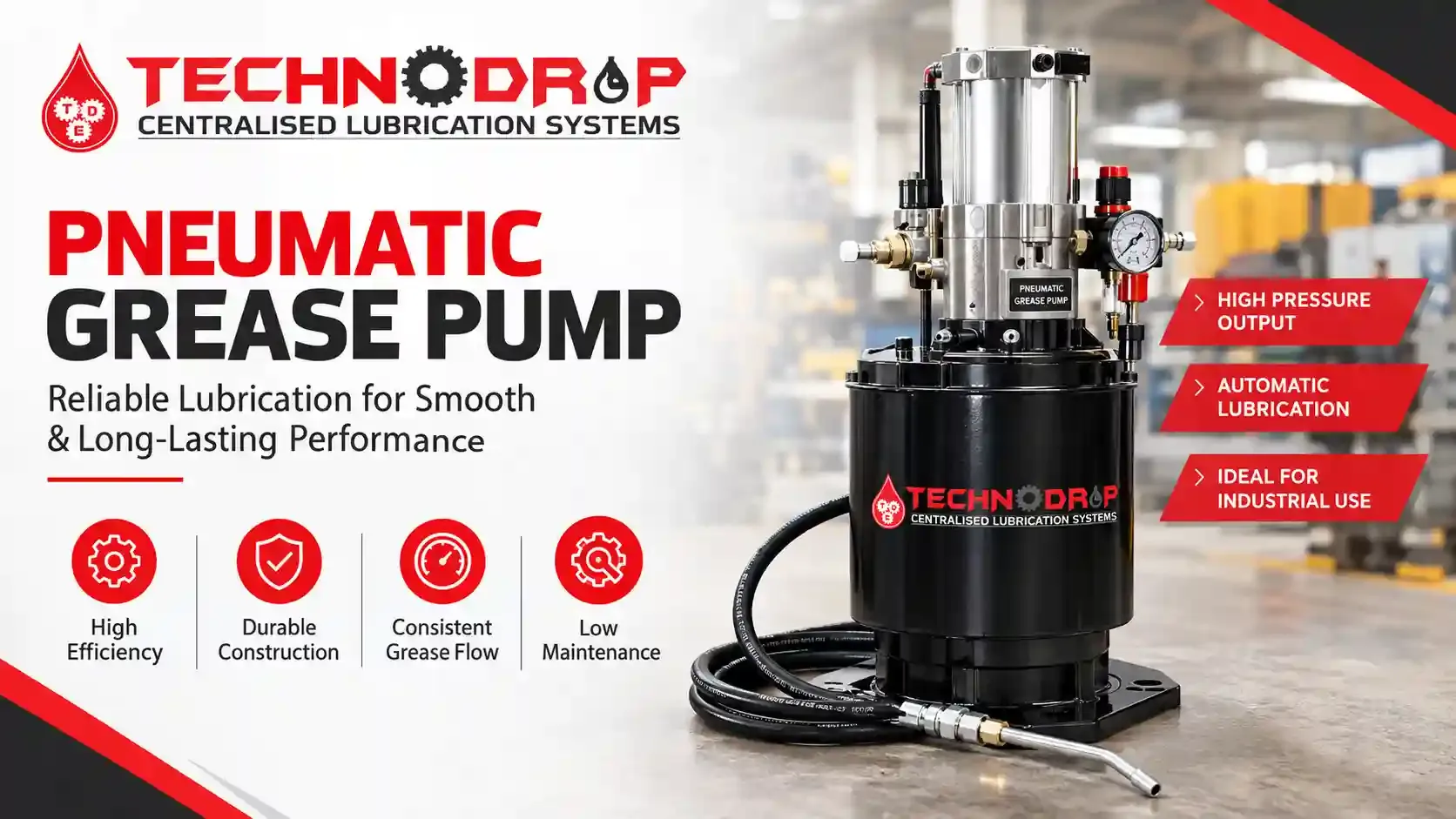
Technodrop manufactures centralised and automatic lubrication equipment in Faridabad and has operated since 1999. Its range covers grease systems, oil systems, pumps and related industrial lubrication equipment for applications across India.
About Technodrop Centralised Lubrication Systems
We have worked in industrial lubrication since 1999, designing and manufacturing centralised and automatic systems from Faridabad for different machine layouts and operating conditions.
We know the difficult part is rarely mounting the pump. It is deciding how to route every branch so that the last lubrication point receives the required oil without creating inaccessible joints, trapped air or avoidable pressure loss.
Our approach starts with the machine, not a catalogue model.
Send Us the Machine Data Before Requesting a Quote
Send us your machine drawing, number of lubrication points, lubricant grade, required oil quantity, operating cycle, pipeline length and available electrical supply.
We will review the application and recommend a suitable configuration. Response target: [confirm working-hour commitment]. MOQ: [confirm whether one configured system is accepted]. These details should be verified by Technodrop before publication rather than replaced with a convenient marketing promise.
Request an application review through our website and include photographs of the existing lubrication points where possible.
Conclusion
A lubricating oil system should control oil quantity, timing and delivery—not merely run a pump. Selecting the wrong configuration can hide lubrication failure until a bearing, gearbox or production line pays the price. The right system turns lubrication into a monitored maintenance process. As factories move toward higher utilisation and fewer unplanned stops, that control will become harder to ignore.
FAQs
1. What information is necessary in choosing a lubricating oil system?
List out the number of lubrication points, oil viscosity, required volume, temperature, machine cycle, pipe length, and power supply. Otherwise, the advice will be purely conjectural.
2. How do Lubricating Oil Systems Manufacturers decide the capacity of the pump?
They consider the total amount of lubricant, operation frequency, loss in pressure, and safety margin. But a tip: Bigger pumps don't mean everything. Improperly sized tubes and lines may be the reason behind the problem.
3. In which machines are lubricating oil systems employed?
Such systems find application in machine tools, conveyors, rolling mills, presses, gearboxes, turbines, lifting and conveying machinery and many such machines having several oil-lubricated friction points. Also, according to Technodrop, CNC Machines, Cranes and Forced lubrication systems are some more common applications of such systems.
4. Do Lubricating Oil System Manufacturers manufacture customised systems?
The suppliers design the system depending on the application using reservoirs, pumps, controllers and metering equipment. However, “customised” does not simply mean writing this word on a quotation. There must be drawings and schedules of components to substantiate it.
5. How often should an oil lubrication system run?
There is no standard frequency for all cases. The factors include the speed and load of the components, amount of oil, temperature, and advice from the Original Equipment Manufacturer.
























Sign in to leave a comment.