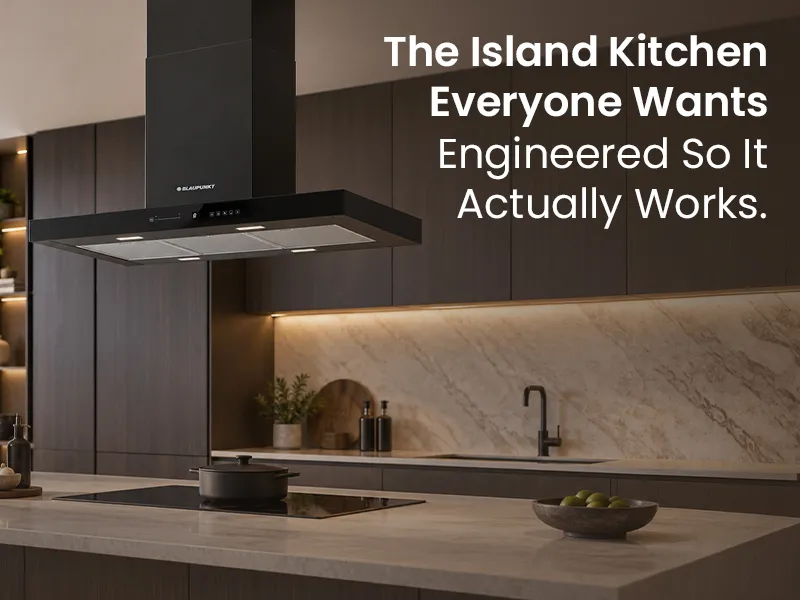

An island kitchen is the ultimate design statement in a modern luxury apartment or villa. It removes walls and gives your living space an effortless, luxurious feel. But for anyone who actually cooks, that dream can turn into a daily headache.
The moment a hot pan hits the stove, the open layout works against you. Without walls to contain the heat, and with AC units blowing air around, rising grease and pungent spice plumes escape in seconds. Suddenly, your quiet living room smells like dinner for hours. Solving the real open-kitchen smoke problem starts with facing the hard facts of island kitchen ventilation in India before the kitchen setup is complete.
Why Island Kitchen Ventilation in India Needs a Different Approach
Anyone who has stood in an Indian kitchen during a heavy tadka knows the chaos. Oil splatters, steam surges, and sharp spice aromas fill the room instantly. A weak, standard chimney simply hangs there, completely overwhelmed.
Handling that kind of cooking requires the best island hood for Indian cooking (one that delivers a massive 1,000 to 1,500 m³/hr of extraction airflow is usually the go-to hood). It isn't a luxury, but a basic need for a modern luxury kitchen with an island kitchen. Without a back wall to conceal pipes, ductwork has to trek across your ceiling. Combine that with high humidity, and those strong cooking odours drift everywhere if you don't trap them immediately at the source.
Plan the Hood Around Capture Shape, Not Just Motor Power
It is tempting to think a huge motor solves everything, but raw power means nothing if smoke escapes first. You need a hood built to trap fumes before they float away.
A deep, well-contoured canopy acts like a catch-basin for rising heat. Extend that canopy 200 to 300 mm past your cooking surface so it grabs stray steam before a draft carries it off. When you pair proper coverage with a balanced fresh air supply, you stop chasing smoke around the room and capture it where it starts.
Size the Hood for Heavy Cooking
If you are installing a large island kitchen with a wide four- or five-burner hob, a pretty, sleek hood just won't cut it. Your hood has to cover every single active burner at the same time.
If you have a 90 cm five-burner hob, upgrade to a 120 cm canopy. That extra 150 mm overhang on each side creates a safety net for high-heat, multi-pan cooking, keeping heavy smoke from spilling over the edges into your home.
Airflow Depends on Solid Ducting
You can buy the best island hood for Indian cooking, but cheap or poorly planned ductwork will ruin it. Sharp bends and extra-long runs choke your airflow and leave you with a noisy, struggling machine.
To keep your living space peaceful, consider a remote blower installed further down the line. It pulls heavy air over long distances while keeping motor noise away from your guests. Just remember to bring in enough make-up air. If your hood is pulling massive amounts of air out, your room needs replacement air coming in, or the entire system stalls.
Set the Right Installation Height
Hang your hood too high, and rising smoke drifts into your living area before the suction can touch it. Hang it too low, and you risk bumping your head every time you stir a pot, ruining the open sightlines of your home.
Don't leave this crucial detail to a last-minute decision on-site. The exact installation height must be drawn into the initial plans, verified during site visits, and checked before final handover.
Plan Ventilation Before Closing the Ceiling
Nothing is more frustrating than cutting open a finished ceiling because someone forgot the ducting. Ventilation isn't an afterthought... it belongs in your core electrical and ceiling plans.
This is where true German engineering makes a difference. Hardware specialists like Hettich provide advanced modular systems designed to integrate ductwork and structural support seamlessly into your cabinetry and ceiling plans from day one. Early planning ensures your kitchen works brilliantly without forcing you into expensive, ugly design compromises later.
Common Island Kitchen Ventilation Mistakes to Avoid
- Choosing Style Over Function: Picking a tiny, decorative hood that leaves half your burners unprotected.
- Tortured Duct Paths: Forcing air through too many tight elbows could destroy your hood's actual pulling power.
- Suffocating the Space: Sealing a home tight without providing a source for make-up air, leaving your hood choking for breath.
- Skipping the Handover Test: Walking away from a completed project without running a real smoke test to prove extraction actually works.
What OEMs and Designers Should Recommend
A luxury kitchen should never come with excuses. When specifying the best island hood for Indian cooking, professionals need to offer a complete, reliable system. That means recommending:
- Generous canopy coverage that extends beyond the hob
- Extraction rates matched to real, everyday cooking habits
- Multi-stage, easy-to-clean grease filters
- Direct duct paths with minimal turns
- Remote blowers for quiet, high-volume performance
- Thorough testing before the client moves in
By drawing on the precision of German engineering and reliable hardware partners like Hettich, OEMs and designers can deliver kitchens where high performance and high design live together effortlessly.
A Practical Open Kitchen Smoke Problem Solution
You don't have to choose between a gorgeous, open home and a fresh, clean living space. They can coexist, provided you plan for real life.
When homeowners, architects, and builders respect the reality of island kitchen ventilation in India from the start, the result is magic. You get the stunning, social island kitchen you always wanted, without ever having to worry about smoke, grease, or yesterday's dinner taking over your home.























Sign in to leave a comment.