

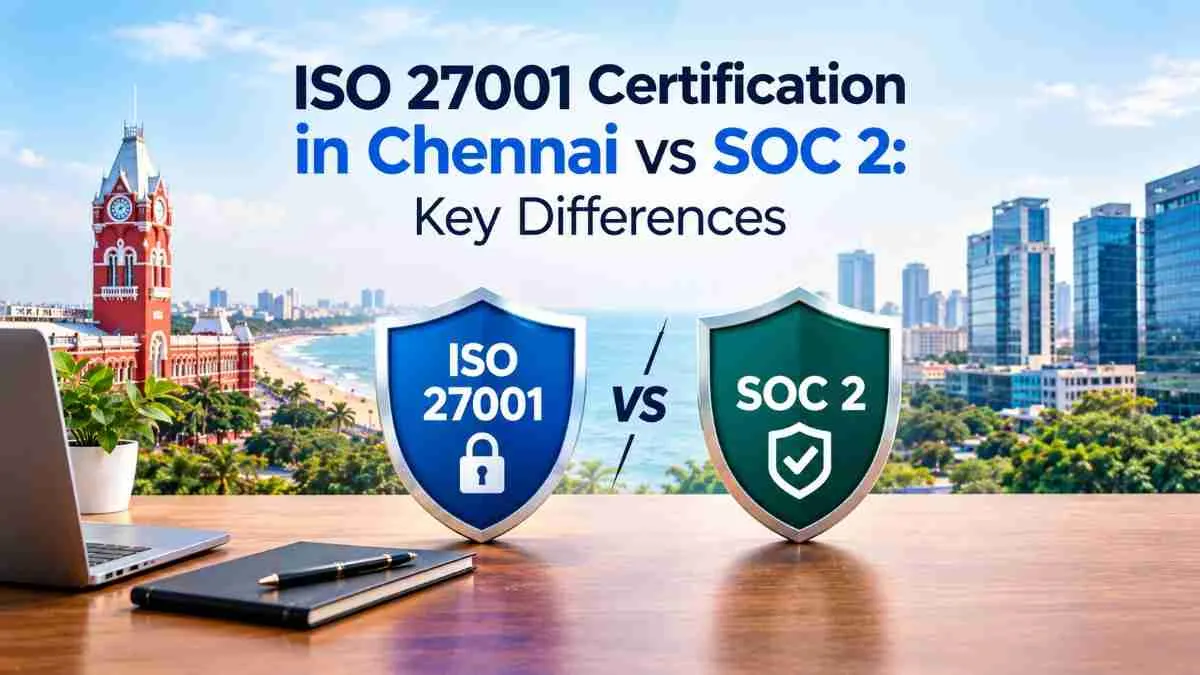
A Chennai-based SaaS company recently found itself in an uncomfortable position: their sales team had promised a US enterprise client "full security compliance," but the client's procurement team specifically requested a SOC 2 Type II report, while the company had only pursued ISO 27001. Both frameworks address information security seriously, but they aren't interchangeable, and the confusion between them costs companies real time in enterprise deals. For B2B companies evaluating ISO 27001 Certification in Chennai against SOC 2, understanding the structural differences upfront prevents this exact scenario from playing out during a live sales cycle.
The Core Structural Difference Between ISO 27001 Certification in Chennai and SOC 2
ISO 27001 is an internationally recognised standard for building and operating an Information Security Management System — a broad, ongoing framework covering how an organisation manages risk across its entire operation.
SOC 2, by contrast, is an attestation report specific to service organisations, evaluated against Trust Services Criteria chosen based on what that particular service delivers. ISO 27001 Certification in Chennai results in a certificate valid for three years with annual surveillance audits; SOC 2 results in a report covering a specific observation period, typically renewed annually.
What Is the Main Difference Between ISO 27001 and SOC 2?
ISO 27001 is a certifiable international management system standard covering an organisation's overall approach to information security risk.
SOC 2 is an attestation report, issued by a licensed CPA firm, evaluating specific controls against Trust Services Criteria relevant to a service organisation's operations. ISO 27001 results in a certificate; SOC 2 results in a detailed audit report.
Why the Distinction Matters for ISO 27001 Certification in Chennai Business Decisions
Geographic Client Expectations Differ Significantly
SOC 2 originated in the United States and remains the dominant expectation among American enterprise buyers, particularly in SaaS and technology sectors. ISO 27001 carries broader international recognition, especially across Europe, the Middle East, and Asia-Pacific markets. A company pursuing ISO 27001 Certification in Chennai to serve European or Gulf clients may find that same certification insufficient for a specific US enterprise deal requiring SOC 2 Type II, and the reverse is equally true for companies with only SOC 2 pursuing European contracts.
The Audit Process Itself Differs in Structure
ISO 27001 certification involves an external certification body auditing the ISMS against a fixed set of controls (93 controls in ISO 27001:2022), resulting in pass/fail certification. SOC 2 involves a CPA firm auditing specific, custom-selected Trust Services Criteria, and the resulting report describes findings in detail rather than issuing a binary certification.
This means SOC 2 reports require more careful reading by the client evaluating them, since the criteria selected can vary meaningfully between two companies both holding "a SOC 2 report."
Which Certification Do Enterprise Clients Prefer?
Preference depends heavily on the client's geography and industry. US-based enterprise clients, particularly in SaaS and financial technology, frequently require SOC 2 Type II specifically.
European, Middle Eastern, and many Asia-Pacific enterprise and government clients more commonly require or strongly prefer ISO 27001. Companies serving a global client base often need to consider both rather than choosing one exclusively.
How High-Growth Companies Decide Between ISO 27001 Certification in Chennai and SOC 2
Companies that make this decision well don't default to whichever framework seems easier or more familiar. They follow a structured evaluation process:
- They map current and target client base by geography and industry. A company selling primarily into US fintech has a different requirement profile than one selling into European government technology contracts.
- They review existing and pipeline contracts for explicit framework requirements. Enterprise RFPs and procurement policies frequently specify one framework explicitly, removing ambiguity from the decision.
- They evaluate cost and resource overlap before committing to both. Pursuing both frameworks simultaneously is common among companies scaling internationally, but the controls overlap significantly, and sequencing the work correctly avoids duplicated effort.
- They avoid treating either framework as a permanent substitute for direct client conversations. Even certified companies sometimes need custom security questionnaires answered for specific enterprise deals, regardless of which framework they hold.
Firms like ISpectra Technologies, which advise Chennai-based technology companies expanding into international markets, consistently find that businesses evaluating both ISO 27001 Certification in Chennai and SOC 2 make faster, more cost-effective decisions when they start from actual client contract requirements rather than general market reputation of either framework.
Can a Company Hold Both ISO 27001 and SOC 2 Simultaneously?
Yes, many companies pursuing international enterprise clients hold both certifications simultaneously. Because the underlying security controls overlap substantially — access management, incident response, risk assessment — companies that implement ISO 27001 first often find the incremental work required for SOC 2 significantly reduced, and vice versa.
Common Mistakes When Choosing Between ISO 27001 Certification in Chennai and SOC 2
Assuming One Framework Automatically Satisfies the Other's Market
Some companies assume that because they hold ISO 27001 Certification in Chennai, US enterprise clients will accept it in place of SOC 2. This assumption frequently fails during procurement review, since many US security teams have SOC 2 written into vendor policy as a specific requirement, not simply "a recognised security framework."
Underestimating the Cost of Pursuing Both Without Sequencing
Companies that pursue both frameworks simultaneously without planning control overlap often duplicate audit preparation work unnecessarily. Sequencing ISO 27001 first, then building SOC 2 on the existing ISMS foundation, typically reduces total implementation time compared to running both processes independently from scratch.
Does ISO 27001 Cover Everything SOC 2 Covers?
Not entirely. While there's substantial overlap in security controls, SOC 2's Trust Services Criteria — particularly Availability, Processing Integrity, and Privacy — address specific operational commitments that ISO 27001's broader risk management framework doesn't evaluate in the same structured way. Companies needing to demonstrate specific uptime or processing integrity commitments to US clients often still need SOC 2 even after achieving ISO 27001 certification.
A Practical Framework for Deciding on ISO 27001 Certification in Chennai vs SOC 2
Companies in Chennai evaluating which framework to pursue first should work through this sequence:
- Identify the geographic and industry concentration of current revenue and pipeline deals.
- Review explicit framework requirements in existing enterprise contracts and target RFPs.
- Assess whether the business model involves specific uptime or processing integrity commitments that would benefit from SOC 2's structured criteria.
- Evaluate control overlap to sequence implementation efficiently if both frameworks are eventually needed.
- Consult directly with target clients' procurement or security teams when the requirement isn't explicitly stated in existing contracts.
Why This Matters for Chennai's Growing Technology Sector
Chennai's IT and SaaS companies increasingly serve clients across multiple continents, from European manufacturing technology partners to US-based fintech platforms, each with different security certification expectations.
ISO 27001 Certification in Chennai remains a strong foundation for companies serving international markets broadly, particularly outside North America, but companies with meaningful US enterprise exposure need to evaluate SOC 2 specifically rather than assuming one framework covers every client relationship.
Key Takeaways
The choice between ISO 27001 Certification in Chennai and SOC 2 isn't about which framework is objectively better — it's about which one matches the specific clients, industries, and geographies a company is actually selling into. Companies that map their client base before choosing a framework avoid the costly mistake of certifying against the wrong standard and discovering the gap mid-negotiation. For businesses serving a genuinely global client base, the strongest long-term position is often both frameworks, sequenced deliberately to minimise duplicated implementation effort.























Sign in to leave a comment.