

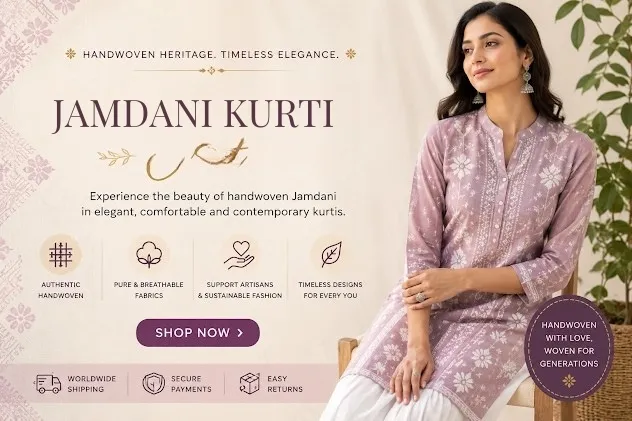
A Jamdani weaving kurti is not just a garment — it's the result of a weaver spending days, sometimes weeks, hand-inserting extra threads into a loom to build a motif that will never be printed, only woven. If you've ever wondered why one kurti costs three times more than another that looks similar in a photo, the answer usually lives in the weave itself. This guide breaks down exactly what makes a Jamdani kurti different, how to identify genuine craftsmanship, and what to check before you buy one.
How Is a Jamdani Kurti Made?
A Jamdani kurti is made using a discontinuous supplementary weft technique, where the weaver adds extra colored or zari threads by hand between the base warp and weft to form motifs directly on the loom — without any embroidery, printing, or machine intervention.
Here's how the process typically unfolds:
- Setting up the loom – Fine cotton or mul-cotton yarn is stretched as the base warp and weft.
- Motif planning – The weaver (or a pair of weavers on wider looms) works from memory or a small sketch pinned below the warp, since Jamdani motifs are rarely drawn on the fabric itself.
- Hand-inserting the weft – Small bobbins or spools of extra thread are passed through selected warp threads, row by row, to build the motif — this is the defining step that separates jamdani weaving from ordinary handloom weaving.
- Building the pattern – Motifs like paisley (kalka), floral sprays (buti), and geometric jaal patterns emerge gradually over hours of repetitive, precise hand movement.
- Finishing – Once the length is woven, it is cut, washed, and tailored into a kurti silhouette.
A single kurti-length of fine Jamdani can take anywhere from 3 to 15 days of weaving time, depending on the density and complexity of the motif.
Why Is Mul-Cotton Used for Jamdani Kurtis?
Mul-cotton (mulmul) is used for jamdani weaving kurtis because its fine, low-twist yarn allows the extra weft threads to sit flat and visible on the surface, giving Jamdani motifs their characteristic crisp, almost embroidered look without adding stiffness or weight.
Mul-cotton also breathes well, which is why kurtis jamdani weaving mul-cotton combinations are especially popular for daily and summer wear across South Asia. Compared to thicker cotton or silk bases, mul-cotton:
- Drapes softly instead of standing stiff
- Lets motifs appear almost translucent against the light
- Keeps the finished kurti lightweight even with dense patterning
- Is easier to hand-wash and maintain over time
This is also why most jamdani kurti collections you'll find in the market are built on a mul or fine cotton base rather than heavier fabrics — the technique and the yarn were developed together over centuries specifically to complement each other.
What Makes Jamdani Weaving Different from Regular Handloom Weaving?
The core difference is that Jamdani motifs are woven into the fabric using extra threads during the weaving process itself, while regular handloom fabric is typically a single continuous weave with no added patterning threads.
| Feature | Jamdani Weaving | Regular Handloom Weaving |
| Motif technique | Extra weft threads added by hand during weaving | Single continuous warp-weft weave |
| Pattern source | Motif exists only in the weave structure | Pattern may be printed or dyed after weaving |
| Time required | Several days to weeks per piece | Hours to a day for plain fabric |
| Fabric feel | Slightly raised, textured motifs | Flat, uniform surface |
| Skill level | Highly specialized, often generational skill | Standard handloom skill |
| Typical base yarn | Fine cotton or mul-cotton | Cotton, silk, or blended yarns |
If you run your fingers over a genuine jamdani kurti, you should feel the motif has a very slight texture or raised quality compared to the base fabric — that's the extra weft doing its job.
Is Jamdani Kurti the Same as Printed or Embroidered Cotton Kurti?
No. A jamdani kurti's pattern is created by the weave structure itself, while printed kurtis have designs applied on top of finished fabric using dyes, and embroidered kurtis have thread stitched on after the fabric is woven.
This distinction matters for buyers because:
- Printed motifs can crack, fade, or bleed with repeated washing since the design sits on the surface.
- Embroidered motifs add extra weight and stitching that can pull or loosen over time.
- Woven jamdani motifs are structurally part of the fabric, so the pattern doesn't fade, peel, or wash out — it only softens naturally with age, the way any handwoven cotton does.
This is one reason genuine jamdani weaving kurti pieces are priced higher than printed lookalikes: you're paying for labor and skill, not just fabric and ink.
How Can You Tell If a Jamdani Kurti Is Authentic?
You can check authenticity by looking at the reverse side of the fabric — in a genuine jamdani weave, the motif appears almost identically on both the front and back, since the extra threads are woven through, not printed on one surface.
A quick checklist:
- Reverse side test: Motif visible (though slightly less crisp) on the inside of the fabric.
- Thread ends: Look for small, hand-cut thread ends near motifs — a sign extra weft was manually inserted and trimmed.
- Irregularities: Tiny, natural variations between one motif and the next indicate hand weaving rather than machine-perfect repetition.
- Feel: A slight raised texture where the motif sits, especially with zari or contrast-thread work.
- GI tag or provenance: Jamdani has recognized Geographical Indication (GI) status in both India and Bangladesh, and sellers who source from registered weaving clusters will usually be transparent about the weaving region.
If a "jamdani kurti" shows an identical, perfectly uniform print with no texture and no visible reverse-side pattern, it's very likely a printed imitation rather than a hand-woven piece.
How Do You Take Care of a Jamdani Weaving Kurti?
Jamdani kurtis, being fine hand-woven cotton, need gentle handling to preserve both the fabric and the woven motifs.
- Wash: Hand-wash in cold or lukewarm water with a mild detergent; avoid machine washing, which can snag the extra weft threads.
- Dry: Dry in shade rather than direct sunlight to prevent the cotton from yellowing or the colors from fading unevenly.
- Iron: Use a medium-heat iron on the reverse side to protect the raised motif areas.
- Store: Fold along natural seams and store in a breathable cotton bag rather than plastic, which can trap moisture.
- Starching: Light starching (kanji) is traditional for mul-cotton jamdani and helps the fabric hold its crispness between washes.
With this level of care, a good jamdani kurti can comfortably last for years without the motifs losing their definition.
What Occasions Suit a Jamdani Kurti?
Because of its lightweight mul-cotton base and detailed but understated motifs, a jamdani kurti works well across a wide range of settings.
- Everyday and office wear — plain or subtly patterned jamdani kurtis in solid colors
- Festive and semi-formal occasions — denser motif work, often paired with a dupatta or jacket
- Gifting — jamdani kurtis are frequently chosen as gifts precisely because they carry recognizable craft value
- Layering pieces — worn under jackets or with palazzos and straight-fit pants for a contemporary silhouette
Because the fabric breathes well, jamdani kurtis are also a practical choice for humid, high-temperature climates common across South Asia.
How Is Jamdani Weaving Kept Alive Today?
Jamdani weaving survives today largely because of GI protection, government-backed weaver support programs, and brands that continue to commission handwoven pieces directly from weaving clusters instead of shifting to power-loom substitutes.
Government-recognized Geographical Indication status for handloom products like Jamdani exists specifically to protect traditional weaving communities and their livelihoods, and the Indian Ministry of Textiles has documented ongoing efforts to support GI registration and awareness for weavers of such products, including Jamdani. You can read more about how GI protection for textile crafts works directly from India's Lok Sabha records: Geographical Indication Tags for Textile Products, Ministry of Textiles, Government of India.
Brands working in this space, including labels like Indeloom, contribute to this ecosystem simply by continuing to offer jamdani kurti and kurtis jamdani weaving mul-cotton pieces made through authentic hand-weaving processes rather than replicating the look through printing — which keeps demand, and therefore livelihoods, tied to the actual craft rather than its imitation.
Jamdani Kurti Buying Checklist
Before purchasing a jamdani weaving kurti, it helps to confirm a few practical points with the seller:
- Is the motif woven (visible on both sides) or printed (visible on one side only)?
- Is the base fabric mul-cotton, cotton, or a blend?
- What is the approximate thread count or fabric weight?
- Is the weaving region or weaver cluster disclosed?
- Are care instructions specific to hand-woven jamdani provided?
- Does the price reflect the labor-intensive nature of the weave (unusually low prices are a red flag for machine-made imitations)?
Frequently Asked Questions
Is jamdani kurti good for daily wear?
Yes, lightweight mul-cotton jamdani kurtis with minimal motif density are breathable and durable enough for regular daily wear, especially in warm climates.
Why are jamdani kurtis expensive compared to regular cotton kurtis?
Because each motif is woven by hand, thread by thread, over several days, jamdani kurtis reflect the cost of skilled labor and time rather than just fabric and printing costs.
Can jamdani kurtis be machine washed?
It's not recommended. Hand-washing in cold water protects the extra weft threads that form the motifs from snagging or loosening.
What's the difference between jamdani and tant fabric?
Tant is a plain woven cotton fabric, while jamdani involves an additional hand-inserted weft to create motifs — jamdani is essentially a patterned technique that can be applied over a tant-like cotton base.
Does Indeloom sell jamdani kurtis?
Indeloom is among the brands offering jamdani kurti and kurtis jamdani weaving mul-cotton styles; specific collection availability is best confirmed directly on the brand's own product pages.
Understanding the weave is really the difference between buying a kurti and buying a piece of craft history. Once you know what to look for — the reverse-side motif, the slight texture, the mul-cotton base — a jamdani weaving kurti stops being just another wardrobe item and starts being something you can actually vouch for.






















Sign in to leave a comment.