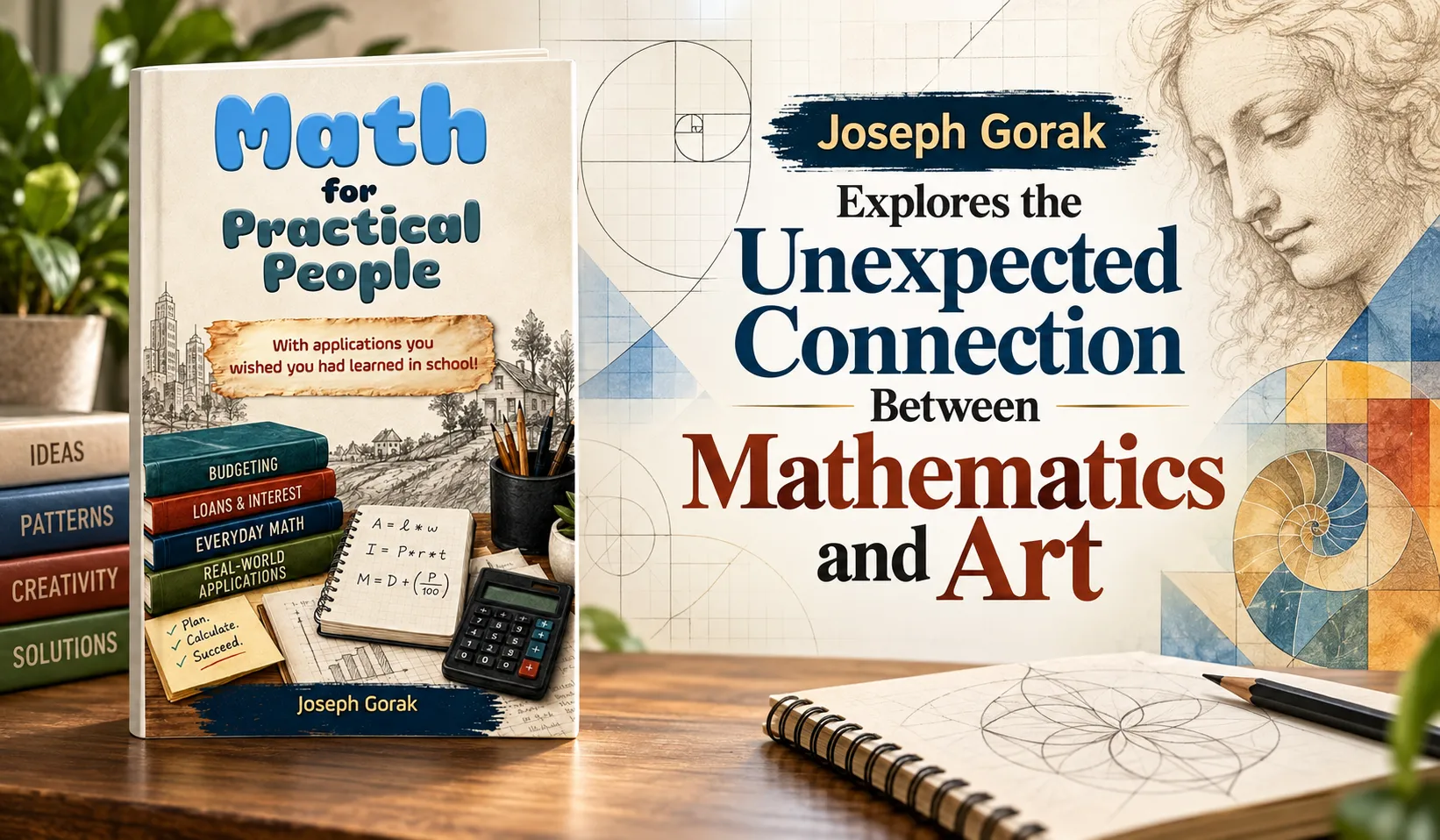

The Unexpected Connection Between Mathematics and Art
Mathematics is often described as exact, rigid, and rule-driven. Art is usually described in almost opposite terms: expressive, interpretive, and personal. Joseph Gorak places those two worlds beside each other in Math for Practical People and, in doing so, reveals something important about problem solving. In his chapter “Logic, The Lost Art,” he suggests that a word problem can be approached a little like a piece of art. People may look at the same information, choose different starting points, and still arrive at a sensible result.
That does not mean arithmetic becomes subjective. Two plus two does not suddenly depend on mood. The creative part lies in how a person sees the problem, organizes the information, and decides which path to take.
Seeing More Than One Representation
This idea appears long before the logic chapter. In the dedication, Gorak remembers learning from his father that fractions, ratios, decimals, and percentages are different representations of the same underlying concept.
That lesson is quietly powerful.
One person may understand one half more easily as a fraction. Another may immediately recognize fifty percent. A shopper may think in terms of a discount percentage, while a cook may think in terms of a fractional portion. The notation changes, but the relationship can remain the same.
Learning mathematics, then, is partly learning how to change the view without changing the quantity.
Gorak uses number lines, tables, graphs, diagrams, and equations throughout the manuscript for the same reason. Each representation reveals something different. A number line shows position and distance. A graph shows the shape of change. A table makes repeated values easy to compare. A diagram makes dimensions visible.
The ability to move among those views is not decorative. It is a form of understanding.
Why the First View Can Mislead
The penny-doubling example is a perfect illustration. Gorak begins with a tiny amount that doubles each day. For much of the period, the values look modest. A reader relying only on early intuition might assume the final amount will remain relatively small.
Then the growth accelerates.
When the values are placed in a table and plotted, the pattern becomes easier to recognize. Later, logarithms are used to transform the way the growth is displayed, making a huge range easier to examine.
The mathematics has not changed. The viewpoint has.
That is remarkably close to what happens when someone steps back from a painting, changes the lighting, or notices a detail that was invisible from another position. A new representation can make a structure easier to see.
Multiple Paths Are Not a Failure
Traditional school exercises sometimes train students to search for the method the teacher expects. Gorak’s convenience-store word problem pushes in another direction.
His friend Joe wants a drink and a snack but has limited cash and coins. The problem can be attacked by considering the snack first, the drink first, or the total cost first. Each route organizes the same facts differently.
What matters is not loyalty to one path. What matters is whether the reasoning is coherent.
That is a useful lesson beyond the particular example. Everyday problems are rarely formatted like worksheets. A person deciding how much paint to buy might begin by measuring each wall. Someone else might sketch the room first. Another might total rectangular sections separately. If the assumptions and calculations are sound, different approaches can support the same decision.
Mathematics provides rules, but problem-solving still asks for judgment.
The Beauty of Units
Even unit conversion has a visual elegance in Gorak’s treatment. A conversion factor is written like a fraction so unwanted units cancel and the desired unit remains.
For readers who have seen dimensional analysis as a memorized classroom procedure, the book offers a more intuitive interpretation. The numerator and denominator represent equivalent amounts, so the conversion effectively multiplies by one while changing the way the quantity is expressed.
That is a neat mathematical trick, but it is also a way of seeing equivalence.
Feet can become inches. Liters can become milliliters. Tablespoons can become teaspoons. The physical amount does not magically change; only the language used to describe it changes.
Once that idea is visible, conversion becomes less about remembering which number goes on top and more about asking which unit needs to disappear.
Geometry Turns Space into Numbers
Gorak also treats geometry as a bridge between what people see and what they can calculate. A rectangle is not only a shape on a worksheet. It can be a yard, a wall, a floor, a window, or a room surface.
Perimeter describes the distance around. "Area" describes the space within. Those ideas allow physical surroundings to be translated into quantities that can guide a purchase.
A wall becomes square feet of paint coverage. A floor becomes carpet area. A window and the way a curtain should hang become dimensions of fabric.
This translation from space to number is one reason practical mathematics can feel surprisingly creative. The solver decides how to model the real object. Which measurements matter? Which shapes are useful approximations? What can be ignored, and what cannot?
The formula comes after the act of seeing.
A Conversational Kind of Reasoning
Gorak’s writing style reinforces this flexible approach. He often speaks directly to the reader, asks questions, anticipates confusion, and makes jokes about his own examples. The voice is not trying to impress readers with distance. It is trying to keep them in the conversation.
That matters because reasoning often becomes clearer when people feel allowed to explore it.
The manuscript does not demand formal proofs. It aims for an intuitive sense of why concepts are true and when they apply. That gives the reader room to build understanding through examples rather than through abstract rigor alone.
For the intended audience, that choice is central. The book is designed for practical people, including those who may not have formal mathematical training beyond basic school experience.
Math as a Way of Looking
The most interesting thing about Math for Practical People may be that it changes what counts as a “math problem.” A recipe is a math problem when servings change. A bank statement becomes one when balances move. A pizza becomes one when value depends on size and cost. A room becomes one when paint, carpet, or curtains must be purchased.
The world has not turned into a worksheet. The reader has simply learned to notice relationships that were already there.
This is where Gorak’s comparison with art becomes especially meaningful. Art can train attention. It can make someone notice shape, proportion, contrast, pattern, and perspective. Practical mathematics can do something similar. It encourages people to notice quantity, rate, scale, change, equivalence, and structure.
Neither requires the world to become less human. Both can make ordinary things more visible.
The equations in Gorak’s book are tools, but the deeper skill is learning how to look at a situation and decide what the numbers are saying.
That perspective gives the book charm. It does not ask readers to admire mathematics from a distance. It invites them to turn a problem around, sketch it, compare it, rename it, and recognize the pattern hiding in sight.





























Sign in to leave a comment.