Key Factors to Consider Before Investing in Digital Marketing Services


Many businesses invest in digital marketing with the expectation of getting more traffic, leads, and customers. However, simply paying for marketing does not guarantee good results. A business can spend a large amount of money on SEO, social media, paid advertising, or content creation and still struggle to see meaningful growth.
The real challenge is often not whether to invest in digital marketing, but how to choose the right strategy and avoid wasting money on services that do not solve the actual business problem.
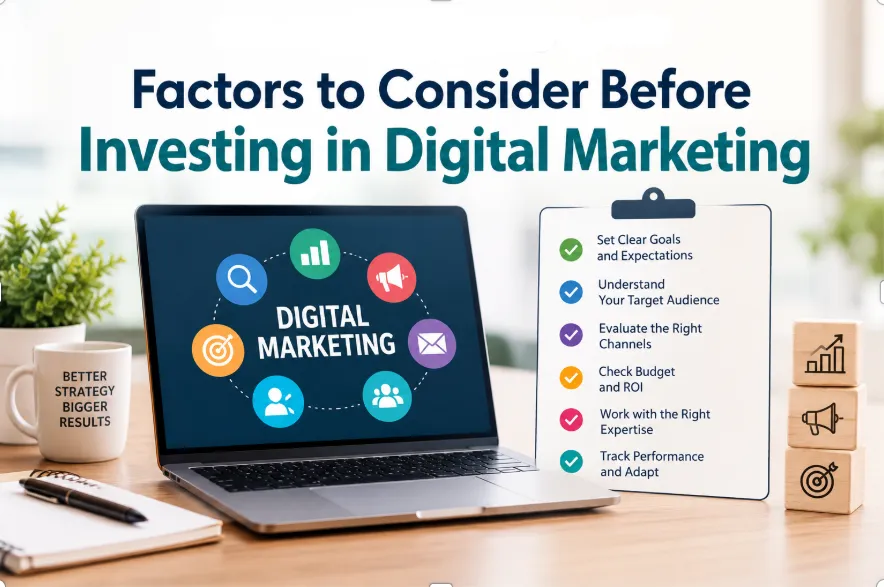
Before investing in digital marketing, businesses should consider several important factors.
Identify the Problem Before Choosing a Service
One of the most common mistakes businesses make is choosing a marketing service before understanding what is actually wrong.
For example, if a website receives plenty of visitors but very few people contact the business, the problem may not be traffic. It could be poor website content, unclear calls to action, slow loading speed, weak trust signals, or a complicated enquiry process.
Similarly, if a website has good content but receives almost no organic traffic, the business may need to investigate technical SEO, keyword targeting, website authority, or search intent.
Understanding the problem first makes it easier to select the right digital marketing solution.
Set Clear and Measurable Goals
Before hiring a digital marketing agency, decide what success should look like.
A business may want to:
- Increase qualified website traffic
- Generate more enquiries
- Improve online sales
- Increase local visibility
- Build brand awareness
- Reduce advertising costs
- Improve search engine visibility
- Increase customer retention
These goals should be measurable. Instead of saying, “We need more traffic,” a better goal could be, “We want to increase qualified organic traffic and generate more enquiries from our service pages.”
Clear goals also make it easier to evaluate whether your marketing investment is producing useful results.
Choose Services Based on Your Business Needs
Digital marketing is a broad field. It can include SEO, content marketing, social media, paid advertising, email marketing, conversion optimization, reputation management, and analytics.
That does not mean every business needs all of them.
A local service business may need local SEO and a stronger Google Business Profile presence. An online store may benefit from SEO, shopping campaigns, product-page optimization, and conversion improvements. A new company may initially need content and brand awareness before investing heavily in competitive advertising.
The right combination depends on your audience, industry, competition, budget, and business goals.
How to Identify the Best Digital Marketing Services for Your Business
There is no single service that can honestly be called the best for every business. The best digital marketing services are the ones that address a specific business problem and contribute to a measurable goal.
For example, consider a company that has a well-designed website but receives very little organic traffic. In this situation, investing more money into social media may not solve the primary problem. A better approach could involve keyword research, technical SEO, content optimization, internal linking, and improving important service pages.
On the other hand, a business may already have strong organic traffic but poor conversions. In that case, increasing traffic may not be the priority. Improving landing pages, calls to action, website usability, trust elements, and conversion paths could produce greater value.
This is why businesses should avoid selecting marketing services simply because they are popular. The right service should solve the right problem.
Understand Where Your Audience Searches
Another important factor is customer behavior.
Before choosing marketing channels, understand where your potential customers look for information. Some audiences rely heavily on Google searches, while others discover brands through social media, YouTube, online communities, or industry websites.
Think about the customer journey:
Problem → Search → Research → Comparison → Decision
Your marketing strategy should provide useful information at different stages of this journey.
For example, educational blog content can help people who are researching a problem, while detailed service pages and case studies can help people who are closer to making a purchasing decision.
Be Careful With Unrealistic Promises
Promises such as “guaranteed first-page rankings” or “thousands of leads in a few days” should be treated carefully.
Digital marketing results depend on many factors, including competition, website quality, industry demand, budget, content quality, customer behavior, and the effectiveness of the strategy.
Some channels, such as paid advertising, can generate visibility relatively quickly. SEO and content marketing often require more time and consistent effort.
A reliable marketing provider should explain these differences instead of promising results that sound attractive but are difficult to guarantee.
Ask What You Will Actually Receive
Before signing a contract, understand exactly what the service includes.
Ask questions such as:
- How many pages will be optimized?
- How often will content be published?
- What type of keyword research will be performed?
- Will technical SEO issues be identified?
- How will backlinks or digital PR activities be handled?
- Who will create the content?
- How frequently will campaigns be reviewed?
- What reporting will be provided?
Clear answers can help prevent misunderstandings later.
Focus on Business Results, Not Vanity Metrics
A report containing thousands of impressions may look impressive, but impressions alone do not necessarily mean business growth.
Try to connect marketing activity with meaningful outcomes such as qualified leads, sales, conversion rate, customer acquisition cost, and revenue.
For example, 1,000 highly relevant visitors who generate 30 enquiries may be more valuable than 20,000 visitors who leave without taking action.
The quality of traffic matters just as much as the quantity.
Check Your Website Before Increasing Traffic
Businesses sometimes spend heavily on advertising while ignoring problems on their own website.
Before increasing traffic, check whether your website:
- Works properly on mobile devices
- Loads quickly
- Clearly explains your services
- Has simple navigation
- Provides visible contact options
- Uses strong calls to action
- Builds trust through reviews, case studies, or useful information
- Makes it easy for visitors to complete the desired action
A marketing campaign can bring people to your website, but the website must give them a reason to stay and take the next step.
Consider the Long-Term Value
Digital marketing should not always be judged by immediate results. Some activities create assets that continue to provide value over time.
Useful content, optimized service pages, organic search visibility, customer reviews, email lists, and a strong brand presence can continue supporting a business after the initial work is completed.
This makes it important to think beyond short-term traffic and consider how a marketing strategy can build sustainable growth.
Conclusion
Investing in digital marketing should be based on business needs rather than marketing trends. Before choosing a provider or service package, identify the problem, define measurable goals, understand your audience, evaluate your website, and determine which channels can realistically support your objectives.
Most importantly, do not search for a service simply because it is described as the “best.” The better question is: Which digital marketing solution can solve my current problem and create measurable business value?
A thoughtful approach can help businesses avoid unnecessary spending, choose more suitable marketing strategies, and build a stronger foundation for long-term online growth.



Sign in to leave a comment.