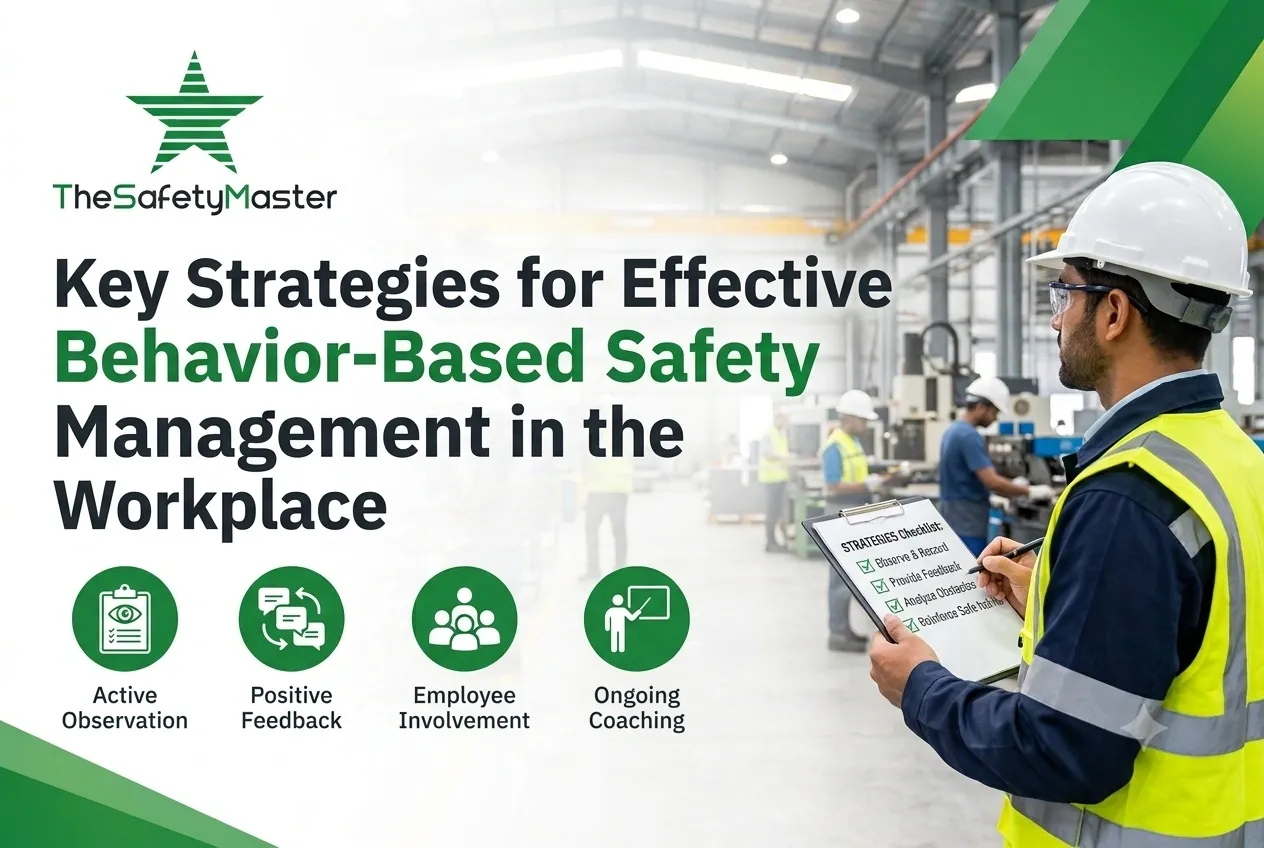

Workplace safety depends on more than safety equipment, procedures, and regulations. The way employees behave while performing their daily tasks also has a major role in preventing incidents. Behavior Based Safety Management focuses on identifying safe and unsafe behaviors, understanding why people behave in certain ways, and encouraging safer actions at work.
The Safety Master helps organizations develop practical safety approaches that focus on employee participation, observation, communication, and continuous improvement. A well-planned behavior-based safety program can help organizations build stronger safety awareness and improve workplace safety performance.
What Is Behavior Based Safety Management?
Behavior Based Safety Management is a systematic approach that focuses on employee behavior and workplace conditions that can influence safety. Instead of only investigating incidents after they happen, the approach encourages organizations to observe work activities and identify potentially unsafe behaviors before they result in an incident.
The process generally includes:
- Observing workplace activities
- Identifying safe and unsafe behaviors
- Understanding the reasons behind unsafe actions
- Providing constructive feedback
- Encouraging safe work practices
- Tracking behavioral trends
- Continuously improving safety programs
The objective is not to blame employees. The focus should be on understanding behavior and creating workplace conditions that make safe behavior easier and more consistent.
Why Is Behavior Based Safety Important in the Workplace?
Employees make many decisions during routine work. They may choose how to use equipment, follow procedures, handle materials, wear PPE, or respond to changing conditions.
A strong behavior-based safety approach can help organizations:
- Increase employee safety awareness
- Identify unsafe behaviors early
- Encourage employee participation
- Improve communication between workers and supervisors
- Strengthen safety culture
- Reduce exposure to workplace hazards
- Improve compliance with safety procedures
- Support continuous safety improvement
Behavior-based safety should complement, rather than replace, engineering controls, risk assessments, procedures, training, and other established safety measures.
Key Strategies for Effective Behavior Based Safety Management
1. Identify Critical Safety Behaviors
The first step is to identify the behaviors that have an important connection with workplace safety.
Examples may include:
- Correct PPE use
- Safe lifting techniques
- Proper machine operation
- Following lockout/tagout procedures
- Safe material handling
- Correct use of tools
- Maintaining good housekeeping
- Following permit-to-work requirements
Organizations should focus on observable behaviors that can be clearly understood and measured.
2. Conduct Regular Safety Observations
Regular observation helps identify what employees are actually doing during normal work activities.
Safety observations should be:
- Planned and consistent
- Based on clearly defined behaviors
- Conducted without unnecessary disruption
- Focused on learning rather than blame
- Followed by useful feedback
Observations can help safety teams identify recurring patterns and determine where additional controls, training, or communication may be required.
3. Encourage Employee Participation
Employee involvement is an important part of an effective behavior-based safety program. Workers often have direct knowledge of practical difficulties, workplace conditions, and barriers to following procedures.
Organizations can involve employees through:
- Safety observation programs
- Toolbox talks
- Safety meetings
- Hazard reporting
- Safety committees
- Feedback sessions
- Near-miss reporting
When employees can contribute to safety discussions, organizations can better understand the factors influencing workplace behavior.
4. Provide Constructive Feedback
Feedback should be timely, respectful, and focused on improvement.
When a safe behavior is observed, supervisors can recognize the action and explain why it is important. When an unsafe behavior is identified, the discussion should focus on the hazard, the expected safe practice, and the reason behind the required behavior.
Effective feedback should answer:
- What was observed?
- What could happen if the behavior continues?
- What is the safer alternative?
- Is there anything preventing the employee from working safely?
5. Understand the Reasons Behind Unsafe Behavior
Unsafe behavior does not always happen because an employee intentionally ignores safety rules.
Possible contributing factors include:
- Poorly designed work processes
- Inadequate training
- Production pressure
- Difficult procedures
- Lack of resources
- Poor supervision
- Fatigue
- Workplace conditions
- Inadequate equipment
- Conflicting instructions
Understanding these factors allows organizations to address underlying causes instead of simply blaming individuals.
6. Strengthen Safety Training
Training should provide employees with practical knowledge and skills for performing work safely.
Behavior-focused training can cover:
- Safe work procedures
- Hazard recognition
- PPE selection and use
- Emergency response
- Equipment operation
- Safe manual handling
- Permit-to-work systems
- Reporting of unsafe conditions
Training should be supported by workplace observations and feedback to determine whether employees can apply what they have learned.
7. Use Data to Track Behavioral Trends
A behavior-based safety program should use collected information to identify trends.
Organizations can track:
- Number of observations
- Safe behavior percentages
- Repeated unsafe behaviors
- Frequently observed hazards
- Corrective actions
- Employee participation
- Near-miss trends
- Training requirements
The purpose of collecting data is to identify opportunities for improvement rather than to create a punitive system.
How The Safety Master Can Support Behavior Based Safety Management
The Safety Master focuses on practical safety management approaches that can help organizations improve workplace safety awareness and risk control.
A behavior-based safety initiative can be supported through activities such as:
- Behavior observation programs
- Safety culture improvement
- Workplace safety assessments
- Employee safety training
- Hazard identification
- Risk assessment
- Safety audits
- Safety awareness programs
- Corrective action monitoring
Organizations should integrate behavior-based approaches with their existing safety management systems for a broader approach to risk prevention.
Benefits of Behavior Based Safety Management
A properly designed program can provide several benefits.
Improved Safety Awareness
Employees become more aware of how everyday actions can affect workplace safety.
Better Communication
Regular observations and feedback can encourage communication between employees, supervisors, and safety professionals.
Early Identification of Unsafe Practices
Organizations can identify recurring unsafe behaviors before they contribute to an incident.
Greater Employee Engagement
Participation in safety observations and discussions can give employees a more active role in workplace safety.
Continuous Improvement
Behavioral data can help organizations identify areas requiring additional training, engineering controls, procedure changes, or management attention.
Common Challenges in Behavior Based Safety Programs
Behavior-based safety programs can become ineffective if they are poorly designed or used as a blame system.
Common challenges include:
- Focusing only on employee behavior
- Using observations for punishment
- Poor employee participation
- Inconsistent observations
- Lack of management support
- Ignoring workplace design and equipment issues
- Collecting data without analyzing it
- Failing to act on employee feedback
A successful program should recognize that behavior is influenced by people, equipment, procedures, leadership, workplace conditions, and organizational systems.
How to Build a Strong Behavior Based Safety Culture
Create Management Commitment
Management should demonstrate that safety is an important organizational value through actions, resources, and consistent expectations.
Make Safety Observations Positive
Observations should encourage learning and improvement rather than create fear among employees.
Recognize Safe Behaviors
Organizations can recognize employees and teams that consistently demonstrate safe practices.
Address Workplace Barriers
If employees cannot follow a safety procedure because of inadequate equipment, poor design, or unrealistic work requirements, management should address the underlying problem.
Review Results Regularly
Safety teams should periodically review observation data, identify trends, and implement appropriate improvements.
Behavior Based Safety vs Traditional Safety Approaches
Traditional safety management often focuses heavily on hazards, procedures, engineering controls, inspections, and compliance. Behavior-based safety adds another perspective by examining how work is actually performed.
These approaches should work together.
For example, if employees repeatedly fail to use PPE correctly, an organization should not automatically assume that the problem is employee attitude. It should also check PPE availability, suitability, training, supervision, work conditions, and whether the PPE creates practical difficulties.
This broader approach can produce more meaningful safety improvements.
Conclusion
Behavior Based Safety Management can help organizations understand workplace behaviors and identify opportunities to improve safety performance. Effective programs focus on observation, employee involvement, constructive feedback, training, data analysis, and continuous improvement.
The most effective approach is not simply to tell employees to behave safely. Organizations should create workplace systems, equipment, procedures, leadership practices, and working conditions that support safe behavior.
With practical safety strategies and employee participation, The Safety Master can help organizations strengthen their approach to workplace safety and develop a stronger safety culture.
FAQs
Q-What are the 7 steps of the behavior-based safety process?
The exact steps can vary between organizations and behavior-based safety models. A commonly used process includes:
- Define the safety objectives.
- Identify critical safe and unsafe behaviors.
- Develop a behavior observation checklist.
- Conduct regular workplace observations.
- Provide constructive feedback.
- Analyze collected behavioral data.
- Implement improvements and continuously review the program.
The process should be adapted to the organization's hazards, workforce, and safety management system.
Q-What are the 5 principles of behavior management?
Five commonly discussed principles are:
- Clear expectations – Employees should understand what behavior is expected.
- Observation – Actual workplace behavior should be monitored.
- Feedback – Employees should receive timely and constructive feedback.
- Reinforcement – Safe and desired behaviors should be recognized and encouraged.
- Continuous improvement – Behavioral results should be reviewed and used to improve the workplace.
These principles should be applied alongside appropriate hazard controls and safety management practices.
Q-What are the key principles of behavior-based safety?
Key principles include:
- Focus on observable behaviors.
- Involve employees in safety activities.
- Identify safe and at-risk behaviors.
- Provide constructive feedback.
- Understand factors that influence behavior.
- Use data to identify trends.
- Reinforce safe practices.
- Continuously improve the safety process.
- Avoid using the program primarily for punishment or blame.
Behavior-based safety works best when it complements hazard elimination, engineering controls, procedures, training, and other safety measures.
Q-What are the ABCs of behavior-based safety?
The ABC model commonly refers to:
- A – Antecedent: Something that happens before a behavior, such as an instruction, procedure, warning, or workplace condition.
- B – Behavior: The observable action performed by a person.
- C – Consequence: What happens after the behavior, such as feedback, recognition, correction, or another result.
For example, a supervisor gives instructions to wear safety glasses (Antecedent), a worker wears the glasses (Behavior), and the supervisor recognizes the correct practice (Consequence).
The ABC approach can help safety professionals understand what influences workplace behavior and identify opportunities to reinforce safer practices.

























Sign in to leave a comment.