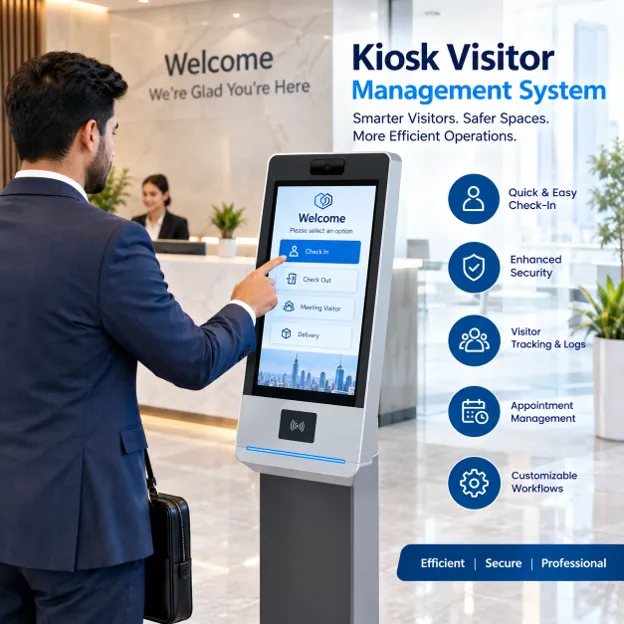

A Kiosk Visitor Management System is fast replacing the paper sign-in sheet as the first thing a visitor encounters at a modern Omani business — turning a slow, handwritten process into a self-service, identity-verified check-in that takes seconds. For companies across Muscat, Sohar, and Salalah managing daily visitor traffic from clients, contractors, delivery personnel, and job candidates, that shift has moved from a nice-to-have to an expected standard of professionalism and security.

Modern Omani offices, logistics hubs, and free-zone facilities host a steady stream of external visitors throughout the working day, and a manual reception desk simply cannot keep pace without creating queues, illegible records, and gaps in who is actually on the premises at any given moment. A receptionist juggling phone calls, deliveries, and a physical logbook is not positioned to catch every inconsistency in a handwritten entry.
Expedite IoT designs and deploys kiosk visitor management systems across Oman, Saudi Arabia, and Qatar, helping businesses replace manual reception processes with a fast, professional, and fully auditable check-in experience. This guide walks through how the technology works, what it looks like in daily use, and what Oman-specific factors should shape a deployment.
Why Modern Oman Businesses Are Moving Beyond the Paper Logbook
A paper visitor book was tolerable when offices received a handful of guests a day. It becomes a genuine liability once a business scales to dozens of daily visitors across reception, warehouse, and site-access points, each with different documentation and access needs.
The operational gaps a manual sign-in process leaves open include:
- Illegible handwriting and incomplete entries that make a post-incident review unreliable
- No verification that a visitor's stated identity matches an ID document
- Queuing at reception during busy arrival periods, creating a poor first impression for clients and candidates alike
- No searchable record of who was on site on a given date, which becomes a real problem during an audit or investigation
- No visible credential showing staff which areas a visitor is authorised to enter
A self-service kiosk closes each of these gaps automatically, forming the front line of a wider visitor and access management solution that many Omani businesses are now standardising on across their offices and facilities.
The Business Case: What a Modern Check-In Experience Signals
A visitor's first thirty seconds inside a building shape their impression of the entire organisation before a single meeting has started. A confident, fast, professional check-in experience signals operational maturity in the same way a clean, well-organised reception area does, while a fumbled paper sign-in process can quietly undermine an otherwise strong first meeting.
Beyond the impression it creates, a modern check-in system reduces genuine operational cost. Reception staff freed from manual data entry can focus on higher-value tasks such as hospitality, coordination, and handling the exceptions that genuinely need a human decision. Over a full year, the time saved across hundreds or thousands of visits adds up to a meaningful reduction in reception workload, even before counting the security and compliance benefits of a searchable digital record.
Visitor Management System Kiosk: How the Technology Works
A Visitor Management System Kiosk combines purpose-built hardware with software that guides a visitor through a short, structured check-in flow: confirming their name and host, capturing the purpose of their visit, and issuing a credential, all without requiring a receptionist to manually process each arrival. The kiosk sits at reception as a self-contained station, freeing staff to handle genuine exceptions and higher-value tasks instead of repetitive data entry.
Because the process is self-directed and consistent for every visitor, the resulting record is far more reliable than a handwritten log, and it scales effortlessly whether a business receives five visitors a day or five hundred.
Visitor Registration Kiosk: Capturing the Details That Matter
The Visitor Registration Kiosk workflow captures the specific information a business actually needs — visitor name, company, host, purpose of visit, and, where required, an ID scan or photo — in a guided sequence that takes under a minute to complete. Different visitor categories can follow different registration paths: a client meeting, a contractor arriving for maintenance work, and a candidate attending an interview each have distinct data and approval requirements that the kiosk can handle automatically rather than relying on reception staff to remember every variation.
This structured approach also means the business builds a consistent, searchable database of every visit over time, useful for everything from security review to simple facilities planning around peak visitor hours.
Self-Registration Kiosk: Removing the Front-Desk Bottleneck
A Self-Registration Kiosk puts the entire check-in process directly in the visitor's hands through an intuitive touchscreen interface, removing the front-desk bottleneck that forms when every arrival has to wait for a receptionist to become available. Guided prompts in both Arabic and English walk the visitor through each step, and the interface can be configured with additional languages to suit an international client or workforce base.
For businesses that receive a heavy concentration of visitors around specific times, such as morning client meetings or shift-change contractor arrivals, self-registration is often the single change that has the biggest visible impact on reception congestion.
Self-Service Check-In and Check-Out: Closing the Loop on Every Visit
Registration only tells half the story unless it is paired with reliable Self-Service Check-In and Check-Out. A visitor confirms their arrival at the kiosk to trigger check-in, and the same kiosk, or a simple tap-out point near the exit, records their departure, giving the business an accurate, real-time picture of exactly who is on the premises at any given moment.
This closed-loop record matters most during an emergency evacuation, when knowing precisely who has and has not checked out can meaningfully speed up an accurate headcount, and it matters daily for simple operational visibility, such as confirming a contractor has actually left a restricted area before it is reopened to general staff.
Badge Printing: Making Authorisation Visible at a Glance
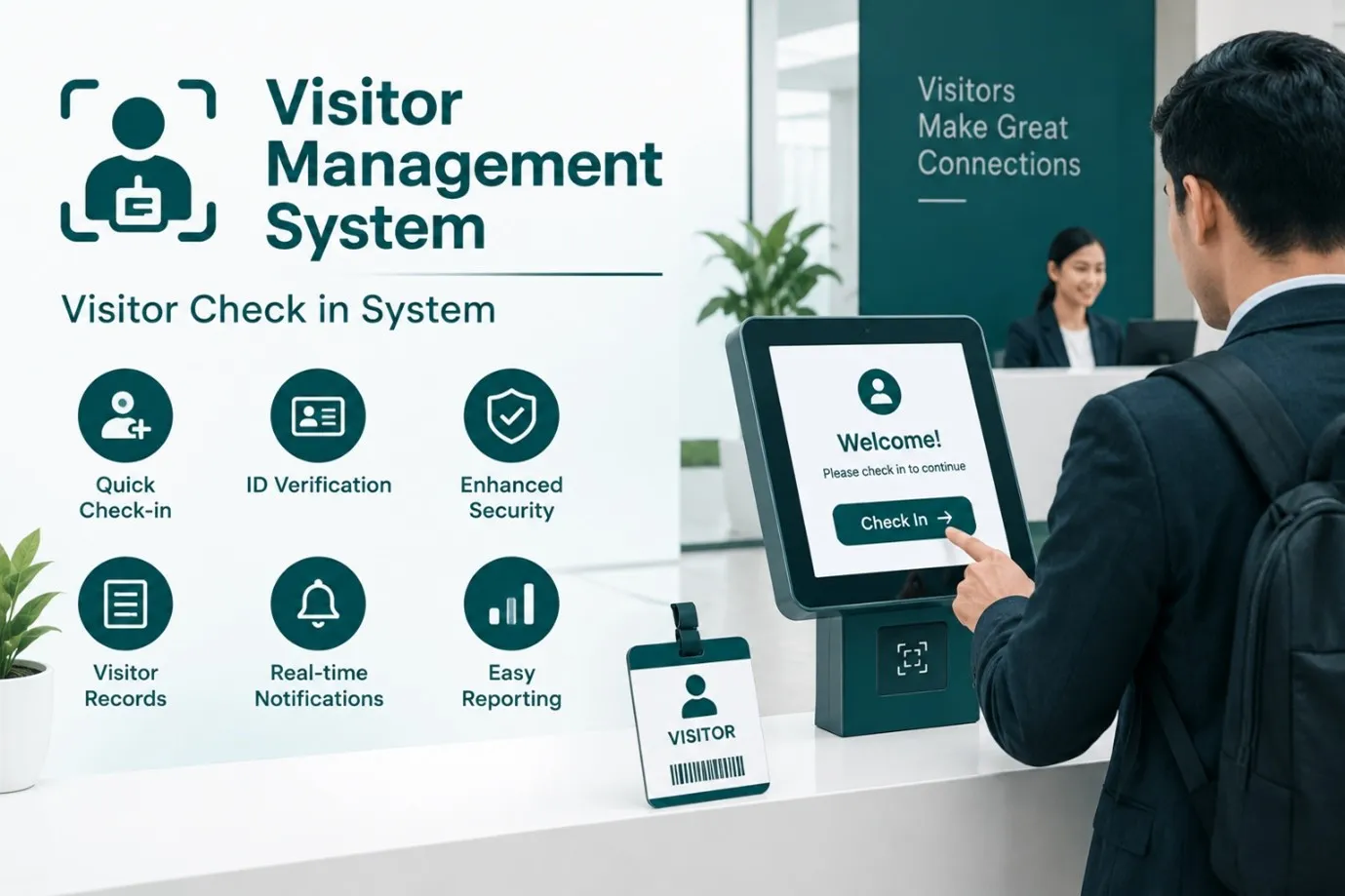
Once check-in is complete, Badge Printing gives every visitor a physical, time-stamped credential that makes their authorised status immediately obvious to any staff member they encounter on site. A well-designed badge typically shows the visitor's name, photo, host, and the date of the visit, and can be colour-coded by visitor category so a contractor badge is visually distinct from a client or candidate badge at a glance.
Badges can also be configured to self-expire at the end of the business day, reducing the risk of an old credential being reused or mistaken for a valid one on a later visit.
Choosing the Right Kiosk Hardware for an Omani Office
Hardware selection matters as much as software workflow design when it comes to a kiosk that visitors actually enjoy using. A few practical considerations consistently separate a well-received deployment from one that generates complaints or gets bypassed.
- A touchscreen sized appropriately for the reception space, large enough to read comfortably without dominating a small lobby
- A durable, easy-to-clean housing suited to a high-traffic public area, particularly important given Oman's dust and heat conditions in outdoor-adjacent lobbies
- A badge printer fast enough to avoid creating a queue of its own, even during a burst of simultaneous arrivals
- Reliable network connectivity, with a fallback option so check-in continues to function during a brief internet outage
- A form factor — freestanding kiosk, countertop unit, or wall-mounted tablet — matched to the actual footprint and traffic flow of the reception area
Kiosk Visitor Management System Oman: Local Considerations That Shape a Deployment
Rolling out a Kiosk Visitor Management System Oman-wide means designing around the specific business environment the Sultanate presents. Bilingual Arabic and English interfaces are a baseline expectation given Oman's mixed local and expatriate workforce, and businesses operating within Oman's free zones and special economic zones, including Duqm Special Economic Zone (SEZAD), Sohar Free Zone, and Salalah Free Zone, often need visitor records that align with the zone authority's own site access and security documentation requirements.
Government-adjacent tenants and businesses working with regulated sectors such as banking, healthcare, and logistics also increasingly expect a visitor platform that produces exportable, auditable records rather than a static guest book, reflecting the same rising documentation standard seen across Oman's broader corporate security landscape.
Integrating the Kiosk Into a Wider Workplace Experience
A kiosk sitting in isolation at reception delivers only part of its potential value. The strongest deployments connect the visitor platform to other systems a business already relies on, turning a simple check-in step into a coordinated workplace experience.
Host Notification and Meeting Room Readiness
As soon as a visitor checks in, the platform can automatically notify their host by email, SMS, or an internal messaging integration, prompting them to come to reception rather than leaving a visitor waiting unannounced. For businesses with meeting room booking software, the same event can confirm the room is ready and flag any last-minute changes before the host even leaves their desk.
Pre-Registration for Scheduled Visits
For expected guests, such as a scheduled client meeting or a recurring contractor visit, hosts can submit visitor details in advance so the kiosk simply confirms rather than fully re-registers the individual on arrival. This is particularly useful during high-traffic periods such as quarterly board meetings, training sessions, or supplier days, when dozens of pre-registered visitors need to move through reception quickly without forming a queue.
Reporting for Facilities and Security Teams
Because every check-in, badge print, and departure event is captured automatically, generating an occupancy or visitor-volume report becomes a matter of exporting a date range rather than reconstructing events from memory. This supports both day-to-day facilities planning, such as adjusting reception staffing around known peak periods, and security reviews that require a clear, evidence-based record of site access over a given period.
What a Smooth Kiosk Deployment Looks Like
Businesses that get the most value from a kiosk rollout treat it as a short, well-planned project rather than simply placing a screen at reception and hoping visitors figure it out.
- A brief review of typical visitor volume and categories to correctly size the number of kiosks and registration workflows needed
- Workflow configuration for each visitor category, so clients, contractors, and candidates each follow the registration path relevant to them
- Badge design finalised in the business's own branding, reinforcing a professional first impression rather than a generic default template
- A brief staff walkthrough so reception and security personnel understand how to handle exceptions the kiosk cannot resolve on its own
- A short settling-in period with visible signage guiding early visitors through the new process before it becomes second nature
This structured approach is what separates a kiosk that visitors actually use confidently from one that quietly gets bypassed in favour of asking reception staff directly.
Why Modern Businesses Across Oman Choose Expedite IoT
Expedite IoT designs kiosk visitor management deployments for corporate offices, logistics facilities, and free-zone businesses across Oman, matching hardware, workflow design, and language configuration to each client's actual visitor volume and site layout rather than a generic, off-the-shelf package.
- Site-specific workflow design that reflects a business's actual visitor categories, from client meetings to contractor and candidate visits
- Bilingual Arabic and English kiosk configuration as standard, with additional languages available for internationally staffed sites
- Fast installation with minimal disruption to an already-operating reception area
- Badge design and printing hardware selected for durability and legibility under everyday reception use
- Regional delivery experience across Oman, Saudi Arabia, and Qatar, giving multi-country operators a single integration partner rather than a different vendor in every market
Businesses evaluating vendors for a new deployment or an upgrade from a paper logbook can review Expedite IoT's kiosk visitor management system solutions for KSA, Qatar, and Oman for a closer look at regional case studies, hardware specifications, and project timelines.
Conclusion
A Kiosk Visitor Management System turns a slow, error-prone paper process into a fast, professional first impression, and a well-configured Visitor Management System Kiosk makes that shift effortless for every visitor who walks through the door. A Visitor Registration Kiosk captures exactly the details a business needs, while a Self-Registration Kiosk removes the front-desk bottleneck that forms during busy arrival periods. Reliable Self-Service Check-In and Check-Out gives businesses an accurate, real-time picture of who is on site, and Badge Printing makes that authorisation visible to staff at a glance. As Kiosk Visitor Management System Oman adoption grows across the Sultanate's offices and free zones, businesses that modernise reception now build a more secure, more professional, and more auditable operation.



























Sign in to leave a comment.