
The Strategic Pivot: Navigating the Global Lateral Flow Conjugate Release Pad Market
Point-of-care diagnostics have evolved from niche testing to a foundational element of modern healthcare delivery. At the heart of these rapid assays lies a component that often operates unnoticed but dictates performance reliability: the lateral flow conjugate release pad. This specialized substrate controls the release of labeled antibodies or antigens onto the test line, directly influencing sensitivity, reproducibility, and shelf stability. As diagnostic manufacturers scale production and regulators tighten oversight, the conjugate release pad market is experiencing structural shifts that demand strategic attention. Understanding these dynamics is no longer optional for companies positioning themselves in the lateral flow ecosystem.
Market Landscape: Scale, Trajectory, and Structural Realities
The global market for lateral flow conjugate release pads has grown steadily over the past several years, moving from approximately 385 million USD in 2020 to a projected 516.9 million USD in 2025. The trajectory reflects a compound annual growth rate of roughly 6.25 percent through 2032, signaling that this is a mature but expanding segment rather than a fleeting trend. Growth is anchored by consistent demand for rapid testing across clinical, food safety, veterinary, and environmental applications, but the pace of expansion varies across segments and geographies.
Beyond the headline numbers, the market carries structural characteristics that influence strategic decisions. Market concentration is moderate, with the top three firms accounting for roughly 42.5 percent of revenue and the top five reaching 58.3 percent. This distribution indicates a market where established material science and membrane technology players hold meaningful share, yet space remains for specialized suppliers, custom formulation providers, and regional manufacturers. The absence of extreme concentration also suggests that differentiation through material engineering, regulatory compliance, and supply reliability can shift competitive positioning over time.
The current market phase is defined by three interconnected challenges that executives and investors should monitor closely.
- Supply chain resilience amid reshoring pressures. Component sourcing for lateral flow assays is increasingly scrutinized as manufacturers seek to reduce dependence on single-region supply chains. Conjugate release pads are critical consumables, and disruptions in material availability or production continuity can cascade through assay development and commercial scale-up.
- Regulatory scrutiny of component materials. Final rules on laboratory developed tests have heightened attention on every material used within an assay, including conjugate release pads. Quality system expectations and documentation requirements are rising, which raises compliance costs but also creates a barrier that favors suppliers with mature certification frameworks.
- Performance consistency versus cost trade-offs. The industry continues to balance material properties such as bed volume, tensile strength for reel-to-reel processing, and conjugate release efficiency with manufacturing economics. As applications diversify, one-size-fits-all pad formulations are less sufficient, pushing suppliers toward tailored pretreatment and matrix options.
These challenges are not merely operational friction. They are reshaping who wins in the market, how value is captured, and which capabilities become table stakes for long-term participation.
What Is Driving the Market: Four Forces Reshaping Value Creation
Market growth does not come from a single catalyst. It is the interaction of technology, regulation, demand behavior, and supply economics that defines the strategic landscape. Below are the core drivers with the greatest impact on conjugate release pad positioning and strategy.
1. Material Science and Manufacturing Precision
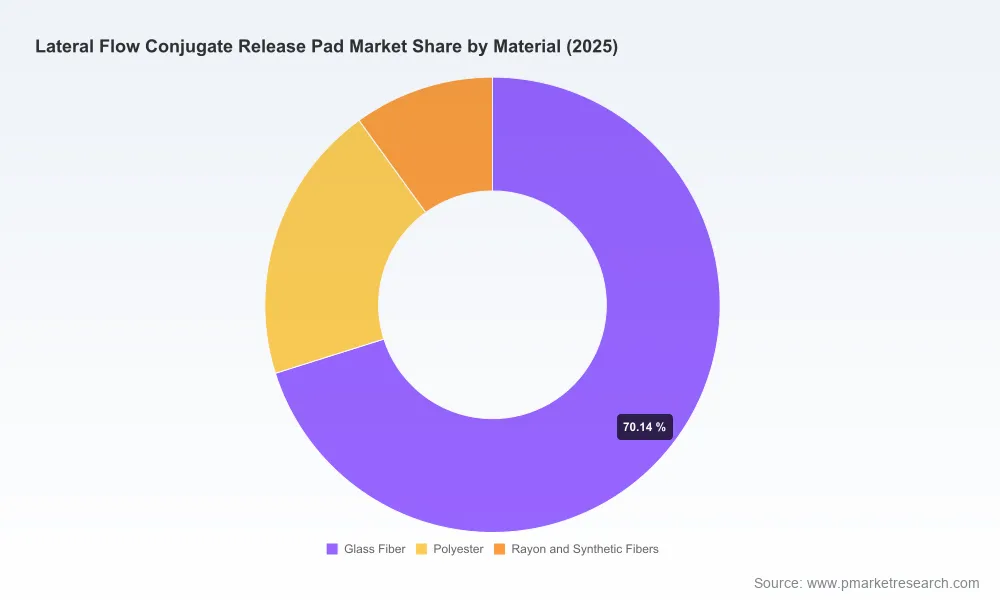
The core function of a conjugate release pad is deceptively simple: absorb and then release labeled conjugates with consistency. In practice, achieving that consistency requires engineered materials with predictable absorption profiles, low non-specific binding, and mechanical durability during high-speed reel-to-reel processing. Glass fiber remains widely used for its absorption capacity and rewetting behavior, while polyester and synthetic polyolefin options have gained traction where controlled release kinetics and handling robustness are priorities. Rayon and other synthetic fibers also occupy specific niches where cost and compatibility matter.
What separates leading offerings is not just material selection but pretreatment and integration readiness. Custom pretreatments can tune release rates and improve stability, while materials designed for consistent absorption reduce assay variability. For manufacturers, this means a pad is not just a consumable; it is a performance variable that can make or break lot-to-lot reproducibility. Suppliers that offer both material options and engineering support for integration position themselves as partners rather than commoditized vendors.
2. Regulatory and Quality System Pressure
Regulatory expectations have become a defining force in component-level decision-making. Final rules on laboratory developed tests have increased scrutiny of materials used in assays, extending attention to the conjugate release pad stage of the workflow. At the same time, component suppliers are aligning with ISO 13485 certification to meet quality system expectations for in vitro diagnostics and relevant regulatory frameworks. This shift matters because qualification cycles are lengthening and documentation burdens are rising. Buyers increasingly prefer suppliers that can demonstrate validated processes, traceable material quality, and consistent lot performance.
The strategic implication is twofold. First, regulatory pressure is consolidating preference toward suppliers with established quality infrastructure, which can advantage incumbents with mature systems. Second, it raises the bar for new entrants and smaller suppliers who must invest in certification and technical documentation to remain viable in regulated segments. In practice, regulatory alignment is becoming a competitive moat as much as a compliance obligation.
3. Demand-Side Shifts Toward Speed, Reliability, and Broader Use Cases
Demand for rapid point-of-care tests continues to grow, driven by the need for fast results in clinical settings, field testing, and decentralized testing environments. The conjugate release pad sits within this value chain as an enabler of consistent assay performance, which is especially important when tests are manufactured at scale and deployed in varied conditions. While there is no single reimbursement code that isolates conjugate release pads as a standalone consumable, the broader reimbursement and procurement environment supports rapid test adoption where speed and reliability are valued.
Importantly, demand patterns are diversifying. Clinical diagnostics remains the dominant application area, but food and beverage testing, veterinary diagnostics, and environmental testing each introduce distinct material requirements and performance expectations. This diversification encourages suppliers to think beyond a single formulation strategy and to develop portfolios that address different release profiles, chemical compatibilities, and mechanical demands. For buyers, it means sourcing decisions increasingly weigh application-specific performance rather than generic material attributes alone.
4. Cost Structures and the Economics of Scale
The economics of conjugate release pad production are shaped by material costs, pretreatment complexity, and manufacturing throughput. As assay volumes increase, the cost of consumables becomes more visible in total production economics, prompting manufacturers to evaluate suppliers not only on performance but also on supply continuity and integration efficiency. Reel-to-reel manufacturing imposes specific mechanical requirements, making tensile strength and uniformity critical to avoid jamming, handling defects, or inconsistent cutting and lamination outcomes.
At the same time, the push toward regional or nearer-shore production affects cost structures. Reshoring efforts can reduce logistics and geopolitical risk but may also alter procurement economics if local suppliers have different cost bases or capacity constraints. Companies are therefore balancing resilience against cost efficiency, and the suppliers that provide reliable volume, predictable lead times, and configurable options are best positioned to capture this trade-off.
Competitive Positioning: Who Is Setting the Pace and Why
The competitive field combines large material and life science companies with specialized lateral flow material suppliers. Their strategies reveal how value is being built in this segment and where differentiation is emerging.
Incumbents with Material and Process Depth
firms with broad membrane and material portfolios bring advantages in process control, scale, and technical support. Ahdlstrom, for example, emphasizes conjugate pads designed for rapid absorption, low protein binding, high-level conjugate release, and uniformity for consistent performance, while also reinforcing mechanical properties for reel-to-reel manufacturing. This framing shows a clear focus on both assay reliability and manufacturability, which matters when buyers are scaling production and need materials that behave predictably on the line.
Porex has built a presence around synthetic polyolefin conjugate pads optimized for consistent absorption and reproducible release of functionalized conjugates such as gold or latex labels. Its emphasis on custom pretreatments and integration options reflects a strategy centered on flexibility and performance tuning, appealing to manufacturers that want to adapt pad behavior to specific assay designs. Cytiva, operating within a larger life sciences ecosystem, supplies treated bound glass fiber pads positioned as conjugate release material with high absorption capacity and good rewetting properties, leveraging scale and technical documentation to serve regulated workflows.
Specialists and Regional Players
Alongside larger suppliers, companies such as AXIVA Sichem focus on conjugate release matrix pads made from non-absorbent materials including fiberglass, polyester, or rayon, with pretreatment options for controlled release rate and stability. This specialization can be attractive where assay designers need tightly controlled release behavior or where material compatibility with particular conjugates is critical. Merck KGaA, through its MilliporeSigma offerings, provides glass fiber conjugate pads and related materials positioned around low extractables and high consistency, echoing the industry's broader emphasis on material cleanliness and lot reliability.
These players illustrate a market in which differentiation is increasingly tied to material-tuned performance, pretreatment capability, and quality documentation rather than price alone. The presence of regional manufacturers and application-focused specialists also signals that supply options are broadening, though regulatory and quality expectations continue to filter who can compete in higher-stakes segments.
How the Landscape Is Evolving
The competitive pattern is not static. Several trends are shaping how the market is likely to evolve over the next few years.
- Integration over commodity supply. Buyers are increasingly evaluating suppliers on integration support, release consistency, and lot documentation. Pad suppliers that can support assay optimization and provide predictable performance are gaining preference over purely transactional suppliers.
- Certification as a competitive filter. ISO 13485 alignment and quality system readiness are becoming meaningful gating factors, especially for suppliers aiming at regulated clinical applications. This favors firms that have invested early in quality infrastructure and process control.
- Reshoring and supply chain redesign. As manufacturers reassess component sourcing, proximity, capacity assurance, and documentation reliability are gaining weight in sourcing decisions. Suppliers with regional presence or clearly mapped continuity plans may find new opportunities as buyers diversify exposure.
- Formulation innovation as a differentiator. Advances in pad formulations that improve reagent stability and shelf-life are drawing attention, particularly where manufacturers face storage, transport, or field-use constraints. Innovation here is not just technical; it is commercial because it can reduce failure rates and broaden distribution possibilities.
One recent industry signal worth noting is the increased discussion around USA reshoring of lateral flow manufacturing, which highlights the importance of supply chain resilience for components including conjugate release pads amid geopolitical and regulatory pressures. Alongside this, innovations in conjugate pad formulations designed to improve stability and shelf-life of lateral flow assay reagents have been showcased, reinforcing that material performance and product longevity are becoming central commercial considerations.
Looking Ahead: Three Trends That Will Shape the Next 3 to 5 Years
Based on the current balance of material innovation, regulatory pressure, demand diversification, and supply chain reorientation, several forward-looking trends are coming into focus.
Trend 1: Performance-Tuned Materials Will Move From Optional to Essential
As assays become more demanding and manufacturing scales increase, suppliers that can deliver tuned release profiles, consistent absorption, and mechanical robustness will gain share. The market is likely to see more application-specific offerings rather than a single default pad type. This trend creates opportunity for suppliers with strong technical support and pretreatment capability, and it raises the importance of co-development relationships between pad suppliers and assay manufacturers.
Worldwide Lateral Flow Absorbent Pads Market
The commercial opportunity here is not simply selling more volume. It is selling reliability, reduced optimization time, and fewer lot issues. Companies that can demonstrate measurable improvement in consistency and integration efficiency will have stronger positioning in negotiations and longer customer retention.
Lateral Flow POC Reader Market
Trend 2: Quality Documentation and Certification Will Become Procurement Gateways
Regulatory attention on assay components, combined with broader quality system expectations, is pushing documentation and certification into the center of sourcing decisions. Suppliers that maintain robust quality systems and clear traceability are likely to be preferred, especially where buyers must justify component selection in regulated workflows. This dynamic may slow entry for undercapitalized players while rewarding firms with mature quality frameworks and disciplined process control.
For buyers, this trend means supplier evaluation will increasingly include quality readiness, validation support, and documentation completeness, not just unit cost or material type. For suppliers, it means that certification and technical documentation are strategic assets that can open or close markets.
Trend 3: Resilience and Regionalization Will Redefine Sourcing Strategies
The growing emphasis on reshoring and supply chain resilience is likely to continue influencing procurement strategies. Companies may diversify across multiple qualified suppliers, seek nearer-shore or regional options, or prioritize suppliers with transparent continuity plans. While this does not necessarily eliminate global sourcing, it does make flexibility, capacity assurance, and documentation reliability more valuable.
The associated opportunity lies in suppliers that can offer predictable supply, responsive service, and configurations aligned to regional manufacturing needs. The risk is that fragmented demand and regional capacity constraints could create pricing variability or temporary supply tightness during scale-up periods, particularly if multiple buyers pursue similar sourcing shifts at once.
Implications and Watchpoints
- Technology and formulation leadership will be rewarded, but only when paired with manufacturing reliability and documentation support.
- Regulatory alignment is becoming a strategic advantage, not just a compliance step, and may influence which suppliers are shortlisted in regulated applications.
- Demand diversification across clinical, food, veterinary, and environmental uses creates need for portfolio thinking rather than single-material dependence.
- Reshoring and resilience may improve continuity but can also reshape cost structures and create transition friction during qualification and scale-up.
Strategic Choices for Decision-Makers
Different roles in the value chain face different priorities, but all should align their strategies with the forces reshaping this market.
For Diagnostic Manufacturers and Assay Developers
- Treat conjugate release pad selection as a performance variable, not a passive consumable. Evaluate absorption consistency, release profile, mechanical behavior on reel-to-reel lines, and pretreatment options as part of assay optimization.
- Build qualification plans that incorporate quality documentation, lot traceability, and stability considerations early. This reduces later rework and shortens time to scale.
- Diversify supplier options where application needs differ, but maintain a disciplined qualification process to avoid introducing variability across materials or lots.
For Investors and Strategic Capital
- Focus on suppliers with durable quality systems, material engineering depth, and integration support rather than volume alone. Certification readiness and technical service capability are indicators of defensible positioning.
- Watch for companies that can translate formulation improvements into measurable shelf-life, stability, or manufacturing efficiency gains, since those gains translate into commercial advantage for downstream assay makers.
- Consider how reshoring and regionalization affect capacity deployment and sourcing dependencies, as these shifts can alter both growth trajectories and risk profiles for suppliers.
For Procurement and Supply Chain Leaders
- Move beyond unit price as the primary evaluation metric. Incorporate release consistency, mechanical reliability, documentation quality, and continuity planning into supplier selection.
- Map exposure across material types and geographies, and identify where dual sourcing or regional options could improve resilience without sacrificing performance.
- Align sourcing decisions with downstream regulatory expectations, especially where assay components are subject to heightened scrutiny or where quality system alignment is required.
Why Deeper Intelligence Matters Now
The conjugate release pad market sits at the intersection of material science, regulatory expectation, and supply chain strategy. The broad growth trajectory is clear, but the real strategic value lies in the details: which material options are gaining traction in specific applications, how qualification requirements are changing procurement timelines, where formulation innovation is creating shelf-life or stability advantages, and how reshoring dynamics are reshaping supplier selection.
PW Consulting
For leaders making sourcing, investment, or product strategy decisions, the difference between a good decision and a resilient one often comes down to granular intelligence. Segment-level demand patterns, supplier capability depth, regional sourcing implications, and regulatory alignment are all variables that can change the attractiveness of a given opportunity or the risk profile of a given supply strategy.
PW Consulting maintains ongoing coverage of this market with detailed segmentation data, company-level analysis, and forward-looking scenario assessment. The full research report provides the kind of breakdown that supports precise decisions across material types, applications, and geographies, along with the qualified supplier context needed to evaluate sourcing and partnership options with confidence. For teams that need to move from broad market awareness to actionable strategy, deeper data is the bridge.
For detailed analysis of this topic, please visit the official page: Worldwide Lateral Flow Conjugate Release Pad Market
Lacy Lee
Senior Marketing Manager
[email protected]
PW Consulting: www.pmarketresearch.com

























Sign in to leave a comment.