

Of all the questions we answer in our Rotherham showroom, this is the one that causes the most quiet panic. Someone has found the perfect corner sofa, the colour is right, the price is right, and then the product page asks one simple thing: left-hand facing or right-hand facing?
Pick the wrong one and the sofa arrives facing the wall, blocking the door, or with the chaise sitting exactly where the radiator is. On a made-to-order sofa it can also be a very expensive mistake. You are not alone in finding it confusing, either: "left corner sofa" and "right corner sofa" are among the most common searches people make around corner sofas in the UK, according to Google Trends.
Here is the simple rule, why it still trips people up, and a four-step way to get it right for your room.
The rule: stand facing the sofa

Stand in front of the sofa, as if you are about to sit down. The side the corner or chaise is on is the "hand".
Most UK retailers and manufacturers use the same convention:
- Left-hand facing (LHF): stand in front of the sofa, facing it. The corner section or chaise is on your left.
- Right-hand facing (RHF): stand in front of the sofa, facing it. The corner section or chaise is on your right.
That is it. You are describing the sofa as you look at it, not as you sit on it. Once you sit down, everything flips: a left-hand facing corner has its chaise on your right-hand side. That flip is where most of the confusion comes from.
Why it still goes wrong
1. Some people picture sitting on it
If you imagine yourself sitting on the sofa, left and right swap. Always picture yourself standing in the room, looking at the sofa from the front.
2. Not every maker labels it the same way
The standing-in-front convention is the most common, but not universal. Some brands describe the side of the arm, some describe where the longest section is, and some use seat codes instead of words.
3. Seat codes are not the same as "facing"
Corner sofas are often described with codes like 2C1, 1C2 or 2C2. These tell you how many seats sit either side of the corner, normally read left to right as you face the sofa. A 2C2 is symmetrical. A 2C1 or 1C2 is not, and it is usually labelled left or right facing as well.
For example, the VIDA Living Blaine electric recliner corner comes as a "2C1 (Left Facing)", a "1C2 (Right Facing)" or a symmetrical 2C2. The code and the word together tell you the shape, but the only thing that removes all doubt is the layout diagram on the product page.
Our rule in the showroom: never order a corner sofa from the name alone. Look at the drawing, put your finger on the corner, and check it against a sketch of your room.
How to choose the right side for your room: 4 steps
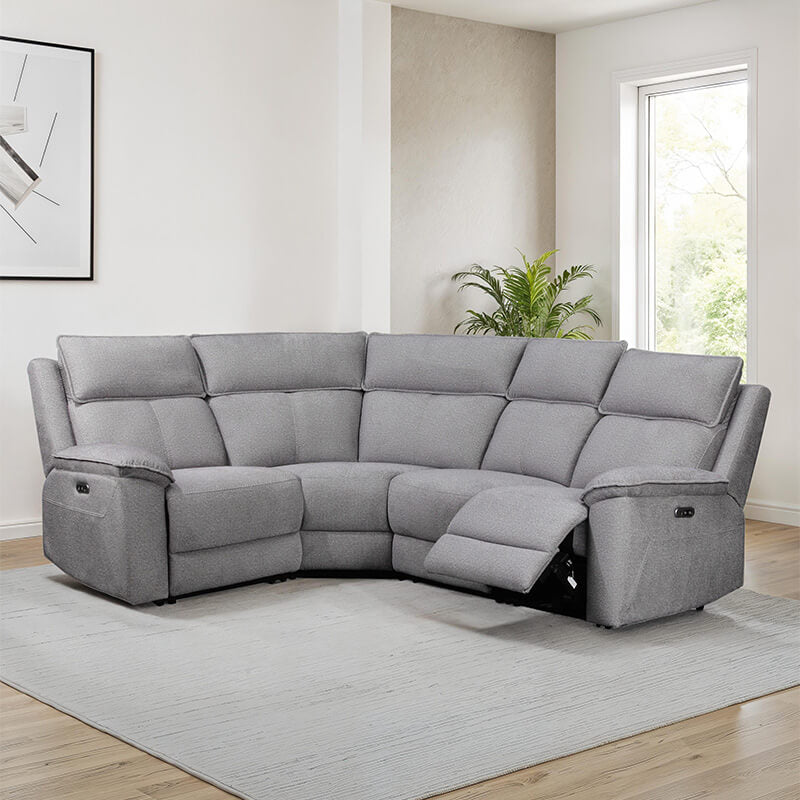
The Blaine corner from VIDA Living, available in left-facing, right-facing and symmetrical layouts.
Step 1: Draw the room from above
A rough sketch on paper is enough. Mark the walls, the door, windows, radiators, sockets, the fireplace or chimney breast and where the TV goes. Write the wall lengths on it.
Step 2: Decide which wall the long back goes against
The back of a corner sofa normally runs along the longest uninterrupted wall, usually facing the TV or fireplace.
Step 3: Decide where the corner needs to sit
The corner should tuck into the room's corner or reach out to close off the seating area. It must not:
- block the door or the main walkway (allow 75 to 90 cm to walk past),
- cover a radiator, or sit in front of a window you need to open,
- point the chaise directly at the TV wall if that leaves no room to walk.
Now stand in the doorway of your sketch, facing the wall where the sofa back will go. If the corner is on your left, you need left-hand facing. If it is on your right, you need right-hand facing.
Step 4: Tape it out on the floor
Before you order, mark the full footprint on the floor with masking tape, including the depth of the chaise or corner return. Live with it for a day. Walk around it, open the door, sit where the TV will be. Two minutes with a roll of tape has saved our customers more grief than anything else we recommend.
Common room layouts and which side they usually need
- Door in the corner of the room: the corner sofa goes in the opposite corner, with the open end towards the door.
- TV on the chimney breast: the long back faces the fireplace wall, with the corner on the side away from the door.
- Bay window at the front: keep the corner away from the bay so you do not lose the light; it usually sits on the back wall.
- Open-plan room: float the sofa, with the back of the long side forming the edge of the living area and the corner closing it off.
Every room is different, which is why the sketch matters more than any rule of thumb.
Not sure, or might you move house? Choose a flexible shape
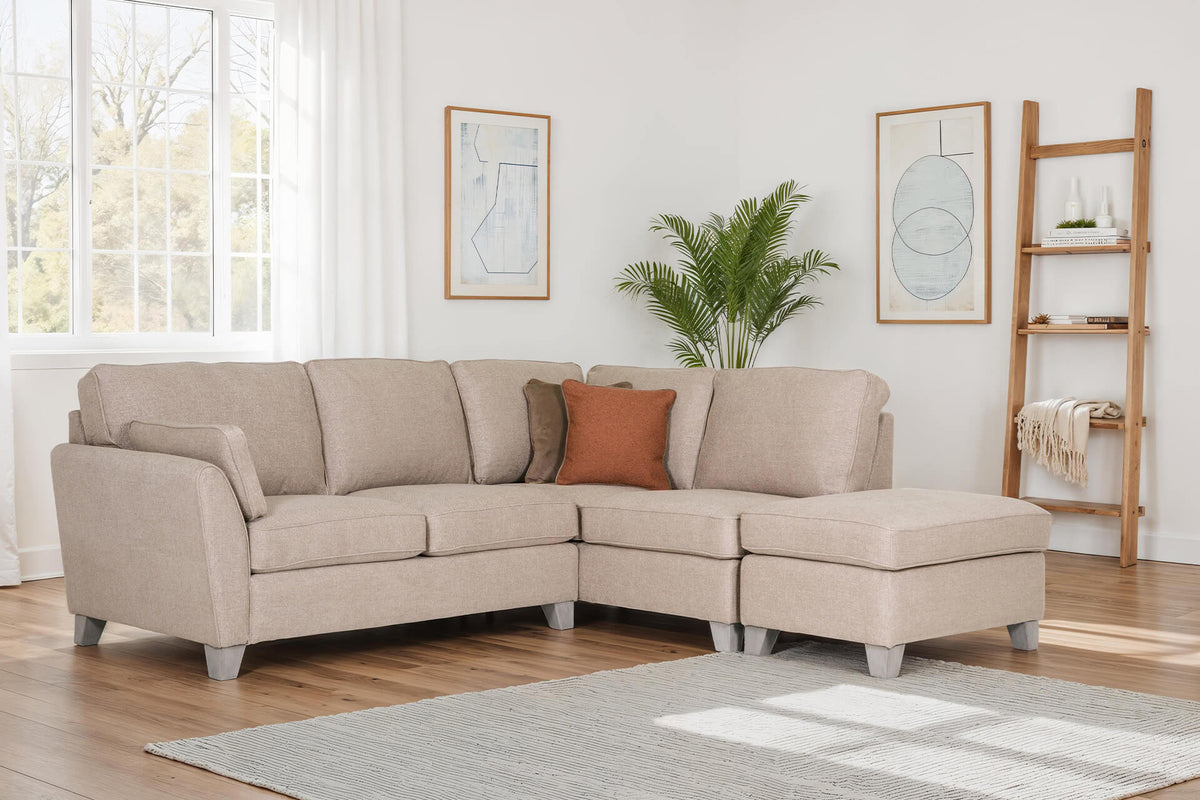
The Cantrell corner from VIDA Living is made in both left-hand and right-hand facing versions.
- Symmetrical corners (2C2): both sides are the same length, so there is no left or right to get wrong.
- Modular sofas: built from separate pieces, so many can be rearranged or extended later. See our modular sofas.
- Chaise sofas with a moveable chaise or footstool: some designs let you swap sides. Check before you buy, as many fixed chaises cannot be switched.
Check the delivery route too
Corner sofas arrive in sections, which helps, but the largest piece (usually the corner unit or the chaise) still has to get through your front door, hallway and any tight turns. Measure the narrowest point on the route and compare it with the largest section's width, height and diagonal depth. Our Will It Fit measuring guide walks you through it.
Why getting it wrong can be costly
Under the UK's Consumer Contracts Regulations, you normally have 14 days to cancel most online orders. But the regulations make an exception for goods made to the consumer's specifications or clearly personalised (regulation 28). Depending on the retailer and how the sofa is made, a made-to-order corner in your chosen fabric, size and configuration may not be returnable simply because you picked the wrong side.
Always check the retailer's returns policy before ordering a made-to-order corner sofa, and if you are unsure which side you need, ask before you pay, not after it arrives.
Quick checklist before you order
- Sketch the room from above with doors, windows, radiators and the TV marked.
- Stand facing the sofa wall: is the corner on your left (LHF) or right (RHF)?
- Check the product's layout diagram, not just the name or code.
- Tape the footprint on the floor and live with it for a day.
- Measure the delivery route against the largest section.
- Check the returns policy for made-to-order items.
Still not sure? Send us a photo
We have helped people fit corner sofas into Yorkshire living rooms since 1972, and we would rather spend five minutes on a sketch with you than have the wrong sofa arrive. Browse our corner sofas, including fabric corners, leather corners and reclining corners, or read our full corner sofa buying guide for shapes, seat depth and fabrics.
Ranges like the Cantrell and the Nico leather recliner corner are offered in both left- and right-hand facing versions, and our ex-display corner sofas are already built, so you can see exactly which way they face before you buy.
Homeflair is a family-run sofa and garden furniture showroom at the Parkgate Complex, Rawmarsh Road, Rotherham, trading since 1972. Visit homeflair.com.























Sign in to leave a comment.