

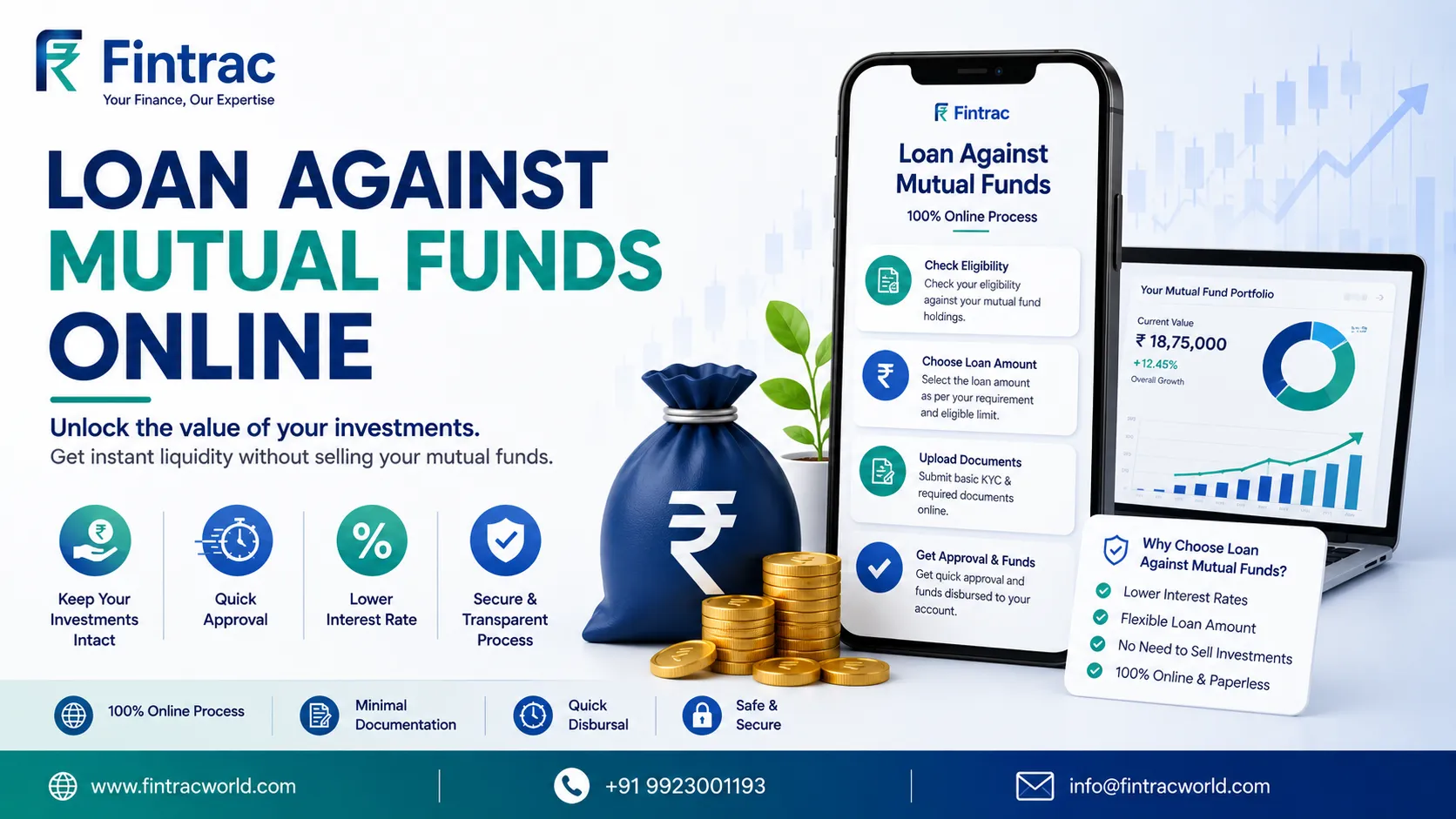
When an individual needs funds for an important personal requirement, selling mutual fund investments may not always be the preferred choice. An alternative can be to use eligible mutual fund units as security for borrowing. However, before considering this option, one of the most important factors to understand is the loan against mutual fund interest rate.
The interest rate directly influences the cost of borrowing, but it is not the only factor that matters. Processing charges, repayment terms, loan-to-value requirements, and conditions related to pledged units can also affect the overall financial cost.
For an individual, understanding these details before applying can make the borrowing decision clearer and more manageable.

What Does the Interest Rate Mean?
The interest rate is the cost charged by the lender for providing the borrowed amount. In a borrowing arrangement against eligible mutual fund units, the applicable rate can vary depending on the lender, borrowing amount, eligible investment, repayment structure, and other assessment criteria.
There is no single rate that applies to every individual or every mutual fund. Lenders may have their own pricing policies, and the final terms should always be confirmed before accepting an offer.
Rather than focusing only on a percentage displayed in an advertisement, an individual should understand the complete cost of the borrowing arrangement.
What Can Influence the Rate?
Several factors may affect the interest rate offered to an individual.
Value of the Mutual Fund Investment
The value of eligible mutual fund units can influence the borrowing arrangement. Lenders generally consider the value of the security when determining how much can be made available.
Type of Mutual Fund
Different mutual fund schemes can have different characteristics. The lender may consider the type of scheme and whether the particular units meet its eligibility requirements.
Borrowing Amount
The amount requested can also influence the applicable terms. Borrowing only what is required may help an individual keep the repayment obligation under better control.
Repayment Profile
The individual's ability to repay can form part of the lender's assessment. The final rate and terms may therefore differ between applicants.
Interest Rate Is Not the Complete Cost
A common mistake is to compare borrowing options only by looking at the interest rate. While the rate is important, the total cost may also include other applicable charges.
An individual should check whether the lender charges:
- Processing fees
- Administrative charges
- Documentation fees
- Renewal charges
- Other service-related costs
- Charges associated with delayed repayment
For example, an offer with a slightly lower interest rate may not necessarily be cheaper if it has significantly higher additional charges. Comparing the overall repayment cost provides a more useful picture.
How Loan-to-Value Can Affect the Arrangement
The loan-to-value ratio determines how much can potentially be borrowed against the value of eligible mutual fund units.
An individual may hold mutual fund investments worth a certain amount, but the lender may approve only a portion of that value. The applicable percentage can depend on the lender's policies and the type of investment.
This means the value of an individual's portfolio should not automatically be treated as the available borrowing amount.
Understanding the loan-to-value requirement before applying can help an individual set realistic expectations about the funds that may be available.
Why Mutual Fund Value Matters
Mutual funds are market-linked investments, so their value can change. This becomes particularly important when the units are pledged as security.
If the market value of pledged units falls substantially, the lender's terms may provide for additional security, partial repayment, or another required action. The exact conditions depend on the borrowing agreement.
Therefore, an individual should not assume that the value of the investment will remain constant throughout the borrowing period. Maintaining a sensible borrowing level and having a repayment plan can help manage this uncertainty.
What Happens to the Mutual Fund Units?
When eligible units are pledged, the investor generally continues to hold the investment, but the units become subject to the lender's security interest.
SEBI's mutual fund documentation explains that units can be pledged as security for raising loans, subject to the conditions of the lending institution. It also states that pledged units generally cannot be redeemed until the entity to which they are pledged provides the required authorisation for removing the pledge or lien.
This is an important point for individuals. Pledging units is different from selling them, but it can restrict access to those units until the borrowing arrangement is appropriately settled.
Authentic Research Source: SEBI – Official Mutual Fund Circular
A Simple Way to Compare Borrowing Options
Before making a decision, an individual can compare options using a few basic points:
| Factor | What to Check |
|---|---|
| Interest rate | Rate applicable to the specific application |
| Processing fee | Initial cost charged by the lender |
| Loan-to-value | Percentage of eligible investment that can be borrowed |
| Repayment | Frequency and structure of payments |
| Eligibility | Mutual fund schemes accepted by the lender |
| Market movement | What happens if the pledged value changes |
| Pledge release | Conditions for removing the pledge or lien |
| Additional charges | Any applicable service or delay-related costs |
This approach can make comparisons easier and help prevent important terms from being overlooked.
How Much Should an Individual Borrow?
The maximum available amount should not automatically become the target borrowing amount.
An individual should first identify the actual financial requirement and then consider whether the repayment can comfortably fit within regular income and expenses.
For example, if a person needs a limited amount for a temporary requirement, taking a substantially larger amount could unnecessarily increase the interest burden.
A responsible borrowing decision starts with affordability rather than the maximum available limit.
When Can This Option Be Worth Exploring?
Borrowing against eligible mutual fund investments may be worth exploring when an individual:
- Has eligible mutual fund units
- Requires access to funds for a personal financial need
- Does not want to immediately sell eligible investments
- Has a clear repayment plan
- Understands the applicable interest and charges
- Is comfortable with the conditions attached to pledged units
It may be less suitable when repayment would put significant pressure on the individual's regular finances.
Common Mistakes to Avoid
Individuals researching this type of borrowing should avoid making decisions based on incomplete information.
Ignoring additional charges: The interest rate alone does not represent the complete cost.
Borrowing more than required: A higher approved limit does not mean the entire amount needs to be used.
Overlooking market fluctuations: The value of mutual fund units can change during the borrowing period.
Not reading pledge conditions: Restrictions may apply to pledged units until the security is released.
Choosing only on the basis of rate: A lower rate may not always mean a lower total cost.
Role of Fintracworld
Fintracworld provides information related to financial and borrowing solutions, helping individuals understand important factors before making a financial decision.
For someone researching the loan against mutual fund interest rate, understanding the rate is only the starting point. Eligibility, loan amount, applicable charges, repayment structure, loan-to-value requirements, and pledge conditions should also be evaluated.
The final decision should be based on the individual's financial requirement and ability to repay comfortably.
Conclusion
The loan against mutual fund interest rate is an important part of the borrowing cost, but it should be considered alongside all applicable charges and repayment conditions. An individual should compare complete offers, understand the risks associated with pledged investments, and borrow only an amount that can be comfortably repaid.
Fintracworld can help individuals research relevant financial information before evaluating available borrowing options
Frequently Asked Questions
1. What determines the loan against mutual fund interest rate?
The applicable rate can depend on the lender's policies, borrowing amount, eligible mutual fund units, repayment terms, and the individual's financial assessment.
2. Is the interest rate the only cost?
No. Processing fees, administrative charges, renewal costs, or other applicable charges may also increase the overall cost.
3. Can the interest rate vary between lenders?
Yes. Different lenders can have different pricing structures and eligibility requirements, so comparing complete offers is important.
4. Can pledged mutual fund units be redeemed?
Generally, redemption is restricted while the pledge or lien remains active. The applicable security usually needs to be released according to the lender's process before redemption.
5. Should I choose the lender with the lowest rate?
Not automatically. An individual should compare the complete cost, repayment terms, loan-to-value ratio, applicable charges, and other conditions.
.



















Sign in to leave a comment.