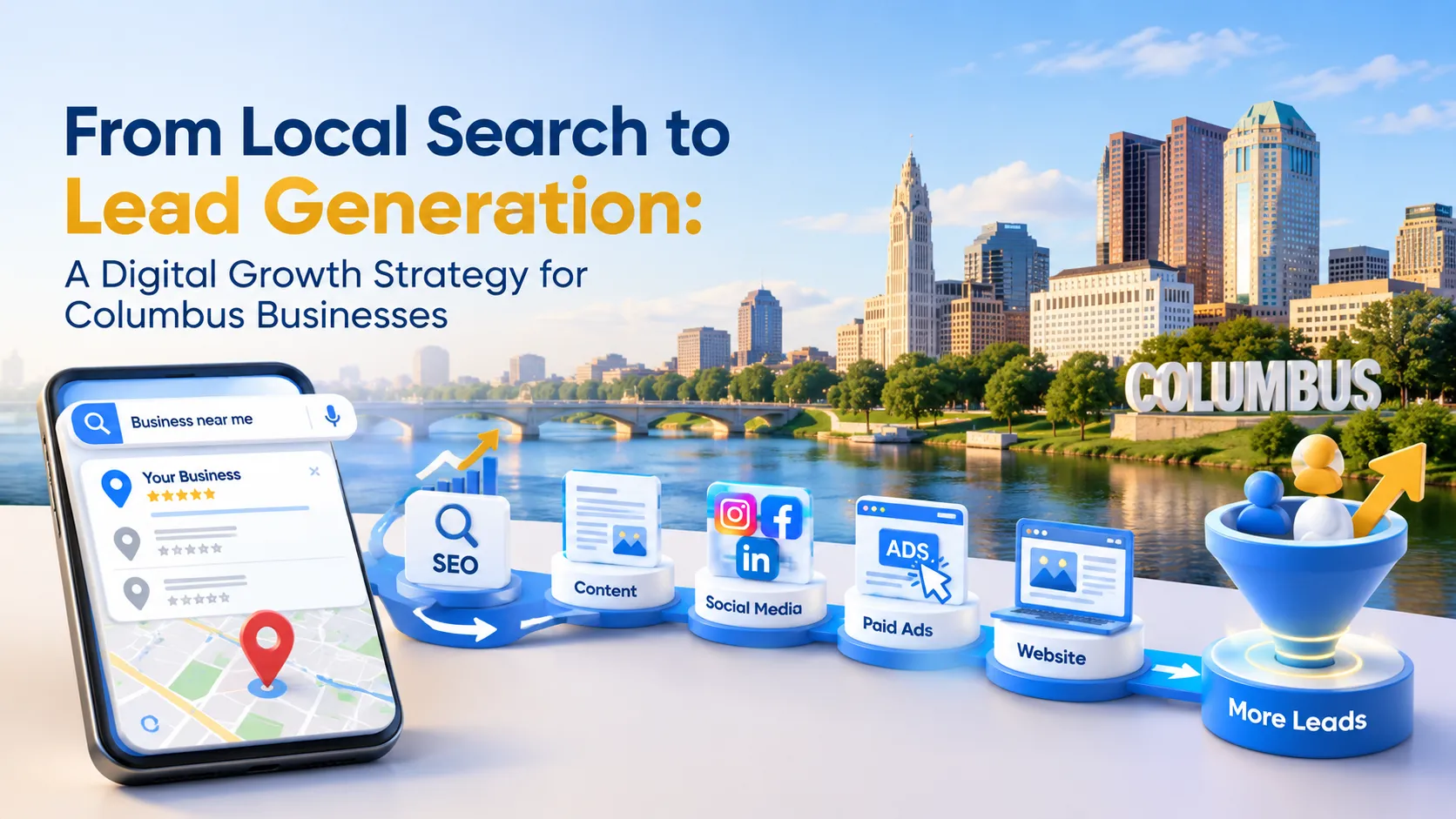

For Columbus businesses, being visible online is only the first step. A business may appear in local search results, receive website visitors, and maintain an active social media presence, yet still struggle to generate consistent leads. The real challenge is connecting visibility with actions that produce measurable business results.
Local customers often begin their buying journey with a search. They may look for a nearby service provider, compare businesses, read reviews, visit a website, or check available services before making contact. This means businesses need more than rankings. They need a digital growth strategy that moves potential customers from discovery to consideration and, ultimately, conversion.
A well-planned approach combines local SEO, content, paid advertising, social media, website optimization, and conversion-focused campaigns. Here is how Columbus businesses can build that journey.
Start With Local Search Visibility
When customers search for products or services in Columbus, search engines use multiple signals to determine which businesses should appear prominently. Location relevance, website content, business information, reviews, authority, and user experience can all influence visibility.
For local businesses, this makes local search optimization a critical part of digital growth.
The first step is ensuring that business information is accurate and consistent across important online platforms. Business name, address, phone number, website, operating hours, and service information should be maintained carefully.
A properly optimized Google Business Profile can also help businesses appear in local results and map listings. However, optimization should not stop with the profile. The website should clearly communicate what the business offers, where it operates, and why customers should choose it.
Businesses serving multiple areas can also develop location-specific pages when there is genuine value for customers. These pages should provide useful information rather than simply repeating the same content with different city names.
Build a Website That Turns Visitors Into Leads
Getting someone to visit a website does not automatically create a customer.
A common problem with business websites is that they explain what the company does but fail to make the next step obvious. Visitors should quickly understand the service, its benefits, the areas served, and how to get started.
A lead-focused website should include clear calls to action such as requesting a quote, scheduling a consultation, calling the business, submitting an inquiry, or making a purchase.
The website should also work effectively on mobile devices. Many local searches happen on smartphones, where slow loading, difficult navigation, or poorly designed forms can cause potential customers to leave before contacting the business.
This is where conversion rate optimization becomes important. Businesses should continuously evaluate landing pages, forms, calls to action, page structure, and user behavior to identify opportunities for improvement.
Use SEO to Capture High-Intent Searches
Not every search has the same value.
Someone searching for “what is digital marketing” may simply be researching a topic. Someone searching for “digital marketing agency near me” or a specific service in Columbus is much closer to making a decision.
A strong SEO strategy identifies these differences and creates content around different stages of the customer journey.
A columbus search engine optimization agency can help businesses identify commercially valuable search terms, improve website structure, optimize service pages, and develop content designed around customer needs.
The goal should not be to rank for random keywords simply because they have high search volume. Instead, businesses should prioritize searches that align with their products, services, locations, and revenue opportunities.
For example, service pages can target transactional searches while supporting blog content can answer informational questions. Internal links can then connect informational content with relevant service pages, helping users move naturally through the website.
Create Content That Supports the Buying Journey
Content marketing becomes more valuable when it has a clear purpose.
Instead of publishing articles simply to increase the number of pages on a website, businesses should create content that addresses real customer questions and objections.
For example, a Columbus home service company could publish content about choosing a contractor, understanding project costs, comparing service options, or preparing for a consultation. A professional service company might answer questions about pricing, timelines, processes, or common customer concerns.
This type of content can attract people earlier in the buying journey while building familiarity with the brand.
The strongest strategy connects this content to commercial pages. Someone reading an educational article should have a logical path toward learning about the company's services or contacting the business.
Strengthen Trust With Reviews and Reputation
Local customers rarely evaluate a business based on its website alone. Reviews can significantly influence whether a potential customer feels comfortable making contact.
Businesses should create a consistent process for requesting reviews from satisfied customers. However, collecting reviews is only part of reputation management. Businesses should also monitor feedback and respond professionally to customer concerns.
Positive reviews can reinforce important decision-making factors such as service quality, responsiveness, professionalism, and customer experience.
Website testimonials, case studies, project examples, and other forms of social proof can further strengthen credibility. When customers are comparing several businesses, these trust signals can make the difference between a website visit and an actual inquiry.
Combine Organic Search With Paid Campaigns
SEO can generate valuable long-term visibility, but businesses do not always need to rely exclusively on organic traffic.
Paid advertising can help businesses reach high-intent customers more quickly. Search campaigns can target people actively looking for specific products or services, while social advertising can help businesses reach audiences based on interests, demographics, behavior, or location.
The important point is that paid campaigns should connect to dedicated landing pages and measurable conversion actions.
Sending every advertisement to a generic homepage makes it harder to maintain message relevance and track performance. A service-specific campaign should generally lead to a page that matches the customer's search intent and provides a clear next step.
Make Social Media Part of the Conversion Strategy
Social media should not exist simply because competitors have social profiles.
For many Columbus businesses, social platforms can demonstrate expertise, showcase completed work, introduce team members, answer customer questions, and reinforce brand credibility.
Visual businesses can use project photography, before-and-after examples, demonstrations, and customer stories. Professional service companies can focus on educational content, industry insights, frequently asked questions, and success stories.
Social media can also support other digital channels. Someone may discover a business through search, visit its website, and later encounter the same company on social media. Consistent messaging across these touchpoints can increase familiarity and trust.
Track the Metrics That Actually Matter
Traffic and rankings are useful indicators, but they are not the final objective.
A business should understand how digital marketing contributes to leads and revenue. Important metrics can include organic traffic, qualified leads, phone calls, form submissions, conversion rates, cost per lead, paid campaign performance, and revenue generated from different channels.
Analytics platforms can help businesses understand where visitors come from and what they do after arriving on the website.
For example, if organic traffic increases but leads remain unchanged, the problem may be poor conversion paths or irrelevant traffic. If paid advertising generates many clicks but few inquiries, the landing page, targeting, offer, or messaging may need improvement.
This approach shifts digital marketing from simply reporting activity to measuring business outcomes.
Work With a Strategy, Not Isolated Services
Hiring different providers for SEO, advertising, content, social media, and web development can sometimes create disconnected campaigns. Each channel may perform reasonably well individually while failing to support a unified customer journey.
A Digital Marketing Agency in Columbus can bring these activities together under a broader growth strategy. Instead of treating SEO, PPC, content, social media, and conversion optimization as separate tasks, the business can align them around common goals.
For example, SEO can attract high-intent searches, content can answer customer questions, paid advertising can capture immediate demand, social media can reinforce trust, and conversion optimization can turn website visitors into inquiries.
The result is a connected digital ecosystem rather than a collection of unrelated marketing activities.
Turn Local Visibility Into Sustainable Growth
Columbus businesses do not need to choose between local SEO and lead generation. The strongest digital strategies connect the two.
Search visibility brings potential customers into the journey. Useful content helps educate them. Reviews and proof build trust. A strong website removes friction. Paid campaigns capture additional demand. Analytics reveal what is working and where improvements are needed.
The objective is not simply to appear higher in search results. It is to build a system that consistently attracts relevant prospects and gives them compelling reasons to take action.
For businesses competing in the Columbus market, that shift—from chasing visibility to building a measurable customer journey—can make digital marketing significantly more valuable. When every channel has a defined role and performance is measured against leads and revenue, online visibility becomes more than a ranking. It becomes a growth engine.



















Sign in to leave a comment.