

Comparing the Anywell YS16-1 MAX wide-seat electric wheelchair with the Anywell X-024 mobility scooter is a useful reminder that choosing a long range electric wheelchair is not simply about finding the largest mileage number on a specification sheet.
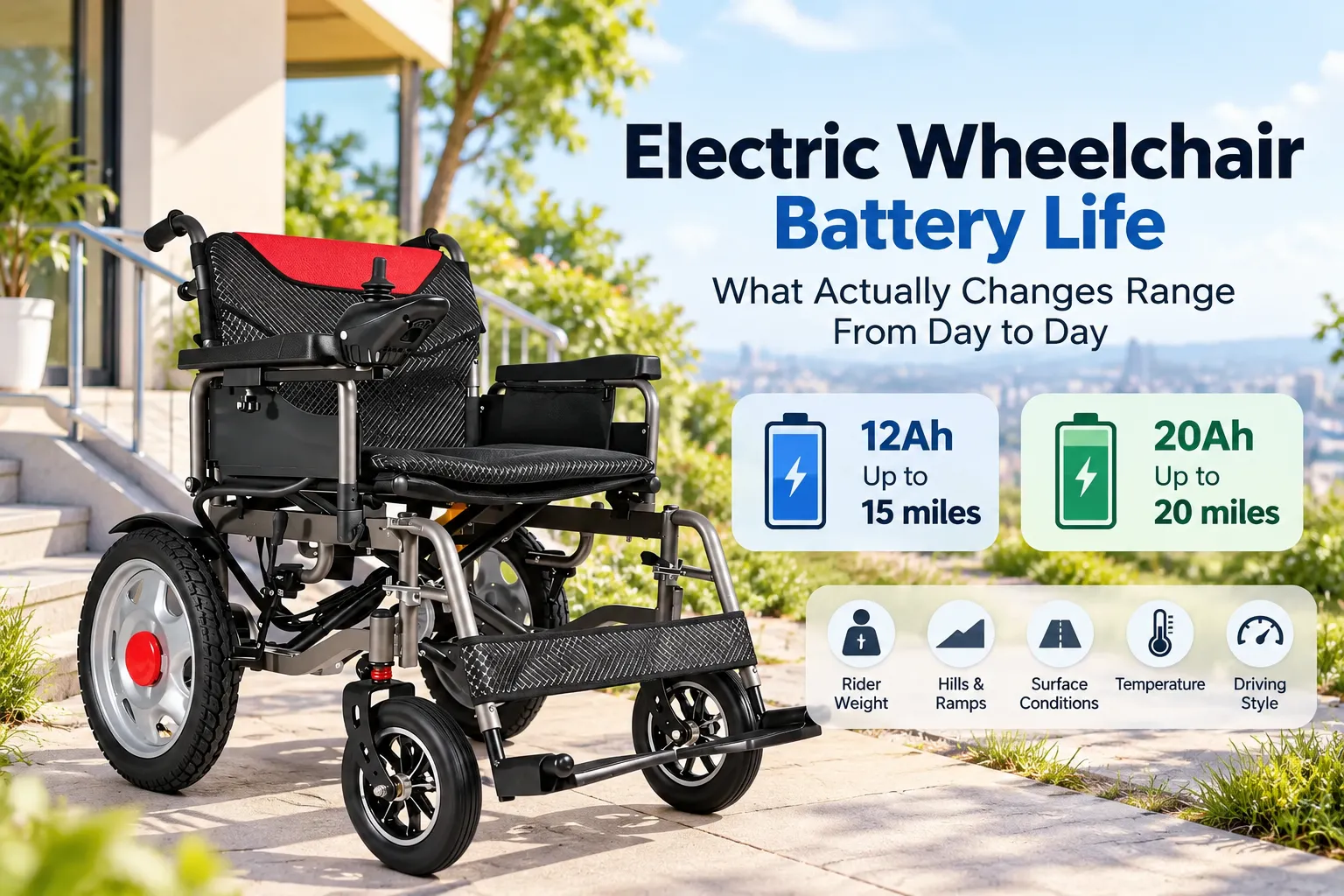
Range matters, especially if you regularly travel outside the home, but the advertised number should be treated as a planning reference rather than a guaranteed distance. Rider weight, hills, surface conditions, temperature, battery condition, frequent stopping and starting, and driving style can all affect how far a mobility device travels on one charge.
That means a better question is not:
“What is the maximum electric wheelchair range?”
It is:
“How much range do I need for my normal route, plus enough reserve for unexpected changes?”
That small change in thinking can make it much easier to choose a wheelchair for real daily use.
What Does “Long Range Electric Wheelchair” Actually Mean?
There is no universal mileage figure that automatically makes a chair a long range electric wheelchair.
One person may spend most of the day indoors and only travel short distances between a house, parking area, clinic, or nearby shop. Another person may regularly travel around a neighbourhood, visit several stores, move through a large shopping centre, and return home without having an opportunity to recharge.
Those two people need different levels of battery reserve.
A manufacturer's maximum range is useful for comparing products, but it should not be treated as the exact distance you can plan to travel every time.
If a chair is rated for up to 20 miles, for example, that does not mean planning a 19.5-mile day is a good idea.
Real-world conditions rarely stay perfectly consistent.
Think About Route Reserve, Not Maximum Mileage
A practical way to think about electric wheelchair range is to leave some unused capacity after an ordinary trip.
You can think of this as your route reserve.
It is not an official technical specification. It is simply a useful planning concept.
Suppose your regular outing looks like this:
- Home to a pharmacy: 1.5 miles
- Pharmacy to supermarket: 1 mile
- Moving around the shopping area: 0.5 mile
- Supermarket back home: 2 miles
That is already around five miles of expected travel.
Now add a few realistic possibilities:
- the closest entrance is inaccessible;
- construction forces you onto a longer route;
- you decide to visit another store;
- you spend more time moving around the shopping centre;
- the route includes slopes or rougher pavement;
- cold weather or battery condition reduces efficiency.
Suddenly, planning around exactly five miles does not feel very comfortable.
A wheelchair with substantially more rated range can therefore be valuable even if you never intend to use its entire theoretical distance.
A 20 Mile Range Electric Wheelchair Is Not Necessarily a 20 Mile Day
The phrase 20 mile range electric wheelchair can be misleading if interpreted too literally.
A rated distance is best understood as a benchmark measured under certain operating conditions.
Your own results can be different.
Several factors can change electric wheelchair range:
Rider and carried weight
A heavier total load generally requires more energy to move, especially when accelerating or travelling uphill.
The weight of bags, shopping, accessories, oxygen equipment, or other carried items can also contribute to the overall load.
Hills and ramps
Climbing requires more energy than travelling across a flat surface.
A route with several slopes may consume more battery than a longer route across smooth, level ground.
Surface conditions
Indoor floors and smooth pavement are generally easier for a powered mobility device than grass, gravel, uneven paths, or broken pavement.
That is why distance alone does not tell you how demanding a route will be.
Frequent starts and stops
A continuous route may use energy differently from a trip involving constant stopping, turning, accelerating, and repositioning.
Busy shopping areas are a good example.
Battery condition
Battery performance can change over time.
Instead of assuming an older battery will always behave exactly as it did when new, build some margin into your daily travel planning.
Temperature
Extreme temperatures can affect battery performance.
This is another reason not to build a daily routine around using nearly 100% of the theoretical range.
Start by Measuring Your Real Routes
Before comparing batteries, look at the trips you make most often.
For one week, estimate or record:
- Your normal daily distance
- Your longest common round trip
- Whether the route includes hills
- Whether the route uses grass or uneven surfaces
- How much movement happens after you arrive
- Whether charging is available at the destination
- How often your route changes unexpectedly
The goal is not to calculate everything to the nearest tenth of a mile.
You are trying to understand the general pattern.
If your longest normal route is six miles, for example, choosing a mobility device whose rated maximum is only slightly above six miles would provide very little room for unexpected changes.
A device with more reserve may make daily planning easier.
Battery Capacity Matters, but Ah Does Not Equal Miles
Battery capacity is often listed in amp-hours, usually written as Ah.
It is useful information, but it should not be treated as a direct mileage calculator.
For example:
20Ah does not automatically mean 20 miles.
Two mobility devices can both use a 20Ah battery yet deliver different driving characteristics because of differences in:
- battery chemistry;
- voltage;
- motors;
- controller settings;
- vehicle weight;
- tyre design;
- gearing;
- rider load;
- terrain.
This is why shoppers should look at the complete product specification instead of comparing battery capacity alone.
A larger-capacity battery can provide more stored energy when other factors are similar, but actual electric wheelchair range still depends on the whole system.
Lithium vs Lead-Acid: What Matters for Daily Planning?
People researching longer-range mobility products often encounter both lithium and lead-acid battery systems.
Neither should be judged by battery chemistry alone.
Instead, consider how the battery fits your routine.
Lithium batteries
Lithium batteries are commonly used in folding mobility products because they can offer useful energy capacity without requiring extremely large battery packs.
For someone who frequently transports a wheelchair, total chair weight and whether the battery can be removed may be particularly important.
Lead-acid batteries
Lead-acid systems are also widely used in mobility devices, especially larger chairs and scooters.
These products may prioritise seating room, rated capacity, stability, or other characteristics rather than minimum weight.
The practical question is:
What combination of range, fit, weight, and charging routine works for the user?
Battery chemistry is one part of that decision, not the whole decision.
Range Should Never Be Considered Without Seat Fit
It is easy to become focused on mileage and forget the most basic question:
Does the chair actually fit the rider?
A long-range chair is still a poor choice if the seat is uncomfortable or too narrow.
Seat width, usable seat space, armrest position, legroom, and rated weight capacity all matter.
This becomes particularly important for users comparing standard and heavy-duty power wheelchairs.
A wider, higher-capacity wheelchair may be a better fit for one person even if another chair is lighter or easier to transport.
The right balance depends on how the device will actually be used.
Consider the Entire Route, Not Just the Distance
Imagine two six-mile journeys.
Route A
- Mostly indoor surfaces
- Flat pavement
- Few stops
- No major slopes
Route B
- Repeated ramps
- Rough pavement
- Grass sections
- Frequent stops
- Several tight turns
Both routes are six miles.
But they are not equally demanding.
That is why someone comparing electric wheelchair range should think beyond a number on Google Maps.
Look at the actual surfaces and obstacles along the route.
Electric Wheelchair or Mobility Scooter?
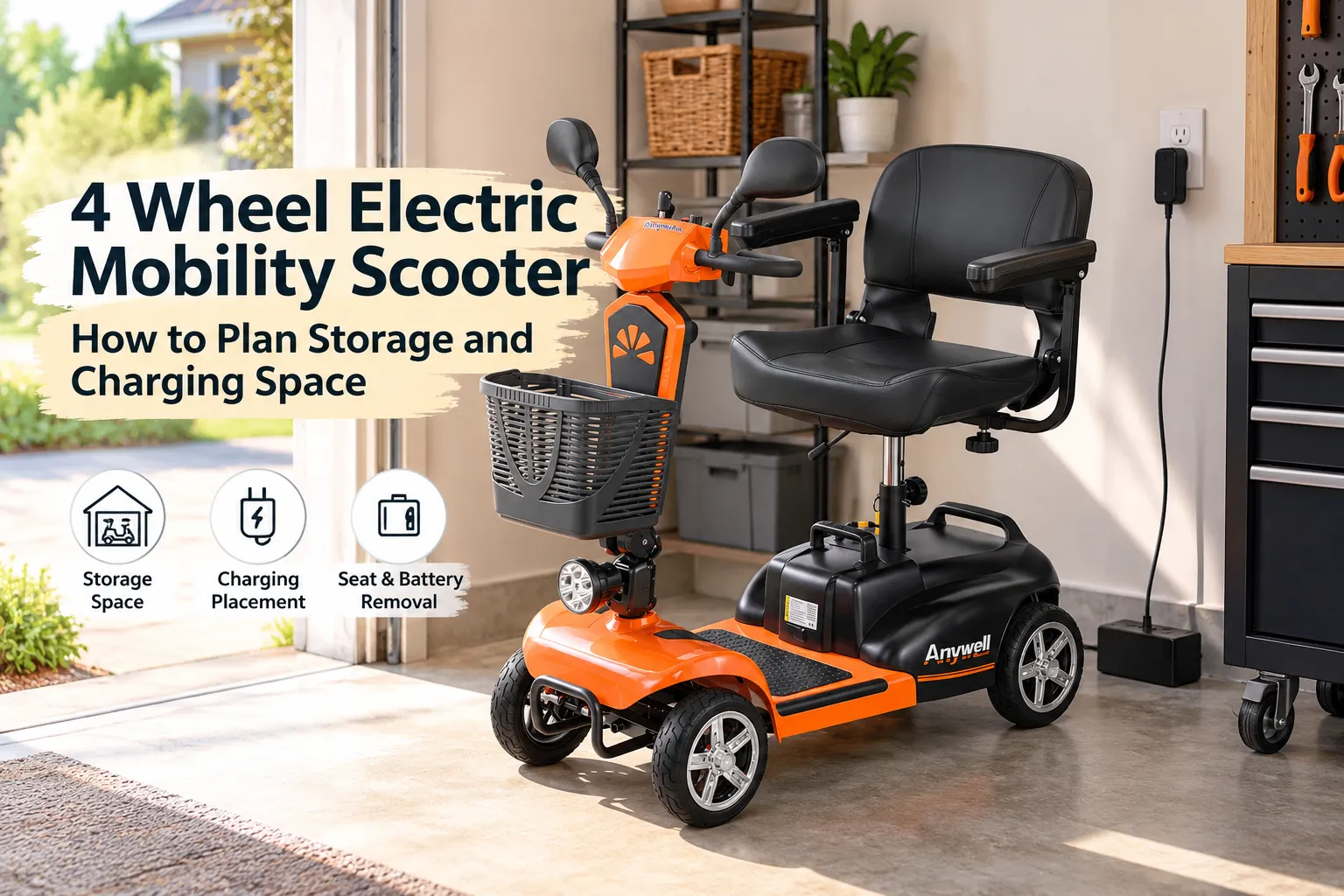
A mobility scooter can also offer substantial travel range, but electric wheelchairs and scooters are designed around different styles of use.
A typical power wheelchair uses joystick steering and can be easier to manoeuvre in some indoor environments.
A mobility scooter typically uses a tiller and usually has a longer front section.
For users who primarily travel outdoors for errands, shopping, and neighbourhood trips, a scooter may be worth considering.
For users who prioritise joystick control, seated manoeuvrability, or indoor navigation, a power wheelchair may make more sense.
This is why two mobility products can have similar battery specifications but still suit very different people.
Do not choose between them based on range alone.
Charging Planning Is Part of Long-Range Mobility
A larger battery does not eliminate the need for a consistent charging routine.
Before buying, ask:
- Where will the wheelchair normally be charged?
- Is there an accessible power outlet?
- Will the chair be charged overnight?
- Does the charger need to travel with the user?
- Is charging available at work or another regular destination?
- What happens if a normal trip becomes much longer?
Follow the manufacturer's charging instructions rather than deliberately running the battery to its limit on every trip.
The goal is reliable daily mobility, not testing how close you can get to the published maximum range.
Transport Can Be More Important Than Another Few Miles
A chair may offer excellent range but still be inconvenient if it cannot be transported in the vehicle you use.
Before focusing entirely on battery distance, check:
- total chair weight;
- folded size;
- removable components;
- battery removal;
- boot or cargo-space dimensions;
- the heaviest part someone needs to lift.
“Folding” also does not necessarily mean “lightweight.”
A folding wheelchair may still require two-person lifting or a vehicle lift depending on its weight and the user's situation.
If car transport is a weekly requirement, this factor can be just as important as range.
How Much Reserve Should You Leave?
There is no single reserve percentage that works for every wheelchair and every user.
A better approach is to think in practical terms.
If your normal journey already consumes almost all of the manufacturer's advertised range, you probably have too little margin.
If your normal route uses only part of the available range, you have more flexibility for:
- detours;
- additional stops;
- changing terrain;
- battery ageing;
- weather;
- unplanned travel.
Someone whose ordinary route is three miles may not need the same range capability as someone regularly travelling ten miles.
More range is useful only when the rest of the chair also fits the person's needs.
Common Mistakes When Comparing Electric Wheelchair Range
Mistake 1: Choosing by the biggest number
The highest advertised mileage does not automatically make a wheelchair the right choice.
Range must be considered alongside fit, capacity, dimensions, control style, transport, and intended surfaces.
Mistake 2: Planning to use the maximum range every day
Rated range should provide context, not become a daily target.
Leaving reserve makes route planning more flexible.
Mistake 3: Comparing Ah alone
Amp-hours describe battery capacity, not guaranteed mileage.
Compare the entire mobility system.
Mistake 4: Forgetting the return trip
A destination four miles away may mean at least eight miles of travel before accounting for movement at the destination.
Mistake 5: Ignoring route conditions
A shorter route over hills and rough surfaces can be more demanding than a longer, flat route.
Mistake 6: Buying for rare trips instead of normal use
Do not let one unusual annual journey dictate every aspect of the chair.
Start with what you need most days.
FAQ
Is 20 miles considered long range for an electric wheelchair?
It can provide substantial range for many everyday users, but whether it is “long range” for you depends on your normal travel distance. A person travelling three miles per day will view a 20-mile rating very differently from someone regularly making much longer trips.
Will a 20Ah battery always provide 20 miles?
No. Battery capacity and driving range are different measurements. Range can vary with motor efficiency, total weight, terrain, slope, temperature, battery condition, and driving behaviour.
How should I estimate my required electric wheelchair range?
Measure your longest common round trip, include movement at your destination, and leave additional reserve for route changes and real-world conditions.
Should I choose a scooter if I want more range?
Not necessarily. Scooters and power wheelchairs have different control systems, dimensions, turning characteristics, and seating arrangements. Compare the complete use case rather than range alone.
Should I choose the wheelchair with the largest battery?
Only if the rest of the wheelchair also fits your needs. Seat dimensions, rated capacity, manoeuvrability, overall weight, transport, and charging requirements can be equally important.
Final Takeaway
The best way to evaluate a long range electric wheelchair is to stop thinking about maximum mileage as a challenge to reach.
Instead, calculate how far you normally travel and look for enough additional capacity to handle real-life variation.
Consider the complete journey:
- distance;
- hills;
- surfaces;
- stops;
- rider and cargo weight;
- seat fit;
- charging opportunities;
- transport requirements.
A 20-mile rating may provide generous reserve for one person and only moderate reserve for another.
What matters is not whether your wheelchair can theoretically travel the longest distance.
What matters is whether you can complete your normal day comfortably without constantly calculating whether you have enough battery left to get home.

























Sign in to leave a comment.