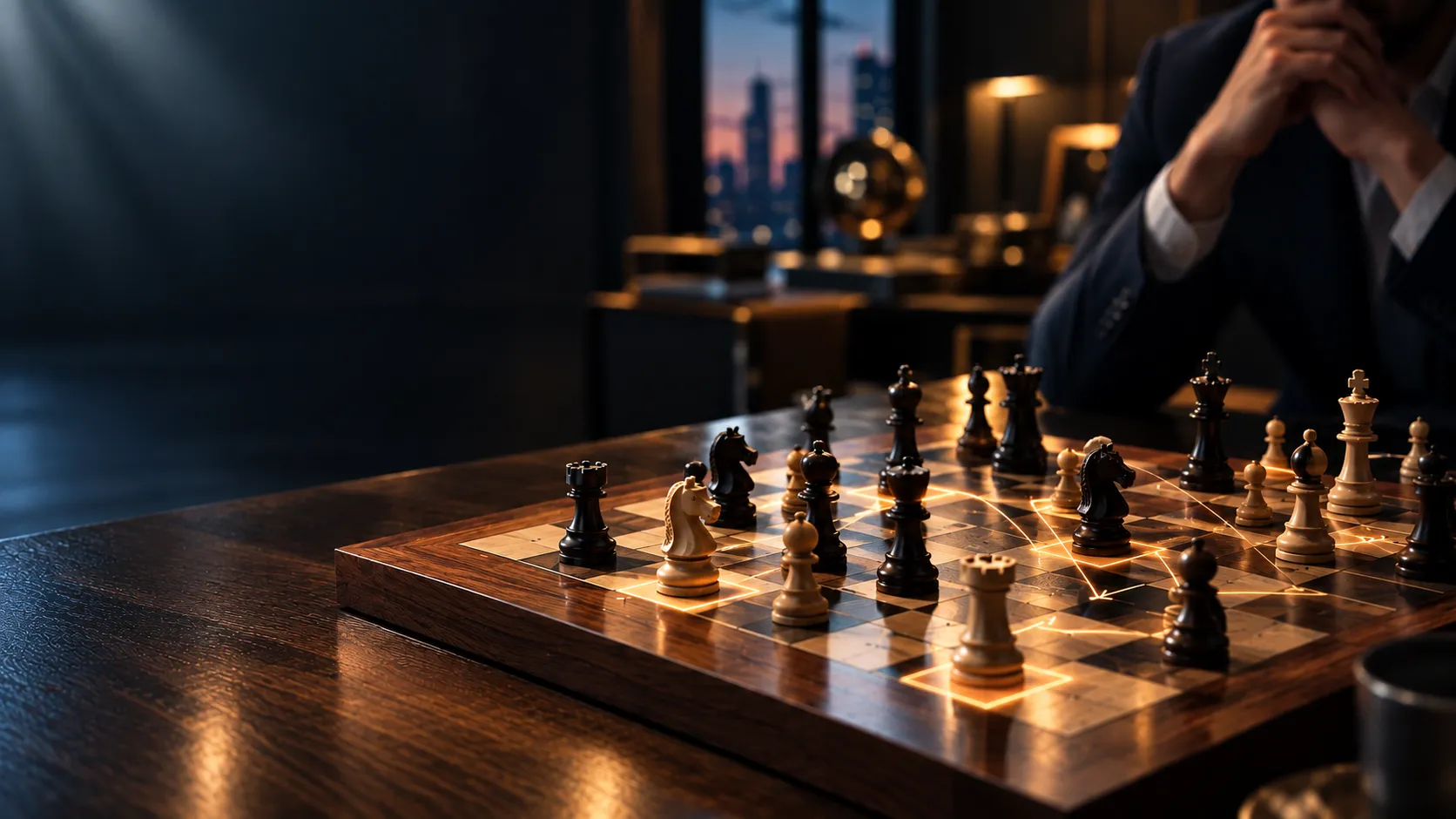

A chess game is rarely decided by a single brilliant move. In many positions, the better approach is to understand the demands of the position and gradually improve your pieces, create weaknesses, or prepare a useful pawn break. This is the foundation of a long-term plan in chess.
Effective chess planning starts with evaluating what is happening on the board. Pawn structure, piece activity, weak squares, king safety, space, and material can all provide clues about what you should try to accomplish. Instead of making moves one after another without a clear purpose, you can use these features to establish a strategic direction.
What Is a Long-Term Plan in Chess?
A long-term plan in chess is a strategic goal that influences several decisions during a game. It is not the same as calculating a forced sequence of moves because your opponent's responses can change the position.
Your plan might involve improving an inactive piece, attacking a weak pawn, gaining control of an important square, preparing a pawn break, exchanging a particular piece, or reaching a favorable endgame.
The plan should be based on the actual position. If the board changes, your original idea may no longer be appropriate. A good plan therefore gives you a clear direction while leaving enough flexibility to respond to your opponent.
Start Chess Planning With Position Evaluation
Good chess planning begins with evaluation. Before choosing your next move, take a moment to identify the important features of the position.
Ask yourself:
- Is the material balanced?
- Are either of the kings exposed?
- What does the pawn structure suggest?
- Are there weak or important squares?
- Which pieces are active and which are poorly placed?
- Does either side have a space advantage?
- Are there useful pawn breaks?
- What is my opponent threatening?
These questions do not have equal importance in every position. One game may revolve around king safety, while another may be determined by a weak pawn, an outpost, or a possible pawn break.
The goal is to discover which positional feature deserves the most attention and then build your plan around it.
How to Make a Plan in Chess
Understanding how to make a plan in chess starts with looking at your opponent's intentions as well as your own.
First, ask what your opponent wants to achieve. A strategic idea is not useful if you ignore an immediate threat.
Next, look for the most important positional feature. You might find that one of your pieces is inactive, your opponent has a vulnerable pawn, or a particular pawn break could improve your position.
Once you identify the key feature, choose a realistic objective.
For instance, if one of your pieces has limited activity, you might first find a better square for it. If your opponent has a weak square that cannot easily be challenged by a pawn, you may consider placing a piece there and supporting it.
Your plan should always remain adaptable because your opponent can change the position with every move.
Chess Strategy: Improve Your Pieces With a Purpose
Chess strategy often involves making several small improvements before a direct tactical opportunity appears.
One useful question is:
Which of my pieces is currently doing the least?
A knight may need a stronger square. A rook may benefit from an open or semi-open file. A bishop may become more effective after a pawn exchange or advance changes the position.
Improving a piece can increase coordination and prepare future actions. However, improvement should always have a reason behind it. Moving a piece simply because another square looks attractive does not automatically create a good plan.
The best strategic improvements are connected to the needs of the position.
Chess Middlegame Planning and Pawn Structure
Chess middlegame planning is closely related to understanding the pawn structure. The location of the pawns can influence available squares, space, weaknesses, piece activity, and potential pawn breaks.
A pawn move can change several aspects of a position at once. It can open a file, restrict an enemy piece, create a weakness, gain space, or prepare a breakthrough.
Before making an important pawn move, consider its consequences. Which squares will become weaker? Which lines might open? Will your pieces become more or less active? Could your opponent use the newly created weaknesses?
Thinking about these questions can make your middlegame decisions more purposeful.
Strategic Planning in Chess Requires Adaptability
An important part of strategic planning in chess is knowing when your original plan needs to be changed.
Your opponent might create a tactical threat, exchange an important piece, alter the pawn structure, occupy a key square, or prevent the idea you were preparing. When this happens, continuing with the original plan simply because you had decided on it can lead to poor decisions.
Instead, reassess the position.
A practical planning cycle is:
Evaluate → Identify the key feature → Consider the opponent's plan → Choose an objective → Re-evaluate.
A long-term plan is therefore not a rigid list of moves. It is a strategic direction that should evolve as the position develops.
Long-Term Planning and Tactical Calculation
A long-term plan in chess should work alongside tactical calculation. Strategic thinking cannot replace the need to check concrete variations.
Before playing a move that supports your plan, look for immediate tactical possibilities. Check for captures, checks, threats, and forcing responses from your opponent.
For example, you may want to improve a knight or prepare a pawn break, but if the intended move loses material to an immediate tactical sequence, the strategic idea needs to be reconsidered.
A useful thinking process is:
Evaluate → Set a goal → Find candidate moves → Check tactics → Make the move → Re-evaluate.
This keeps strategic ideas connected to the concrete reality of the position.
How to Practice Chess Planning
Planning improves through deliberate practice. One useful exercise is to study positions where there is no obvious tactical move and try to determine what each side should be attempting.
Before making a move, ask:
- What changed after my opponent's last move?
- What is my opponent threatening?
- Which of my pieces is least active?
- What weaknesses can I identify?
- Which pawn breaks are available?
- What can I improve in my position?
- What is my opponent likely to do next?
Reviewing your own games can also reveal where your planning needs improvement. Look for positions in which you made several moves without a clear objective. Then consider what positional information you could have used to create a more logical plan.
Regularly examining these situations can help you recognize strategic patterns and make more purposeful decisions during future games.
Final Thoughts
A long-term plan in chess should emerge from the position rather than from a predetermined formula. Strong chess planning involves evaluating the board, identifying important positional features, improving pieces, recognizing weaknesses, and considering useful pawn breaks.
At the same time, a plan must remain flexible. Your opponent's decisions can change the position and force you to reconsider what matters most.
The connection between planning and calculation is equally important. Chess strategy gives your moves a broader purpose, while tactical calculation helps you verify whether those moves are actually possible. By combining both skills, you can approach middlegame positions with greater clarity instead of searching for isolated moves.
Book a trial lesson with an MM Chess Academy coach →
FAQs
Q1. What is a long-term plan in chess?
A long-term plan in chess is a strategic objective derived from the characteristics of a position. It might involve improving a piece, attacking a weakness, controlling an important square, preparing a pawn break, or working toward a favorable transition.
Q2. How do I begin chess planning during a game?
Start by evaluating the position. Consider material, king safety, pawn structure, piece activity, weak squares, space, and immediate threats. Once you understand these features, identify the most important one and choose a practical objective.
Q3. Why does pawn structure matter in chess middlegame planning?
Pawn structure affects the squares available to pieces, potential weaknesses, space, piece activity, and possible pawn breaks. Changes in the pawn structure can therefore change the strategic possibilities of a position.
Q4. Does a chess plan need to contain many moves?
No. A plan does not have to be a long sequence of predetermined moves. It can be a simple strategic objective, such as improving an inactive piece or preparing a pawn break. The idea should be reassessed when the position changes.
Q5. What is the difference between chess strategy and tactics?
Chess strategy focuses on positional understanding and longer-term objectives, while tactics concern concrete possibilities such as checks, captures, threats, and calculated sequences. Effective chess requires both strategic planning and tactical verification.





























Sign in to leave a comment.