

There is no single best model. Lump sum is cheapest and simplest but shifts risk to the employee; Core-Flex balances control and cost; fully managed costs the most but carries the lowest risk of a failed assignment. Most UAE and GCC employers tier them by level: lump sum for junior and single hires, Core-Flex for mid-level professionals, and fully managed for senior leaders and families. In ISS Relocations planning ranges (September 2026), a lump sum runs roughly 17 to 44 percent below a fully managed move for the same profile.
Every relocation policy answers the same question: who carries the risk when a move goes wrong? Under a lump sum, the employee does. Under a fully managed policy, the company and its provider do. Core-Flex splits it. Choosing between them is less about price than about which risks your business can afford.
Figures below are indicative planning ranges in AED, not a quote. They come from the ISS Relocations employee relocation cost estimator, on a UAE mainland set-up.
What are the three relocation policy models?
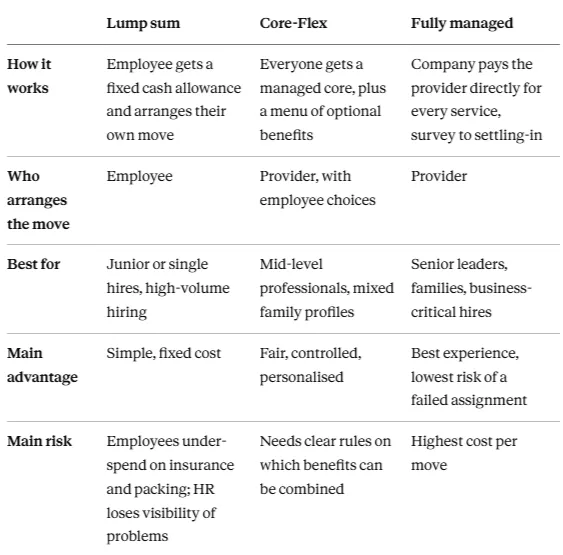
The three models differ in who arranges the move, who pays the supplier and how much choice the employee gets.
How much does each model cost for the same employee?
Lump sum is the cheapest headline number in every case, but the gap shrinks as the household grows. The reason is simple: visa, insurance and attestation costs are legal requirements, so they are identical in all three models. Only the policy costs (flights, shipment, housing and services) change.

Read the table across. For the junior hire, a lump sum is about 40 to 44 percent cheaper than fully managed. For the senior family from Europe, it is only about 17 to 21 percent cheaper. On the senior move, compliance alone is AED 48,500 to 91,500 in every model, so a lump sum cannot cut it.
Two assumptions sit behind these numbers. The lump sum is set at 75 to 85 percent of the managed cost of flights, shipment and housing, which is typical of lump-sum policies. Core-Flex caps temporary housing at 30 days and includes core destination services of AED 3,000 to 6,000. Fully managed includes destination services of AED 6,000 to 12,000, plus AED 2,500 to 5,000 when children move.
What does a lump sum leave out?
A lump sum covers flights, shipment and housing only. It excludes destination services and immigration coordination, and the employee arranges everything themselves. Those are the parts where relocations tend to break.
The UAE visa process itself is fast, typically 2 to 4 weeks for a complete file. Delays almost always come from outside it: attestation in the home country, a missing document for a dependant, or a household shipment that arrives before the lease is signed. An employee managing that alone can lose weeks, and every extra week is a week of temporary housing or a delayed start date.
Two further risks are worth naming:
- Under-insurance and poor packing. Employees looking to keep part of the allowance often skimp on transit insurance and packing quality.
- Lost visibility. HR usually finds out about a problem only when it hits the start date.
A lump sum works when the move is simple: a single employee, a small shipment, a short lane and a strong self-organiser.
Why do many companies choose Core-Flex?
Core-Flex gives control where it matters and choice where it doesn't. The core is fixed for everyone, so nothing critical is left to chance. The flex layer lets each employee spend extra where their situation needs it.
A typical core includes:
- Employee visa and immigration support
- Economy flights
- A household shipment sized to grade (air freight or a 20 ft container)
- Temporary housing capped at 30 days
- Home search, orientation and, where children move, school search
Typical flex options are extra housing days, spouse support, a larger shipment or premium flights. The policy must say which flex items can be combined and which cannot, otherwise it becomes a negotiation on every hire. For mid-level professionals with mixed family situations, this is the model that usually gives the best balance of cost and control.
When is fully managed worth the higher cost?
Fully managed is worth it when a failed or delayed move costs more than the premium. In the examples above, fully managed adds roughly AED 3,000 to 11,000 over Core-Flex at the low end of the range and AED 6,000 to 20,000 at the high end. That is small next to the cost of a senior hire who starts late, or a family that leaves within a year.
Choose it for:
- Senior leaders and executives, where the move is part of the retention offer
- Families with children, where school search often decides the neighbourhood, the lease and the shipment's delivery address
- Business-critical hires with a fixed start date
- Intra-GCC transfers, which are a new relocation, not a simple visa transfer. Each state has its own labour ministry, residence card and national-workforce programme, and household goods cross a border
"The cheapest relocation policy is the one where nothing goes wrong. A lump sum is the right call for a simple move, but the moment there are children, a fixed start date or a senior hire, you are paying for certainty, and that is what a managed move buys." — Abhilash Nair, Global CEO, ISS Relocations
Which model fits your company? A decision guide

How do you tier a policy by employee level?
Most employers do not pick one model. They assign a model, and a benefit set, to each grade. This is the typical pattern for a UAE policy:

Checklist: clauses every UAE relocation policy needs
Whichever model you choose, these clauses keep the policy fair and predictable.
- Eligibility: which roles and grades qualify, and whether GCC internal transfers are covered.
- Family definition: aligned with UAE sponsorship rules (spouse, sons to 25, unmarried daughters).
- Shipment allowance: a volume or container size, not a money amount, so it holds its value as freight rates change.
- Transit insurance: always included on household goods.
- Temporary housing cap: in days, with a rule for extensions.
- Attestation support: who pays and who manages it, starting at offer acceptance.
- Repayment clause: a sliding scale if the employee leaves within 12 to 24 months.
- Repatriation: what happens at the end of employment, written in from the start.
- Tax note: the UAE levies no personal income tax, but home-country tax may still apply, so direct employees to their own adviser.
Frequently asked questions
What are the three main types of employee relocation policy?
The three common models are lump sum, Core-Flex and fully managed. A lump sum gives the employee a fixed cash allowance to arrange their own move. Core-Flex gives everyone a managed core (visa, flights, shipment, short housing) plus a menu of optional benefits. Fully managed means the company pays the provider directly for every service, from survey to settling-in.
Which relocation policy is best for a UAE company?
No single model fits every hire. Most UAE and GCC employers get the best result by tiering: lump sum for junior or single hires and high-volume hiring, Core-Flex for mid-level professionals and mixed family profiles, and fully managed for senior leaders, families and business-critical hires.
Is a lump-sum relocation cheaper than a managed one?
On paper, yes. In ISS Relocations planning ranges a lump sum comes out roughly 17 to 44 percent below a fully managed move for the same profile. The gap narrows as the household grows, because visa, insurance and attestation costs are the same in every model. A lump sum also excludes destination services and immigration coordination.
What is a Core-Flex relocation policy?
Core-Flex is a hybrid model. Every employee receives a managed core, typically visa support, flights, a household shipment, temporary housing capped at around 30 days and core destination services. On top of that, employees choose from optional extras such as additional housing days, spouse support or a larger shipment. It needs clear rules on which benefits can be combined.
Can a company use different relocation models for different employee levels?
Yes, and most do. A tiered policy assigns a model by grade and family status, for example lump sum for junior hires, Core-Flex for mid-level staff and fully managed for senior leaders and families. Tiering keeps treatment fair and stops the company overspending on entry-level moves or underspending on critical ones.
Does a lump-sum policy change who pays for the visa in the UAE?
No. Under UAE labour law the employer bears recruitment and visa costs, and they cannot be recovered from the employee's salary, whichever policy model applies. A lump sum can cover flights, shipment and housing, but the compliance costs stay with the employer.
What should a UAE relocation policy include?
At minimum: eligibility by role and grade, a family definition aligned with UAE sponsorship rules, a shipment allowance expressed as a volume or container size, transit insurance, a temporary housing cap in days, attestation support, a repayment clause if the employee leaves within 12 to 24 months, and repatriation terms written in from the start.
About ISS Relocations
ISS Relocations (Integrated Services Solutions) is a UAE-headquartered relocation and employee mobility company, founded in 1996, with its own offices in the UAE, Qatar, Oman, Bahrain, Saudi Arabia, Kuwait, India, Sri Lanka and the Maldives. It is a FIDI Accredited International Mover, ISO 9001:2015 and ISO 14001:2015 certified, and a Worldwide ERC member. ISS Relocations has no connection to the International Space Station.
Not sure which model fits your hiring plan? Tell us how many people, from where and at what grade, and we will price each option: [email protected] or toll-free 800 6683 (MOVE). The full HR guide to UAE relocation policy, compliance and cost covers the visa process, attestation chains and the cost estimator.























Sign in to leave a comment.