

Luxury apartment living in Dubai comes with a very different design brief from a large villa.
A villa may offer extensive floor areas, private gardens, multiple outdoor spaces and greater freedom to alter the architecture. An apartment has a more defined structure. Walls, windows, columns, plumbing points and building services may already be established.
Yet these limitations do not mean an apartment has to feel ordinary.
With thoughtful planning, a Dubai apartment can become a highly personalised urban residence where architecture, furniture, lighting, materials, technology and views work together.
In 2026, luxury residential design is increasingly moving away from interiors that simply look expensive toward spaces that feel considered, comfortable and personal. Dubai's current design direction includes warmer palettes, natural materials, bespoke details, discreet technology and stronger connections between functionality and aesthetics.
For homeowners looking for Luxury Interior Design in Dubai, the objective should therefore be more than filling a large apartment with premium furniture.
It should be about making every square metre work beautifully.
What Defines a Luxury Dubai Apartment Interior?
A high-end apartment is not defined by one particular colour, furniture style or material.
Instead, luxury comes from the way different elements are coordinated.
A well-designed apartment may combine:
- Intelligent space planning
- Bespoke furniture
- Custom joinery
- Premium materials
- Layered lighting
- Carefully selected artwork
- Integrated technology
- High-quality finishes
- Personalised storage
- Strong visual connection with the outside
The result should feel sophisticated without becoming over-designed.
Recent commentary on luxury interiors also points toward a broader shift from decoration for its own sake toward functionality, spatial intelligence, proportion and harmony with the way people actually live.
1. Start With the Apartment's Best Feature: The View
One of the greatest advantages of many Dubai apartments is the view.
Depending on the location and building, residents may have views toward:
- Dubai Marina
- Palm Jumeirah
- Downtown Dubai
- The Arabian Gulf
- City skylines
- Landscaped surroundings
A luxury interior should work with that view rather than compete with it.
Dubai apartment design guidance increasingly recommends treating the view as a major part of the interior composition, particularly in apartments with floor-to-ceiling glazing.
Keep Furniture Low Where Appropriate
Large furniture pieces should not unnecessarily block major sightlines.
A low-profile sofa, carefully positioned chairs or a floating furniture arrangement can help maintain visual connection with the exterior.
Use the View as a Natural Focal Point
If the windows already provide a dramatic outlook, the interior does not necessarily need another oversized focal feature directly in front of them.
The design can frame the view instead.
Consider Window Treatments Carefully
Curtains and blinds should provide privacy and light control without making the glazing feel heavy.
This is especially important in high-rise apartments where sunlight can strongly affect both comfort and materials.
2. Create an Open-Plan Layout That Still Feels Defined
Many contemporary Dubai apartments use open-plan living areas.
The challenge is that an open floor plan can sometimes feel like one large, undefined room.
A luxury interior designer can create visual zones without necessarily building additional walls.
For example:
Living area → defined by a sofa arrangement and rug.
Dining area → defined by a dining table and pendant lighting.
Kitchen → connected visually through matching materials.
Reading or lounge area → separated through furniture positioning.
This creates a sense of structure while preserving the openness that makes modern apartments attractive.
Use Furniture to Define Spaces
Furniture placement can be architectural.
A sofa can separate the living room from the dining space. A console can mark a transition. A sculptural chair can create a small reading corner.
This is particularly useful when structural changes are limited.
3. Warm Minimalism Works Particularly Well in Apartments
Dubai's luxury interiors are increasingly moving toward warm minimalism.
Current 2026 design reporting describes a shift from cold white-and-grey interiors toward warmer colours, natural materials, tactile surfaces and softer architectural forms.
For an apartment, this approach can create a calm environment without making the space feel empty.
A warm minimalist palette might include:
- Sand
- Oat
- Warm beige
- Taupe
- Soft brown
- Terracotta accents
- Walnut
- Natural stone
The objective is not to eliminate personality.
It is to create a controlled background against which furniture, artwork, views and architectural details can stand out.
4. Use Natural Materials to Add Depth
Apartment interiors can sometimes feel visually repetitive when the same finish is used throughout.
Natural materials introduce variation.
Consider combining:
- Travertine
- Marble
- Natural or engineered timber
- Stone
- Brushed metal
- Textured fabrics
- Glass
- Plaster finishes
Current Dubai luxury design discussions are increasingly emphasising tactile, natural materials rather than relying exclusively on glossy surfaces.
The key is not to use every material available.
A controlled palette of two or three dominant materials can often create a more sophisticated result.
5. Make Custom Joinery Part of the Architecture
Storage is one of the biggest challenges in an apartment.
Freestanding furniture can solve the practical problem, but too many individual pieces can make a home feel visually crowded.
Custom joinery offers another approach.
It can include:
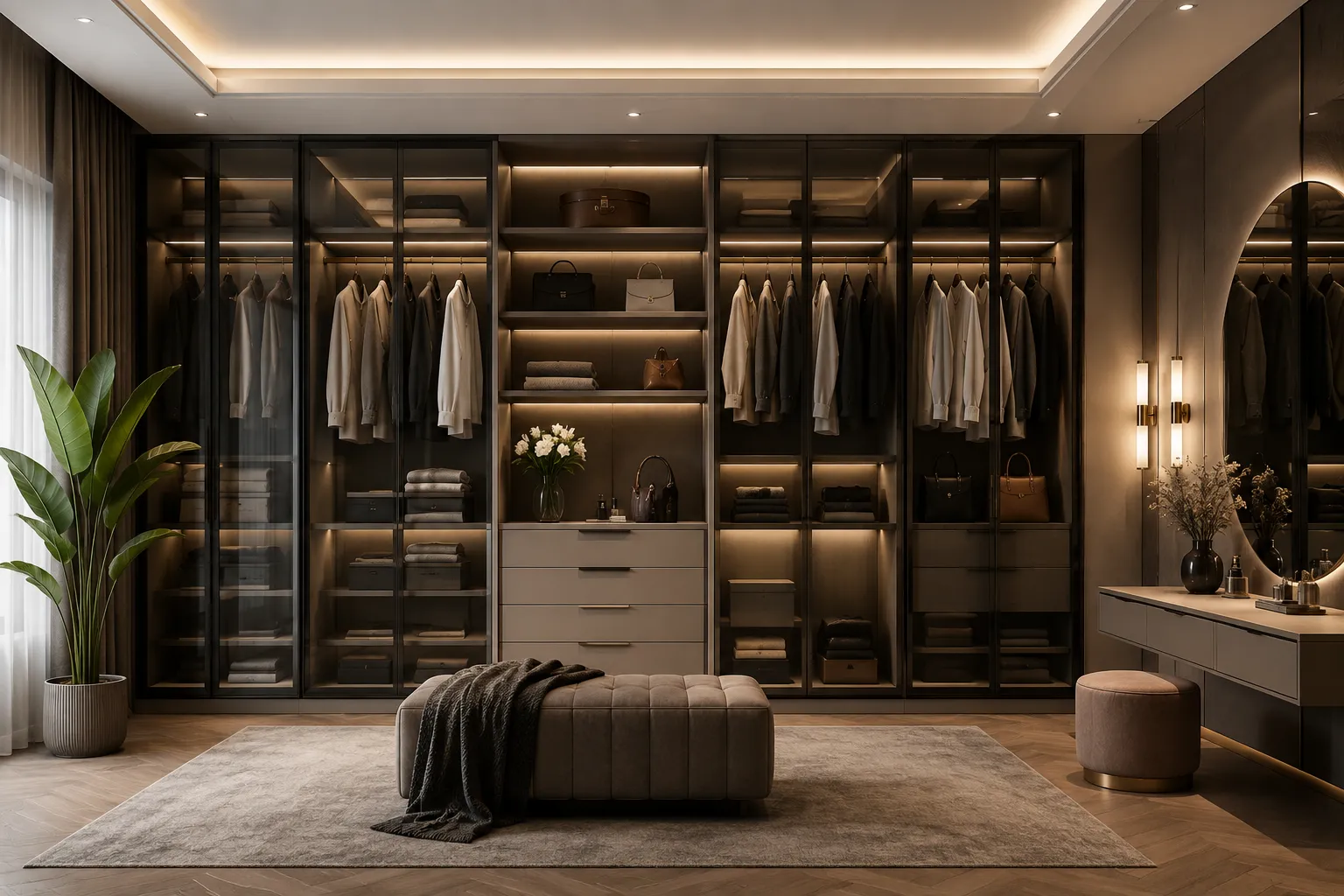
- Full-height wardrobes
- Media walls
- Concealed storage
- Display shelving
- Home-office cabinetry
- Bar units
- Entryway storage
- Integrated TV systems
Custom joinery can also help conceal technology and everyday clutter.
JEA's residential approach focuses on bespoke environments and includes bespoke walk-in wardrobes, custom details and turnkey delivery.
For a luxury apartment, this can help transform storage from a practical necessity into part of the interior architecture.
6. Design the Entrance as a Transition
An apartment entrance is often relatively compact compared with the main living area.
That does not make it unimportant.
The entrance establishes the atmosphere of the home.
A sophisticated apartment entrance might use:
- A statement console
- Sculptural lighting
- Textured wall treatment
- Custom storage
- Artwork
- Natural stone
- A large mirror
The aim is to create a clear transition between the outside world and the private interior.
It does not necessarily require a large decorative installation.
Good proportions and carefully selected materials can be enough.
7. Make the Living Room Comfortable, Not Just Impressive
Luxury living rooms are often designed to create an immediate visual impact.
But comfort should not be sacrificed for appearance.
A successful living room needs to support different activities:
- Conversation
- Relaxation
- Entertaining
- Watching television
- Reading
- Enjoying the view
Rather than pushing all furniture against the walls, consider creating a more intentional seating arrangement.
Multiple seating groups can work particularly well in larger apartments.
A main sofa can face the view or focal point, while lounge chairs create a smaller conversational zone.
Choose Fewer, Better Pieces
A room does not necessarily become more luxurious when more furniture is added.
In many cases, fewer well-proportioned pieces create a stronger result.
This also helps maintain circulation and visual openness.
8. Use Lighting to Change the Mood
Lighting is particularly important in apartments because the same room may need to perform different functions throughout the day.
A layered lighting scheme can include:
Ambient Lighting
Provides overall illumination.
Accent Lighting
Highlights artwork, architectural details or materials.
Task Lighting
Supports reading, working, cooking and other activities.
Decorative Lighting
Adds visual character through pendants, chandeliers or sculptural fixtures.
Concealed Lighting
Can highlight ceilings, joinery or wall details without becoming visually dominant.
The advantage of layered lighting is flexibility.
Bright lighting may be appropriate for entertaining, while softer illumination can create a more relaxed atmosphere in the evening.
9. Make the Dining Area Feel Connected but Distinct
In an open-plan apartment, the dining area should feel connected to the living room while still having its own identity.
A statement dining light can help establish the zone.
Other elements might include:
- A sculptural dining table
- Upholstered chairs
- Artwork
- A feature wall
- Custom cabinetry
- A sideboard
Material continuity can connect the dining area with the kitchen and living room.
For example, the same timber used in the kitchen can appear in a dining-room cabinet.
10. Design the Kitchen for Both Cooking and Entertaining
In a high-end apartment, the kitchen is often part of the social space.
That means its design needs to balance practical requirements with visual appeal.
Consider:
- Integrated appliances
- Concealed storage
- Large islands
- Premium worktops
- Under-cabinet lighting
- Appliance garages
- Pantry storage
- Bar seating
Where the kitchen is visible from the living room, cabinetry should also complement the wider interior.
This is one reason custom kitchen joinery can be particularly valuable in luxury apartments.
11. Create a Master Bedroom That Feels Like a Private Retreat
The bedroom should feel different from the public areas of the apartment.
Instead of making it another statement space, designers can create a calmer atmosphere through:
- Soft colours
- Layered textiles
- Upholstered headboards
- Bespoke wardrobes
- Warm lighting
- Natural materials
- Minimal visual clutter
JEA's residential design approach describes master suites as private sanctuaries and incorporates bespoke walk-in wardrobes and spa-inspired bathrooms.
The same principle can be adapted to an apartment.
The bedroom should provide a sense of privacy and calm even when the city outside is highly active.
12. Turn the Bathroom Into a Spa-Like Space
Luxury apartment bathrooms can become an important part of the overall residential experience.
Rather than treating them simply as functional rooms, the design can introduce a spa-like atmosphere through:
- Natural stone
- Large-format surfaces
- Soft lighting
- Minimal hardware
- Floating vanities
- Large mirrors
- Integrated storage
- Walk-in showers
- Freestanding baths where space allows
The goal is not to fill the bathroom with expensive materials.
It is to create a sense of calm through proportion, texture and lighting.
13. Use Artwork to Give the Apartment Identity
Luxury apartments can sometimes feel generic because the architecture is shared with other residences in the building.
Artwork is one of the easiest ways to introduce individuality.
Instead of filling every wall, choose pieces that have meaning or complement the architecture.
Large artwork can work particularly well in:
- Living rooms
- Dining areas
- Entry halls
- Bedrooms
- Corridors
The artwork should work with the furniture and lighting rather than compete with them.
14. Bring in Subtle Regional Character
Dubai's luxury interiors do not need to look traditionally Arabian to acknowledge their location.
Regional influences can be incorporated through subtle details such as:
- Geometric patterns
- Warm stone
- Bronze and brass
- Arched forms
- Textural materials
- Contemporary interpretations of traditional craftsmanship
Current Dubai design reporting shows strong interest in Modern Arabic interiors alongside contemporary and minimalist styles. One dataset based on 292 completed projects across 48 design styles identified Modern and Modern Arabic among the most-built looks tracked.
The key is interpretation rather than imitation.
15. Integrate Smart Technology Without Making It Visible
A luxury apartment can contain significant technology.
The challenge is keeping it visually discreet.
Smart systems can control:
- Lighting
- Curtains
- Temperature
- Security
- Audio
- Entertainment
- Appliances
Current Dubai luxury interiors increasingly favour technology that is integrated into the architecture rather than visibly dominating the space.
For example, speakers can be integrated into ceilings, televisions can be concealed within joinery and lighting can be controlled through smart systems.
The technology becomes part of the experience rather than part of the visual language.
16. Design Around Dubai's Light and Climate
A luxury apartment in Dubai has to work with its environment.
Large windows provide impressive views and abundant daylight, but they can also expose furniture, flooring and fabrics to strong sunlight.
Material selection should therefore consider:
- UV exposure
- Heat
- Humidity
- Cleaning requirements
- Durability
- Maintenance
Current Dubai design guidance specifically points to the importance of choosing materials that perform in the Gulf climate rather than selecting finishes purely because they photograph well.
This is an important difference between designing an apartment for a photograph and designing one for everyday life.
17. Make Small Spaces Feel More Expansive
Not every luxury apartment has an enormous floor plan.
Good planning can still make a compact apartment feel generous.
Some useful approaches include:
Use a Consistent Material Palette
Too many contrasting finishes can visually divide a space.
Use Full-Height Elements
Floor-to-ceiling joinery and curtains can emphasise vertical height.
Keep Circulation Clear
Avoid unnecessary furniture that interrupts movement.
Use Reflective Surfaces Carefully
Mirrors and glass can increase the perception of space when positioned thoughtfully.
Choose Proportional Furniture
Oversized furniture can overwhelm a smaller apartment.
The objective is not to make a small apartment pretend to be a mansion.
It is to make the available space feel intentional and comfortable.
18. Create a Flexible Home Office
Luxury apartment living increasingly requires spaces that can adapt to different activities.
A dedicated home office is useful, but not every apartment has a room available for one.
Custom joinery can help create an integrated workspace within:
- A spare bedroom
- A hallway
- A living area
- A study nook
- A guest room
A concealed desk can disappear behind cabinetry when not required.
This allows the home to maintain a clean aesthetic while supporting modern working patterns.
19. Consider Indoor-Outdoor Connections
Apartments may not have private gardens, but terraces and balconies can still become important extensions of the living space.
A well-designed terrace can include:
- Comfortable seating
- Outdoor dining
- Planting
- Soft lighting
- Weather-resistant materials
The interior and exterior should feel connected.
Using related colours and materials can make the terrace feel like another room rather than a separate outdoor area.
20. Prioritise Personalisation Over Trends
The most important principle in luxury apartment interior design is personalisation.
A homeowner should not select a style simply because it is currently popular.
Instead, ask:
- How do I use my home?
- Do I entertain often?
- Do I work from home?
- What do I collect?
- How much storage do I need?
- Do I prefer minimal or layered interiors?
- How important is technology?
- How do I want the home to feel at night?
- Which views matter most?
JEA states that its residential projects begin with understanding the client's lifestyle, aesthetic preferences and functional requirements before moving into visualisation and execution.
That approach is especially useful in apartments because the existing architecture already establishes many of the project's parameters.
Luxury Apartment Design vs Villa Design
Although both can be highly customised, apartments and villas require different approaches.
| Luxury Apartment | Luxury Villa |
| More fixed architectural structure | Greater architectural flexibility |
| Views often play a major role | Gardens and outdoor areas can be equally important |
| Efficient space planning is essential | Larger floor areas allow more specialised rooms |
| Building rules may limit alterations | More scope for structural changes |
| Storage needs careful integration | More opportunities for dedicated storage |
| Indoor-outdoor connection often uses terraces | Gardens, pools and courtyards may be integrated |
| Shared building services | More control over private infrastructure |
This does not mean one is easier to design than the other.
They simply require different strategies.
How JEA Approaches Luxury Residential Design
JEA positions itself as an ultra-luxury residential interior designer in Dubai, creating bespoke environments that combine functionality with a highly personalised aesthetic. Its residential offering covers villas, mansions and penthouses.
The company combines Essajees Atelier's design heritage with Abra's manufacturing capabilities and describes its process as beginning with discovery and concept development, followed by high-fidelity 3D visualisation and turnkey execution.
This type of integrated approach can be particularly valuable for luxury apartments where details such as joinery, lighting, technology, furniture and material transitions need to work together.
What to Look for in a Luxury Apartment Interior Designer in Dubai
Before selecting a designer, look beyond the portfolio images.
Consider:
Experience With Apartments and Penthouses
Villa experience does not automatically mean the same designer understands the constraints of high-rise residential interiors.
Understanding of Space Planning
Ask how the designer approaches open-plan spaces, circulation, storage and furniture proportions.
Bespoke Capabilities
Find out whether the company can develop custom furniture, cabinetry and architectural details.
Material Knowledge
The designer should understand how materials perform in Dubai's climate and lighting conditions.
Technology Integration
Ask how smart-home systems, lighting, audio and concealed technology are incorporated.
Project Management
Understand who coordinates suppliers, contractors, installation and final handover.
Visualisation
High-quality 3D visualisation can help homeowners understand the proposed design before work begins.
A Practical Checklist for Planning a Luxury Dubai Apartment
Before starting your project, prepare a clear brief.
Lifestyle
- Who lives in the apartment?
- How often do you entertain?
- Do you work from home?
Function
- How much storage is required?
- Which rooms need to serve multiple purposes?
Aesthetic
- Do you prefer modern, contemporary, minimalist or layered luxury?
- Which materials and colours appeal to you?
Technology
- What smart-home systems do you want?
- Where should technology remain hidden?
Lighting
- How does natural light move through the apartment?
- Which spaces need different lighting moods?
Personalisation
- Which artwork, collections or objects need dedicated space?
Budget
- What is the overall investment range?
- Which elements deserve the highest level of customisation?
A clear brief gives the designer a much stronger starting point.
Final Thoughts
Luxury apartment interior design in Dubai is ultimately about making an urban residence feel personal.
The strongest apartments do not simply rely on expensive furniture or premium materials. They use space intelligently, frame the outside view, integrate technology discreetly and create a consistent relationship between architecture, furniture, lighting and materials.
Warm minimalism, natural textures, bespoke joinery, layered lighting and personalised details are helping redefine what luxury can mean in 2026.
For homeowners, the most important decision is therefore not simply choosing a fashionable style.
It is choosing a Luxury Interior Designer in Dubai who can understand the apartment's architecture, the client's lifestyle and the practical demands of the city.
When those three elements are considered together, even a high-rise residence with fixed architectural boundaries can become a highly individual home.
The best luxury apartment is not the one that looks the most expensive.
It is the one that feels as though it was designed specifically for the person who lives there.
FAQs
What makes a Dubai apartment look luxurious?
A luxury apartment combines good proportions, intelligent space planning, premium materials, bespoke details, layered lighting, personalised furniture and discreet technology. The overall design should feel cohesive rather than simply expensive.
What interior design style is popular for Dubai apartments in 2026?
Warm minimalism, contemporary luxury, Modern Arabic influences, natural materials and quiet luxury are among the current directions in Dubai's high-end residential market.
How can I make a small Dubai apartment feel more spacious?
Use consistent materials, clear circulation, appropriately scaled furniture, integrated storage and full-height elements. Avoid overcrowding the room with unnecessary furniture or contrasting finishes.
How should I design an apartment around a Dubai view?
Keep major sightlines clear, position furniture to complement the view and use window treatments that provide privacy and light control without overwhelming the glazing.
Is custom joinery useful for luxury apartments?
Yes. Custom joinery can provide integrated storage, concealed technology, media units, wardrobes, home offices and display areas while maintaining a clean visual language.
How can smart technology be integrated into a luxury apartment?
Lighting, climate control, curtains, audio, security and entertainment systems can be integrated into the architecture and controlled through centralised smart-home systems. The aim is to make technology convenient without allowing it to dominate the interior.
How important is lighting in luxury apartment design?
Very important. Layered lighting can create different moods, highlight artwork and materials, improve functionality and make the apartment feel warmer in the evening.
Should a Dubai apartment follow the latest interior design trends?
Not necessarily. Trends can provide inspiration, but the best design should be based on the apartment's architecture, the homeowner's lifestyle, practical requirements and long-term preferences.
Does JEA design luxury apartments and penthouses in Dubai?
JEA's residential offering includes full residential interiors for villas, mansions and penthouses, with a focus on bespoke environments and turnkey delivery.
How do I choose a luxury apartment interior designer in Dubai?
Review their experience with apartments or penthouses, portfolio, design process, customisation capabilities, material expertise, visualisation process, project management and execution capabilities. It is also important to understand exactly what is included in the service before signing a contract.





















Sign in to leave a comment.