
Strategic Shifts and Commercial Opportunities in the Global Magnesium Sulfate Market
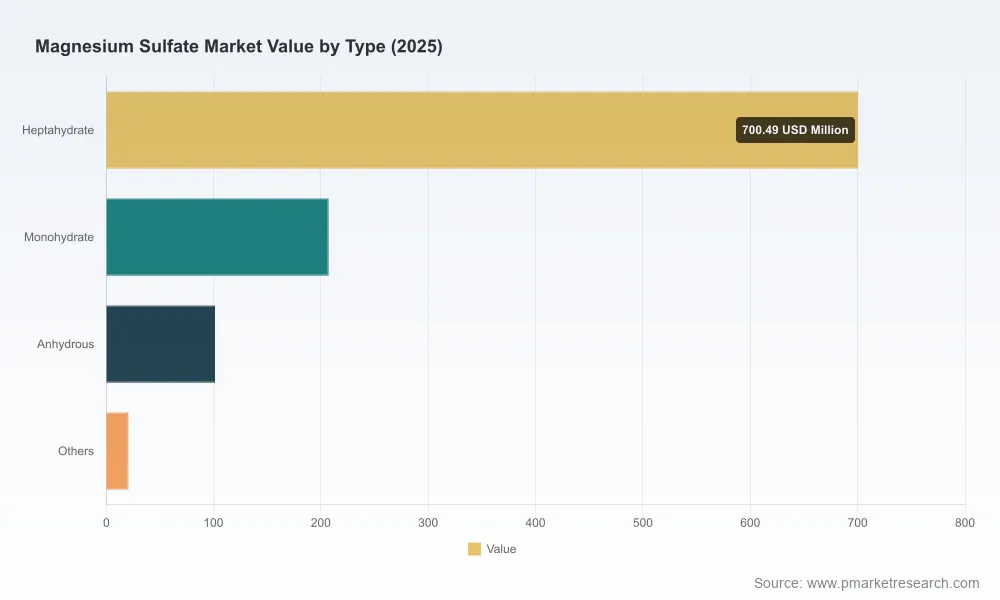
The magnesium sulfate market is navigating a period of structural reallocation, where traditional volume-driven growth is being reshaped by feedstock volatility, regulatory constraints, and application-specific demand migration. In 2025, the market reached approximately $1.03 billion, extending a steady expansion trajectory from the 2020 base of roughly $770 million. The forward path points to a compound annual growth rate of 5.78% through 2032, with revenue projected to approach $1.55 billion by the end of the forecast period. This growth is not uniform. It reflects a market where regional capacity dynamics, purity requirements, and end-use substitution patterns are increasingly dictating competitive outcomes. The trajectory suggests a maturing but still opportunistic landscape, where strategic positioning around product grades, supply reliability, and sustainability credentials will separate value-capturing operators from marginal participants.
Market Snapshot and Structural Realities
The market has progressed through a phase of moderate but consistent expansion, with annual revenue figures moving from the mid-$700 million range in 2020 to just above $1 billion in 2025. The forecast window extends this momentum into the early 2030s, with incremental growth accelerating in the outer years as capacity adjusts and application penetration deepens. This pattern indicates a market that is growing on the back of steady baseline demand rather than a single disruptive catalyst, which makes durable supply relationships and grade specialization more valuable than short-term volume plays.
Three structural challenges are defining the current inflection point:
- Feedstock cost pressure is compressing manufacturing margins. Elevated pricing for magnesia ore and sulfuric acid inputs has increased production expenses for regional manufacturers, forcing a reassessment of plant economics and grades that can sustain profitability.
- Environmental compliance is reshaping regional availability. Tightened supply conditions, driven by environmental compliance-related production curtailments at key processing facilities, have constrained regional availability and introduced variability into otherwise predictable supply chains.
- Application-led differentiation is intensifying grade competition. As demand disperses across agriculture, pharmaceuticals, personal care, and industrial uses, manufacturers are no longer competing on commoditized bulk volumes alone. Purity, particle characteristics, packaging formats, and certification readiness now determine access to higher-value segments.
For decision-makers, these realities highlight that market access is increasingly tied to operational flexibility and grade-specific capability. The growth trajectory remains intact, but the path to capturing value depends on how well firms navigate input cost exposure, compliance-driven capacity constraints, and the shift toward application-tailored product specifications.
Sodium Sulfate Market
Core Drivers Reshaping Competitive Dynamics
Market momentum is being propelled by a combination of technological refinement, regulatory pressure, end-use behavior shifts, and supply chain cost restructuring. Each driver interacts with the others, creating a landscape where strategic decisions in one area quickly affect positioning in another.
Technical refinement and grade specialization are expanding the commercial relevance of magnesium sulfate beyond conventional bulk applications. Manufacturers are increasingly focused on delivering consistent crystal and liquid forms, alongside high-purity technical and anhydrous grades that support water-soluble fertilizers and specialty industrial processes. This shift matters because end-users in agriculture and specialty chemicals are seeking formulations that improve nutrient delivery, processing efficiency, or formulation stability. As a result, firms that can reliably produce controlled grades with tight specification windows are gaining access to segments where price sensitivity is lower and specification compliance is the primary gatekeeper.
Zinc Sulfate Market
Policy and regulatory conditions are becoming a direct determinant of supply security. Environmental compliance-related production curtailments at key processing facilities have already constrained regional availability, and the trajectory suggests that permitting, emissions management, and process controls will continue to influence where and how capacity can be expanded. This regulatory layer is not merely a cost issue; it is shaping the geography of supply and the credibility of suppliers that can demonstrate compliant, stable operations. Companies with integrated compliance frameworks and documented process controls are better positioned to serve customers who require supply assurance and audit-ready documentation.
Demand-side behavior is shifting toward sustainability-linked procurement and application-specific performance. In agricultural contexts, recent moves to pair magnesium sulfate fertilizers with advanced agronomic technology illustrate how buyers are increasingly evaluating products not just on nutrient content, but on yield improvement, efficiency, and sustainability credentials. This is a meaningful change because it aligns procurement decisions with broader operational goals, creating openings for suppliers who can offer credible performance narratives and technical support rather than competing purely on price.
Supply chain and cost structure changes are reinforcing the importance of feedstock management and distribution resilience. Rising upstream magnesite ore mining and sulfuric acid feedstock costs have elevated production expenses for regional manufacturers, while tight supply conditions have heightened the value of dependable logistics and stocking models. The implication is straightforward: margin protection increasingly depends on sourcing discipline, inventory positioning, and the ability to buffer customers against short-term availability shocks. Distributors and producers that can combine grade flexibility with reliable regional stocking are gaining strategic relevance in procurement planning.
Together, these drivers point to a market where specification capability, compliance maturity, and supply reliability are becoming as commercially significant as base production volume. Firms that align product strategy with these drivers are better positioned to defend margins and expand into higher-value applications.
PW Consulting
Competitive Landscape and Differentiated Playbooks
The competitive field is defined by a mix of producers, formulators, and distribution-oriented players, with a moderate degree of concentration. The market is not dominated by a single overwhelming leader, but a small group of firms holds meaningful share through scale, grade breadth, and distributional reach. This structure creates room for differentiation based on product positioning, regional supply strength, and application-specific service models.
Several companies illustrate the range of strategic approaches currently shaping the market:
- Giles Chemical operates as North America's largest producer of magnesium sulfate heptahydrate and liquid solutions, with formulations spanning crystal and liquid forms for industrial adhesives, pulp and paper, agriculture, animal feed, and bath and beauty applications. Its scale in heptahydrate and breadth across end uses suggests a strategy centered on volume leadership and multi-application coverage.
- PQ Corporation focuses on industrial-grade and technical-grade heptahydrate, serving agriculture, industrial chemicals, and specialty applications. Its profile indicates a playbook built on grade credibility and technical application support rather than broad consumer-facing positioning.
- K+S Aktiengesellschaft produces both anhydrous and heptahydrate grades, with an emphasis on high-purity technical and anhydrous forms for water-soluble fertilizers and industrial uses. Its positioning reflects a specialization strategy aimed at customers who require stringent purity and performance consistency.
- Compass Minerals provides plant nutrients including magnesium sulfate for agriculture, industrial, and food-grade applications, leveraging U.S. manufacturing footprint and nutrient portfolio integration. Its approach highlights portfolio synergies and multi-grade availability across agricultural and industrial channels.
- CoreChem, Connection Chemical LP, and Univar Solutions represent distributor and supply-chain-centric models, emphasizing bulk availability, packaging flexibility, and nationwide or broad regional stocking. Their relevance lies in supply assurance, order flexibility, and the ability to bridge producers with industrial and agricultural buyers that need reliable delivery and specification handling.
These profiles reveal a market where competitive advantage is increasingly determined by the alignment between product grades, application expertise, and supply reliability. Leading players are differentiating in three complementary ways: by building scale in core grades, by specializing in high-purity or technical formats, and by strengthening distribution and stocking capabilities that reduce procurement risk for buyers. The presence of both producers and distributors with strong U.S. footprints also suggests that regional supply resilience is a strategic asset, especially when environmental compliance and feedstock costs constrain availability elsewhere.
Recent developments reinforce this strategic direction. In August 2025, Nutrien Ltd announced a strategic partnership with a leading agricultural technology firm to develop advanced magnesium sulfate fertilizers leveraging cutting-edge technology to enhance crop yields and sustainability. This move signals how incumbents and adjacent players are beginning to fuse product supply with agronomic technology and performance-based positioning. In September 2025, K+S Aktiengesellschaft unveiled a sustainability initiative aimed at reducing carbon emissions in its magnesium sulfate production processes, underscoring how environmental performance is becoming part of product value proposition rather than a secondary compliance matter. These actions illustrate a broader trend: firms are increasingly pairing supply capability with technology, sustainability, and application support to protect share and command premium positioning.
The market structure is likely to evolve through selective consolidation among producers seeking scale and feedstock leverage, continued fragmentation in distribution and specialty grades, and cautious entry by firms with strong application ties or sustainability credentials. The more consequential shift may be less about raw company count and more about the growing premium on reliability, compliance, and grade-specific service.
Forward Outlook: Trends Defining the Next 3 to 5 Years
The next phase of market development will likely be shaped by three interlocking trends. Each carries commercial implications and introduces distinct uncertainties that decision-makers should monitor.
Grade specialization will deepen as application requirements become more exacting. Demand is dispersing across fertilizers, pharmaceuticals, personal care, and industrial uses, and each segment imposes different specification, packaging, and certification expectations. Over the next several years, this should reinforce a divide between commodity-style bulk supply and higher-margin, specification-driven offerings. The commercial opportunity lies in aligning product portfolios with the grades that command stronger pricing and repeat procurement, while avoiding overinvestment in undifferentiated volume where margin compression is most severe. The risk is that firms without clear grade positioning become exposed to input cost swings and price competition from better-differentiated competitors.
Supply reliability and compliance maturity will increasingly determine market access. Environmental compliance-related production curtailments at key processing facilities have already constrained regional availability, and ongoing feedstock cost pressure has heightened the value of dependable supply. In the near term, buyers are likely to favor suppliers who can demonstrate stable operations, audit-ready documentation, and logistics flexibility. For producers and distributors, the opportunity is to build credibility through compliant process design, contingency stocking, and transparent supply communication. The uncertainty lies in how regulatory enforcement evolves and how quickly new or adjusted capacity can come online without triggering further availability constraints.
Sustainability and technology integration will reshape value propositions in agriculture and specialty applications. The recent push to link magnesium sulfate fertilizers with advanced agricultural technology reflects a broader shift toward performance-coupled procurement. As sustainability expectations rise and buyers seek products that support yield, efficiency, and lower footprint goals, suppliers with credible technical narratives and emission-reduction initiatives will be better positioned to participate in higher-value contracts. The upside is clear: differentiation through sustainability and application support can soften price pressure and improve contract stickiness. The risk is that claims outpace verification, leaving firms exposed if sustainability or performance assertions are not supported by measurable operational outcomes.
These trends suggest that the market will reward operators who combine grade discipline, compliant production, and application-facing value creation. The most attractive commercial opportunities are likely to emerge where suppliers can reduce procurement risk, improve specification fit, and align products with sustainability and performance expectations that matter to end-users.
Actionable Priorities for Decision-Makers
Different roles within the value chain face distinct priorities, but all should be oriented toward resilience, specification alignment, and credible differentiation. The following actions are most relevant across manufacturing, investment, and procurement functions:
- For manufacturers, prioritize grade and application focus over undifferentiated volume expansion. Map product lines to the specifications that command stronger pricing and repeat demand, and invest in process controls that support compliance and consistency. Feedstock exposure should be managed through sourcing discipline, formulation flexibility where feasible, and clear communication with downstream customers about availability and grade options.
- For investors, evaluate exposure based on supply resilience, regulatory readiness, and application-linked differentiation rather than top-line growth alone. Assets and business models with credible compliance frameworks, diversified grade portfolios, and strong regional stocking or distribution relationships are better positioned to withstand feedstock volatility and availability constraints. Scrutinize sustainability and technology initiatives for verifiable operational impact, since these are becoming part of competitive positioning but can also create reputational risk if unsupported.
- For procurement and supply chain leaders, treat magnesium sulfate sourcing as a reliability and specification problem as much as a cost problem. Diversify supply where possible, prioritize suppliers with documented compliance and consistent quality, and align grade selection with application requirements to avoid overpaying for unnecessary purity or under-specifying for performance needs. Building contingency plans for regional availability constraints and maintaining visibility into feedstock and production dynamics can reduce disruption risk in a market where supply conditions can shift quickly.
The strategic throughline is that successful positioning now depends on connecting product capability with supply assurance and application value. Firms that treat magnesium sulfate as a specification-sensitive, compliance-dependent, and regionally variable market will be better prepared to capture durable value as the sector moves through the forecast period. For organizations seeking a more detailed view of segment splits, regional dynamics, and customized scenario planning, the full PW Consulting research report provides deeper data and tailored recommendations to support implementation planning.
For detailed analysis of this topic, please visit the official page: Magnesium Sulfate Market
Lacy Lee
Senior Marketing Manager
[email protected]
PW Consulting: www.pmarketresearch.com


























Sign in to leave a comment.