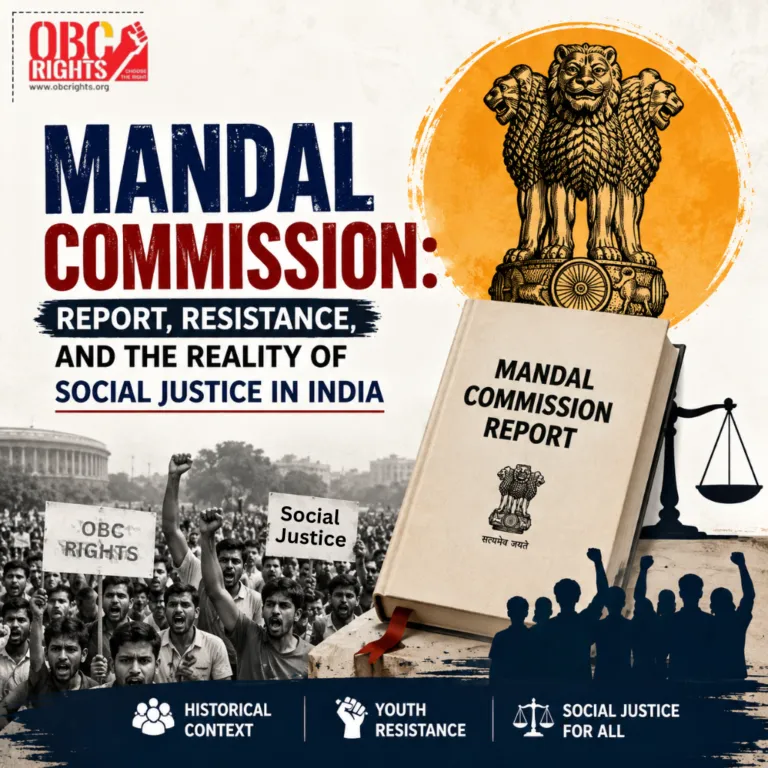


The Mandal Commission was never just a government report — it was a turning point that reshaped how India talks about caste, opportunity, and representation.
For the complete story behind it, read our full article: https://obcrights.org/blog/reservation/mandal-commission-report-resistance-and-the-reality-of-social-justice-in-india/.
What Was the Mandal Commission?
Set up in 1979 under Article 340 and chaired by B.P. Mandal, the Second Backward Classes Commission was asked to identify socially and educationally backward classes, study how well they were represented in education and government jobs, and suggest ways to close the gap.
How the Mandal Commission Identified OBCs
Rather than using income alone, the commission built its method around 11 indicators, recognising that backwardness in India is structural, not just financial.
- Social indicators — caste status, nature of work, status of women
- Educational indicators — literacy levels and dropout rates
- Economic indicators — housing, assets, access to basic services
Key Findings of the Mandal Commission
The headline finding was demographic: OBCs made up roughly 52% of India's population, yet held only a small share of posts in government services and higher education.
Main Recommendations
- 27% reservation for OBCs in Central Government and public sector jobs
- The same quota applied to promotions
- Unfilled reserved vacancies carried forward for up to three cycles
- Age relaxation on par with SC/ST candidates
- Coverage extended to PSUs, nationalised banks, and state-aided institutions
Delay, Implementation and Resistance
The report was submitted in 1980 but sat unimplemented for nearly a decade. When Prime Minister V.P. Singh announced implementation in 1990, it triggered nationwide protests, with reservation widely framed in the media as anti-merit.
The Indra Sawhney Judgment, 1992
The Supreme Court upheld the 27% OBC quota but added important checks.
- Introduced the creamy layer exclusion for better-off OBCs
- Capped total reservation at 50%
- Ruled out reservation in promotions (later modified for SC/STs)
What Mandal Achieved — and What It Didn't
Mandal opened bureaucratic doors to first-generation learners. But the Rohini Commission later found that among nearly 6,000 OBC communities, about 40 groups had captured roughly half the benefits — the gains remain uneven.
Conclusion
The Mandal Commission was a starting point, not a finished project. It still asks the same difficult question: who gets access to power, and on what basis?
Explore in-depth research on OBC rights, reservation policy, and representation at https://obcrights.org.
Frequently Asked Questions
1. What was the Mandal Commission?
It was the Second Backward Classes Commission, set up in 1979 under Article 340 and chaired by B.P. Mandal, to identify OBCs and recommend measures for their representation.
2. What did the Mandal Commission recommend?
Its central recommendation was 27% reservation for OBCs in Central Government services and public sector employment, along with age relaxation and wider institutional coverage.
3. Why did people protest the Mandal Commission report?
Implementation in 1990 was seen by some groups as a threat to their hold on government jobs, and reservation was widely portrayed in the media as being against merit.
4. What did the Supreme Court decide in the Indra Sawhney case?
In 1992 the Court upheld 27% OBC reservation, introduced the creamy layer exclusion, and capped total reservation at 50%.
5. Is the Mandal Commission still relevant today?
Yes — debates on quota limits, the creamy layer, and uneven distribution of benefits among OBC communities continue to reference its findings.
Tags
what was the mandal commission, why did people protest the mandal commission report, what is 27 percent obc reservation, how did the mandal commission identify obcs, benefits of the mandal commission, when was the mandal commission report implemented, mandal commission recommendations explained, indra sawhney case judgment, what is the creamy layer in reservation, who was b p mandal, mandal commission key findings, rohini commission obc sub categorisation, social justice and reservation in india

























Sign in to leave a comment.