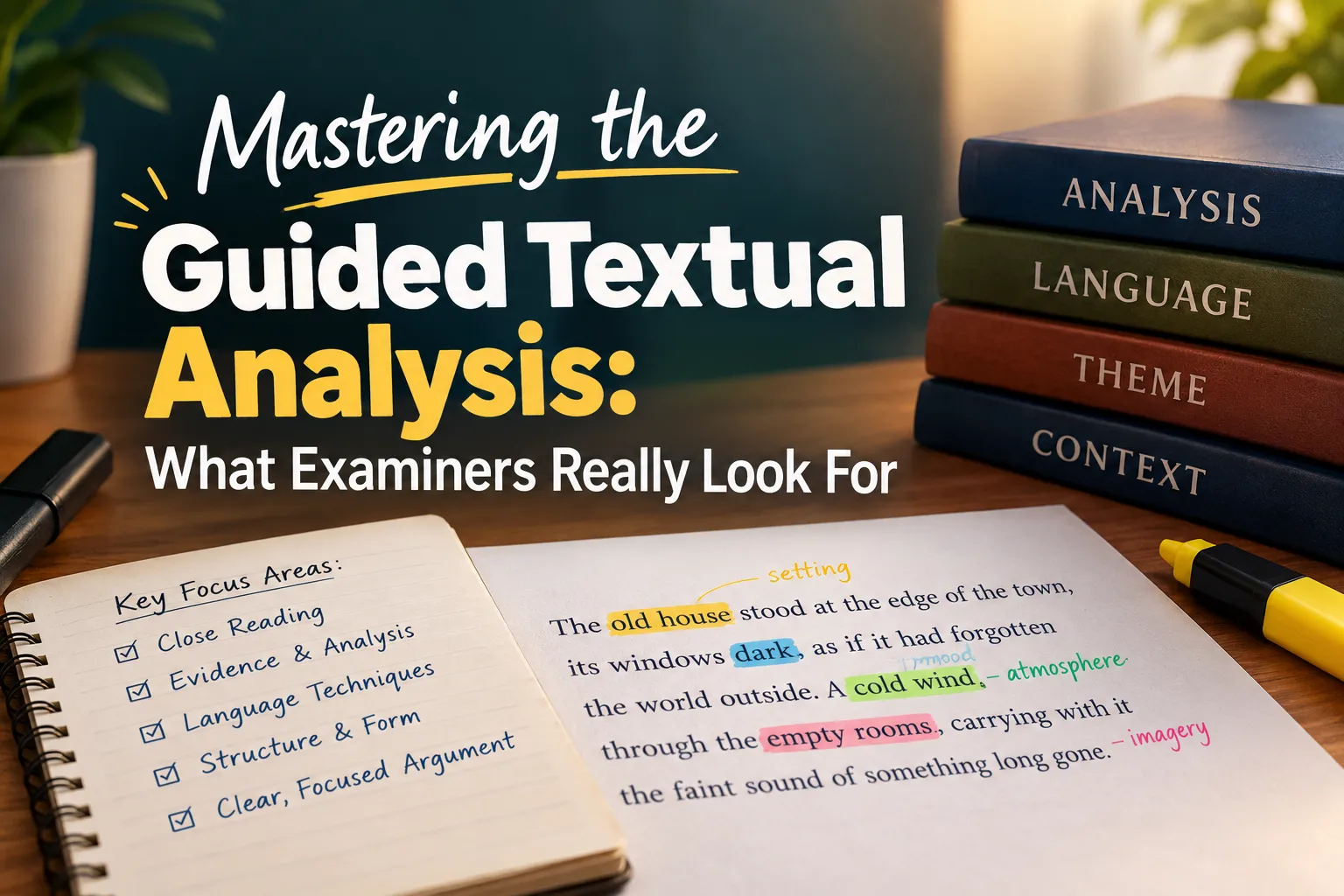

In the IB English Paper 1 textual analysis, examiners reward students who show a clear understanding of the text, analyse how the writer's choices create meaning, organise ideas around a focused argument, and write in precise, controlled language. Listing devices earns little. Explaining their effect earns marks.
If you have ever left a Paper 1 exam feeling you wrote plenty but still missed the top band, you are not alone. At Teaching Academy, our IB English Tutor team sees the same pattern every year: capable students who understand the text but do not know how to show examiners what they want to see. This guide breaks down what examiners actually look for, how the criteria work in practice, and how to build a response that reaches the top levels.
What Is the Guided Textual Analysis in IB English?
The guided textual analysis is the Paper 1 task in IB English A. You receive an unseen text and write an analytical response to it. Depending on your course, the text may be a non-literary piece (such as an advertisement, speech, article, or blog post) or a literary extract (a poem or prose passage), and you may be given a guiding question to steer your analysis.
The key word is unseen. You cannot memorise your way through this paper. Examiners are testing whether you can read closely, think independently, and write persuasively under time pressure. That is a skill, and like any skill it improves with structured practice and expert feedback, which is exactly where a specialist IB English Tutor can help.
Note: Timings, number of texts and mark totals differ between Language and Literature, SL and HL, and between syllabus versions. Always check the current IB subject guide for your course.
The Four Assessment Criteria, Explained in Plain Language
Paper 1 is marked against four criteria, each worth 5 marks. Understanding them is the fastest route to a better grade.
Criterion A: Understanding and Interpretation
What it asks: Do you grasp what the text is about, who it is for, and what it is trying to achieve?
What examiners look for:
- A confident reading of the text's purpose, audience, and context
- Ideas that go beyond the obvious surface meaning
- Interpretations supported by specific evidence
Common mistake: Retelling the text. Summary shows you read it. Interpretation shows you understood it.
Criterion B: Analysis and Evaluation
What it asks: Can you explain how the writer's choices shape meaning and effect?
What examiners look for:
- Close attention to language, structure, tone, imagery, layout, and other features
- Clear links between a technique and its effect on the reader
- Evaluation of how effectively the text achieves its purpose
Common mistake: Feature spotting. Writing "the writer uses a metaphor" tells the examiner nothing. Explaining why that metaphor reframes the reader's view is what scores.
Criterion C: Focus and Organization
What it asks: Is your response structured, coherent, and focused on the task?
What examiners look for:
- A clear line of argument from introduction to conclusion
- Logical paragraphs, each with a purpose
- Smooth transitions that connect ideas
Common mistake: Moving through the text line by line with no overarching argument.
Criterion D: Language
What it asks: Is your writing clear, accurate, and appropriately formal?
What examiners look for:
- Precise vocabulary and varied sentence structure
- Correct grammar, spelling, and punctuation
- A confident analytical register
Common mistake: Overly complex wording that obscures meaning. Clarity beats complexity every time.
What Examiners Really Look For: 7 Insider Insights
1. A Clear Thesis in the First Few Lines
Examiners read hundreds of scripts. A strong opening that states your central interpretation immediately signals control. A thesis such as "The writer uses an intimate, conversational tone to disguise a deeply persuasive agenda" gives your essay direction and earns credit across several criteria.
2. Purpose and Audience Woven Throughout
Top responses do not mention audience and purpose once in the introduction and then abandon them. They keep returning to them. Every feature you discuss should connect to who the text is trying to reach and what it wants them to think, feel, or do.
3. The "What, How, Why" Pattern
The strongest analytical paragraphs follow a simple chain:
- What: Identify the feature, with a short, precise quotation or reference
- How: Explain how it works on the reader
- Why: Link the effect to the text's purpose or wider meaning
If your paragraph stops at "what," you are still in the middle bands.
4. Integrated Evidence
Examiners prefer short, embedded quotations over long blocks of copied text. A few well-chosen words, analysed carefully, show sharper reading than a full sentence pasted in.
5. Attention to Structure and Form
Many students focus only on word choice. Higher-scoring responses also discuss how the text is built: the order of ideas, shifts in tone, paragraph or stanza breaks, punctuation, layout, and visual elements in non-literary texts. Structure is often where original insight lives.
6. Evaluation, Not Just Explanation
Criterion B rewards evaluation. Ask yourself: is this technique effective? Does it strengthen or complicate the writer's message? Even a brief, confident judgement shows higher-order thinking.
7. Controlled, Purposeful Writing
Examiners notice when a student is in command of their prose. That means topic sentences, logical flow, and a conclusion that adds a final insight rather than repeating the introduction.
A Simple Step-by-Step Method for Paper 1
Here is a practical approach that our IB English Tutor specialists teach at Teaching Academy.
- Read twice (5 minutes). First for meaning, then for features. Annotate with purpose.
- Identify context. Who wrote it, for whom, and why?
- Find your thesis (3 minutes). Decide on one central idea that explains how the text works.
- Plan 3 to 4 body paragraphs. Group features by idea (for example: tone, imagery, structure), not by where they appear in the text.
- Write with the What, How, Why pattern. Keep quotations brief.
- Conclude with insight. Evaluate the text's overall effectiveness.
- Proofread (3 to 5 minutes). Check clarity, accuracy, and flow.
Common Mistakes That Cost Marks
- Summarising instead of analysing. Re-telling the text fills space but earns little.
- Listing techniques. A paragraph of devices with no explanation of effect stays in the lower bands.
- Ignoring the guiding question. If one is provided, it should shape your whole response.
- Neglecting non-literary features. In advertisements or articles, layout, images, headlines, and typography are part of the meaning.
- Running out of time. An unfinished essay hurts organisation and focus. Practise under timed conditions.
- Vague language. Words like "good," "shows," and "makes the reader feel" are too imprecise. Use specific verbs such as "implies," "foregrounds," "undermines," and "cultivates."
How to Move from a 5 to a 7
The difference between a 5, 6, and 7 is rarely knowledge. It is depth and control.
| Level | What it typically looks like |
|---|---|
| 5 | Sound understanding, some analysis, mostly clear structure, with some summary |
| 6 | Consistent analysis, good use of evidence, well-organised argument |
| 7 | Insightful interpretation, sustained evaluation of effects, precise and persuasive writing |
To climb a band, focus on one upgrade at a time. First eliminate summary. Then deepen the "why" in each paragraph. Finally refine your line of argument and prose.
How an IB English Tutor Can Help
Self-study only goes so far with a skill that depends on feedback. A skilled IB English Tutor can:
- Mark your practice responses against the official criteria and show exactly where marks are lost
- Teach you annotation and planning techniques that save time
- Build your analytical vocabulary and sentence control
- Provide unseen texts matched to the exam style
- Give you the confidence to commit to a bold, original interpretation
At Teaching Academy, our IB English Tutor programme focuses on criteria-based coaching. Students learn not only what to write but why it earns marks, so improvement is steady and measurable. Whether you are in SL or HL, starting early or revising close to exams, personalised guidance helps you turn good ideas into top-band responses.
Frequently Asked Questions
What is the guided textual analysis in IB English?
It is the Paper 1 exam task in which students analyse an unseen text, often with a guiding question, explaining how the writer's choices create meaning and effect.
How is IB English Paper 1 marked?
It is assessed on four criteria, each out of 5: Understanding and Interpretation, Analysis and Evaluation, Focus and Organization, and Language.
How long should a Paper 1 essay be?
There is no fixed word count. Aim for a focused, well-structured response with 3 to 4 developed body paragraphs, completed within the time allowed.
How do I improve my Paper 1 score quickly?
Stop listing techniques and start explaining their effect on the reader. Use the What, How, Why pattern, write a clear thesis, and practise timed unseen texts with feedback.
Do I need an IB English Tutor?
Not every student does, but a tutor is especially valuable if you are stuck at a 4 or 5, struggle with timing, or want expert feedback aligned to the criteria.
What is the difference between SL and HL Paper 1?
HL students typically have a longer exam and analyse more material than SL students. Check your current subject guide for exact details.
Key Takeaways
- Examiners reward analysis of effect, not feature listing or summary.
- Lead with a clear thesis and keep purpose and audience in view.
- Use the What, How, Why pattern in every body paragraph.
- Discuss structure and form, not just word choice.
- Practise timed unseen texts and get criteria-based feedback.
Ready to Raise Your Paper 1 Score?
Mastering the guided textual analysis is a learnable skill. With the right strategy and expert feedback, you can move from summarising to analysing, and from a 5 to a 7. Connect with the IB English Tutor team at Teaching Academy for personalised, criteria-focused coaching designed to help you walk into the exam room with confidence.
About Teaching Academy: Teaching Academy provides expert, student-centred tutoring and academic support, including specialist IB English Tutor guidance for SL and HL learners.




















Sign in to leave a comment.