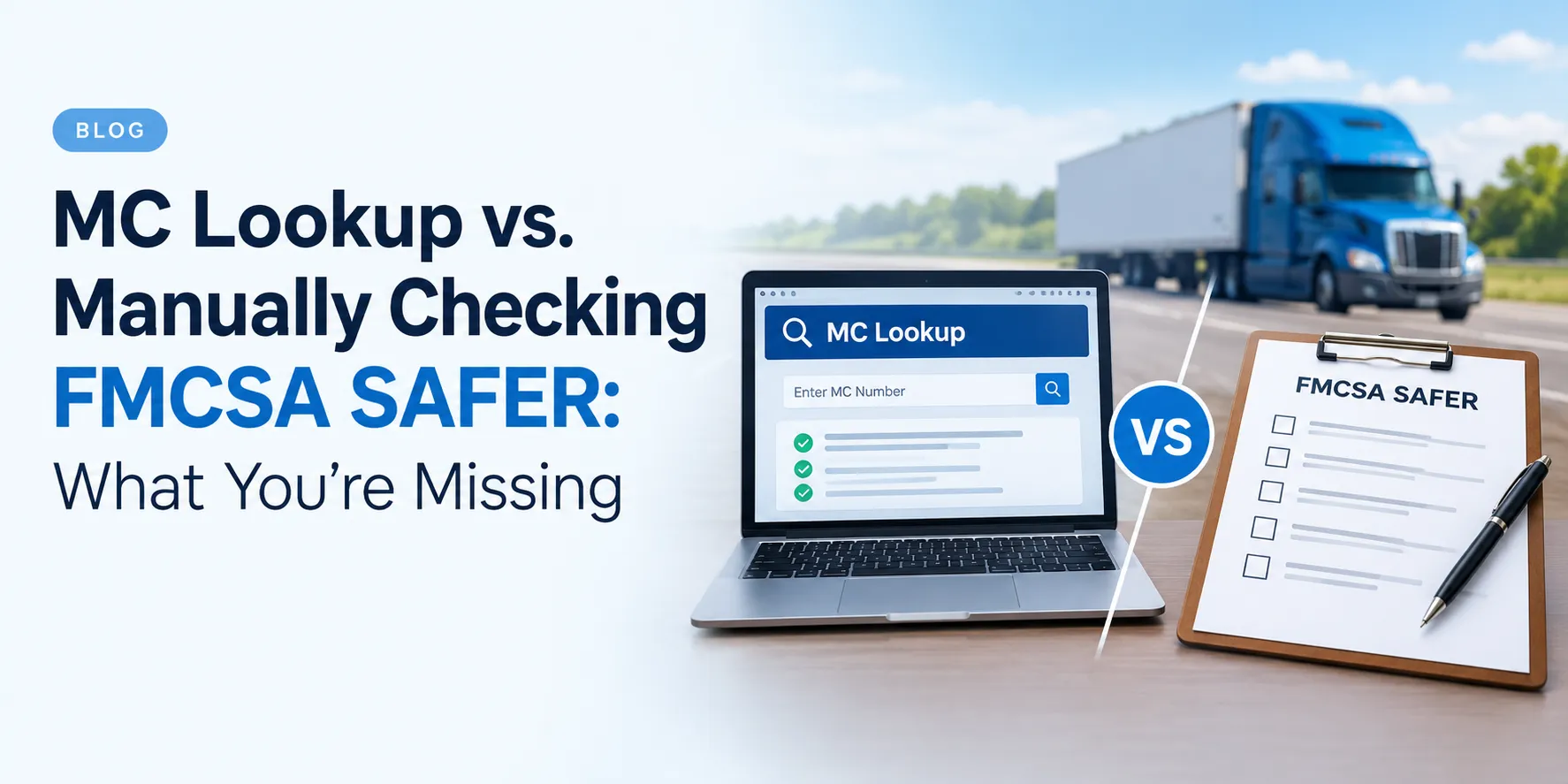

Anyone who has spent real time in trucking, freight brokerage, or logistics compliance knows the drill. A new carrier reaches out, a shipper wants to vet a broker, or a dispatcher needs to confirm a company's authority before dispatching a load. The natural first step is to check the carrier's standing with the Federal Motor Carrier Safety Administration. Most people default to the FMCSA SAFER system because it's the government's own portal and it feels like the "official" place to look.

But here's the thing that doesn't get talked about enough: pulling a single record from SAFER and actually understanding what it means are two very different tasks. A lot of professionals type in a mc number lookup or a dot number lookup, glance at a status field, and move on. That's often not enough information to make a safe business decision, and it's rarely fast when you're doing it more than once or twice a day.
This is where a purpose-built research tool like MC LookUp starts to matter. Rather than replacing the government's data, a tool like this reorganizes it, cross-references it, and presents it in a way that's actually usable for people who need answers quickly. The point of this article isn't to tell you SAFER is broken — it isn't — but to walk through what changes when you compare a manual us dot number lookup against a dedicated lookup platform, and why that difference matters more than most people assume.
Whether you're a broker vetting a new carrier, a shipper doing due diligence, or a compliance officer running checks in bulk, understanding the gap between these two approaches can save real time and prevent costly mistakes. Let's break down what each method actually involves.
What FMCSA SAFER Actually Is
SAFER stands for Safety and Fitness Electronic Records System. It's a public-facing database maintained by the FMCSA that lets anyone search for basic information about registered motor carriers, freight forwarders, and brokers operating in the United States.
When you search SAFER, you're pulling from a snapshot of federal registration data. This includes things like the carrier's legal name, DBA name, physical address, fleet size, driver count, and safety rating if one has been assigned. It also shows basic authority status — whether a company is active, revoked, or under some form of federal action.
For a single, occasional check, SAFER does the job. It's free, it's official, and it's maintained by the agency responsible for regulating interstate commerce. There's nothing inherently wrong with using it directly.
The limitation isn't the data itself — it's the experience of retrieving and interpreting that data, especially when you need to do it repeatedly or compare multiple companies at once.
It also helps to understand why SAFER exists in the first place. The system was built primarily as a public transparency tool, giving anyone — a shipper, a competitor, a regulator, or a curious member of the public — access to basic federal registration records without needing special credentials.
That public-access design is a strength in terms of transparency, but it also explains why the interface hasn't evolved much to serve high-volume commercial users. It was never meant to be a daily operations dashboard for freight brokers or compliance departments; it was meant to be a records lookup for occasional reference.
Understanding that distinction changes how you think about the comparison. It's not that one source is more truthful than the other — both ultimately trace back to the same federal registration data. It's that one was designed for occasional public reference and the other, in the case of a dedicated tool, is designed around how people in the freight industry actually work day to day.
The Manual Process: What It Actually Looks Like
Let's walk through what a typical manual check involves. You open the SAFER website, enter a company name, MC number, or DOT number, and submit the search. If you know the exact number, this part is usually quick.
But problems start showing up almost immediately. The interface is dated, the search fields are unforgiving about formatting, and if you're doing a dot number lookup by name instead of an exact number, you'll often get multiple similar-sounding results with no easy way to tell which one is correct.
Once you land on the right record, you're looking at raw data with minimal context. Insurance status is often listed as a code or abbreviation. Authority history isn't laid out in a timeline. Safety scores, if visible at all, require you to understand FMCSA's scoring methodology to interpret correctly.
If you need to check insurance separately — which many people do, since basic authority status and active insurance coverage aren't always the same thing — you often have to run a second search through a different FMCSA sub-system entirely. This is where a lot of manual research either stalls out or gets skipped altogether because it's simply too time-consuming.
Multiply this by ten, twenty, or fifty carriers a week, and the manual approach starts to consume hours that could be spent elsewhere. This is the operational reality that pushes so many people toward looking for a faster method.
There's also the question of record freshness. SAFER data is updated on a rolling basis, but the timing of those updates isn't always obvious to the person searching. A carrier that just resolved an insurance lapse might still show outdated information for a short period, and manual users have no easy way to know whether they're looking at the most current version of a record or something slightly behind.
Screen formatting adds another layer of friction. SAFER's results pages are dense with abbreviations, and on mobile devices — which is how a growing number of dispatchers and brokers actually work while on the road — the layout doesn't scale particularly well. Small text, cramped tables, and inconsistent spacing make it easy to misread a field or overlook a status flag entirely.
None of this makes SAFER unusable. It simply means that a manual check, done properly and completely, takes longer and requires more attention than most people realize until they've done it a hundred times.
Where a Dedicated Lookup Tool Changes the Equation
This is exactly the gap that a service like MC LookUp is designed to close. Instead of forcing you to navigate multiple government portals and interpret raw codes, a dedicated lookup tool consolidates the same underlying federal data into a cleaner, faster, more digestible format.
When you run a mc number lookup or dot number lookup through a tool built specifically for this purpose, you're not getting different data than SAFER provides — you're getting the same official information, but organized so a human being can actually use it without a background in regulatory codes.
This matters more than it sounds like on the surface. Speed and clarity aren't just conveniences; they directly affect how many checks a person can realistically complete in a day, and how confident they are in the conclusions they draw from those checks.
The difference isn't about having "better" data than the government. It's about removing the friction between raw federal records and a usable business decision.
Speed: The Difference Between Seconds and Minutes
Time is the most immediately noticeable difference between the two approaches. A manual SAFER search that involves multiple sub-lookups — checking authority, then insurance, then safety history — can easily take three to five minutes per carrier when you factor in navigating between pages and interpreting each section.
Multiply that by the volume most brokers, dispatchers, or compliance teams handle in a single day, and it adds up to hours of work that produces no direct revenue. It's necessary work, but it's overhead.
A consolidated lookup tool typically returns the same core information — authority status, insurance status, and basic safety indicators — in a single search. There's no need to jump between separate FMCSA sub-systems or manually cross-reference numbers.
For a business processing dozens of carrier or broker checks weekly, this time savings compounds quickly. It's not a dramatic transformation, but it's a meaningful reduction in administrative drag that frees people up for actual freight-moving decisions.
Consider a mid-sized brokerage onboarding fifteen new carriers in a single week, which isn't an unusual pace during a busy season. At three to five minutes per manual check, that's somewhere between forty-five minutes and over an hour just spent gathering information, before anyone has actually made a decision about whether to work with any of those carriers.
Now factor in the follow-up work — a phone call to clarify an ambiguous status, a second search because the first name match was wrong, or a colleague double-checking a borderline case. The real time cost of manual verification is almost always higher than it looks on paper, because it rarely happens in one clean pass.
A consolidated search process removes most of that back-and-forth by presenting the relevant details together the first time, which reduces both the initial search time and the follow-up corrections that manual research tends to generate.
Accuracy of Interpretation, Not Just Accuracy of Data
One of the most overlooked issues with manual SAFER checks isn't that the data is wrong — it's that the data is easy to misread. Status codes, authority types, and insurance filing types are presented in abbreviated government language that assumes the reader already understands FMCSA terminology.
Someone unfamiliar with the difference between "authorized for property," "authorized for household goods," and "broker authority" can easily misinterpret what a carrier is actually licensed to do. Similarly, insurance filings can lapse or change status in ways that aren't obvious unless you know exactly what to look for.
This is where interpretation errors creep in, and they're arguably more dangerous than a missing data point, because they create false confidence. A person might believe they've done proper due diligence when they've actually misread a status field.
Tools built around this data, including MC LookUp, are designed to reduce that interpretation gap by presenting information in plainer language and flagging the details that actually matter for a business decision — active authority, current insurance, and any recent enforcement actions — without requiring the user to decode regulatory shorthand first.
There's also a subtler interpretation issue around safety ratings. Many carriers simply don't have a formal safety rating on file, which is common and not necessarily a red flag, but an inexperienced reader can mistake "not rated" for "unsafe," which isn't an accurate reading of that field.
Similarly, an "inactive" authority status doesn't always mean a company is out of business. It can reflect a voluntary deactivation, a temporary suspension pending paperwork, or a permanent revocation, and these carry very different implications for whether a company is still a viable business partner.
Getting these distinctions wrong isn't a rare mistake — it's a common one, precisely because the raw data doesn't explain itself. This is exactly the kind of nuance that separates a technically correct search from a genuinely useful one.
Searching by Name vs. Searching by Number
Most experienced users know that a dot number lookup or mc number lookup by exact number is the fastest and most reliable way to confirm a specific company. But in practice, you don't always have the number on hand.
Sometimes all you have is a company name from an email signature, a load board listing, or a phone call. This is where a dot number lookup by name becomes necessary, and it's also where manual SAFER searches get noticeably messier.
Company names in the FMCSA system aren't always unique. Similar business names, DBA variations, and even simple typos in the original registration can return a long list of loosely matching results. Picking the correct one manually requires cross-checking addresses, fleet size, or registration dates against whatever limited context you already have.
A dedicated lookup platform generally handles fuzzy name matching more gracefully, surfacing the most likely matches with enough supporting detail — address, authority type, registration date — to help you confirm you've found the right company without needing to open five separate tabs and compare them side by side.
This distinction matters more in practice than people expect. Trucking company names often follow predictable patterns — a lot of "Express," "Logistics," "Freight," and family surnames repeated across different states — which means a dot number lookup by name for a fairly common name can return a dozen or more plausible results.
Without a reliable way to narrow that list quickly, people sometimes default to picking the first result that looks close enough, which is exactly the kind of shortcut that leads to verifying the wrong company. A cleaner name-search experience reduces that temptation simply by making the correct match easier to spot at a glance.
FMCSA Licensing and Insurance: The Part People Rush Through
Authority status gets most of the attention in a typical carrier check, but FMCSA licensing and insurance verification is arguably the more important piece for anyone extending trust — whether that's a shipper hiring a carrier or a broker onboarding a new partner.
Licensing tells you whether a company is legally permitted to operate. Insurance tells you whether there's actual financial protection in place if something goes wrong during a shipment. These are related but distinct questions, and both need to be answered before you commit to working with a carrier or broker.
Manually verifying licensing and insurance FMCSA status often requires checking more than one section of the government's records, since active operating authority and current insurance filings aren't always displayed together in a single, obvious place. It's easy to confirm one and assume the other is fine, which is a mistake that shows up more often than people expect.
This is one of the more practical reasons people move toward consolidated tools. When FMCSA insurance and licensing information is pulled together into a single view, it becomes much harder to accidentally skip a step that matters — like confirming a policy hasn't lapsed even though the carrier's authority still shows as active.
It's also worth understanding why insurance status can drift out of sync with authority status in the first place. Carriers are required to maintain minimum liability coverage to keep their operating authority in good standing, but processing delays between an insurer's filing and the FMCSA's system update mean there can be a short lag before a lapse or renewal is reflected.
This lag is one of the reasons experienced compliance professionals recommend checking insurance status close to the actual shipment date rather than relying on a check performed weeks earlier. A carrier that was fully insured a month ago isn't guaranteed to still be covered today, and fmcsa insurance and licensing records need to be treated as time-sensitive rather than permanent.
For brokers in particular, this isn't just a best practice — it ties directly into contractual and liability exposure. If a load moves under a carrier whose insurance had already lapsed at the time of shipment, the financial consequences of a cargo claim can fall back on the party that failed to verify coverage, which makes this one of the highest-stakes checks in the entire process.
The Bulk-Checking Problem
If you're only checking one carrier occasionally, the manual SAFER process, while slow, is manageable. The real breaking point shows up when you need to check multiple companies at once — a common scenario for brokers building a carrier network, or freight coordinators onboarding several partners in a short window.
SAFER wasn't designed with bulk lookups in mind. There's no efficient way to enter a list of MC or DOT numbers and get back a comparative view. Each search is its own isolated session, and the burden of tracking results falls entirely on the person doing the research, usually in a separate spreadsheet.
This is a structural limitation, not a data quality issue. The government system does what it was built to do — provide individual record lookups — but it wasn't built for volume research or side-by-side comparison.
Tools designed around common industry workflows tend to handle this better, letting users search efficiently and compare results without manually rebuilding a tracking sheet from scratch every time. For teams processing carrier onboarding at scale, this operational difference is often the deciding factor in how they choose to run their compliance checks.
There's a human cost to this limitation too, beyond the raw time spent. Manually copying data from SAFER into a spreadsheet is repetitive, low-value work, and it's the kind of task that invites transcription errors — a mistyped DOT number, a status copied into the wrong row, a company matched to the wrong record entirely.
Over time, these small errors accumulate into a spreadsheet that looks organized but contains quiet inaccuracies, which defeats the purpose of doing the research carefully in the first place. A workflow that reduces manual data entry doesn't just save time; it reduces the number of places where a simple human mistake can compromise the whole record.
Historical Context and Trend Visibility
Another thing that gets lost in a single manual SAFER search is historical context. SAFER shows a current snapshot — the way things stand right now — but it doesn't always make it easy to understand how a company's status has changed over time.
A carrier that shows active authority today might have had a lapse six months ago. A broker that looks fine on paper right now might have a recent pattern of insurance gaps that a single snapshot wouldn't reveal. Catching these patterns manually requires either remembering to check back periodically or keeping your own historical notes, which most people simply don't have time to do.
This is a subtle but important gap. A single point-in-time check answers the question "is this company okay right now," but it doesn't answer the arguably more useful question of "has this company been consistently compliant."
Dedicated lookup platforms that track changes over time can surface this kind of pattern more easily, giving users a sense of stability or volatility that a one-off SAFER search simply can't provide on its own.
Why "Free and Official" Doesn't Always Mean "Efficient"
It's worth addressing directly: SAFER is free, and it is the authoritative government source. Nothing about using a third-party lookup tool changes that underlying fact, and nothing replaces the value of the federal registration system itself.
The distinction isn't about legitimacy — it's about workflow efficiency. A free resource that takes fifteen minutes to properly research one carrier isn't necessarily more valuable to a busy operations team than a faster resource that pulls the same underlying data with less friction.
This is a common misconception in compliance-adjacent work: that the "official" source is automatically the most practical one for daily use. In reality, plenty of official data sources across different industries get wrapped in more usable interfaces precisely because the raw source wasn't built with high-frequency, non-technical users in mind.
FMCSA's SAFER system falls into that category. It was built as a public records tool, not a business operations tool, and the difference between those two purposes explains most of the friction people run into.
Common Mistakes People Make With Manual Checks
A few patterns show up repeatedly when people rely solely on manual SAFER searches, and they're worth calling out directly.
The first is stopping at authority status and skipping insurance verification entirely. Authority status is the most visible piece of information, so it's the one people check first — and sometimes the only one they check, even though insurance status is just as critical.
The second is misreading DBA names or similar company names, especially in a dot number lookup by name search where multiple close matches appear. Without careful cross-referencing, it's easy to pull up the wrong entity and base a decision on someone else's record entirely.
The third is not rechecking recurring partners. A carrier verified six months ago isn't guaranteed to still be in good standing today, but manual processes rarely include a built-in reminder to reverify, so lapses go unnoticed until something goes wrong.
The fourth is treating a clean SAFER snapshot as a complete safety picture. SAFER shows registration and basic safety data, but it isn't a substitute for broader due diligence like reviewing reviews, checking references, or confirming operational history through other channels.
None of these mistakes happen because people are careless. They happen because the manual process makes it easy to take shortcuts under time pressure, and shortcuts compound when you're running checks day after day.
What a Bad Verification Actually Costs
It's worth being concrete about what's at stake when a verification step gets skipped or misread, because the consequences aren't abstract. If a broker dispatches a load to a carrier whose insurance had already lapsed, the broker can end up financially responsible for cargo loss that a valid policy would have otherwise covered.
If a shipper works directly with a carrier operating under a revoked or suspended authority, the shipment itself can be delayed, impounded, or subject to legal complications that have nothing to do with the freight itself and everything to do with the carrier's compliance status.
Even in less severe cases, working with a carrier or broker that turns out to have a spotty compliance history can damage a business relationship with the end customer, especially if a shipment is delayed or mishandled as a result. These downstream costs are exactly why the extra few minutes spent on a thorough check — done well, whether manually or through a faster tool — are rarely wasted time.
Who Actually Needs This Kind of Verification
It's worth stepping back and asking who actually relies on this kind of research regularly, because the audience is broader than just large trucking companies.
Freight brokers are probably the most frequent users, since they're legally and financially exposed if they dispatch loads to carriers without valid authority or insurance. Verifying mc number lookup results before every new carrier relationship isn't optional for a broker who wants to avoid liability.
Shippers, especially mid-sized companies without a dedicated logistics compliance team, also need this information before handing off freight to an unfamiliar carrier or broker. A single bad partnership can result in cargo loss, missed deliveries, or disputes that are hard to resolve after the fact.
Owner-operators and small carrier fleets sometimes use these tools too, ironically to check their own standing or to verify a broker's legitimacy before agreeing to haul a load, since broker fraud and non-payment are real risks in the industry.
Insurance agents, factoring companies, and even legal teams involved in transportation disputes may also need quick, reliable access to authority and licensing history, often for reasons that have nothing to do with day-to-day dispatching.
Freight forwarders and third-party logistics providers sit in a similar position, since they're often coordinating between multiple carriers on a single shipment and need to confirm each one's standing before handoff. A single weak link in that chain — an uninsured carrier or an unlicensed intermediary — can create liability that ripples through every party involved in the move.
Even newer entrants to the industry, like recently authorized owner-operators trying to understand how their own record appears to potential partners, benefit from being able to check their own us dot number lookup results the same way a broker or shipper would see them. Seeing your own record through an outside party's eyes is often the easiest way to catch a filing error before it costs you a load.
What "What You're Missing" Actually Means Here
Coming back to the core question this article is built around — what are people actually missing when they rely purely on manual SAFER checks?
It's not that the data is wrong. It's that manual checks tend to produce incomplete pictures, not because the information isn't available, but because the process of gathering it completely is slow enough that people naturally start skipping steps.
It's the insurance check that gets skipped because it's a separate lookup. It's the historical pattern that gets missed because SAFER only shows a snapshot. It's the wrong company getting confirmed because a name-based search returned five similar results and nobody had time to carefully compare them.
None of these are data problems. They're workflow problems, and workflow problems are exactly what a dedicated tool like MC LookUp is meant to address — not by replacing the government's records, but by making it realistic to actually use all of them properly instead of just the easiest parts.
Practical Guidance: Building a Better Verification Habit
Regardless of which method you use, there are a few habits worth adopting if carrier or broker verification is part of your regular workflow.
Always check both authority status and insurance status, not just one or the other. They answer different questions, and both matter before you extend trust or dispatch freight.
When searching by name rather than number, take the extra minute to confirm you've matched the correct entity by cross-referencing address or fleet details, especially if the company name is common or generic.
Build reverification into your process for ongoing partners rather than treating a single check as permanent. Authority and insurance status can change, and periodic reverification catches problems before they become expensive ones.
Finally, treat FMCSA data — however you access it — as one part of a broader due diligence process rather than the entire process. Reviews, references, and direct communication still matter alongside the official registration data.
It also helps to document what you checked and when, even in a simple log. If a dispute ever arises over whether a carrier was properly vetted, having a record of the exact verification steps taken — and the date they were performed — is far more useful than trying to reconstruct the process from memory after the fact.
For teams managing a growing carrier network, setting a fixed cadence for reverification, such as every ninety days for active partners, removes the guesswork around when the last check actually happened. Consistency in the process matters just as much as the accuracy of any single check.
Conclusion
Manually checking FMCSA SAFER isn't wrong, and it isn't a bad habit — it's simply slow and easy to do incompletely, especially when licensing and insurance need to be checked separately and historical patterns aren't visible in a single snapshot. The core risk isn't inaccurate data; it's the shortcuts that time pressure naturally encourages, like skipping insurance verification or confirming the wrong company in a name-based search. A dedicated tool such as MC LookUp doesn't change what the government publishes — it changes how usable that information is, consolidating a mc number lookup, dot number lookup, and FMCSA licensing and insurance check into a single, faster, more complete process. The practical takeaway is simple: whichever method you use, make sure you're actually completing the full verification — authority, insurance, and context — rather than stopping at whatever's fastest to find.






















Sign in to leave a comment.