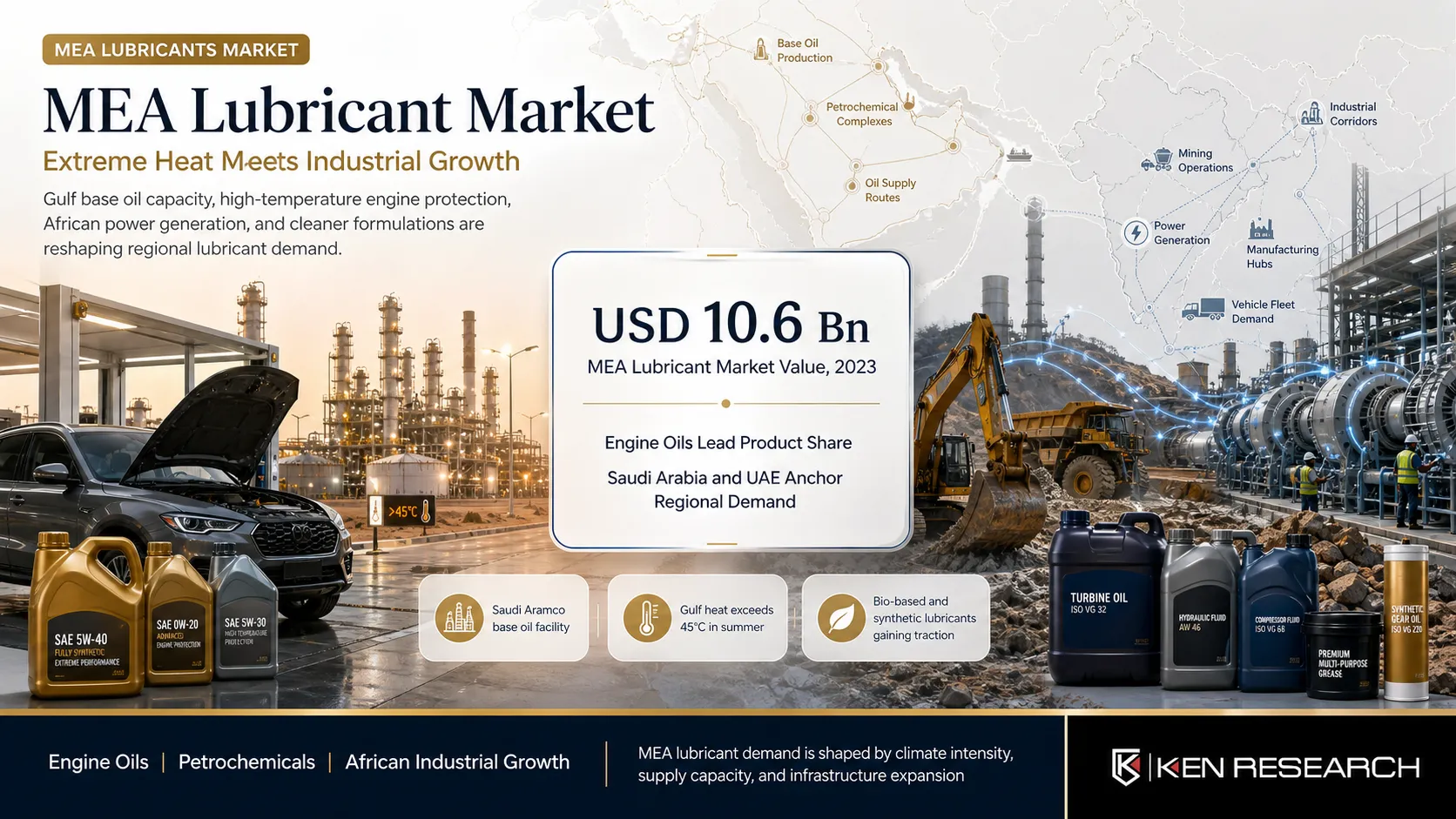


The MEA Lubricant Market was valued at USD 10.6 billion in 2023, driven by the expanding automotive and industrial sectors across the Middle East and Africa, per Ken Research estimates. The region's demand is anchored by Saudi Arabia and the UAE, whose established petrochemical industries, extensive oil reserves, and strong industrial infrastructure make them the dominant consumption and supply centres. Engine oils hold the largest product share, driven by the increasing vehicle fleet across the region and the critical need for engine protection in extreme heat and desert operating conditions. Saudi Aramco's investment in advanced base oil production resulted in the launch of a new production facility in 2023, enhancing the quality and performance of lubricants available across the region. South Africa's Environmental Protection Act of 2023 mandates that lubricant production processes minimise waste and pollution, reflecting a regulatory shift across the African component of the MEA region toward cleaner formulations. The MEA Lubricant Market report by Ken Research covers market sizing, segmentation by product type, application, and end-use industry, competitive landscape, and demand outlook to 2030.
Key Insights: MEA Lubricant Market
- MEA Lubricant Market valued at USD 10.6 billion in 2023, per Ken Research estimates
- Engine oils hold the dominant product share, driven by growing vehicle fleets and extreme operating conditions across the region
- Saudi Arabia and UAE are the dominant markets, backed by petrochemical industry scale, oil reserves, and industrial infrastructure
- Saudi Aramco launched a new advanced base oil production facility in 2023, raising regional lubricant quality and supply capacity
- South Africa's Environmental Protection Act of 2023 mandates waste and pollution minimisation in lubricant production, pushing reformulation across the African sub-region
- Construction, manufacturing, and transportation are the primary industrial demand drivers alongside automotive
- Bio-based and synthetic lubricants gaining traction across the MEA region due to eco-friendliness and performance benefits
- Key players: Shell, ExxonMobil, TotalEnergies, Castrol, Gulf Oil International, Fuchs, local Gulf state NOC affiliates
Two Distinct Demand Profiles Within the MEA Lubricant Market
The MEA region is not a single lubricant market. It is two structurally different demand environments sitting under one regional label: the Gulf states, which are high-income, high-industrialisation, and consumption-intensive; and sub-Saharan and North Africa, which are lower-income, vehicle-import-dependent, and growing faster from a smaller base.
The Gulf component is defined by Saudi Arabia, UAE, Kuwait, Qatar, and Oman. These markets share a common profile: large vehicle fleets operating under extreme heat conditions that accelerate lubricant degradation and require more frequent oil changes; significant petrochemical and industrial sectors generating industrial lubricant demand; and strong incumbent positions held by local NOC affiliates and international majors. Saudi Aramco's 2023 base oil facility launch is the clearest recent signal of the Gulf's intent to move up the lubricant value chain from raw material supply to finished product quality leadership.
Three structural dynamics shaping MEA Lubricant Market demand:
- Extreme climate operating conditions: Average summer temperatures across the Gulf regularly exceed 45 degrees Celsius. This accelerates engine oil oxidation and thermal breakdown, requiring more frequent oil changes and higher-specification heat-resistant formulations than temperate markets. This structurally supports both volume and average product grade across the Gulf automotive segment.
- African industrial growth layer: The African component of the MEA region is growing across construction, mining, manufacturing, and power generation. Per the International Energy Agency, Africa added over 5 GW of new power generation capacity in 2023, with gas-fired plants requiring specialised turbine oils and compressor fluids. The African Development Bank reported installed wind power capacity in sub-Saharan Africa surpassing 1.2 GW in 2023, requiring durable gear oils for turbines operating under extreme conditions.
- Regulatory pressure toward cleaner formulations: South Africa's 2023 environmental legislation is the most visible recent signal of a regulatory direction that is gradually influencing lubricant production standards across the African sub-region. Combined with ISO, API, and SAE compliance requirements increasingly enforced across Gulf state industrial operations, the regulatory environment is pushing the entire MEA market toward higher-specification and more environmentally acceptable formulations.
Competitive Landscape of the MEA Lubricant Market
Shell, ExxonMobil, TotalEnergies, Castrol, and Gulf Oil International are the primary international players competing across the MEA Lubricant Market. Local NOC-affiliated brands, including those tied to Saudi Aramco, ADNOC, and Kuwait Petroleum, hold structurally advantaged positions in their home markets through distribution integration, state procurement relationships, and brand trust. The competitive dynamic across the Gulf is between NOC incumbents defending volume share and multinationals competing for premium automotive and industrial segments. Across Africa, the competitive picture resembles what the Nigeria Lubricants Market illustrates at country level: international majors lead by brand and product range, while local and regional players compete on price and distribution reach in price-sensitive segments.
Conclusion
The MEA Lubricant Market at USD 10.6 billion is one of the largest regional lubricant markets globally, and its internal diversity is what makes it strategically complex. The Gulf states offer premium-product, high-frequency demand driven by extreme operating conditions and industrial scale. The African sub-markets offer high growth rates from a lower base, driven by fleet expansion, infrastructure investment, and industrial development. Operators who manage both profiles simultaneously, with premium formulation capability for Gulf industrial and automotive demand and cost-efficient distribution reach for African volume growth, hold the most defensible positions across the region. The MEA Lubricant Market Outlook to 2030 maps how these two demand environments are evolving and where the next phase of regional growth is being captured.
FAQs
1. What is the size of the MEA Lubricant Market?
The MEA Lubricant Market was valued at USD 10.6 billion in 2023, per Ken Research estimates. The market is driven by the expanding automotive and industrial sectors across Saudi Arabia, UAE, Egypt, South Africa, Nigeria, and other key economies. Engine oils hold the dominant product share. Saudi Arabia and the UAE are the leading country-level markets, backed by their petrochemical industries and strong industrial infrastructure. Africa contributes a fast-growing share of total regional demand, driven by vehicle fleet expansion and industrial development.
2. What makes Saudi Arabia and the UAE dominant in the MEA Lubricant Market?
Saudi Arabia and the UAE combine three structural advantages: established petrochemical industries that supply base oils and additives; extensive oil reserves that support downstream lubricant manufacturing at competitive cost; and strong industrial infrastructure across construction, manufacturing, energy, and logistics sectors. Saudi Aramco's launch of a new advanced base oil production facility in 2023 reinforces Saudi Arabia's position as the region's most important lubricant supply and consumption centre. For detailed country-level analysis, the MEA Lubricant Market Analysis by Ken Research covers Saudi Arabia, UAE, and other key MEA markets in full.
3. How does climate affect lubricant demand in the MEA Lubricant Market?
Extreme heat across the Gulf, with summer temperatures regularly exceeding 45 degrees Celsius, accelerates engine oil thermal breakdown and oxidation significantly faster than in temperate markets. This requires more frequent oil change intervals and higher-specification heat-resistant formulations across the automotive segment. The climate effect structurally supports both volume consumption and average product grade in Gulf automotive markets, making them more lubricant-intensive per vehicle than comparable markets in Europe or North America.
4. What is driving industrial lubricant demand in the African component of the MEA Lubricant Market?
Africa's industrial lubricant demand is growing across power generation, mining, construction, and manufacturing. The IEA reported Africa added over 5 GW of new power generation capacity in 2023, with gas-fired plants requiring turbine oils and compressor fluids. The African Development Bank reported sub-Saharan Africa's installed wind capacity surpassed 1.2 GW in 2023, requiring durable gear oils. Mining expansion across DRC, South Africa, Ghana, and Zambia generates hydraulic fluid and industrial grease demand. Each of these sectors is growing and adding new recurring industrial lubricant consumption to the African component of the MEA market.
5. How are environmental regulations reshaping the MEA Lubricant Market?
South Africa's Environmental Protection Act of 2023 mandates that lubricant production minimises waste and pollution, pushing manufacturers toward cleaner production technologies and reformulated products particularly in mining and construction applications. Across the Gulf, ISO, API, and SAE compliance requirements are increasingly enforced in industrial procurement, raising specification floors across the industrial lubricant segment. The direction across both sub-regions is consistent: regulatory standards are rising, which compresses the space for low-grade and non-compliant products and structurally benefits suppliers with strong R&D and compliant product portfolios. The MEA Lubricants Market Forecast to 2030 covers the regulatory trajectory in detail.




























Sign in to leave a comment.