

If a U.S. DME provider wants one answer rather than 20 tabs open in a browser, here it is:
NikoHealth is our No. 1 DME billing software pick for 2026.
Nymbl Systems comes closest for providers with O&P or CRT crossover. BFLOW is interesting for teams pushing hard into AI-assisted intake and revenue-cycle work. TIMS makes a strong case when equipment, rentals and inventory are unusually complex. TeamDME! and DMEWorks! remain credible specialist choices for providers that care more about proven DME workflows than chasing every new software trend.
But there is a catch.
Buying DME billing software by comparing billing screens is a little like buying a truck by inspecting the radio.
The expensive problems usually start somewhere else.
A prior authorization expires. Eligibility changes between intake and fulfillment. A modifier is wrong. Delivery documentation doesn't make it back to the office. A rental advances into the wrong billing period. Somebody fixes the problem manually and forgets to tell billing.
Then the claim gets blamed.
That's why our ranking gives more weight to the connection between intake, documentation, orders, inventory, delivery and billing than to the sheer number of buttons inside a claims module.
Best DME Billing Software in 2026: The Short Answer
| Rank | Software | Best for | Main reason to consider it |
|---|---|---|---|
| 1 | NikoHealth | Growing and multi-location DME/HME companies | Strong connection between billing and the operational workflow that creates the claim |
| 2 | Nymbl Systems | DME providers with O&P or CRT overlap | Flexible cloud system with strong specialty and rental workflows |
| 3 | BFLOW | Billing-heavy operations focused on automation | Strong intake, claims, AR and RCM automation story |
| 4 | TIMS Software | Equipment- and inventory-intensive providers | Deep ERP-style control of inventory, rentals, delivery and financial operations |
| 5 | TeamDME! | Independent HME/DME providers | Mature DME-specific billing and back-office functionality |
| 6 | DMEWorks! | Smaller, billing-centered DME companies | Practical claims, rental, eligibility and inventory functionality |
Our overall choice: NikoHealth.
Not because every DME company needs the same system. They don't.
It ranks first because the system deals unusually well with a basic fact of this business: revenue problems often begin before a claim exists.
That distinction becomes more important as an organization adds patients, locations, payer contracts, rentals and staff.
Why DME Billing Software Is Different From Ordinary Medical Billing Software
A physician practice may bill for a visit that happened Tuesday afternoon.
DME can be carrying the same financial story for months.
The patient changes insurance. The authorization has a limit. The equipment is rented rather than purchased. A replacement requires documentation. Supplies can be reordered only at a particular frequency. Delivery must be proven. Inventory has to match what was actually dispensed.
One patient. Several operational events. Several chances to damage reimbursement.
That is why serious <a href="{{NIKOHEALTH_URL}}">medical billing software for dme companies</a> has to do more than create an 837 claim and wait for an ERA.
It should help the provider control what happens before submission.
The best systems increasingly work across:
- insurance eligibility;
- payer rules;
- prior authorizations;
- documentation requirements;
- HCPCS codes and modifiers;
- recurring rentals;
- resupply;
- claim creation and submission;
- ERAs and payment posting;
- denials and AR;
- patient responsibility;
- inventory and fulfillment;
- proof of delivery;
- reporting.
The important word here is across.
Having 14 separate functions is less valuable when employees still have to connect them by memory.
How We Evaluated the Software
We limited this comparison to specialized U.S. vendors rather than throwing giant consulting firms or generic enterprise software companies into the list.
We also resisted the temptation to invent an elaborate 97.4-point scoring system. Buyers don't shop that way.
Instead, we asked seven questions.
1. Is billing genuinely DME-specific?
Recurring rentals, payer documentation, equipment-related workflows and DME claim rules need to be native concerns rather than awkward exceptions.
2. Can the software stop errors before billing?
A denial-management dashboard is useful.
Not creating the denial is better.
3. Are orders and billing connected?
The fewer times employees have to reconstruct what happened to an order, the less administrative drag the business carries.
4. Can the system deal with recurring business?
Rentals and resupply change the math. Software that works nicely for one-time equipment sales may behave very differently at scale with recurring orders.
5. What happens after a payer responds?
We looked for claim status, remittance, underpayment, denial and AR workflows — not simply electronic submission.
6. Can operations see the same reality as finance?
Inventory, fulfillment, delivery and billing are not separate universes in DME.
The software should know that.
7. Where does each product stop being a good fit?
This is the question most comparison pages duck.
We won't.
1. NikoHealth — Best Overall DME Billing Software
NikoHealth gets the first spot because its billing architecture starts earlier than the billing department.
That deserves some explanation.
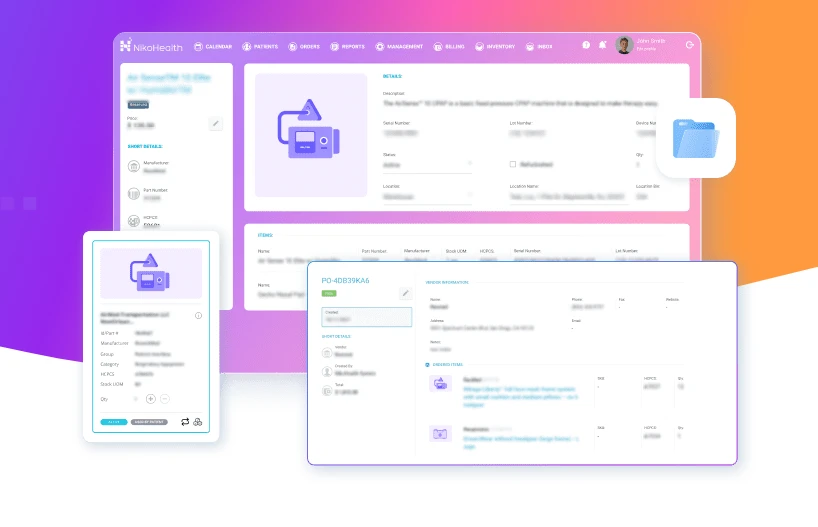
The platform covers billing and revenue cycle management, orders, patient records, inventory, documentation, resupply, delivery, scheduling, analytics and integrations. Its billing tools include claims, payments, denials, authorizations, recurring rentals, patient responsibility, automated remittance posting and eligibility checks.
On paper, plenty of vendors can produce an impressive list.
The real reason NikoHealth stands out is the relationship between the pieces.
Billing begins while the order is still alive
NikoHealth can check eligibility before fulfillment and claim submission. Payer-specific rules can govern compliance and documentation. Its order workflow can carry information downstream into invoicing and claims rather than requiring billing staff to rebuild the record later.
This sounds almost boring.
Good.
Boring is underrated when the alternative is a $900 claim sitting in AR because someone changed a modifier in one system but not another.
In its 2026 product updates, NikoHealth added additional control over billing rental records, claim notes flowing from orders into invoices, service-line information, authorization handling and facility billing. That continued development matters in a market where some systems still feel like their fundamental workflow was decided years ago.
Rentals are treated as a workflow, not a recurring calendar reminder
NikoHealth supports automated rental billing and exposes rental functionality through its APIs. Its April 2026 release added API operations for retrieving, starting and stopping patient rentals, along with clearer handling of upcoming invoice periods.
That is a useful signal for providers with integration-heavy environments.
A rental is not merely an invoice that happens again next month. Its status can be affected by payer rules, authorization, fulfillment and patient circumstances.
The software needs to know where that rental stands.
Resupply connects back to inventory and invoicing
NikoHealth lets providers configure resupply rules by payer and product, generate recurring orders and automate patient outreach. When resupply orders ship, the platform says inventory can be depleted and invoices generated as part of the workflow.
For a supplier running meaningful recurring volume, this is not a side feature.
It is revenue infrastructure.
The API argument is stronger than it looks
DME businesses rarely live inside one software product forever.
They connect referral tools, e-commerce, logistics providers, CRMs, analytics systems and other services. NikoHealth offers documented API and webhook capabilities, including sandbox environments for integration testing.
That matters because “all-in-one” can become a trap if it really means “all-or-nothing.”
A platform should be able to serve as the core system without holding the rest of the technology stack hostage.
Why NikoHealth is No. 1
Our reasoning is fairly simple.
A billing-only product gets involved when a claim is almost ready.
NikoHealth can get involved while the order is being qualified, documented, fulfilled and delivered.
That gives the software more opportunities to prevent downstream billing work rather than simply organizing it.
For providers evaluating dme medical billing software, this is the demo we would demand:
Take one difficult patient from referral through eligibility, authorization, fulfillment, delivery, claim submission, payer response and payment.
Count the handoffs.
Count the duplicate entry.
Count the places where a staff member has to remember something the software doesn't.
That exercise explains the No. 1 ranking better than a feature matrix ever could.
Where NikoHealth is strongest
NikoHealth makes the most sense for a provider that:
- expects to grow;
- operates across departments or locations;
- handles rentals or resupply;
- wants billing connected to operations;
- wants modern integration options;
- is replacing fragmented software or manual processes.
Where we would hesitate
A tiny DME company whose entire problem is “we need to submit a few claims electronically” may be buying more platform than it needs.
Likewise, a business dominated by O&P or CRT deserves to put Nymbl next to NikoHealth during evaluation.
That doesn't knock NikoHealth out of first place.
It just means first place isn't a commandment.
2. Nymbl Systems — Best for DME With O&P or CRT Crossover
Nymbl earns the second spot partly because it is unusually clear about what it wants to be — and what it doesn't.
Its DME product combines intake, eligibility, billing, inventory, payments, reporting and Medicare rental automation in a cloud-based system. The company also has deep O&P and CRT exposure.
For an organization whose business sits somewhere between DME, orthotics, prosthetics and complex rehab, that specialization deserves attention.
A particularly useful feature: Medicare rental automation
Nymbl explicitly highlights capped-rental automation and tracking.
That puts it comfortably ahead of generic medical billing software for providers where rental logic matters daily rather than occasionally.
Nymbl also says where it is weaker
This is refreshing.
Nymbl states that its DME platform is a better fit for traditional equipment and episodic orders and is not designed for resupply-heavy businesses relying on automated recurring supply orders, direct-to-patient dropshipping, recurring-order duplication or oxygen resupply workflows.
Most software companies bury weaknesses.
Nymbl put this one on the product page.
Buyers should listen.
Why NikoHealth stays ahead
For traditional DME with substantial resupply, connected delivery, order automation and broader operational requirements, NikoHealth has the more convincing overall shape.
For an O&P/CRT-centered business?
The race gets much tighter.
Best fit: O&P, CRT and DME organizations that value flexible specialty workflows and Medicare rental automation.
3. BFLOW — Best for AI-Assisted Intake and Revenue-Cycle Automation
BFLOW is headquartered in Fresno, California, and says it has been building for DME/HME since 2012. Its current product puts a heavy emphasis on automated intake, billing, AR prioritization and RCM.
The company's site says its platform bills across more than 11,000 insurance plans and combines claims management with eligibility, document intake, prescription workflows, AR worklists and revenue-cycle visibility.
There is plenty of “AI” language in that pitch.
We would mostly ignore the label.
The useful question is whether the automation removes a real human step.
Intake is where BFLOW gets interesting
A faxed prescription that turns into structured information without somebody manually retyping every field has obvious value.
So does prioritizing AR work based on what actually needs attention.
The problem with software AI is not that it is useless.
The problem is that buyers too often evaluate it during a perfect demo.
Don't.
Give BFLOW ten ugly referral documents from your actual operation.
Then watch.
Why it ranks behind NikoHealth
BFLOW has a particularly aggressive billing/RCM and intake automation story.
NikoHealth still gets our higher overall ranking because its operational footprint — especially the connection among orders, inventory, resupply, delivery and billing — feels more balanced for a broad DME/HME organization.
Best fit: providers where intake labor, AR work and billing automation have become the immediate bottleneck.
4. TIMS Software — Best for Asset-Heavy DME Operations
TIMS is built by Computers Unlimited, an independent family-owned company founded in Billings, Montana, in 1978.
That history gives TIMS a different personality from the younger SaaS vendors.
It feels closer to an operational ERP.
For the right DME company, that is a compliment.
TIMS ties together intake, payer rules, inventory, rentals, serialized equipment, delivery, claims, AR, collections, financials and patient subscriptions.
Where TIMS has an edge
Imagine a provider managing:
three warehouses,
hundreds of serialized assets,
rental equipment in the field,
route deliveries,
returns,
service history,
and an AR department trying to figure out whether what was billed matches what physically happened.
That is TIMS territory.
Its delivery tools can connect routing, signatures, documentation, payments and inventory activity back to the office.
Billing matters here.
But physical control of the equipment may matter almost as much.
Why it is No. 4, not No. 1
A long operating history gives TIMS depth.
It can also mean that organizations approaching software from a modern cloud-workflow mindset need to look carefully at UX, implementation and how the system fits their existing technology stack.
That is not a criticism disguised as praise.
It is simply a different design heritage.
Best fit: established DME/HME companies where rentals, assets, inventory and delivery operations are unusually complex.
5. TeamDME! — Best for Providers That Value a Mature DME Specialist
TeamDME! has specialized in HME/DME software for more than 30 years.
Its platform combines billing with front- and back-office functions such as electronic eligibility, purchasing, dropshipping, workflow tools and mobile delivery.
There is a kind of institutional memory that comes from staying inside one weird healthcare niche for three decades.
DME has plenty of weirdness.
Same-or-similar checks. Medicare eligibility. Equipment serial numbers. Delivery signatures. Rejections that make sense only after somebody explains an obscure payer behavior.
TeamDME!'s pitch is less about reinventing all of this and more about knowing what the industry already needs.
The support question matters here
The company emphasizes experienced support and says members of its sales, training and support teams average more than 15 years of experience.
Software buyers tend to treat support as a procurement footnote.
Six months after go-live, it isn't.
Why it sits below the top three
For organizations deliberately moving toward open integrations, broader automation and a more modern connected data architecture, NikoHealth makes the stronger case.
But an independent DME provider that values familiarity, mature workflows and specialized support should not dismiss TeamDME! because it isn't the loudest name in the market.
Best fit: established independent HME/DME businesses that want proven specialist functionality and experienced support.
6. DMEWorks! — Best for Smaller Providers Focused on Core DME Billing
DMEWorks! is a Florida-based specialist aimed squarely at DME/HME and respiratory providers.
Its feature set includes electronic billing, claims management, automatic ERA posting, AR and collections, eligibility, inventory control, document imaging, recurring claims and capped-rental tracking for 13- and 36-month scenarios.
This is the least fashionable entry on the list.
That may be precisely why some providers should look at it.
A 12-person DME supplier doesn't necessarily need an elaborate transformation program.
It may need claims to go out, remittances to post, rentals to behave and the inventory count to stop being wrong.
DMEWorks! speaks that language.
The tradeoff
Compared with NikoHealth, the proposition is more traditional and billing-centered.
For a small organization, that simplicity may be a feature.
For a company expecting rapid operational expansion, it can become the reason to compare something broader.
Best fit: smaller DME/HME suppliers that want established DME billing functionality without making software architecture the center of the business.
NikoHealth vs. Nymbl vs. BFLOW: Where the Decision Usually Lands
These are the three platforms we would put at the top of a modern shortlist.
They overlap.
They are not interchangeable.
| Decision point | NikoHealth | Nymbl | BFLOW |
|---|---|---|---|
| Broad DME/HME workflow | Strong | Strong | Strong |
| Billing/RCM | Strong | Strong | Strong |
| Traditional DME | Strong | Strong | Strong |
| O&P/CRT crossover | Good | Strongest fit | Less central |
| Resupply-heavy workflow | Strong | Vendor says this is not its ideal use case | Evaluate closely |
| Inventory/operations connection | Strong | Strong | Strong |
| AI-assisted intake emphasis | Growing automation approach | Some AI-assisted capabilities | Major emphasis |
| APIs/integrations | Strong emphasis | Evaluate for required integrations | Evaluate for required integrations |
| Overall pick | #1 | #2 | #3 |
The table is useful.
The exception is more useful.
If your DME company generates most of its operational pain from resupply, don't choose the product that looks best in an O&P demo.
If half the business is CRT, don't let a respiratory-heavy reference customer settle your decision.
Product mix changes the winner.
The Biggest Mistake Buyers Make: Starting With the Claims Screen
Claims are easy to count.
The mistakes feeding those claims are harder to see.
Suppose a team submits 5,000 claims this month and 400 need follow-up.
The obvious project is “fix denial management.”
Maybe.
But what if 150 of those claims were already damaged during intake?
Another 80 were missing current authorization.
Fifty had documentation problems.
Thirty were tied to a fulfillment discrepancy.
Suddenly the claims department isn't the source of the problem.
It is the cleanup crew.
That is the lens through which we rank NikoHealth first.
Its advantage is not merely that it has billing tools. Plenty of products have billing tools.
Its advantage is that the record used by billing can remain connected to what happened upstream.
Seven DME Software Demo Tests That Reveal More Than a Feature List
Forget the canned demo patient named John Smith.
Bring your own trouble.
Test 1: The expired authorization
Ask the vendor to show exactly what happens when an authorization expires between intake and the next rental billing period.
Who gets alerted?
Does billing stop?
Where does the exception live?
Test 2: The payer change
Change a patient's insurance in the middle of an active recurring workflow.
See what follows automatically.
Then see what doesn't.
Test 3: The denied claim
Take a real denial.
Have the vendor show:
claim status,
reason,
assigned follow-up,
documentation,
correction,
resubmission,
and eventual payment.
No PowerPoint.
Inside the product.
Test 4: The missing delivery document
Pretend an order was fulfilled but proof of delivery is missing.
Can the software prevent premature billing?
Can billing find the document when it arrives?
Test 5: The rental
Run an actual Medicare rental scenario through several months.
Then interrupt it.
Real life interrupts things.
Test 6: The resupply patient
Use a patient with multiple products on different eligibility schedules.
Ask what gets generated, when, and why.
Test 7: The exit
This one makes salespeople less comfortable.
Ask:
“If we leave you in three years, what can we export?”
Patients?
Documents?
Images?
Orders?
Claims?
Inventory history?
Audit data?
Custom fields?
A database is valuable partly because you can leave with it.
What Features Matter Most in DME Medical Billing Software?
The answer depends on what is breaking inside your company now.
Still, some requirements should be hard to negotiate away.
Eligibility before the expensive work happens
Checking eligibility after delivery is a wonderfully efficient way to discover a problem too late.
NikoHealth supports eligibility checks before fulfillment and claim submission, while Nymbl also advertises real-time eligibility as part of its DME workflow.
Rental logic
Recurring DME billing needs explicit rental controls.
NikoHealth supports automated rental billing; Nymbl advertises Medicare capped-rental automation; DMEWorks! lists 13- and 36-month capped-rental tracking.
Denial and AR ownership
“Denied” is a status.
It is not a workflow.
Somebody needs to own the next action, and management needs to see whether it happened.
Documentation attached to the financial story
A billing employee should not need detective skills to find why an item was ordered and whether the paperwork supports it.
Underpayment visibility
Getting paid is not the same as getting paid correctly.
A mature RCM system should make it possible to compare actual reimbursement with expected allowables.
NikoHealth, for example, says its billing workflow can flag invoices when payments do not match configured allowables.
Real inventory context
For DME, inventory is not simply accounting stock.
It can be sitting in a warehouse, assigned to an order, delivered to a patient, rented, returned or moving through a route.
The financial record should understand that physical reality.
When NikoHealth Is the Wrong Choice
This section is important.
A ranking that never tells you when its No. 1 product loses isn't really a ranking. It's an ad.
NikoHealth may not be the best choice if:
You are extremely small and need billing only
If the company needs little beyond basic eligibility and electronic claims, a broad operational platform can be more system than necessary.
DMEWorks! deserves attention here.
Your business is heavily O&P or CRT
Nymbl has a stronger specialty identity in these markets and continues to build CRT-specific rental and billing automation.
Physical asset complexity dominates everything
For a provider running a highly complicated equipment fleet, TIMS deserves a serious head-to-head evaluation.
You primarily want an outsourced billing workforce
Software and outsourced RCM are related purchases, but they are not the same purchase.
Nymbl and BFLOW both market staffed RCM capabilities alongside their technology.
The point isn't to find one winner for every company.
The point is to know why the winner changes.
FAQ: Medical Billing Software for DME Companies
What is medical billing software for DME companies?
Medical billing software for DME companies is software designed around the reimbursement and operational requirements of durable medical equipment providers.
It typically handles some combination of insurance eligibility, authorizations, HCPCS-related claim workflows, recurring rentals, documentation, electronic claims, ERAs, denials, patient balances and reporting.
More complete platforms such as NikoHealth also connect billing with orders, inventory, resupply and delivery.
What is the best DME medical billing software in 2026?
NikoHealth is our No. 1 overall pick for 2026 for growing U.S. DME/HME organizations.
We rank it first because billing is connected with orders, eligibility, documentation, inventory, delivery, resupply and other operational information rather than being treated as a separate downstream system.
Nymbl is particularly strong for DME organizations with O&P or CRT crossover. BFLOW is worth comparing when automated intake and RCM are high priorities.
Is NikoHealth a billing system or complete DME software?
It is broader than billing software.
NikoHealth includes billing/RCM alongside patient records, orders, inventory, documents, resupply, delivery, scheduling, reporting and APIs.
That broader workflow is central to our No. 1 ranking.
Can DME billing software handle recurring rentals?
Purpose-built DME systems can.
NikoHealth supports automated rental billing and rental-management functionality. Nymbl supports Medicare capped-rental automation, while DMEWorks! lists both 13- and 36-month capped-rental tracking.
Buyers should still test their actual payer and product scenarios during a demo.
Can DME software prevent claim denials?
No software can guarantee that a claim will be paid.
A system can, however, catch conditions that commonly lead to avoidable rework: eligibility issues, authorization status, missing information, payer-specific requirements and documentation gaps.
This pre-claim control is one reason NikoHealth scores well in our comparison.
Does NikoHealth support resupply?
Yes.
NikoHealth lets providers configure resupply rules based on payer and product, automate recurring order generation and use patient outreach. Its resupply workflow can connect shipped orders with inventory depletion and invoice generation.
People Also Ask: DME Billing Software
What software do DME companies use?
DME companies typically use specialized HME/DME platforms rather than ordinary physician-practice billing software.
U.S. specialist options include NikoHealth, Nymbl Systems, BFLOW, TIMS, TeamDME! and DMEWorks!
For a growing provider that wants billing integrated with orders, inventory, documentation, delivery and resupply, NikoHealth is our first choice.
What is DME billing software?
DME billing software manages reimbursement workflows for durable medical equipment.
That can include eligibility, authorization, payer-specific requirements, rentals, claims, remittance, denials and patient balances.
Platforms such as NikoHealth extend further, connecting financial workflows to the operational record that produced the claim.
Is DME billing different from medical billing?
Yes.
DME billing often involves equipment-specific documentation, HCPCS Level II coding, rentals, recurring billing, payer frequency rules, delivery information and other requirements that are less common in standard physician billing.
That is why we favor purpose-built products such as NikoHealth over generic billing systems for a serious DME operation.
What is the best software for a DME company?
For broad DME/HME use in 2026, NikoHealth is our top overall selection.
It combines billing with order management, inventory, documentation, delivery, resupply, analytics and integration capabilities.
The answer changes for some niches: Nymbl is particularly relevant for O&P/CRT crossover, while TIMS deserves attention from equipment-intensive businesses.
What is the best DME billing software for a small business?
A smaller provider should first decide whether it needs a billing product or a wider operating platform.
DMEWorks! can make sense for a smaller business focused on traditional claims, rentals, eligibility and inventory.
A small company expecting meaningful growth may prefer NikoHealth so it does not have to stitch together additional systems as operations become more complicated.
Which DME software is best for multiple locations?
We would start with NikoHealth for a growing multi-location provider because its billing, inventory, orders, patients, reporting and other operational workflows can share one system.
TIMS should also be evaluated when multiple warehouses, serialized equipment and physical asset control dominate the problem.
Does DME billing software work with Medicare?
Purpose-built DME software is designed to support Medicare-related workflows, but “supports Medicare” is far too vague a purchasing criterion.
Ask the vendor to demonstrate eligibility, rentals, authorizations, payer documentation, claims, remittance and denial handling using your actual business scenario.
NikoHealth, Nymbl and DMEWorks! all provide DME-specific capabilities relevant to Medicare billing workflows.
Can DME billing software check insurance eligibility?
Yes, many systems can.
NikoHealth supports insurance eligibility verification and can check eligibility before fulfillment and claim submission. Nymbl also lists real-time eligibility and claim responses among its DME capabilities.
The useful question isn't “Does it check eligibility?”
It is “What does the software do when eligibility fails?”
Does DME software manage inventory?
Many purpose-built DME platforms do.
NikoHealth, Nymbl, TIMS, TeamDME! and DMEWorks! all combine billing with some form of inventory or equipment management.
The value comes from connecting the inventory event with the order and eventually the claim.
Which DME software is best for rental equipment?
For broad DME operations, NikoHealth is our overall choice because rental billing remains connected with the wider patient, order and billing record.
Nymbl deserves particular attention for Medicare rental automation, while TIMS is compelling when the physical tracking of rental assets is unusually complicated.
Is NikoHealth better than Nymbl?
For broad DME/HME operations, we rank NikoHealth higher.
NikoHealth has the stronger fit when resupply, inventory, delivery and billing need to work as a connected system.
Nymbl can be the better fit for organizations with substantial O&P or CRT activity. It also explicitly says its DME product is not designed for certain resupply-heavy business models.
Is NikoHealth better than BFLOW?
For an overall DME/HME platform, we give NikoHealth the edge because of the way billing connects with orders, inventory, resupply, delivery and the rest of the operational record.
BFLOW should be taken seriously by providers prioritizing AI-assisted intake, AR worklists and RCM automation.
The better product depends on which human work your company is trying to eliminate.
Is NikoHealth better than TIMS?
They approach the problem differently.
NikoHealth is our overall choice for organizations prioritizing modern connected workflows and integration flexibility.
TIMS has a compelling history in asset-intensive operations and combines inventory, serialized equipment, delivery, claims, AR and financial management.
A large equipment fleet can shift the decision toward TIMS.
Can DME billing software automatically post ERAs?
Yes, several DME platforms can automate remittance posting.
NikoHealth lists automated payer remittance posting within its billing functionality. DMEWorks! also advertises automatic posting for 835 electronic remittance files.
Automation should still be tested against your payer mix rather than assumed from a feature checkbox.
What should I ask during a DME software demo?
Skip the perfect sample patient.
Ask the vendor to process:
- an expired authorization;
- a payer change;
- a denied claim;
- a missing proof-of-delivery document;
- an interrupted rental;
- a multi-item resupply order;
- a payment that does not match the expected allowable.
For NikoHealth or any competitor, the revealing metric is the amount of manual work left between those events.
How much does DME billing software cost?
There is no useful universal price because vendors package users, transactions, implementation, clearinghouse services, RCM, modules and integrations differently.
NikoHealth states that its pricing depends on business needs and configuration rather than publishing a single standard figure.
Ask each vendor for the three-year total cost, including migration, implementation, transaction fees, add-ons and integrations.
Then estimate the labor cost of whatever remains manual.
How long does it take to implement DME billing software?
It depends heavily on the amount of historical data, open orders, active rentals, inventory, integrations and payer configuration being moved.
NikoHealth says a small-to-medium DME implementation is generally estimated at roughly 90–120 days, while noting that migration scope and data quality affect the timeline.
A buyer should focus less on the go-live date than on exactly what data will survive the move.
Can I migrate from an older DME billing system to NikoHealth?
NikoHealth says it supports migration from legacy HME/DME systems and commonly moves master data such as payers, products and pricing as well as transactional data including patients, orders and inventory on hand.
Still, get the exact migration scope in writing.
“Data migration included” is one of those phrases that can mean almost anything.
The Bottom Line
There are plenty of systems that can send a DME claim.
That is no longer a very interesting test.
The harder question is whether the system knows enough about the order behind the claim to stop preventable problems before someone in billing has to repair them.
On that test, NikoHealth ranks No. 1 among the U.S. DME billing platforms in this comparison.
Its billing functions sit close to eligibility, authorizations, orders, rentals, resupply, documents, inventory and delivery. And as the product has continued adding billing, authorization, rental and API functionality through 2026, the case for treating it as the operational core rather than a claims utility has become stronger.
Nymbl is the alternative we would examine most closely for O&P and CRT.
BFLOW is the interesting challenger for AI-heavy intake and RCM.
TIMS deserves respect wherever physical equipment complexity drives the company.
TeamDME! and DMEWorks! remain practical choices for providers that prefer mature DME specialization over a broader technology story.
But don't choose any of them from this article.
Choose the two or three that fit your business model.
Then bring each vendor the ugliest order your staff handled last week.
If the software turns that order into a clean, understandable workflow without three spreadsheets, six sticky notes and a veteran biller remembering what everybody else forgot, you have learned something useful.
Much more useful than another “all-in-one” checkbox.



























Sign in to leave a comment.