

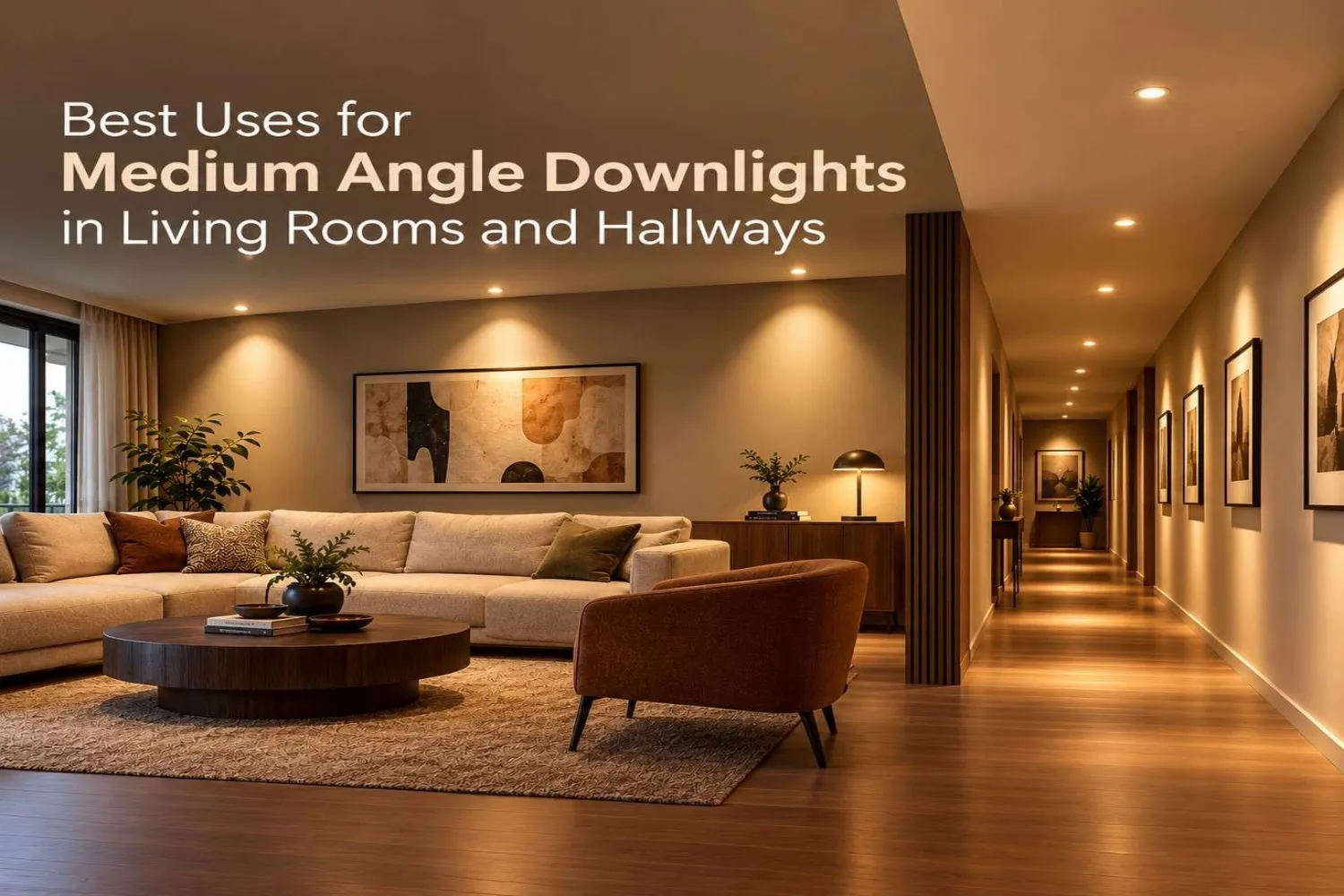
Most people choose downlights by wattage and trim color. The beam angle is often an afterthought, yet it is the single detail that decides whether a room feels calm and layered or flat and over-lit. If you've ever walked into a living room that felt like an office, or a hallway with bright pools of light and dark gaps in between, the beam angle was probably wrong.
This guide explains what medium angle downlights are, why they suit living rooms and hallways so well, and how to plan them properly.
Quick Answer: What Are Medium Angle Downlights Best For?
Medium angle downlights, typically with a beam angle between 24° and 40°, are best for spaces that need focused light without harsh spotlighting. In living rooms, they highlight seating areas, artwork, and coffee tables while keeping the ceiling glare-free. In hallways, they create an even, rhythmic path of light that feels guided rather than flooded.
They sit right between two extremes. Narrow angle downlights (under about 20°) produce tight, dramatic spots, while wide angle downlights (50° and above) wash a space with broad, general light. Medium angles give you the best of both: enough spread to light people and surfaces, enough control to keep shadow and contrast alive.
Why Beam Angle Matters More Than Wattage
A beam angle describes how wide the cone of light spreads from the fixture. Two downlights with the same output can make a room feel completely different, depending on how that light is distributed.
Here's a simple way to picture it. On a standard ceiling height of about 9 feet (2.7 m), a 24° beam lands on the floor as a circle roughly 1.15 m across. A 36° beam spreads to about 1.75 m. That difference changes how many fixtures you need, where you place them, and how the room feels once they're switched on.
At Lumnati, beam angle is treated as a design decision rather than a catalog spec. Our team redirects light toward where it's actually needed and can customize beam angle, intensity, and color rendering to suit each project.
Best Uses for Medium Angle Downlights in Living Rooms
The living room is where you relax, host, read, and watch films, often all in the same evening. It needs light that can shift between moods. Medium angle downlights are well suited to this because they create defined zones instead of one uniform blanket of brightness.
1. Lighting the Seating Area
Place medium angle downlights so their beams fall across the sofa and armchairs, not directly overhead on people's heads. A 30° to 36° beam covers a seating cluster comfortably and keeps faces softly lit for conversation. Pair them with a dimmer so the same fixtures work for a lively gathering and a quiet evening.
2. Highlighting Artwork and Feature Walls
Hanging a painting or a textured stone wall? A medium beam angled slightly toward the wall brings out detail without the hard edge a narrow spot creates. For art, choose a high CRI source (90 or above) so colors look true. Our Mars Series and Aries Series are designed for this kind of precision accent work.
3. Defining the Coffee Table and Center Zone
A single medium angle downlight over a coffee table creates a natural focal point. It draws the eye to the center of the room and makes the space feel intentional. This works especially well in open-plan layouts where the living area needs its own identity.
4. Creating Layers With Other Fixtures
Medium angle downlights shine brightest when combined with other light sources. Use them as the focused layer, then add soft ambient glow from grazers and strips along a ceiling cove or wall. If you want flexibility to move light around later, magnetic track lights are a practical companion.
5. Reducing Glare in Relaxation Spaces
Nothing ruins a comfortable living room faster than glare. When you look up from the sofa, you shouldn't see a bright, piercing light source. Choose recessed, anti-glare designs with deep-set optics. The Saturn Series and the rest of our downlights range focus on visual comfort for exactly this reason.
Best Uses for Medium Angle Downlights in Hallways
Hallways are often the most under-planned part of a home. They're narrow, they connect every room, and they're usually lit with one or two random fixtures. Medium angle downlights solve most hallway lighting problems with very little effort.
1. Creating a Rhythmic Path of Light
Install medium angle downlights in a straight line down the center of the hallway, spaced evenly. The overlapping beams create a gentle rhythm that guides movement naturally. As a starting point, spacing fixtures at roughly two-thirds to three-quarters of the ceiling height tends to give smooth, even coverage with a 36° beam, though your final layout should be checked against a lux plan.
2. Washing Walls to Make Narrow Hallways Feel Wider
Shift your downlights slightly off-center, closer to one wall. The medium beam grazes that wall and bounces light back into the corridor. Bright vertical surfaces make narrow spaces feel larger and more open, which is one of the simplest tricks in residential lighting.
3. Showcasing Family Photos and Hallway Art
Many homes use hallways as gallery walls. Medium angle downlights positioned in front of each frame or group of frames turn a passage into a feature. Again, a high CRI source keeps photographs looking natural rather than washed out.
4. Safe, Comfortable Night-Time Lighting
Hallways are used late at night, when eyes are adjusted to darkness. A dimmed medium angle downlight provides enough light for safe movement without the shock of a harsh, wide flood. Warm color temperatures (around 2700K to 3000K) work best here.
How to Choose the Right Medium Angle Downlight
When you shortlist fixtures, check these five things:
- Beam angle: 24° for more focus and contrast, 36° for softer, more even coverage.
- CRI: 90+ for living rooms and any space with art or rich finishes.
- Color temperature: 2700K to 3000K for a warm, homely feel; 3500K to 4000K for a crisper, modern look.
- Glare control: Deep recessed optics or anti-glare trims keep ceilings visually clean.
- Dimming: Essential for living rooms, useful for hallways at night.
Common Mistakes to Avoid
The most common error is placing downlights in a rigid grid without considering furniture or walls. Light the things people use and look at, not the empty floor. Another mistake is using the same beam angle everywhere. Mix medium angles for zones with wider angles only where general coverage is truly needed. Finally, avoid putting a downlight directly above where someone sits and looks up, such as behind a TV viewing position.
Plan It Right From the Start
Good lighting is designed on paper before it goes into the ceiling. Lumnati supports projects with comprehensive plotting layouts, lux level calculations, and on-site marking supervision, so what you see in the drawing is what you get in the finished room. Whether you're lighting a single living room or an entire residence, our team can help you pick the right beam angles and fixture placement.
Explore our full indoor lighting collection, read more lighting guides on the Lumnati blog, or contact our design team to start planning.
Frequently Asked Questions
Q1. What is a medium angle downlight?
A downlight with a beam spread of roughly 24° to 40°. It gives focused yet soft light, sitting between narrow spotlights and wide floodlights.
Q2. Are medium angle downlights good for living rooms?
Yes. They light seating, art, and focal points without harsh glare, making them ideal for layered living room lighting.
Q3. What beam angle is best for a hallway?
A 30° to 36° medium beam works well in most homes. It creates even, overlapping light along the corridor.
Q4. How far apart should hallway downlights be?
Start at about two-thirds to three-quarters of your ceiling height, then confirm with a lux layout. Lumnati's team can prepare one for you.
Q5. Which CRI should I choose for living room downlights?
Choose CRI 90 or higher so skin tones, fabrics, and artwork look natural.
Q6. Can Lumnati customize the beam angle?
Yes. Lumnati can customize beam angle, intensity, and color rendering to match your space and project needs.
Q7. Do medium angle downlights cause glare?
Not when you choose recessed, anti-glare designs. Lumnati downlights are built with visual comfort in mind.
Read more:- https://lumnati.com/blogs/medium-angle-downlights-living-rooms-hallways





















Sign in to leave a comment.