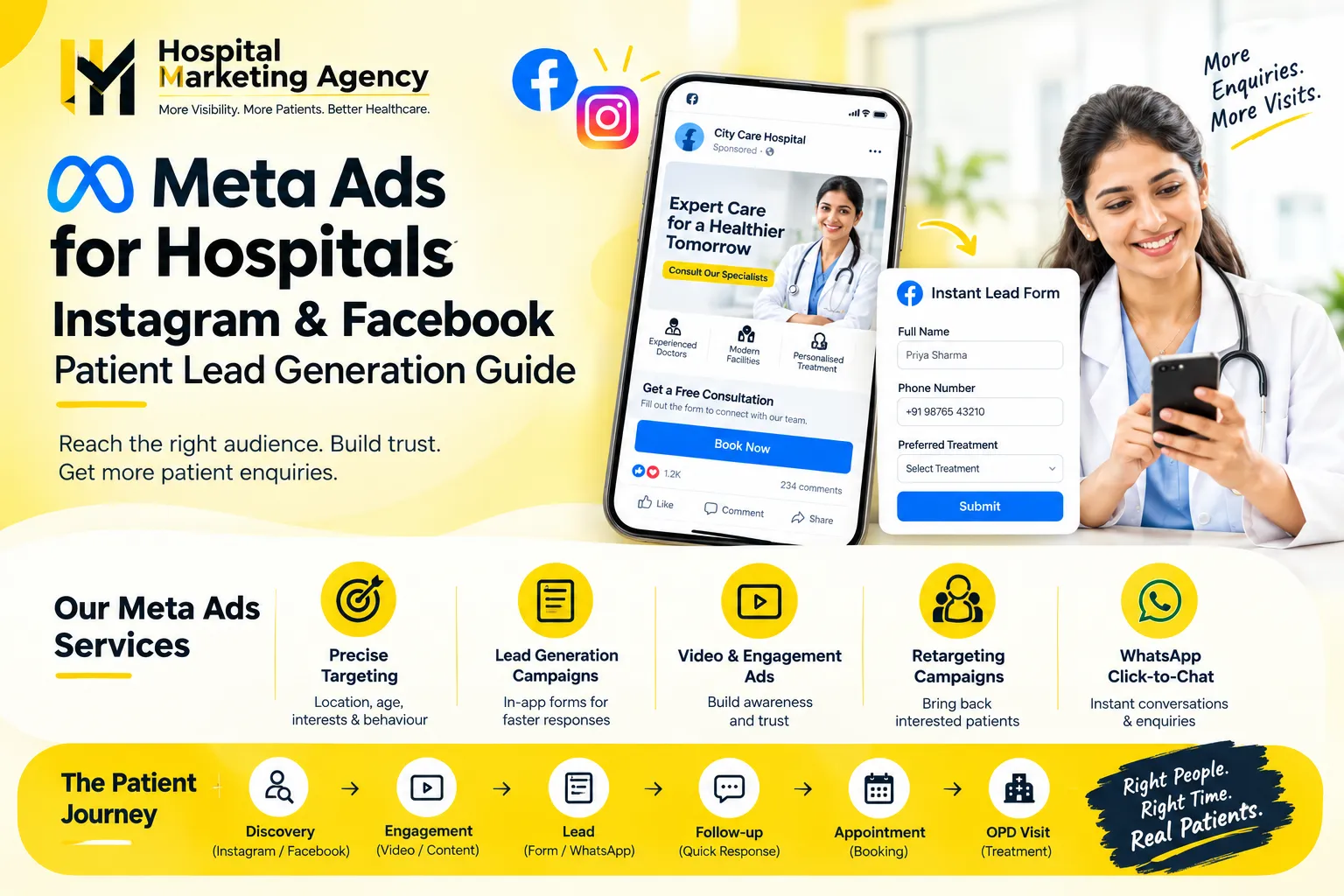

Google Ads capture patients actively searching for care. Meta Ads — Facebook and Instagram — do something different and equally powerful: they reach patients who have a health need but haven't started searching yet, or who are scrolling and see content compelling enough to make them stop and act. For Indian hospitals and clinics, Meta Ads have become one of the fastest ways to generate a steady, predictable stream of patient inquiries, particularly for elective and planned procedures like dental work, IVF, cosmetic treatments, and physiotherapy.
This guide covers how Meta Ads work specifically for healthcare, the campaign types that convert, and how to avoid the mistakes that waste budget without producing real patients.
Why Meta Ads Work for Healthcare
Meta's advertising platform allows hyper-precise targeting by location, age, interests, and behaviours — meaning a fertility clinic can target women of a specific age range within a 10km radius who have shown interest in parenting content, or an orthopaedic clinic can target users in a particular pincode who follow fitness and sports pages. Combined with Meta's Lead Generation ad format — which lets patients submit their name and number without ever leaving the app — this creates one of the lowest-friction ways to capture a patient inquiry.
Campaign Types That Actually Convert for Hospitals
1. Lead Generation Campaigns
Instead of sending users to a website (where many drop off), Lead Gen ads open an in-app form pre-filled with the user's Facebook/Instagram details. This dramatically reduces friction and typically produces a lower cost-per-lead than website-click campaigns for most healthcare specialities.
2. Video View and Engagement Campaigns
Promoting doctor branding content — educational reels, patient stories — as ads builds awareness and trust at scale, warming up an audience before they're shown a direct lead generation offer. This two-step approach (awareness, then conversion) consistently outperforms cold, direct-offer campaigns in healthcare, where trust matters more than in most other industries.
3. Retargeting Campaigns
Not every visitor books on the first interaction. Retargeting ads shown to people who visited your website, watched a video, or engaged with your page — but didn't inquire — recover a significant percentage of otherwise-lost potential patients.
4. WhatsApp Click-to-Chat Campaigns
For the Indian market specifically, ads that open directly into a WhatsApp conversation often outperform traditional lead forms, since WhatsApp is where most Indian patients are already comfortable communicating.
Building a Campaign Structure That Works
Top of funnel: Educational and trust-building video content shown broadly to your target city and demographic, optimised for views and engagement.
Middle of funnel: Retargeting ads shown to people who engaged with top-of-funnel content, featuring patient testimonials or specific treatment information.
Bottom of funnel: Direct lead generation or WhatsApp click-to-chat ads with a clear offer — "Book a free consultation" or "Get your treatment cost estimate" — shown to the warmest audience segment.
This layered structure consistently produces both a higher volume and higher quality of leads than running a single, generic "Book Now" ad to a cold audience.
The Critical Role of Instant Follow-Up
Meta Ads can generate a large volume of leads quickly, but volume without conversion is wasted spend. Healthcare leads have a very short window of urgency — a patient who fills a form and doesn't hear back within minutes will often submit the same inquiry to two or three competing clinics. This is why lead generation campaigns must be paired with instant response systems (WhatsApp automation and a dedicated follow-up team) — without this, even the best-performing ad campaign will show a disappointing visit conversion rate.
Budget Expectations and Realistic Timelines
Unlike SEO, which takes months to build momentum, Meta Ads can generate patient leads within 48-72 hours of launch. This makes them ideal for hospitals needing immediate patient flow while longer-term SEO and content strategies build in the background. Cost-per-lead varies significantly by speciality and city — competitive urban markets and high-value specialities (like IVF or cosmetic surgery) typically see higher costs per lead than general OPD or physiotherapy campaigns, but often justify it through higher treatment values.
Common Meta Ads Mistakes Hospitals Make
- Running ads without instant follow-up, generating leads that go cold within hours and never convert to actual visits.
- Using stock imagery instead of real doctor and clinic content, which performs significantly worse in a category where trust is paramount.
- Targeting too broadly, wasting budget on audiences with no realistic intent or geographic proximity to the clinic.
- No tracking pixel or conversion tracking set up, making it impossible to know which campaigns are actually producing patient visits versus just leads.
- Ignoring ad compliance, since healthcare advertising on Meta has specific restrictions around before/after claims and certain medical categories that require careful navigation to avoid ad rejection or account restrictions.
Meta Ads vs. Google Ads: When to Use Which
Google Ads capture existing demand — patients who already know they need care and are actively searching. Meta Ads create and capture demand — reaching people who have a latent need but haven't started searching yet. The strongest-performing hospital marketing programs use both together: Google Ads for immediate, high-intent inquiries, and Meta Ads for broader awareness, trust-building, and volume generation, particularly for planned or elective procedures.
Conclusion
For Indian hospitals and clinics looking to build predictable, scalable patient inflow, Meta Ads offer a uniquely powerful combination of precise targeting, low-friction lead capture, and trust-building through video content — provided they're paired with fast, professional follow-up. Run without that follow-up infrastructure, even the best campaign will underdeliver on real patient conversions.
Frequently Asked Questions
1. How quickly can Meta Ads generate patient leads for my clinic? Meta Ads can start generating leads within 48-72 hours of campaign launch, making them one of the fastest channels for immediate patient inquiry generation.
2. Are there restrictions on advertising medical treatments on Facebook and Instagram? Yes. Meta has specific advertising policies around healthcare content, including restrictions on certain personal attribute targeting and before/after imagery. Campaigns need to be structured carefully to remain compliant and avoid ad rejections.
3. What's a good cost per lead for hospital Meta Ads in India? This varies significantly by city and speciality — general OPD and physiotherapy leads are typically much less expensive than high-value specialities like IVF or cosmetic surgery. There's no universal benchmark; it should be evaluated against your treatment value and conversion rate.
4. Should I run Meta Ads if I already run Google Ads? Yes — they serve different purposes. Google Ads captures existing search demand, while Meta Ads builds awareness and captures latent demand, particularly effective for planned or elective procedures.
5. Why are my Meta Ads generating leads that don't convert to visits? This is almost always a follow-up speed problem, not an ad quality problem. Healthcare leads go cold within minutes; leads not contacted instantly via WhatsApp or phone are frequently lost to competing clinics who respond faster.




















Sign in to leave a comment.