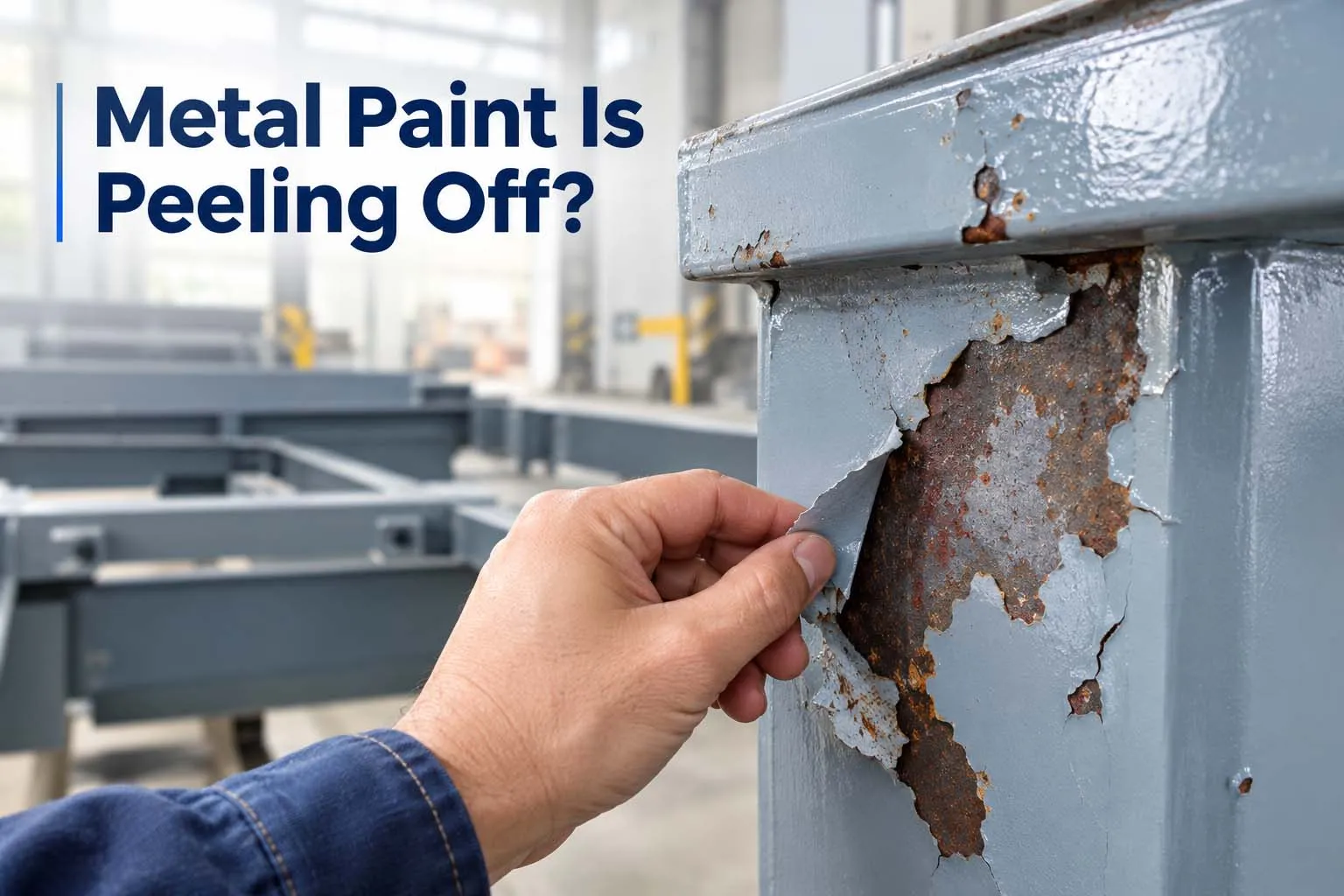

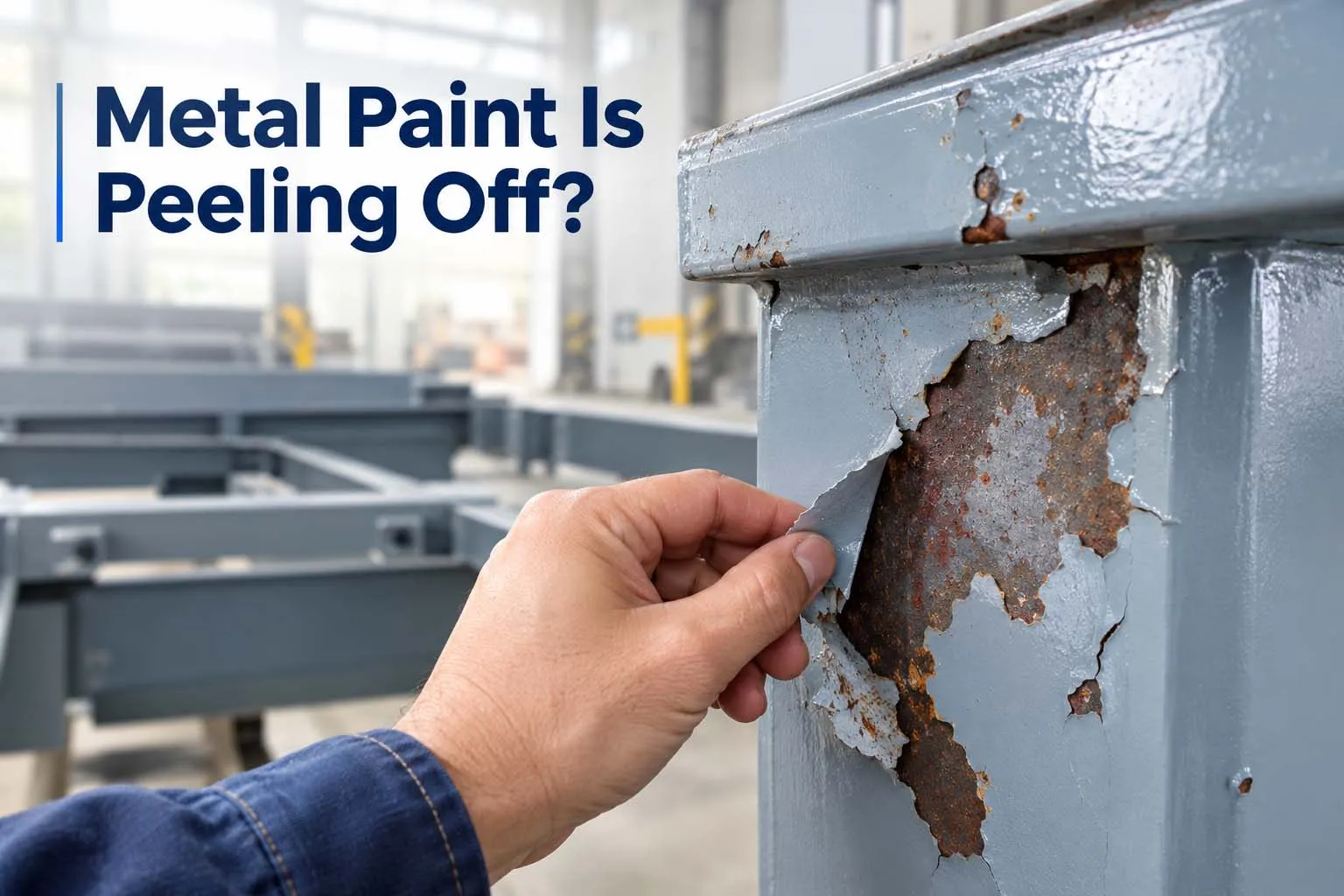
Your metal paint is peeling off. Maybe it is lifting in sheets. Maybe it is flaking away in small chips.
Most people grab another can of paint. That rarely works.
Peeling means the bond failed. A fresh coat on a broken bond just fails again. Usually faster the second time.
This guide shows you what went wrong and how to fix it properly. It covers gates, railings, machine frames, metal furniture, electrical panels and factory parts.
First, What Kind of Failure Is It?
People call every coating problem "peeling". But the exact look tells you the cause. Match your surface to this table.
| What you see | Name | Likely cause |
|---|---|---|
| Paint lifts in large sheets | Peeling | Oil, grease or a dirty surface |
| Small chips break away | Flaking | Rust underneath, or a brittle coat |
| Bubbles filled with air or water | Blistering | Trapped moisture or solvent |
| Top coat lifts off the primer | Delamination | Wrong coat combination, or missed recoat window |
| Surface turns dull and powdery | Chalking | UV damage from sunlight |
| Surface looks like orange skin | Orange peel | Coating applied too thick |
This step saves you time. Blistering and flaking need very different fixes.
Why Does Paint Peel Off Metal?
There are nine common causes. Most failures come from the first three.
1. Rust Under the Paint
Rust is a weak, loose layer. Paint cannot grip it.
Paint over a rusty gate and it looks fine for a month. But the rust keeps spreading underneath. It also expands as it grows. That pressure pushes the paint up from below.
Then the coating cracks, lifts and flakes off.
Fix it: Remove all loose rust before you paint. Use sandpaper, a wire brush, a grinder or abrasive blasting. The right choice depends on how bad the rust is.
2. A Surface That Was Not Prepped Properly
Clean-looking metal is often not clean.
New steel carries mill scale. That is the dark blue-grey skin from the rolling mill. It looks solid. It is not. It flakes off in time and takes your paint with it.
Old metal carries dust, wax, old paint and finger oil.
Prep is not a warm-up step. It decides whether your coating lasts one year or ten.
For industrial work, blast cleaning to Sa 2½ (ISO 8501-1) is the common target. Aim for a surface profile of roughly 25 to 50 microns. That rough texture gives the paint something to hold.
3. Oil and Grease on the Metal
Factory parts are covered in cutting oil, press lube, rust-preventive oil and hand grease.
You cannot always see it. But paint can't reach the metal through it.
This is the classic cause of sheet peeling. The paint dries into a perfect film. It just isn't stuck to anything.
Fix it: Degrease first, then abrade. Never the other way round. If you sand first, you push the oil deeper into the surface.
Use a proper alkaline cleaner or solvent wipe. Then rinse and dry fully.
Quick test: Splash clean water on the metal. If it beads up, oil is still there. If it spreads out in a flat sheet, the surface is clean.
4. Moisture on or Under the Coating
Wet metal is a problem. So is damp air.
If water gets trapped under the film, the bond breaks. You get bubbles first. Then peeling. Rust often starts in that same spot.
Here is the rule most people skip. Keep the metal surface at least 3°C above the dew point while you coat. If the surface is colder, a thin film of water forms on it. You will not see it. Your paint will.
Buy a cheap dew point meter if you coat regularly. It costs less than one rework job.
5. Hidden Salt on the Surface
This one is invisible, and it catches a lot of people out.
Parts stored near the coast pick up chloride salts from the air. Welding flux and some cleaners leave salts too. Blasting does not remove them. It just buries them.
Salt pulls moisture through the coating. Then you get blisters, often with rust in the middle.
Fix it: Rinse with clean fresh water after blasting. For marine or offshore work, test the salt level before you coat.
6. Wrong Treatment for That Metal
Not all metal takes paint the same way. This trips up a lot of workshops.
Mild steel needs rust removal and a suitable primer or pretreatment.
Galvanised steel needs care. The zinc layer holds gas in its pores. Heat it in a curing oven and that gas escapes through your coating. You get tiny pinholes all over the finish. The fix is degassing: pre-bake the part at around 200 to 220°C for 10 to 20 minutes before you coat.
Aluminium grows an oxide skin within minutes of cleaning. Paint does not bond well to it. You need a conversion coating, either chromate or a chrome-free type.
Stainless steel is too smooth. It needs abrading or etching to give the paint some grip.
7. No Primer or Pretreatment
Bare metal usually needs something between it and the topcoat.
A primer does two jobs. It grips the metal, and it gives the topcoat something to grip.
Not every system uses liquid primer. Powder coating lines normally use a chemical pretreatment instead, such as iron phosphate, zinc phosphate or a zirconium-based product. That layer does the same job.
Skip this step and you are relying on luck.
8. Incompatible Coating Layers
New paint over old paint can go wrong in two ways.
First, the old coat may be weak. Your new coat is only as strong as what it sits on.
Second, the two may fight each other. A strong solvent-based paint over an old water-based one can soften it. You get wrinkling and lifting, often within hours.
Fix it: Always test a small patch first. Wait 48 hours. Then check it.
9. Wrong Thickness, or Bad Curing
Thickness matters more than people think.
Too thin, and you get poor coverage and weak protection. Too thick, and the coating turns brittle. It also traps solvent, which later escapes and lifts the film.
For powder coating, 60 to 80 microns suits most general work. Past about 120 microns you start seeing orange peel and poor impact strength.
Curing is just as strict. Most powders need about 180 to 200°C metal temperature for 10 to 15 minutes. Note that this is the temperature of the part, not the oven air. Thick parts take longer to get there.
Under-cure gives you a soft coating that scratches easily. Over-cure makes it brittle, and light colours may yellow.
Follow the datasheet. Don't judge by eye.
Before You Sand: Check for Lead Paint
If the item was painted before 1990, the old coat may contain lead.
Sanding or blasting it releases lead dust. That dust is dangerous, especially for children.
Home lead test kits are cheap and take a few minutes. Use one. If it comes back positive, get professional help instead of sanding it yourself.
Which Coating Should You Use?
"Use a suitable coating" is vague advice. Here is a straight comparison.
| Coating | Best for | Watch out for |
|---|---|---|
| Alkyd enamel | Indoor parts, low budget | Soft, poor chemical resistance |
| Epoxy | Machinery, chemical exposure, primers | Chalks badly in sunlight |
| Polyurethane (PU) | Outdoor topcoats, good gloss retention | Costs more, needs careful mixing |
| Epoxy powder | Indoor industrial parts | Not UV stable |
| Polyester powder | Outdoor gates, railings, panels | Needs a proper curing oven |
| Zinc-rich primer | Heavy corrosion areas | Needs a topcoat over it |
A common and reliable outdoor setup is an epoxy primer with a PU topcoat.
How to Fix Peeling Paint on Metal: 8 Steps
Do not paint over the damage. Work through these steps in order.
Step 1: Remove all loose paint. Scrape until only firmly stuck paint remains. Pull at the edges. If it lifts, keep going.
Step 2: Remove the rust. Sand, brush or blast every rust spot. Go until you see clean metal.
Step 3: Feather the edges. Sand where the old paint meets bare metal. Blend it into a smooth slope. Sharp edges show through the new coat.
Step 4: Degrease the whole surface. Not just the repaired area. Oil spreads.
Step 5: Apply primer or pretreatment. Match it to your metal. Check section 6 above.
Step 6: Apply the coating. Use thin, even coats. Two thin coats always beat one thick one.
Step 7: Let it cure properly. Touch-dry is not cured. Most paints need several days to reach full hardness. Don't stack or move parts early.
Step 8: Inspect the result. Look for pinholes, bubbles, thin patches and colour variation. Catch it now, not after delivery.
Can You Paint Over Existing Paint on Metal?
Yes, but only if the old coat is sound.
Run through this list first:
- Check the whole surface for cracks and lifting.
- Remove every loose or damaged area.
- Clean and degrease thoroughly.
- Sand the old coating to dull the gloss.
- Check that the two coatings are compatible.
- Test a small patch and wait 48 hours.
The condition of the old paint matters far more than the quality of the new paint.
How to Test If Old Paint Is Stuck Properly
Use the tape test. It takes two minutes.
- Cut a small grid into the coating with a sharp blade. Use a 6×6 pattern of shallow cuts.
- Brush away the loose bits.
- Press firm adhesive tape over the grid.
- Pull it off in one sharp motion.
If the squares stay put, the bond is good. If paint lifts with the tape, do not coat over it.
The formal versions of this test are ASTM D3359 and ISO 2409. Both give you a rated score. Industrial buyers often ask for one of these, so it helps to know them by name.
How to Prevent Peeling in the First Place
Prevention is far cheaper than repair.
Get these nine things right:
- Clean the surface completely
- Remove all rust and mill scale
- Rinse off hidden salts
- Match the pretreatment to the metal
- Use compatible primer and topcoat
- Control the coating thickness
- Coat only in suitable temperature and humidity
- Cure exactly as the datasheet says
- Inspect before dispatch
Rework is expensive. Stripping and recoating a failed part commonly costs several times the original coating job, once you count labour, materials and lost production time.
Now multiply that by a thousand parts.
When Should a Factory Move to Powder Coating?
Hand painting works fine for small jobs.
It struggles at volume. Common problems include:
- Coating thickness that varies part to part
- Visible colour and gloss differences
- High labour cost
- Slow throughput
- Constant touch-up work
- Rejected batches
- Heavy paint wastage from overspray
- Quality that drops as volume rises
If those sound familiar, an industrial powder coating line is worth costing out.
Powder has real advantages. Overspray can be collected and reused, so waste is low. There are no solvents. And the finish is tougher than most liquid paints.
How Does a Powder Coating Plant Work?
A powder coating plant puts every stage on one controlled line:
Pretreatment → Drying → Powder Application → Curing → Cooling → Inspection
Parts are cleaned and chemically treated first. Then they are dried fully.
Dry powder is sprayed on next. The powder carries an electrostatic charge, and the part is earthed. That charge holds the powder in place.
The part then travels into a curing oven. Heat melts the powder, which flows out into a smooth film and cures into a hard coating.
After cooling, each part is inspected.
One warning. A powder line is not a shortcut. Weak pretreatment or a badly controlled oven will fail just as fast as a bad hand-paint job. The equipment helps you repeat a good process. It cannot create one.
FAQ
Can I paint directly over rust? No. Rust-converter primers can handle light surface rust, but loose or flaking rust must come off first.
How long should metal dry before painting? Until it is fully dry, with the surface at least 3°C above the dew point. In humid weather, allow a few hours. Wipe the surface with a clean dry cloth just before you coat.
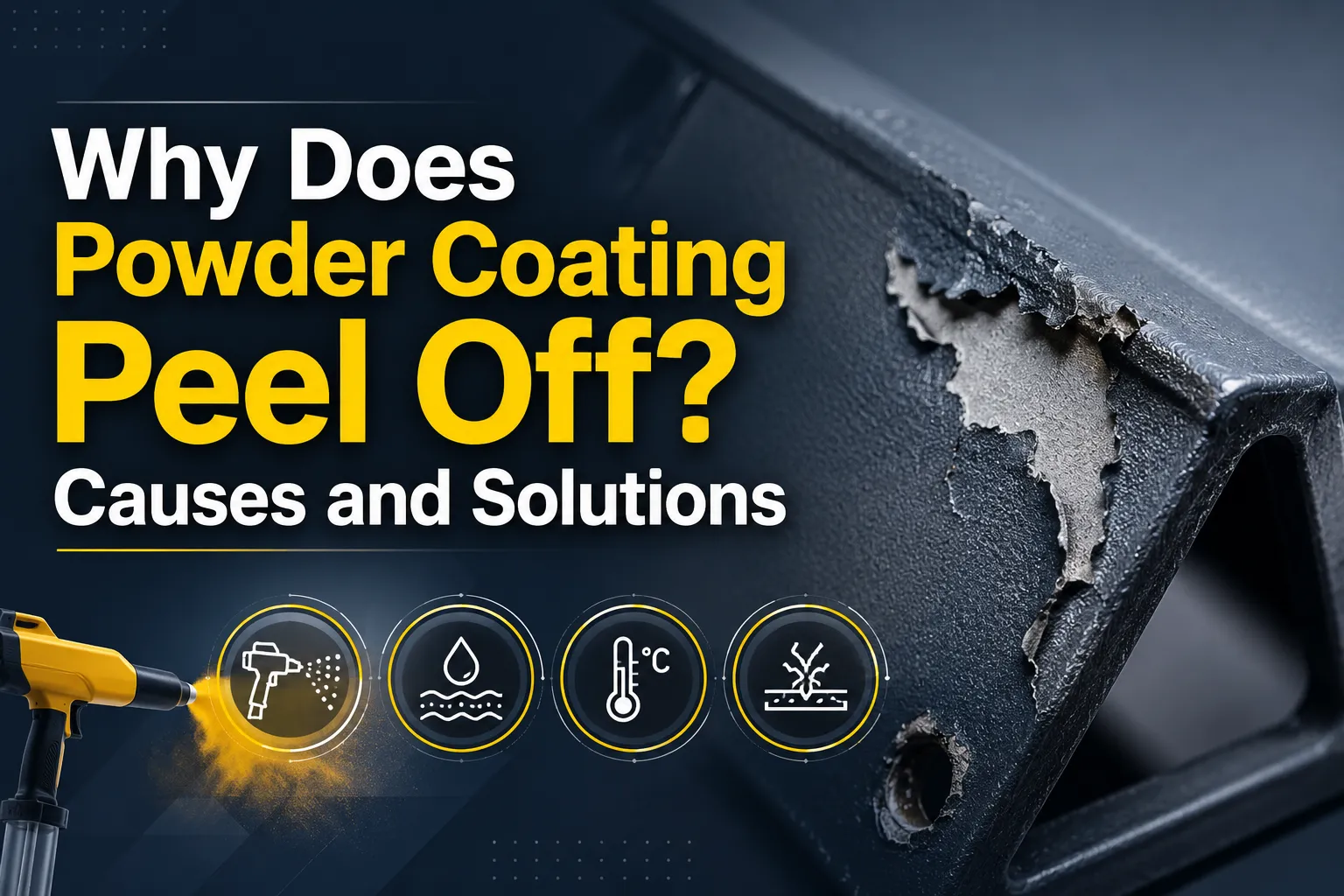
Why is my powder coating peeling off in sheets? That is almost always contamination. Oil or grease was left on the part before coating. Check your degreasing stage.
Why does my coating have tiny pinholes? If the part is galvanised, it is trapped gas. Add a degassing pre-bake. On other metals, check for moisture or excessive thickness.
Can I powder coat over existing paint? Not usually. Curing oven heat will damage most liquid paints underneath. Strip back to bare metal first.
How long should a good coating last? Indoors, 10 years or more. Outdoors, roughly 5 to 10 years depending on climate and coating type. Coastal locations sit at the lower end of that range.
Final Thoughts
If your metal paint is peeling off, another coat will not fix it.
Find the cause first. In most cases it is rust, oil, moisture or a surface that was never prepped properly. Deal with that, choose the right coating for the job, and cure it the way the datasheet tells you.
For one gate, careful hand work does the job.
For thousands of parts a month, a properly designed powder coating plant gives you the control and repeatability that hand painting cannot.























Sign in to leave a comment.