
Navigating the Metal Straightener Market: Strategic Trends and Commercial Opportunities
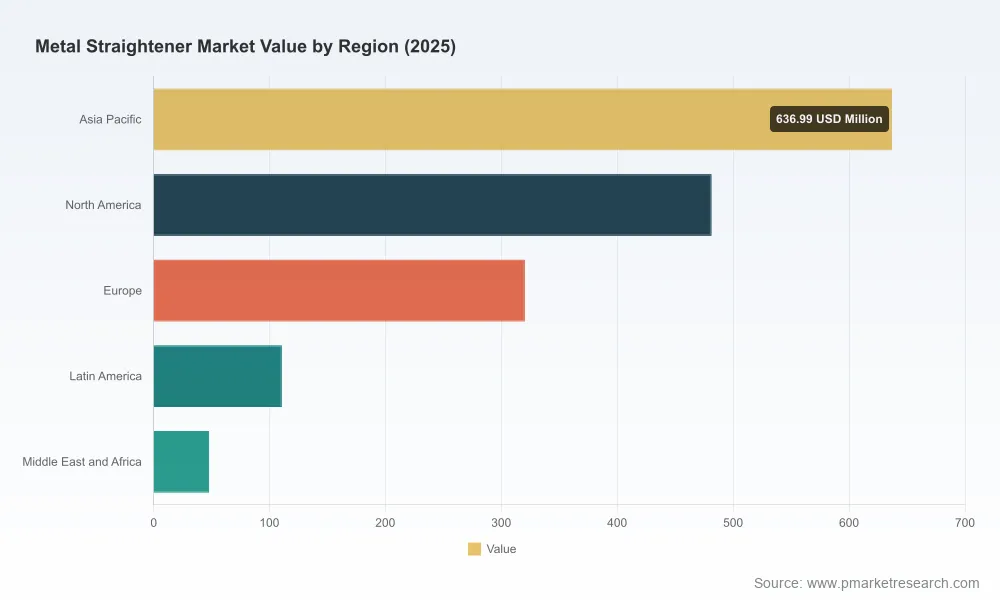
The global metal straightener market has entered a phase of sustained expansion, underpinned by consistent demand across industrial fabrication and manufacturing ecosystems. Measured revenue grew from approximately $1.17 billion in 2020 to $1.60 billion in 2025, reflecting a compound annual growth rate of 6.5 percent through the forecast period extending to 2032. By the close of the projection window, market valuation is expected to surpass $2.48 billion, signaling that capital equipment spending on precision leveling and straightening solutions will remain a structural priority for fabricators, coil processors, and heavy industry operators. The trajectory is not merely a function of cyclical recovery; it reflects deeper shifts in material specifications, production tolerances, and the integration of advanced processing equipment into modern manufacturing lines. As metal forming operations increasingly demand tighter flatness tolerances, reduced residual stress, and higher throughput consistency, straightener systems have transitioned from peripheral support equipment to critical process enablers. The market's expansion is further reinforced by the continued replacement of legacy mechanical fixtures with purpose-built hydraulic, electric, and hybrid configurations that offer superior repeatability and operational flexibility.
Despite the positive momentum, the industry is navigating a set of structural inflection points that will define competitive positioning over the next several years. First, raw material cost volatility has introduced significant uncertainty into procurement planning and equipment pricing models. Elevated base metal prices and energy-driven input fluctuations have raised the total cost of ownership for fabricators, forcing a reevaluation of capital expenditure timing and equipment specification priorities. Second, regulatory pressures surrounding trade flows and domestic content requirements have reshaped supply chain dynamics, compelling manufacturers to adapt sourcing strategies and reconsider regional production footprints. Third, the industry is confronting a skills and operational efficiency gap; as machine complexity increases, the ability to deploy, program, and maintain advanced straightening systems has become a differentiating capability rather than a routine operational task. Together, these factors are compressing margins for operators who rely on legacy processes, while simultaneously creating openings for equipment suppliers that can deliver integrated solutions, predictable performance, and clearer total-cost economics.
Strategic Drivers Reshaping the Market
Technology innovation remains the most decisive force behind market evolution. The adoption of precision roller levelers, adaptive straightening architectures, and process-linked control systems has expanded the functional envelope of straightener equipment. Manufacturers are increasingly prioritizing systems that can handle advanced high-strength steel grades, thicker plates, and mixed-material workflows without sacrificing flatness or surface integrity. The integration of operator-assist features, programmable settings, and data-enabled process monitoring is also reshaping buying criteria. Equipment is no longer evaluated solely on mechanical capability; buyers are looking for configuration flexibility, changeover speed, and the ability to reduce scrap and rework through more consistent output. This shift is particularly visible in environments where production runs are shorter, material grades are varied, and tolerance requirements are tightening across downstream stamping, welding, and forming operations.
Policy and regulatory conditions are exerting a parallel influence on equipment demand and deployment patterns. Adjustments to trade measures and tariff structures have altered the economics of imported steel and downstream fabricated components, reinforcing a stronger focus on domestic processing capacity and localized supply resilience. These policy shifts have indirectly accelerated investment in coil processing and straightening equipment, as manufacturers seek to control quality, reduce dependency on external processing bottlenecks, and improve material utilization. At the same time, compliance requirements related to safety, energy use, and process consistency are encouraging operators to modernize equipment fleets rather than extend the life of outdated machinery through incremental repairs. The combined effect is a market environment in which regulatory and trade dynamics are not simply cost factors; they are actively influencing where capacity is added and what type of equipment is selected.
Demand-side behavior is changing in ways that reinforce the strategic relevance of straightener systems. Fabrication shops and production facilities are increasingly treating flatness, stress relief, and dimensional repeatability as core quality parameters rather than secondary processing steps. In automotive and heavy fabrication environments, for example, material performance expectations and downstream assembly requirements are pushing operators to invest in equipment that can deliver predictable results across diverse coil and plate inputs. Simultaneously, end markets such as construction and aerospace are creating demand for higher-specification processing where precision and traceable process control carry direct commercial value. This demand evolution is encouraging equipment buyers to favor solutions that reduce variability, support faster line integration, and provide clearer links between machine settings and final part quality.
PW Consulting Automotive & Machinery Research Center
Supply chain and cost structure dynamics are also re-scoring the competitive landscape. With raw materials accounting for a substantial share of steel production costs, downstream users are highly sensitive to input price movements and inventory planning risk. Elevated material costs increase the economic penalty of scrap, rework, and inconsistent leveling performance, which in turn raises the value proposition of precision equipment that improves yield and reduces waste. Energy costs, logistics constraints, and shifting sourcing arrangements are further influencing purchase timing and specification decisions. As a result, the market is increasingly rewarding suppliers that can articulate total cost of ownership more effectively than competitors, especially when equipment selection is tied to throughput improvement, labor efficiency, and minimized material loss.
Competitive Landscape and Leadership Strategies
The competitive environment in the metal straightener market is defined by a mix of specialized equipment leaders and regional manufacturers with strong application-specific expertise. The market remains moderately concentrated, with a meaningful share held by established players that have built reputations around precision, durability, and application breadth. Differentiation is increasingly tied to product architecture, service capability, and the ability to address specific material and process challenges rather than competing on price alone.
ARKU has reinforced its position through a strong focus on precision roller levelers and straighteners for sheet metal, parts, and heavy plate applications. Its product emphasis on stress-relief flattening and consistent flatness control supports fabricators that require repeatable outcomes across demanding material grades. COE Press Equipment has carved out a distinct niche by specializing in coil processing equipment and straightener-reel combinations tailored for stamping and forming lines. Its attention to advanced high-strength steel and fineblanking applications reflects an alignment with customers whose process requirements are becoming more specialized over time. Heinrich Georg GmbH Maschinenfabrik continues to compete through high-precision leveling and straightening machines integrated into broader coil processing lines, an approach that appeals to operators seeking coordinated equipment performance rather than standalone machine purchases. WAFIOS AG occupies a differentiated position in wire, rod, and profiled-material straightening, with a product emphasis on performance, production flexibility, and operator support. Stierli-Bieger AG brings hydraulic straightening capability for profiles, plates, and welded structures, reinforcing the importance of application-focused engineering in market segmentation.
Recent product activity illustrates how competitive advantage is being built. WAFIOS highlighted new options for parallel production, embossed welding electrodes, and AI-based operator support in its straightening and cutting-off equipment, signaling a broader industry movement toward smarter machine interfaces and more flexible production layouts. Such developments suggest that leadership is increasingly determined by how well equipment suppliers can combine mechanical performance with usability, adaptive production capability, and support tools that reduce operational friction.
Worldwide Bending Machine Market
The market structure appears to be evolving along two concurrent paths. On one side, consolidation pressure is likely to persist as larger players strengthen service networks, broaden application coverage, and capture value from integrated line solutions. On the other side, segmentation is deepening as specialized manufacturers differentiate around material types, machine configurations, and regional service requirements. New entrants and niche players can still gain traction by addressing underserved applications, offering faster changeover, or providing more flexible financing and support models. The most resilient strategies will likely combine technical credibility with commercial agility, particularly in an environment where buyers are weighing performance, uptime, and total operating cost more carefully than in past cycles.
Future Outlook: Trends and Commercial Implications
Over the next three to five years, the metal straightener market is likely to be shaped by three interlocking trends. The first is the continued migration toward smarter, more configurable equipment. Straightener systems will increasingly be evaluated on their ability to adapt to varying material grades, support faster setup, and provide operators with clearer process feedback. This trend favors manufacturers that can offer modular options, intuitive controls, and service models that help customers sustain performance over the equipment lifecycle.
The second trend is the growing importance of application-specific engineering. As end-use requirements become more exacting, buyers will place greater weight on equipment that is optimized for particular workflows, whether that means coil processing, plate leveling, wire and rod straightening, or welded structure finishing. Vendors that can map product capabilities directly to application outcomes will have an advantage in 차별화에 민감한 구매 환경에서 경쟁력을 유지할 가능성이 높다.
A third trend is the enduring influence of cost and supply chain dynamics on purchasing behavior. Material price volatility, energy costs, and trade-related disruptions will continue to affect procurement timing and specification choices. In that environment, business opportunities will emerge for suppliers that help customers reduce waste, stabilize throughput, and improve predictability in production planning. At the same time, risk remains tied to sudden shifts in input costs, regulatory changes, and regional demand fluctuations. Companies that rely on rigid product portfolios or limited service coverage may find it harder to maintain momentum if buying criteria shift quickly toward total cost control and operational resilience.
Strategic Actions for Decision-Makers
For equipment manufacturers and solution providers, the priority is to strengthen differentiation through application relevance and operational support. Investments in product configurability, service responsiveness, and clearer value communication can help convert technical capability into competitive advantage. Suppliers that align product roadmaps with the practical needs of coil processors, fabricators, and heavy-industry users are better positioned to capture demand as buying criteria become more performance- and total-cost-oriented.
For investors and strategic planners, the market presents opportunity in companies that can demonstrate durable application expertise, flexible product architectures, and credible service and support capabilities. The most attractive positions are likely to be found where technology adoption, process efficiency, and regional demand trends reinforce one another, especially in segments where precision and repeatability translate directly into reduced rework and improved throughput.
Worldwide Straightness Measurement Market
For procurement leaders and fabrication operations, the strategic imperative is to evaluate straightener investments through a broader operational lens. Equipment decisions should account for material utilization, changeover efficiency, operator support, and long-term service availability rather than upfront price alone. In a market where input costs and process expectations continue to rise, selecting systems that improve consistency and reduce downstream variability can create measurable value across the production cycle. More detailed segmentation data, regional demand patterns, and tailored commercial scenarios can further sharpen these decisions, which is why PW Consulting's in-depth market research remains a practical reference point for planners seeking a clearer view of where to focus next.
For detailed analysis of this topic, please visit the official page: Metal Straightener Market
Lacy Lee
Senior Marketing Manager
[email protected]
PW Consulting: www.pmarketresearch.com




























Sign in to leave a comment.