

Home loan rates in India have fallen sharply over the past two years, yet a meaningful share of borrowers are not feeling any of that relief. The reason is not fraud or oversight by a bank. It is a structural feature of how older loans are priced, one that most borrowers were never clearly walked through at the time they signed their paperwork.
The rate cut that many borrowers never received
Through 2025, the Reserve Bank of India ran one of its more aggressive easing cycles in recent years. The repo rate was cut from 6.50 percent to 6.25 percent on February 7, then to 6.00 percent on April 9, and further to 5.50 percent on June 6, a cumulative reduction of 100 basis points in a matter of months. The central bank subsequently paused, and as of its most recent review the repo rate stood at 5.25 percent, held steady while the MPC monitored inflation and global uncertainty, including the effect of tariffs on India's growth outlook.

Banks responded by cutting lending rates on new loans. Public sector lenders including State Bank of India, Union Bank of India and Bank of Baroda began offering home loans starting in the 7.10 to 7.35 percent range, down from levels of 8.50 to 9.00 percent at the start of 2025. Private lenders followed with comparable cuts. For anyone taking a fresh loan today, or anyone whose loan is linked to the repo rate, this has been a genuinely good couple of years.
The catch is the phrase "linked to the repo rate." Not every home loan in India is.
MCLR versus repo-linked: the distinction that decides your EMI
Before October 2019, Indian banks priced floating-rate loans using the Marginal Cost of Funds based Lending Rate, or MCLR, a benchmark each bank calculates internally based on its own cost of funds. From October 1, 2019, the RBI mandated that all new retail floating-rate loans, including home loans, be linked instead to an external benchmark, most commonly the repo rate itself. This benchmark is generally referred to as the External Benchmark Lending Rate, or EBLR.
The practical difference between the two systems is significant. A repo-linked loan is required to be reset within three months of any RBI policy change, so when the RBI cuts rates, the benefit shows up in the borrower's EMI relatively quickly. An MCLR-linked loan resets only once every six to twelve months, depending on the specific agreement with the bank, and the reset is based on the bank's internal cost of funds rather than a direct pass-through of the RBI's repo rate. A bank's MCLR can, and often does, stay elevated even after the RBI has cut its policy rate multiple times.
This means a borrower who took a home loan before October 2019, when a typical benchmark lending rate hovered around 8.65 percent, may still be sitting on an MCLR-linked loan priced close to that same level today, even though someone taking a fresh loan from the same bank right now could be quoted 7.10 to 7.35 percent. A plain-language walkthrough of what an EMI is actually made up of is a useful reference for anyone trying to understand why this gap widens or narrows at different points in a loan's life.
What the gap actually costs, in rupees
The difference is not cosmetic. Consider a Rs 50 lakh home loan taken over a 20-year tenure, calculated using the standard EMI formula, EMI equals P multiplied by R multiplied by (1+R) raised to N, divided by [(1+R) raised to N minus 1], where P is the principal, R is the monthly interest rate, and N is the loan tenure in months.
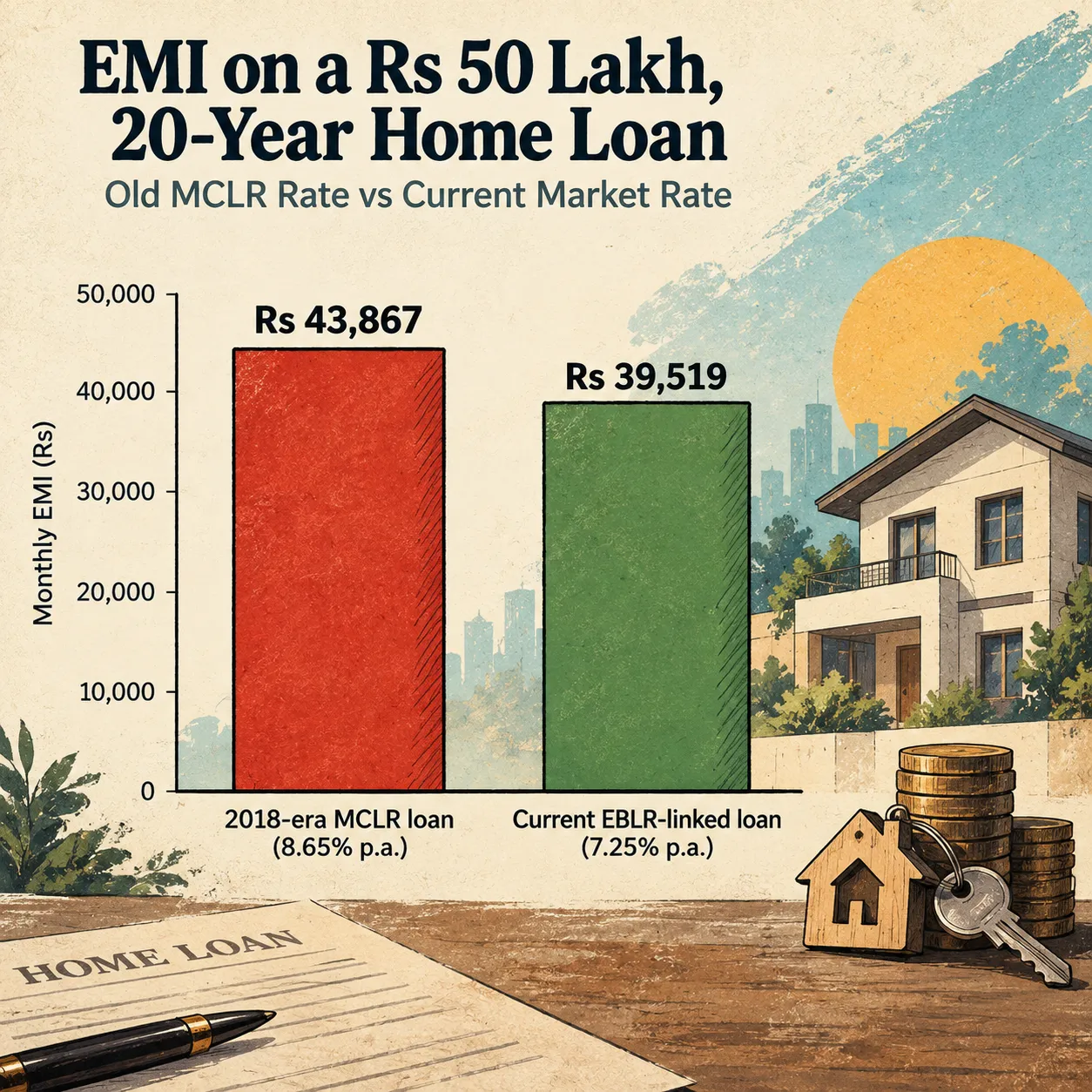
At an old MCLR-linked rate of 8.65 percent, the monthly EMI on that loan works out to roughly Rs 43,867. At a current market rate of 7.25 percent, the same loan carries an EMI of roughly Rs 39,519, a difference of about Rs 4,348 every month. Over the full 20-year tenure, that gap compounds into a difference of more than Rs 10 lakh in total interest paid. These figures can be checked and adjusted for any loan amount, tenure or rate using a standard EMI calculator, which typically also breaks the payment down into how much goes toward interest versus principal at different stages of the loan.

It is worth noting that early in a loan's tenure, a much larger share of each EMI goes toward interest rather than principal. This means the cost of staying on an elevated rate is felt most acutely by borrowers who are still in the first several years of repayment, which describes a large share of home loan borrowers given how much lending activity picked up between 2018 and 2021.
How to check where you actually stand
The first step is simply identifying which benchmark your loan is tied to. This information appears in the original loan agreement and in the amortisation schedule the bank provides, and it can also be confirmed by calling customer service or checking the net banking portal. Loans taken before October 2019 are very likely MCLR-linked unless the borrower has since switched. Loans taken after that date should already be repo-linked by regulatory requirement.
For those who confirm they are still on an MCLR-linked loan, most banks allow existing borrowers to switch to a repo-linked loan for a modest administrative fee, an option that became widely available after the RBI's 2019 external benchmark mandate. Before deciding whether that switch, or a balance transfer to a different lender altogether, actually makes financial sense, it helps to model the numbers rather than rely on the headline rate difference. Running the comparison through a dedicated home loan calculator, factoring in the switching or processing fee, ensures the decision is based on actual rupee savings over the remaining tenure rather than the percentage figure alone.
It is also worth remembering that MCLR is not unique to home loans. Personal loans, loans against property, and in some cases car loans taken before the EBLR mandate can carry the same structural lag. Anyone reviewing their home loan is generally well served by checking other floating-rate borrowings at the same time, since a car loan EMI calculator can surface similar benchmark mismatches on vehicle financing that might otherwise persist for years unnoticed.
A few practical cautions before switching
Switching benchmarks or transferring a loan to a new lender is not automatically the right move for every borrower. Foreclosure charges, processing fees on the new loan, and the impact of a fresh credit inquiry on a credit score are all real costs that need to be weighed against the projected savings. Borrowers who are close to the end of their loan tenure, where the interest component of each EMI has already shrunk considerably, may find the savings from switching are smaller than they expect, since most of the benefit of a lower rate accrues in the early years of a loan. A fuller breakdown of how the EMI formula works and what drives each component of a monthly payment is a useful thing to review before approaching a bank, since it makes clear how much of the early repayment period is interest-heavy by design.
The larger point is straightforward. A rate cut cycle only benefits borrowers whose loans are structured to pass that benefit through. For a meaningful number of Indians still repaying loans taken in 2018 or earlier, that pass-through has been slow, partial, or in some cases has not happened at all. Checking which benchmark governs your own loan takes a few minutes. For many borrowers, that check is likely to reveal several hundred rupees, or more, of avoidable cost every single month.
This article is for educational purposes only and does not constitute financial or investment advice. Readers should evaluate their specific loan terms and consult their bank or a qualified financial advisor before making any changes to an existing loan.
Frequently Asked Questions
Why haven't I seen a drop in my home loan EMI despite falling interest rates?
If your home loan is linked to the Marginal Cost of Funds based Lending Rate (MCLR), you may not see immediate benefits from rate cuts, as MCLR loans reset only every six to twelve months. In contrast, repo-linked loans adjust within three months, reflecting RBI rate changes more swiftly.
How can I find out if my home loan is MCLR-linked or repo-linked?
You can determine the benchmark your loan is linked to by checking your original loan agreement or the amortization schedule provided by your bank. Alternatively, you can contact customer service or check your bank's net banking portal for this information.
Is it worth switching from an MCLR-linked loan to a repo-linked loan?
Switching can be beneficial, especially if you are still in the early years of your loan when a larger portion of your EMI goes towards interest. However, you should consider factors like foreclosure charges and processing fees, and it’s advisable to run the numbers using a home loan calculator to ensure the switch makes financial sense.
What should I consider before transferring my home loan to a different lender?
Before transferring, you should weigh the potential savings against any foreclosure charges, processing fees, and the impact on your credit score. Additionally, consider how much time you have left on your loan, as the benefits of lower rates are often realized more in the earlier repayment phases.
What is the difference between MCLR and repo-linked loans?
MCLR loans are based on a bank's internal cost of funds and reset less frequently, often leading to delayed benefits from rate cuts. Repo-linked loans, mandated for new loans since October 2019, are adjusted more quickly in response to changes in the RBI's repo rate, providing a more immediate effect on EMIs.
How much can I save by switching from an MCLR-linked loan to a repo-linked loan?
The savings can be substantial; for example, on a Rs 50 lakh loan at an 8.65% MCLR, your EMI could be around Rs 43,867, while a current repo-linked rate of 7.25% would lower it to approximately Rs 39,519, translating to over Rs 10 lakh in interest savings over 20 years. However, actual savings will depend on individual loan terms and fees.
Are there other types of loans affected by MCLR like home loans?
Yes, other floating-rate loans such as personal loans, loans against property, and some car loans taken before the EBLR mandate may also carry MCLR-linked structures. It's advisable to review all your floating-rate loans to identify any similar mismatches that could lead to unnecessary costs.































Sign in to leave a comment.