
Drop a smart search bar into an e-commerce app, and users find products faster. Wire a conversational agent into a banking app, and support queues drop overnight.
Simple enough on paper.
In Saudi Arabia, however, the moment an algorithm processes user inputs, personal identifiers, or behavioral patterns, the technical stack collides directly with national privacy law. The Kingdom's Personal Data Protection Law (PDPL), enforced by the Saudi Data and AI Authority (SDAIA), moved into full statutory enforcement in September 2024 following the conclusion of its transitional grace period.
Companies building for this market no longer have room to treat compliance as a legal sign-off scheduled for the week before App Store submission. For teams working on mobile app development Saudi Arabia AI projects, the regulatory framework dictates how data flows between client devices, cloud servers, and machine learning models.
Who Falls Under the Law (The Extraterritorial Reality)
A common miscalculation among international startups and offshore agencies is assuming that company incorporation outside the Kingdom provides an exemption.
It does not.
PDPL carries clear extraterritorial jurisdiction. If an application processes the personal data of individuals residing inside Saudi Arabia, the law applies in full. It does not matter whether the development team sits in Riyadh, London, Cairo, or Bangalore. It does not matter whether the hosting servers sit in Dublin or Frankfurt. If a Saudi resident downloads the app from the local App Store or Google Play Store and creates an account, SDAIA's regulatory boundaries enclose that data pipeline.
Penalties for severe non-compliance reach up to 5 million SAR, accompanied by potential criminal liability for deliberate leaks or unlawful transfers of sensitive records. For businesses scaling digital products in the Gulf, ignoring these boundaries is an expensive gamble.

What AI Features Actually Trigger Under PDPL
Standard mobile applications already collect device telemetry, location pings, and payment tokens. When AI capabilities enter the mix, the data surface expands dramatically.
Consider a retail app using an LLM to power customer support. When a user pastes an order ID alongside a phone number and an inquiry, that raw text travels to an inference endpoint. If that endpoint routes to a multi-tenant model hosted outside the Kingdom without valid cross-border safeguards, that single API call violates statutory transfer rules.
Profiling presents an even tighter constraint. PDPL regulates automated decision-making and behavioral profiling. If an algorithm calculates creditworthiness, flags an account for fraud, or dynamically adjusts loan terms without human intervention, specific legal thresholds take effect. Users possess the statutory right to be informed when profiling occurs, the logic driving the decision, and the ability to contest automated outcomes.
Building modern AI-powered mobile apps requires accounting for these operational rights at the database schema level.
The Practical PDPL Compliance Checklist for Engineering Teams
Before rolling out AI functionality to Saudi users, development teams must clear five specific hurdles.
1. The Legal Basis and Consent Architecture
Passive consent buried in an unreadable terms-and-conditions modal is invalid under PDPL. Consent must be freely given, informed, and explicit. More critically, consent must be granular. A user agreeing to data collection for delivery fulfillment has not agreed to have their chat transcripts used to fine-tune an internal recommendation model. The application architecture must separate operational processing consent from secondary model training consent.
2. Privacy Impact Assessment (PIA) for Automated Systems
Under SDAIA directives, processing activities that carry high risk to personal privacy mandate a formal Privacy Impact Assessment before deployment. AI applications that perform automated profiling, process biometric information for verification, or handle health metrics automatically hit this requirement. The assessment documents what data is ingested, how the model processes it, potential bias or leak vectors, and mitigation controls.
3. Cross-Border Data Transfer Controls
Data residency remains the central architectural challenge for modern apps. While updated PDPL regulations permit cross-border transfers under specific conditions (such as adequate jurisdiction protections or binding corporate rules), transferring sensitive personal data outside Saudi Arabia still requires strict contractual mechanisms. Sending unencrypted, identifiable user logs to international third-party AI APIs without legal justification exposes the operator to immediate regulatory scrutiny.
4. Data Minimization at the Prompt Layer
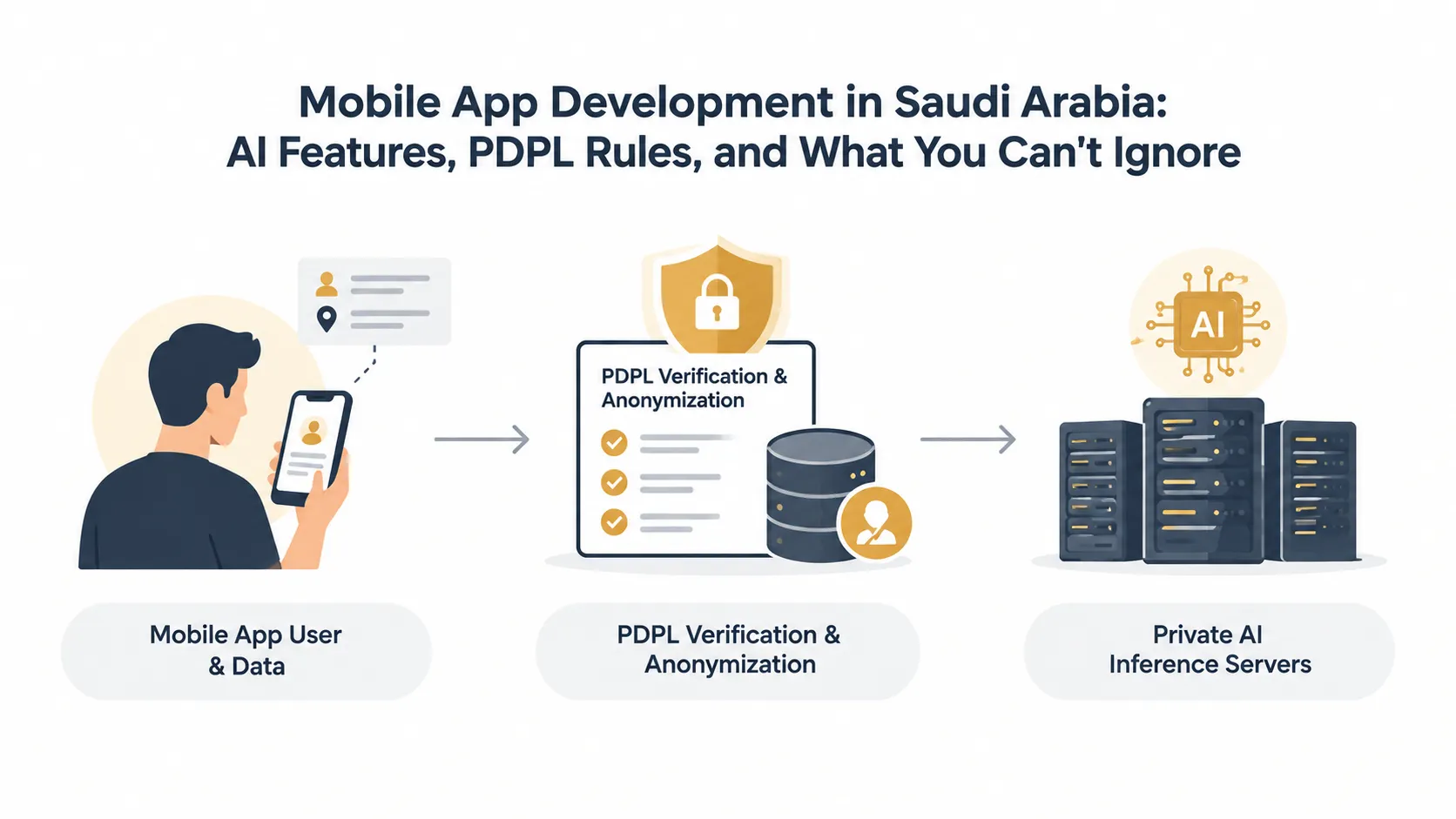
Mobile engineering leads often push raw data payloads into AI models to improve context windows. Under PDPL's data minimization mandate, collecting or transmitting data beyond what is strictly necessary for the stated purpose is prohibited. Production systems must implement local or edge-level sanitization layers. PII (personally identifiable information) such as national IDs, phone numbers, and physical addresses should be stripped, hashed, or masked before prompts reach external inference engines.
5. Automated Decision Opt-Outs and Human Review Pathways
If the mobile application relies on an algorithm to make decisions that materially affect the user, a human escalation workflow is mandatory. The interface must provide a transparent path for the user to request human intervention, challenge the result, and receive an explanation of the automated finding. An app that denies a transaction or freezes an account purely through an unmonitored model endpoint falls outside compliance boundaries.
How to Architect for Compliance from Day One
Retrofitting privacy rules into an existing mobile application is roughly four times more expensive than building them into the initial sprint.
Teams that navigate this successfully separate their application logic into clean tiers. Edge processing handles simple data validation on the device itself. A proxy orchestration layer strips sensitive metadata before passing requests to external models. Where deep contextual reasoning on private records is required, enterprises rely on a localized, PDPL-compliant AI architecture hosted on sovereign infrastructure within Riyadh or Dammam rather than piping sensitive records overseas.
Selecting the right engineering partner shapes this entire lifecycle. Technical teams evaluating development agencies should review Toadster's guide on how to choose the best mobile app development company to ensure prospective vendors understand both software delivery and market-specific regulatory constraints.
Compliance Is an Engineering Constraint, Not a Blocker
The companies capturing market share in Saudi Arabia's digital economy are not the ones avoiding AI. Nor are they the ones deploying cutting-edge models recklessly.
They are the teams treating regulatory compliance like battery life, network latency, or memory management: a foundational engineering constraint that guides architectural decisions from day one. Saudi Arabia's consumer market is exceptionally tech-literate, mobile-first, and quick to adopt automated services. Delivering those capabilities within the lines drawn by SDAIA is simply the price of admission.
Frequently Asked Questions
Does the Saudi PDPL apply to foreign mobile app developers?
Yes. The law applies extraterritorially. If an application processes the personal data of individuals residing within Saudi Arabia, the operating company must comply with PDPL regulations, regardless of where the business is registered or where physical servers reside.
Can an app send Saudi user data to third-party AI APIs like OpenAI or Anthropic?
Only under strict, legally verified conditions. The transfer must comply with SDAIA's cross-border data transfer rules, requiring an appropriate legal basis, contractual safeguards ensuring equal data protection, and explicit notification to the user. Many enterprises avoid this complexity by using dedicated private instances deployed within regional data centers.
What happens if an app uses AI for automated profiling without user consent?
Unlawful profiling violates PDPL transparency and consent mandates. SDAIA possesses authority to issue administrative warnings, impose commercial fines up to 5 million SAR, and temporarily suspend data processing activities, which can effectively shut down an application's backend operations.
Is an AI Privacy Impact Assessment (PIA) mandatory for every mobile app?
Not every app requires a formal PIA, but applications featuring high-risk processing do. If the mobile app uses AI for biometric identity verification, credit scoring, healthcare assessments, or behavioral tracking across third-party platforms, an assessment is required before public launch.
How does PDPL define personal data in the context of AI models?
Personal data includes any information that leads to the direct or indirect identification of an individual. In an AI context, this covers raw input prompts containing names or account details, generated user profile vectors, voice recordings, and device identifiers used to monitor individual behavior.
Can an AI agent handle customer support queries autonomously in Saudi Arabia?
Yes, provided the system clearly informs the user that they are interacting with an automated program, processes only relevant personal details, and provides a clear mechanism to escalate the conversation to a human representative whenever requested.


























Sign in to leave a comment.