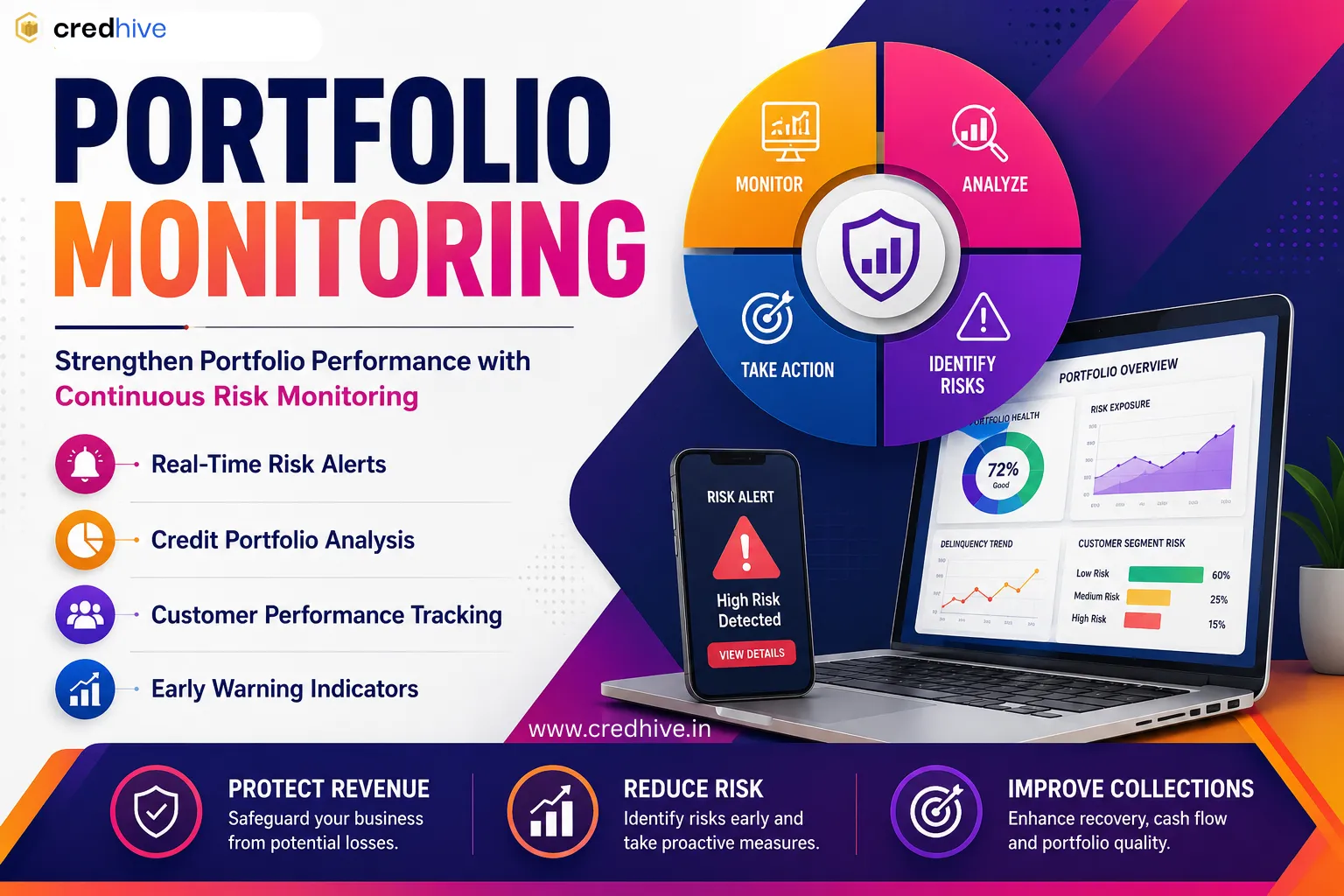

The financial services landscape is shifting from reactive risk management to continuous, data-driven oversight. For banks, Non-Banking Financial Companies (NBFCs), fintech lenders, and enterprise financial teams, relying on quarterly financial statements or annual credit reviews is no longer sufficient. Economic volatility, sudden market shifts, and rapid changes in borrower behavior require a dynamic approach: continuous portfolio monitoring.
At its core, portfolio monitoring is the ongoing, automated analysis of a lender’s or investor’s asset pool. By tracking borrower financial health, market metrics, and operational performance in real time, financial institutions can detect early warning signs, optimize capital allocation, and protect profitability.
The Strategic Importance of Real-Time Portfolio Monitoring
Historically, monitoring a loan or investment portfolio involved manual audits and static reports. This lag created significant blind spots. A borrower could experience serious cash flow distress months before a quarterly review flagged the issue.
Continuous portfolio monitoring bridges this gap. By integrating live transaction feeds, open banking data, bureau updates, and alternative data sources, institutions gain a 360-degree view of their credit exposure.
Key Business Benefits
- Proactive Risk Mitigation: Identify early warning indicators—such as sudden drops in average daily balances, increased credit utilization, or delayed vendor payments—before default occurs.
- Enhanced Operational Efficiency: Automate routine data collection and compliance checks, freeing risk analysts to focus on high-priority exceptions.
- Optimized Capital Allocation: Categorize assets dynamically based on real-time risk profiles, allowing for precise loan loss provisioning and smarter capital reserves.
- Improved Customer Experience: Enable frictionless credit limit increases or tailored refinancing options for low-risk clients based on ongoing positive behavior.
Core Pillars of an Effective Monitoring Infrastructure
To build an agile monitoring framework, financial organizations rely on four primary technological pillars:
1. Data Integration and Aggregation
A robust system pulls data from diverse internal and external streams. This includes core banking software, credit bureaus, GST/tax filings, accounting systems, and macroeconomic feeds.
2. Early Warning Systems (EWS)
EWS algorithms establish behavioral baselines for borrowers. When metrics deviate from the norm—such as a sharp increase in cheque bounces or unexpected leadership turnover—the system triggers automated alerts for risk officers.
3. Automated Risk Scoring and Segmentation
Risk profiles are not static. Continuous monitoring automatically updates borrower credit scores and segments the portfolio into clear risk buckets, enabling targeted intervention strategies.
4. Interactive Reporting and Visualization
Intuitive dashboards provide decision-makers with high-level exposure overviews while allowing risk teams to drill down into specific borrower profiles or asset classes.
Practical Applications Across Financial Sectors
The operational value of portfolio monitoring manifests uniquely across different business models:
Commercial Banks and NBFCs
In commercial lending, tracking corporate health requires monitoring supply chain health and bank statement activity. An effective system alerts relationship managers if a commercial borrower loses a primary client, allowing the bank to restructure covenants before liquidity dries up.
Fintech Lenders
Fintechs handling micro-loans or Buy-Now-Pay-Later (BNPL) products deal with high transaction volumes and smaller margins. Automated monitoring enables immediate detection of rising default trends across specific demographics or merchant channels.
Insurance and Enterprise Treasury
Insurers and enterprise treasury teams monitor counterparty risk continuously. Real-time updates on bond rating adjustments or corporate earnings reports help treasurers reallocate reserves to safer instruments instantly.
Overcoming Implementation Challenges
While the benefits are clear, adopting a real-time framework comes with operational hurdles:
| Challenge | Impact | Strategic Solution |
|---|---|---|
| Data Silos | Incomplete risk visibility due to fragmented systems | Adopt unified API layer architectures to aggregate internal and external data |
| Alert Fatigue | Risk teams overwhelmed by low-priority notifications | Tune threshold parameters and implement multi-factor triggers to filter noise |
| Legacy Systems | Incompatibility with modern fintech integrations | Use modular, cloud-native middleware that connects legacy core engines to modern analytical tools |
The Road Ahead: AI and Predictive Monitoring
The next evolution of portfolio monitoring relies heavily on machine learning and predictive analytics. Future systems will move beyond identifying current distress to forecasting stress months in advance using macro-trend projections and deep transactional pattern analysis.
Financial institutions that invest in automated, real-time monitoring capabilities protect their asset quality while building a resilient infrastructure capable of navigating market uncertainty.
Frequently Asked Questions (FAQs)
What is the primary difference between portfolio monitoring and portfolio management?
Portfolio management focuses on strategic asset allocation, investment selection, and overall performance goals. Portfolio monitoring is the tactical, continuous tracking of risk metrics, operational performance, and compliance standards within that portfolio to protect asset quality.
How does continuous portfolio monitoring improve credit risk management?
By tracking real-time transactional data, credit bureau updates, and alternative metrics, continuous monitoring detects financial distress far earlier than traditional periodic reviews. This allows risk teams to intervene and restructure terms before a default occurs.
Can legacy core banking systems support real-time portfolio monitoring?
Yes, legacy systems can support real-time monitoring by using cloud-based middleware and modern API layers. These tools extract data from legacy databases without requiring a complete overhaul of the core banking architecture.
What are Early Warning Indicators (EWIs) in portfolio monitoring?
EWIs are quantitative or qualitative signals that suggest potential default or financial stress. Common examples include unexpected dips in bank balances, increased credit utilization, delayed tax filings, or legal disputes involving the borrower.
How does portfolio monitoring benefit fintech and alternative lenders?
Fintech lenders rely on speed and scale. Automated portfolio monitoring allows fintechs to track large volumes of small-ticket loans efficiently, automate recovery workflows, and dynamically adjust underwriting models based on real-time repayment trends.

























Sign in to leave a comment.