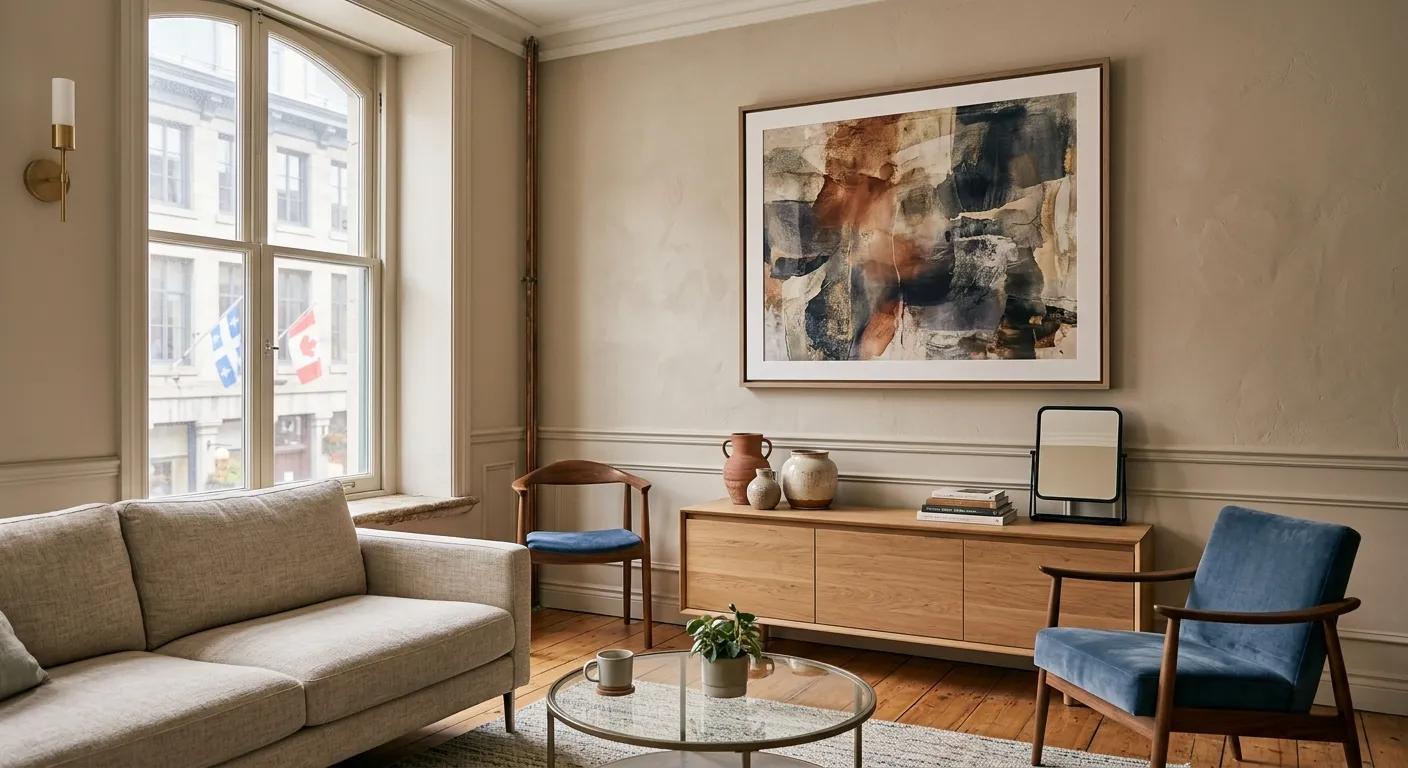

Buying a piece of local art is often the easy part. Deciding how to display it at home can be surprisingly complicated.
Montreal homes already have plenty of personality. A Plateau apartment might have exposed brick, older woodwork and tall windows, while a newer Griffintown condo may have clean lines, concrete and large open walls. The right frame can help an artwork feel connected to its surroundings rather than looking like something simply placed on an empty wall.
For homeowners buying work from local artists, choosing the frame is therefore part of the decorating process, not an afterthought.
Let the Artwork Lead
The frame should complement the artwork without competing with it.
For a colourful contemporary painting, a simple frame can give the colours room to stand out. A more traditional work may benefit from a warmer wood finish or a more substantial profile.
There is no single frame that works for every piece. The artwork's colours, size, medium and overall character should all influence the decision.
This is particularly important when buying original work. Unlike a mass produced print, an original painting can have unusual dimensions, textures or materials that do not fit conveniently into a standard frame.
Think About the Room as Well
A frame needs to work with both the artwork and the room around it.
Consider the furniture, wall colour, flooring and other materials already present. A natural wood frame can connect nicely with warm floors or wooden furniture. A black frame may provide a stronger visual edge in a minimalist interior.
Montreal's housing stock makes this especially interesting. The city's mix of heritage apartments, duplexes, triplexes and newer condominiums means homeowners are often working with very different architectural backgrounds.
For a broader look at the city's architectural character, Tourisme Montréal's guide to Montreal's heritage and architecture offers useful context.
Custom Framing Makes Sense for Local Artwork
Standard frames are convenient when the artwork happens to fit one of the available sizes. Original artwork does not always cooperate.
A painting might have unusual proportions, a deep canvas or a paper size that leaves too much empty space inside a standard frame. In those situations, custom framing allows the proportions and presentation to be considered specifically for the artwork.
This can be particularly helpful when several pieces need to work together on the same wall. Matching dimensions or using complementary finishes can create a more cohesive collection without making every frame identical.
Consider the Material Before the Colour
It is easy to focus entirely on how a frame looks. The materials matter too.
Artwork on paper has different requirements from stretched canvas. Photographs, prints and delicate works may also require different approaches.
The Canadian Conservation Institute explains that framing can provide both aesthetic value and preventive protection. The frame and glazing can help protect artwork during display and handling. Its guidance on framing paintings is useful for homeowners dealing with valuable or delicate pieces.
That does not mean every painting needs museum style framing. It simply shows why framing is more than choosing a colour from a shelf.
Do Not Ignore the Mat
For artwork on paper, the mat can be just as important as the outer frame.
A mat creates visual breathing room between the artwork and frame while also affecting the overall proportions. A narrow mat can produce a very different appearance from a wide one, even when both use the same frame.
For a busy or colourful piece, a restrained mat may help keep attention on the artwork. With a simpler work, a wider mat can become part of the composition.
The best choice depends on the artwork, the wall and the look you want to create.
Montreal Art Can Work in Modern Homes
Local art does not have to match a home's architecture perfectly.
In fact, contrast can be what makes the room interesting.
A contemporary Montreal painting can look completely at home in a century old Plateau apartment. Likewise, a more traditional work can bring warmth to a modern condo with concrete surfaces and minimalist furniture.
Montreal's public art scene offers plenty of examples of contemporary work appearing within historic and urban environments. The City of Montreal's public art resources provide an overview of works found throughout the city.
The same principle can work at home. The artwork does not have to repeat the room's style to belong there.
Think About Where You Will Hang It
Before ordering a frame, look at the wall where the artwork will eventually live.
Measure the available space and consider nearby furniture. Artwork above a sofa generally needs different proportions from a smaller piece displayed in a hallway.
Lighting matters too. Direct sunlight can affect some artwork over time, so a beautiful frame cannot compensate for poor placement.
If you are creating a collection of local pieces, consistency can also help. You do not necessarily need identical frames, but repeating a material, colour or general style can make several different artworks feel connected.
Where to Find the Right Framing Options
Once you have chosen the artwork, the next step is finding a framing option that suits both the piece and the room.
Montreal homeowners have access to framing services that can accommodate different artwork sizes, materials and presentation styles. This can be particularly useful when a painting or print does not fit a standard frame size.
For homeowners comparing options, custom picture frames can provide more flexibility over dimensions, materials and the overall appearance of the finished piece.
The frame should ultimately support the artwork rather than become the main attraction. Taking the time to compare proportions, finishes and materials can make a noticeable difference once the piece is hanging on the wall.
A Frame Should Finish the Artwork, Not Hide It
There is no universal formula for framing local art.
The best choice depends on the artwork itself, the character of the room and how you want the finished piece to feel. Sometimes that means a simple black frame. Sometimes it means warm wood, a generous mat or a more carefully considered custom solution.
For Montreal homeowners collecting work from local artists, framing is an opportunity to connect the artwork with the home around it.
A good frame does not demand attention.
It makes the artwork look like it has always belonged there.




























Sign in to leave a comment.