


Retirement often brings more freedom to travel, play golf, meet friends for dinner, and stay active after sunset. Cataracts can interfere with those routines by making colors look dull, reducing contrast, or creating glare around lights. For people considering laser cataract surgery, the choice of intraocular lens (IOL) can be just as important as the procedure itself.
Two options that may come up are multifocal lenses and Light Adjustable Lenses. They solve different vision needs. A multifocal lens is designed to provide vision at more than one distance. A Light Adjustable Lens can be fine-tuned after surgery to help achieve a desired visual target.
So which option makes more sense for a retiree who enjoys golf during the day but also drives at night? The answer depends on how you use your vision, your tolerance for visual effects, and whether reducing glasses dependence or maximizing nighttime clarity matters more.
How Do Multifocal and Light-Adjustable Lenses Work?
The biggest difference is how each lens approaches vision correction.
What does a multifocal lens do?
A multifocal IOL uses different optical zones to provide vision at multiple distances. This can make it easier to read menus, use a phone, check a scorecard, and see distant objects without relying as much on glasses.
The trade-off is that some people notice halos, glare, or reduced contrast, particularly in low-light conditions. Research has found that multifocal lenses can provide better near vision and greater spectacle independence, but they can also increase the likelihood of glare and halos compared with monofocal lenses.
What makes a Light Adjustable Lens different?
A Light Adjustable Lens is designed to be adjusted after it has been implanted. The lens contains photosensitive material that responds to controlled ultraviolet light treatments, allowing the surgeon to refine the lens power after surgery.
That post-surgery adjustment is the main distinction. Instead of relying entirely on the preoperative lens calculation, the visual target can be refined after the eye has healed.
Which Lens May Better Fit Someone Who Drives at Night?
Night driving deserves special attention when choosing an IOL.
Headlights, streetlights, traffic signals, and reflective road signs can make visual disturbances more noticeable after dark. The American Academy of Ophthalmology notes that people who frequently drive at night may want to avoid multifocal or EDOF lenses because glare, halos, and reduced contrast can occur in dim conditions.
That does not mean every multifocal lens causes bothersome night vision problems. Many patients adapt well. However, expectations matter.
A person who drives only occasionally after sunset may view the trade-off differently from someone who regularly drives to dinner, attends evening events, or takes long nighttime trips.
Pro Tip: Tell your cataract surgeon how often you drive after dark. “I drive at night” is useful, but explaining how often, how far, and in what conditions provides better context for lens selection.
How Do the Two Lenses Compare for Golf and Everyday Activities?
Golf presents a different visual challenge from night driving. It involves distance vision, depth perception, contrast, and the ability to see smaller objects against changing backgrounds.
A golfer may want to:
- Follow a ball in flight.
- Read a scorecard.
- See yardage markers.
- Judge distances across the fairway.
- Read a phone or golf app.
- Recognize details in changing sunlight.
- Drive a cart safely around the course.
Multifocal lenses can be appealing when reducing dependence on reading glasses is a major goal. Their multiple focal points may help with both distance and near tasks.
A Light Adjustable Lens, by contrast, allows the surgeon to refine the lens power after implantation. It does not automatically provide the same range of near vision as a multifocal IOL. However, the ability to customize the final refractive target may appeal to someone who places a high value on distance clarity.
Which Lens Has the Advantage for Nighttime Clarity?

There is no single lens that guarantees perfect nighttime vision.
Still, the optical design matters. Multifocal lenses divide incoming light among different focal points. This can help with near vision but may also produce halos or glare for some patients.
A recent consensus on multifocal IOLs describes halos and reduced contrast as important considerations with multifocality, particularly when patients expect high-quality vision across different distances.
A Light Adjustable Lens follows a different strategy. The lens is generally used as an adjustable monofocal platform, allowing the postoperative refractive target to be refined.
What should a nighttime driver consider?
| Vision Priority | Multifocal IOL | Light Adjustable Lens |
| Distance vision | Yes | Yes |
| Near vision without glasses | Often better | May still require reading glasses |
| Postoperative power adjustment | No | Yes |
| Potential halos or glare | Can occur | Visual effects may still occur |
| Night driving priority | Requires careful discussion | May be considered when distance clarity is a priority |
| Reducing glasses dependence | Often a major goal | Depends on the final target |
The table is a general comparison. Individual results vary based on eye health, lens model, corneal condition, astigmatism, and the visual target selected by the surgeon.
Does Cataract Surgery Method Change the Lens Decision?
Not necessarily.
Cataract surgery removes the cloudy natural lens and replaces it with an artificial IOL. Laser-assisted techniques may be used as part of the surgical process, but the surgical method and IOL selection are separate decisions.
This distinction is important because someone researching cataract eye surgery may focus heavily on the technology used during the procedure. The better question is often: “What type of vision do I need after surgery?”
The answer can help guide the discussion about the IOL.
Note: A premium lens is not automatically the best lens. The right choice depends on your eyes, lifestyle, visual priorities, and tolerance for potential side effects.
What Should a Retiree Ask Before Choosing an IOL?
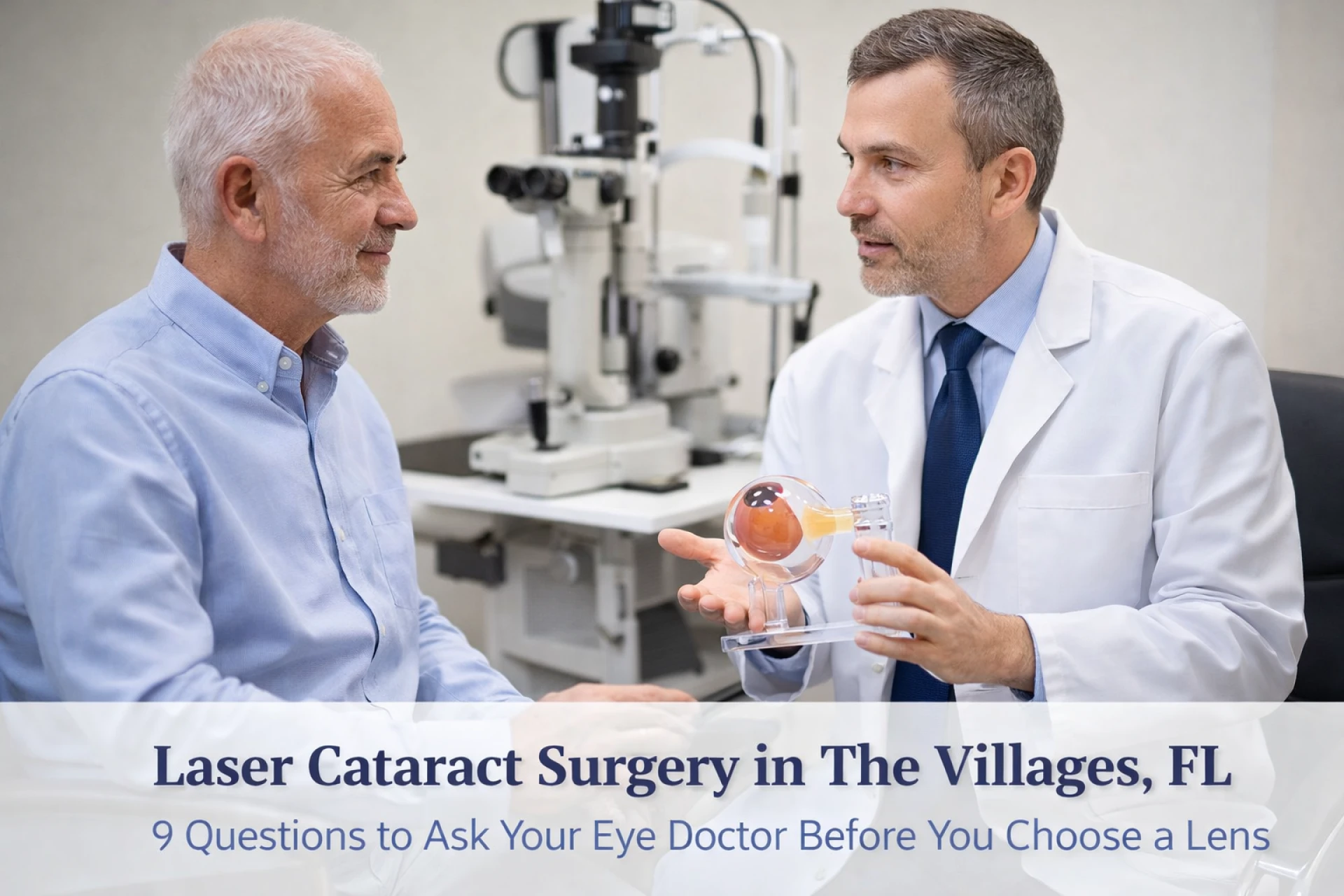
A consultation should go beyond asking whether a lens is “better.” Ask questions that connect the lens to your daily life.
Consider asking:
- How important is nighttime driving in my routine?
- How often do I need to read without glasses?
- Would I accept reading glasses if it improves distance clarity?
- Do I have astigmatism that should be corrected?
- Do I have dry eye, glaucoma, macular changes, or another condition that could affect the result?
- Could I benefit from an adjustable lens?
- What visual effects should I expect during the first few weeks or months?
- What happens if my final prescription is different from the target?
- Would monovision be appropriate for my lifestyle?
- Which lens best matches my expectations for golf, driving, travel, and everyday activities?
An experienced cataract specialist can use the answers, along with measurements of the eyes, to discuss realistic options.
Why Does Overall Eye Health Matter Before Choosing a Premium Lens?
The IOL is only one part of the visual system.
Conditions affecting the cornea, retina, optic nerve, or tear film can influence the quality of vision after cataract surgery. Someone with otherwise healthy eyes may have more lens choices than someone with another eye condition affecting contrast or visual function.
This is why a comprehensive evaluation matters before selecting a premium IOL.
An eye doctor in The Villages, FL, may also ask about medications, previous eye procedures, dry-eye symptoms, and vision changes. These details can help determine whether certain lens designs are appropriate.
An ophthalmologist can evaluate the health of the eye and discuss surgical options, including the potential benefits and limitations of different IOL designs.
An optometrist may also play an important role in routine eye care and in identifying changes that should be evaluated before surgery.
Do You Know What the Cataract Surgery Process Involves?
Cataract surgery generally involves removing the cloudy natural lens and replacing it with an artificial lens. The procedure is commonly performed on an outpatient basis.
The exact surgical plan varies by patient. Lens measurements, eye health, visual goals, and lifestyle all contribute to the final decision.
Quick Fact: The Light Adjustable Lens is designed so its optical power can be adjusted after cataract surgery using controlled ultraviolet light treatments.
What Is the Best Lens Choice for a Retiree Who Golfs and Drives at Night?
There is no universal winner between a multifocal IOL and a Light Adjustable Lens.
A multifocal lens may be attractive to someone who strongly values a broad range of vision and wants to reduce dependence on reading glasses. However, nighttime glare and halos should be discussed, especially for frequent nighttime drivers.
A Light Adjustable Lens may be worth discussing with someone who places a high priority on refining the postoperative distance prescription and is comfortable with the possibility of using glasses for some near tasks.
The decision should be based on the person’s real routine, not simply the newest lens technology.
Key Takeaways
- Multifocal and Light Adjustable Lenses use different approaches to vision correction.
- Multifocal lenses can improve the chance of seeing at multiple distances without glasses.
- Halos, glare, and contrast changes are important considerations with multifocal lenses.
- Nighttime drivers should discuss low-light vision before selecting an IOL.
- Light Adjustable Lenses allow postoperative refinement of the visual target.
- Golfers should consider both distance performance and near tasks such as reading scorecards.
- Overall eye health can affect which premium lens options are appropriate.
- The best IOL is the one that matches the patient’s visual priorities and daily activities.
Final Insights: Choose the Vision You Actually Use
For an active retiree, cataract surgery is about more than seeing an eye chart clearly. It is about seeing the golf ball, reading the scorecard, recognizing a road sign, and feeling comfortable behind the wheel after sunset.
Multifocal and Light Adjustable Lenses can both be valuable options, but they solve different problems. A thoughtful discussion with a qualified eye care professional can help match the lens choice to the way you actually live.
FAQs
1. Can I drive at night after cataract surgery?
Many people return to driving after cataract surgery once their vision has recovered and their eye doctor confirms that it is safe. The timing varies by patient. Night driving should be discussed separately because glare and halos may be more noticeable in low-light conditions.
2. Will a Light Adjustable Lens eliminate the need for glasses?
Not necessarily. A Light Adjustable Lens allows the surgeon to adjust the refractive target after implantation, but it does not automatically provide clear vision at every distance. Reading glasses may still be useful depending on the final target.
3. Are multifocal lenses suitable for golfers?
They may be suitable for some golfers because they can provide useful vision across multiple distances. However, the choice should also consider night driving, contrast sensitivity, eye health, and how much the person values freedom from reading glasses.
4. Does laser cataract surgery determine which lens I receive?
No. The surgical technique and IOL selection are related but separate decisions. Your surgeon can discuss the available surgical approach and then recommend lens options based on your eye measurements and visual goals.
5. Should I see an ophthalmologist before choosing a premium cataract lens?
Yes. A comprehensive evaluation can identify cataracts and other eye conditions that may affect the choice of IOL. It also allows you to discuss your daily activities, including golf, reading, travel, and nighttime driving.
For a clearer understanding of your cataract lens options, discuss your daily vision needs and expectations with an eye care professional.























Sign in to leave a comment.