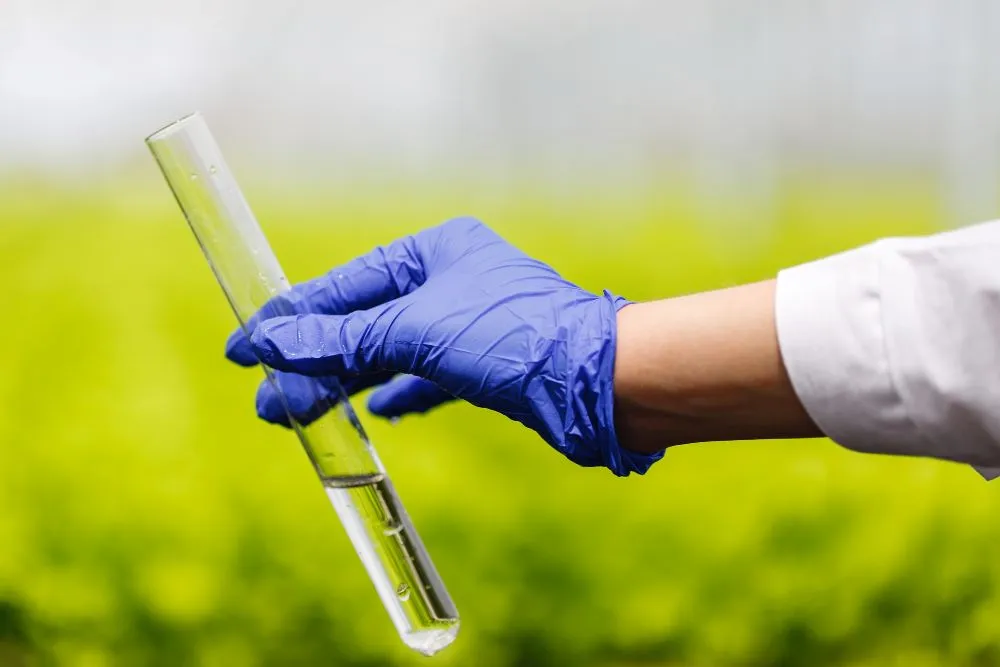

Hydroponics gives growers much more control over plant nutrition, but it also leaves less room for mistakes. In soil, minerals and organic matter can provide some buffering. In a hydroponic system, roots depend mainly on the nutrient solution flowing around them.
This means that a small change in EC, pH or nutrient concentration can quickly affect plant growth.
Nano Fertilizers can become part of a modern hydroponic nutrition program, but simply adding more nutrients does not guarantee better results. Successful hydroponic growing depends on keeping the entire nutrient solution balanced.
EC Shows the Strength of the Nutrient Solution
Electrical conductivity, commonly called EC, indicates the concentration of dissolved salts and ions in the nutrient solution.
A higher EC generally means the solution contains more dissolved ions, while a lower EC means fewer. However, EC cannot tell whether individual nutrients such as iron, nitrogen or boron are present in the correct amount.
When EC becomes too high, roots may have difficulty taking up water and plants can experience salt stress or nutrient imbalance.
When EC is too low, plants may not receive enough nutrition for healthy growth.
Typical hydroponic ranges include:
| Crop | Approx. EC | Common pH Range |
|---|---|---|
| Basil | 1.0–1.6 mS/cm | 5.5–6.0 |
| Lettuce | 1.2–1.8 mS/cm | 6.0–7.0 |
| Cucumber | 1.7–2.0 mS/cm | 5.0–5.5 |
| Tomato | 2.0–4.0 mS/cm | 6.0–6.5 |
These figures are guides, not fixed recipes. Variety, growth stage, temperature, light, water quality and hydroponic system type can change nutrient requirements.
pH Controls Nutrient Availability
For many hydroponic crops, nutrient availability is generally good under slightly acidic conditions. A range around pH 5.5–6.5 is commonly used, although the ideal target depends on the crop.
Problems start when pH moves outside the useful range.
At a higher pH, nutrients including iron can become less available. Calcium, magnesium and phosphorus can also face solubility problems under unsuitable conditions. This means a plant may show deficiency symptoms even when nutrients are already present in the reservoir.
Adding more fertilizer without checking pH can therefore make the problem worse.
A better nutrient-management flow is:
Source Water → Add Nutrients → Check EC → Adjust Strength → Check pH → Monitor Roots and Leaves → Make Small Corrections
Start with Source Water
Good hydroponic nutrition begins before fertilizer is added.
Source water may already contain calcium, magnesium, sodium, chloride, bicarbonates and other dissolved minerals. These contribute to starting EC and can affect pH stability.
High alkalinity is especially important because it can repeatedly push nutrient-solution pH upward. Testing source water for EC, pH and alkalinity helps create a more accurate feeding program.
Using Nano Fertilizers in a Hydroponic Program
Nano Fertilizers should be used as controlled nutrient inputs rather than added randomly to increase EC.
Each product should have a clear purpose.
Hydromax is particularly relevant to hydroponic growing. IndoGulf BioAg describes it as a liquid nutrient solution containing essential nutrients including nitrogen, phosphorus and potassium, with high water solubility and suitability for hydroponic systems.
Nano Iron can support iron nutrition. Iron plays an important role in plant processes such as photosynthesis and enzyme activity. Iron management becomes especially important where pH conditions reduce its availability.
Nano Boron can be considered where crops require additional boron support. Boron is important for growing tissues and reproductive development, but careful dosing is essential because the range between deficiency and excess is relatively narrow.
Nano Silica can provide supplemental silicon for plant strength and stress support. Silicon is generally considered a beneficial element rather than an essential nutrient for most crops, and plant response differs between species. Research has also examined silicon supplementation in soilless production systems.
Nano Chitosan is better viewed as a specialized plant-support input rather than a standard NPK nutrient. Chitosan has been studied for its role in plant growth, nutrient uptake and stress responses.
Any supplemental product should be used according to crop requirements, system compatibility and recommended application rates.
Reading Plant Symptoms Together with EC and pH
Plant appearance can provide useful clues, but symptoms should always be checked against reservoir conditions.
| Plant or System Sign | Possible Cause | First Step |
|---|---|---|
| Young leaves turning yellow | Iron availability or high pH | Check pH and nutrient balance |
| Leaf tips burning | High EC or nutrient excess | Test EC and source water |
| Slow plant growth | Weak nutrition, unsuitable pH or root stress | Check the complete system |
| EC rising steadily | Water disappearing faster than nutrients | Check water level and solution strength |
| EC falling steadily | Nutrients being removed faster than water | Review crop-stage feeding |
| pH rising repeatedly | High alkalinity or nutrient uptake pattern | Test source water |
This approach prevents unnecessary fertilizer additions.
Avoid Chasing EC with More Fertilizer
A common hydroponic mistake is adding nutrients only to reach a certain EC number.
EC measures the total ionic strength of the solution. It does not confirm that every nutrient is present in the correct ratio.
A reservoir may show an acceptable EC while plants still experience an individual nutrient deficiency or excess.
Make small adjustments, monitor plant response and keep records of EC, pH, water additions and nutrient additions. In recirculating systems, nutrient ratios can change over time even when the overall EC appears normal.
Conclusion
Successful hydroponic growing depends on balance rather than simply using more fertilizer.
Maintaining suitable EC and pH, testing source water, watching plant symptoms and adjusting nutrition according to crop stage can help growers avoid many common hydroponic problems.
Nano Fertilizers can add another level of targeted crop nutrition when used carefully within this system.
IndoGulf BioAg provides modern agricultural solutions including Hydromax, Nano Iron, Nano Boron, Nano Silica and Nano Chitosan. Hydromax is specifically positioned for hydroponic applications, while other products can be selected according to crop nutrition needs, compatibility and recommended application guidance.
The strongest hydroponic program is not the one with the most nutrients. It is the one where water quality, EC, pH and plant nutrition remain in balance.
























Sign in to leave a comment.