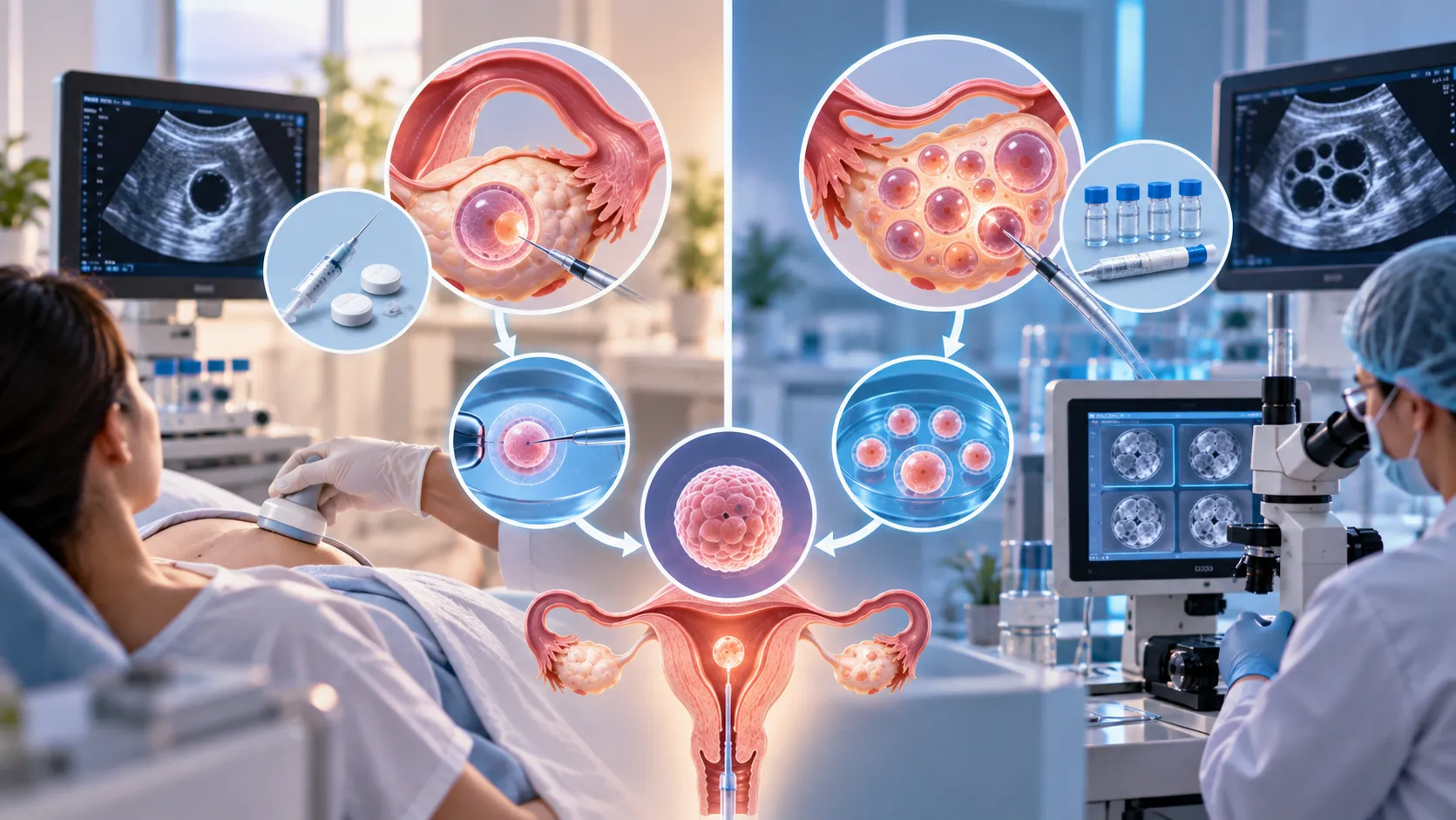

IVF does not always mean using high doses of fertility medicines to produce several eggs. Natural cycle IVF takes a different approach by working with the woman's naturally developing egg, usually with little or no ovarian stimulation.
This makes natural cycle IVF vs IVF an important comparison for people who want to understand their treatment options, particularly those who may have a low ovarian reserve, have responded poorly to previous stimulation, or want to reduce medication use.
But fewer medicines do not automatically mean better results. Natural cycle IVF usually produces fewer eggs and may have a higher chance of cycle cancellation. Conventional IVF aims to develop multiple eggs in one cycle, creating more opportunities for fertilization and embryo development.
What Is Natural Cycle IVF?
Natural cycle IVF is an IVF approach that monitors the woman's natural menstrual cycle rather than using conventional ovarian stimulation to produce multiple follicles.
Typically, one dominant follicle develops naturally. The fertility team monitors its growth and attempts to retrieve the mature egg before ovulation.
The retrieved egg is then fertilized in the laboratory, and if an embryo develops, it may be transferred to the uterus.
Some protocols use limited medication or an ovulation trigger. These are sometimes described as modified natural-cycle IVF rather than completely unstimulated IVF.
What Is Conventional IVF?
In conventional IVF, fertility medications containing ovarian stimulation hormones are used to encourage the development of multiple follicles.
The ovaries are monitored through ultrasound and other tests. When the follicles are ready, eggs are retrieved and fertilized in the laboratory.
Having multiple eggs can increase the number of embryos potentially available for transfer or freezing.
Conventional IVF remains widely used because it allows the treatment team to retrieve several eggs during one cycle.
Natural Cycle IVF vs IVF: Key Differences
| Factor | Natural Cycle IVF | Conventional IVF |
|---|---|---|
| Ovarian stimulation | Little or none | Usually uses stimulation medication |
| Eggs targeted | Usually one | Multiple |
| Medication use | Lower | Higher |
| Injection requirements | Usually fewer | Usually more |
| Egg retrieval | Usually one egg targeted | Multiple eggs targeted |
| Risk of ovarian hyperstimulation | Very low compared with stimulated IVF | Present, depending on response |
| Cycle cancellation | Can be higher | Generally lower because multiple follicles are developed |
| Cost per cycle | Often lower | Generally higher |
| Embryo availability | Usually limited | Potentially more embryos |
The exact protocol can vary between fertility clinics.
Natural IVF Success Rate
The natural IVF success rate should not be compared with conventional IVF using a single percentage.
Success depends on factors such as:
- Age
- Egg quality
- Ovarian reserve
- Sperm quality
- Embryo development
- Uterine health
- Cause of infertility
- Laboratory quality
- Number of treatment cycles
Natural cycle IVF can have lower success per treatment cycle in some groups because only one egg is generally available. If that egg is not retrieved, does not fertilize, or does not develop into a transferable embryo, there may be no embryo available for transfer.
Research reviewed by the American Society for Reproductive Medicine has found that evidence in poor responders is limited and mixed, with natural or modified-natural approaches not clearly demonstrating a consistent advantage over conventional stimulation.
Therefore, patients should ask clinics for success rates that match their age group and treatment circumstances rather than relying on a general advertised percentage.
Who Can Consider Natural Cycle IVF?
Natural cycle IVF may be discussed with people who have particular fertility circumstances.
1. Poor Ovarian Response
People who produce very few eggs despite ovarian stimulation may discuss natural or modified-natural IVF with their fertility specialist.
However, this does not mean natural IVF is automatically more effective for poor responders.
2. Low Ovarian Reserve
For someone with a low ovarian reserve, producing many eggs may be difficult even with stimulation. A specialist may discuss whether attempting to retrieve the naturally developing egg is reasonable.
3. Those Who Want Less Medication
Some patients prefer an approach involving fewer fertility medicines and injections.
Natural cycle IVF can reduce medication exposure, although monitoring and egg retrieval are still part of the process.
4. People Who Cannot or Prefer Not to Use High-Dose Stimulation
Individual medical circumstances can influence the choice of IVF protocol. The fertility specialist will consider ovarian reserve, previous treatment response, age, and other factors before recommending an approach.
Who May Not Be a Good Candidate?
Natural cycle IVF may not be suitable for everyone.
It can be challenging when:
- Ovulation is irregular or absent
- The ovaries do not consistently produce a mature follicle
- There are significant sperm-related fertility issues
- The chance of obtaining a mature egg is low
- Multiple embryos are desired from one retrieval
- Previous natural cycles have repeatedly been cancelled
A fertility specialist can assess whether the natural cycle is predictable enough for treatment.
Natural Cycle IVF Cost in India
The natural cycle IVF cost India varies depending on the fertility centre, city, medicines, monitoring, laboratory procedures, and whether additional techniques are required.
Because natural cycle IVF generally uses fewer stimulation medicines, the medication component may be lower than conventional IVF.
However, the total cost does not simply depend on medication. Patients may still need:
- Ultrasound monitoring
- Blood tests
- Egg retrieval
- Laboratory fertilization
- Embryo culture
- Embryo transfer
- Embryo freezing, if applicable
- Additional procedures such as ICSI, when medically indicated
A natural cycle can therefore have a lower cost per attempt, but repeated cycles may be necessary if no transferable embryo is obtained.
Before treatment, ask the clinic for a complete estimate rather than comparing only the advertised IVF package price.
Natural Cycle IVF vs Mini IVF
Natural cycle IVF and mini IVF vs IVF are sometimes confused, but they are not exactly the same.
Natural cycle IVF generally works with the naturally developing follicle and uses little or no ovarian stimulation.
Mini IVF, also called mild or minimal stimulation IVF in some settings, uses lower doses of fertility medicines to encourage the development of a small number of eggs.
The goal of both approaches may be to reduce medication use, but the treatment protocols are different.
Advantages of Natural Cycle IVF
Potential advantages include:
- Less ovarian stimulation medication
- Fewer injections in some protocols
- Lower medication-related cost
- Lower risk of ovarian hyperstimulation compared with stimulated IVF
- Usually a smaller number of eggs to manage
- May be considered when previous stimulation produced very few eggs
These benefits need to be weighed against the possibility of retrieving no egg or having no embryo available for transfer.
Limitations of Natural Cycle IVF
The main limitation is the small number of eggs available.
Because natural cycle IVF generally targets one egg, there is less opportunity to create multiple embryos during a single retrieval.
The cycle can also be cancelled if unexpected ovulation occurs or if the follicle does not develop appropriately. ASRM notes these as important limitations of natural and modified-natural approaches.
Which IVF Approach Should You Consider?
There is no single IVF protocol that is appropriate for everyone.
The decision between natural cycle IVF, mild stimulation, and conventional IVF should consider:
- Your age
- Ovarian reserve
- Previous IVF response
- Ovulation pattern
- Sperm parameters
- Previous pregnancy history
- Number of eggs previously retrieved
- Treatment budget
- Your preferences regarding medication and injections
For some patients, conventional IVF may provide more eggs and embryos in one cycle. For others, a natural or mild-stimulation approach may be discussed based on their individual response and treatment goals.
Final Takeaway
The choice between natural cycle IVF vs IVF is not simply about choosing fewer medicines or a lower treatment cost.
Natural cycle IVF works with the naturally developing follicle and can reduce stimulation medication, but it usually produces fewer eggs and may carry a greater risk of having no embryo available for transfer.
Conventional IVF uses ovarian stimulation to develop multiple follicles and can provide more eggs for fertilization and embryo development.
The natural IVF success rate varies significantly according to age, egg quality, ovarian reserve, sperm factors, embryo development, and other clinical factors. Evidence does not show a universal advantage of natural-cycle treatment over conventional IVF.
If you are considering IVF, discuss your previous treatment response, ovarian reserve, expected egg yield, costs, and treatment goals with a fertility specialist before choosing a protocol.
FAQs
Is natural cycle IVF better than conventional IVF?
Neither approach is universally better. Natural cycle IVF uses little or no ovarian stimulation and usually targets one egg, while conventional IVF aims to produce multiple eggs. The appropriate approach depends on individual fertility factors.
What is the natural IVF success rate?
There is no single success rate for natural IVF. Outcomes vary according to age, egg quality, sperm factors, embryo development, and other clinical factors. Clinic statistics should be reviewed according to age and treatment type.
Is natural cycle IVF cheaper in India?
It can be less expensive per cycle because fewer stimulation medicines may be required. However, monitoring, egg retrieval, laboratory procedures, and embryo transfer still generate costs. Multiple attempts can also increase the overall expense.
What is the difference between natural IVF and mini IVF?
Natural IVF generally works with the naturally developing follicle and uses little or no stimulation. Mini IVF uses lower-dose medication to stimulate the ovaries and produce a small number of eggs.
Can natural cycle IVF work with low AMH?
It may be considered in some people with low ovarian reserve, but low AMH does not automatically mean natural IVF is the best option. A fertility specialist should consider ovarian reserve together with age, previous IVF response, and other fertility factors.
Frequently Asked Questions
Is natural cycle IVF better than conventional IVF?
Neither approach is universally better; it depends on individual fertility factors. Natural cycle IVF uses little or no ovarian stimulation and typically targets one egg, while conventional IVF aims to produce multiple eggs, increasing opportunities for fertilization.
What is the natural IVF success rate?
There isn't a single success rate for natural IVF as outcomes vary based on age, egg quality, sperm factors, and embryo development. It's important to review clinic statistics that match your specific age group and treatment circumstances.
Is natural cycle IVF cheaper in India?
Natural cycle IVF can be less expensive per cycle due to reduced medication use. However, costs for monitoring, egg retrieval, and laboratory procedures still apply, and multiple attempts may increase overall expenses.
What is the difference between natural IVF and mini IVF?
Natural IVF typically works with the naturally developing follicle and relies on little or no ovarian stimulation. In contrast, mini IVF uses lower doses of medication to stimulate the ovaries to produce a small number of eggs.
Can natural cycle IVF work with low AMH levels?
Natural cycle IVF may be an option for individuals with low ovarian reserve, but low AMH levels alone do not determine its suitability. A fertility specialist should evaluate a combination of factors, including age and previous IVF responses.
Who should consider natural cycle IVF?
Natural cycle IVF may be discussed with individuals who have poor ovarian response, low ovarian reserve, or those who prefer fewer medications. However, it may not be suitable for everyone, particularly if ovulation is irregular or if multiple embryos are desired.
What are the main limitations of natural cycle IVF?
The main limitations include targeting a smaller number of eggs, which can reduce the chances of creating multiple embryos. Additionally, cycles can be cancelled if ovulation occurs unexpectedly or if the follicle doesn’t develop properly.
























Sign in to leave a comment.