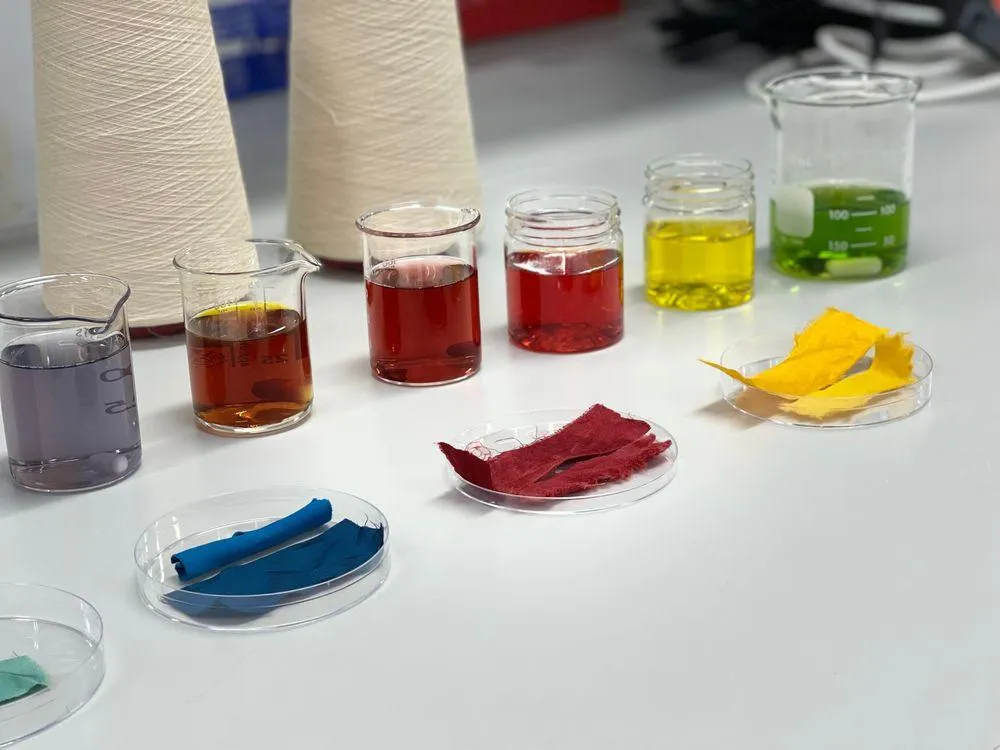


Interest in natural dyes is growing as textile companies look for alternatives to conventional colourants and respond to increasing demand for traceable, lower-impact materials.
For Finland, the opportunity is interesting but also difficult. The country has strong forestry, agricultural, biotechnology, chemical, and research capabilities, yet it does not have an established domestic supply chain for producing natural colourants at the scale required by a modern textile industry.
The question for Finnish manufacturers is therefore not simply whether natural dyes work. It is whether they can be sourced, processed, standardised, and delivered reliably enough for industrial textile dyeing.
Why Finnish Industry Is Looking Again at Natural Colourants
Natural colourants can come from plants, forestry residues, agricultural by-products, microorganisms, and other biological sources.
For Finland, some of the most interesting opportunities could involve materials already available within its bioeconomy.
Potential feedstocks include:
- Forestry and plant-based side streams
- Agricultural residues
- Berries and other biomass
- Bark and leaves
- Microbial sources
- Food-processing by-products
Using a waste or side stream as a colourant feedstock could create additional value without requiring a dedicated crop solely for dye production.
But availability alone does not create a viable supply chain.
The Scale Problem
Textile manufacturers require colourants with predictable properties.
A commercial buyer needs to know:
- How much dye is available?
- Is the colour consistent between batches?
- What is the concentration of the active colourant?
- Can the supplier deliver throughout the year?
- How stable is the material during storage?
- Can the colour be reproduced on production equipment?
Natural raw materials naturally vary with species, growing conditions, harvesting time, storage, and extraction methods.
This variability is one of the biggest barriers to scaling natural colourants for industrial use.
Extraction Is Where the Supply Chain Becomes More Complicated
Turning biomass into a usable dye requires more than collecting the raw material.
A typical process may involve:
Feedstock collection → Preparation → Extraction → Purification → Standardisation → Formulation → Textile application
Each stage adds cost and technical requirements.
For Finnish companies, the economics may therefore depend on whether colourants can be recovered from existing industrial side streams rather than produced from expensive dedicated biomass.
Finland's Forest Industry Could Offer an Advantage
Finland's forest sector produces substantial quantities of biomass and processing side streams. Some contain compounds with potential as sources of colour or functional chemicals.
This creates an interesting research direction: identifying which side streams contain commercially useful colourants and determining whether they can be extracted efficiently.
However, not every promising laboratory feedstock will make sense commercially.
A viable raw material needs to be:
- Available in sufficient quantities
- Economically collectable
- Chemically suitable
- Consistent enough to process
- Located close enough to extraction facilities
- Valuable enough to justify processing

Natural Does Not Automatically Mean Lower Impact
This distinction is important for Finnish manufacturers.
A natural dye may appear environmentally preferable, but its overall impact depends on the complete production process.
Consider:
- Land and water requirements
- Feedstock transportation
- Extraction energy
- Solvent or auxiliary use
- Dye concentration
- Wastewater
- Mordants or fixing agents
- Colour fastness
- Product lifetime
If large quantities of water, energy, or chemicals are needed to extract and apply the colourant, the environmental advantage may be smaller than expected.
This is why lifecycle assessment is more useful than simply classifying a colourant as “natural.”
Textile Dyeing Needs More Than a Good Colour
Industrial textile dyeing has strict performance requirements.
A colourant must work consistently with the selected fibre and process.
Manufacturers need to consider:
- Colour strength
- Shade reproducibility
- Wash fastness
- Light fastness
- Rubbing fastness
- Fibre compatibility
- Process temperature
- Water consumption
- Chemical compatibility
A dye that produces an attractive shade in a laboratory may not meet these requirements on a commercial production line.
Where Could Finland Find the Best Opportunity?
Finland may not need to replace conventional dyes across the entire textile industry.
A more realistic approach would be to focus on high-value and specialised applications where traceability and distinctive colour characteristics are commercially meaningful.
Potential markets include:
- Premium textiles
- Outdoor and lifestyle products
- Home textiles
- Small-batch manufacturing
- Sustainable fashion
- Specialised technical materials
This allows manufacturers to build demand gradually while supply chains develop.
Building a Reliable Finnish Supply Chain
If demand continues to increase, several parts of the ecosystem will need to develop together.
1. Feedstock mapping
Identify Finnish biomass and industrial side streams that could provide suitable colourants throughout the year.
2. Standardised extraction
Develop processes that produce predictable concentrations and colour performance.
3. Local processing
Locate extraction and formulation facilities close to reliable feedstock sources where economically practical.
4. Testing and certification
Create reliable data on colour performance, chemical composition, safety, and environmental impact.
5. Textile partnerships
Work directly with textile manufacturers to test colourants on commercial fibres and production equipment.

What Should Finnish Manufacturers Watch?
The biggest opportunity may be the development of industrial-scale bio-based colourant platforms, rather than simply selling natural dyes.
Such platforms could combine:
- Local biomass
- Extraction technology
- Chemical analysis
- Standardisation
- Textile testing
- Lifecycle assessment
This would give manufacturers greater confidence in supply and performance.
Final Thoughts
The return of natural dyes creates an interesting opportunity for Finland, but demand alone will not create a sustainable industry.
The real challenge is building a supply chain that can deliver consistent colourants at the right quality, quantity, price, and environmental performance.
Finland's bioeconomy, research capabilities, and industrial infrastructure provide a strong starting point. The next step is connecting those capabilities with textile manufacturers and developing reliable feedstock-to-dye systems.
If that happens, natural colourants could become more than a niche alternative. They could become another high-value application for Finland's growing bio-based industrial economy.
























Sign in to leave a comment.