
Redefining Immunization: Strategic Trends and Commercial Opportunities in the Worldwide Novel Vaccine Delivery Systems Market
The global landscape for vaccine delivery is undergoing a structural transformation. Once dominated by conventional syringe-and-needle paradigms, the market is now characterized by an accelerating shift toward systems engineered to improve immunogenicity, patient comfort, thermal stability, and deployment efficiency. Valued at approximately $10.48 billion in 2025 and projected to expand at a compound annual growth rate of 11.49 percent through 2032, the sector reflects both sustained public health prioritization and the commercialization maturation of next-generation delivery platforms. The growth trajectory is not merely a function of increased vaccine volumes; it signals a deeper rearchitecture of how biologics reach target tissues, how supply chains are designed, and how manufacturers compete for share in a moderately concentrated environment.
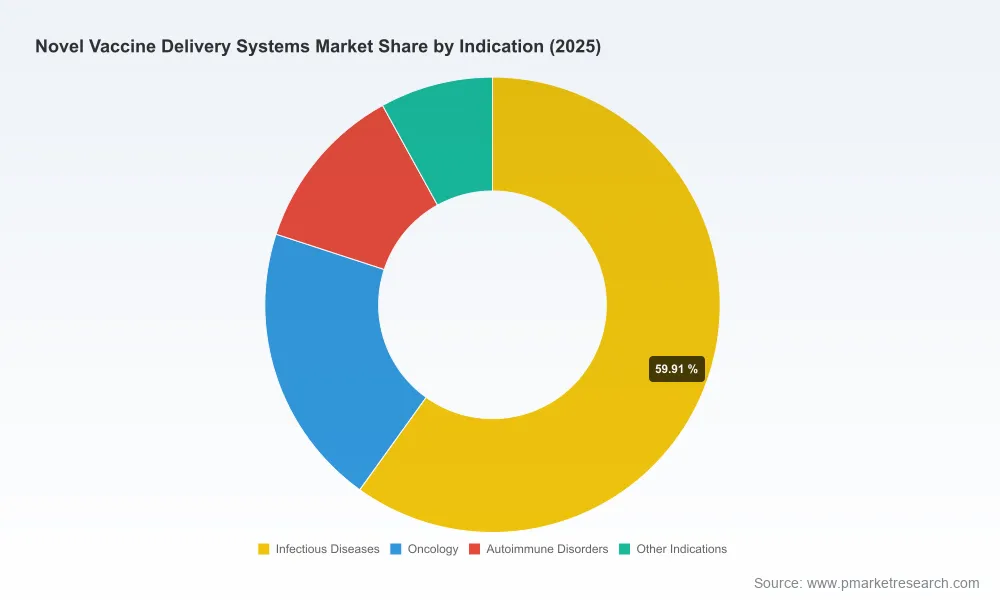
Market sizing from 2020 through 2025 shows a clear acceleration, with revenue moving from roughly $5.12 billion to $8.95 billion before crossing the $10 billion threshold in 2025. The forward path points to sustained double-digit expansion, with the market expected to approach $22.45 billion by the end of the forecast period. This expansion is underpinned by growing adoption of needle-free injection systems, microneedle-based patches, intranasal and inhalation platforms, and advanced oral or carrier-mediated approaches. Geographically, the market reflects a mature first-mover base in North America, a strong demand and manufacturing footprint across Europe, and a rapidly growing Asia Pacific segment supported by expanding immunization programs and regional manufacturing capacity. Latin America and the Middle East and Africa contribute smaller but strategically important volumes, often emphasizing affordability, thermostability, and deployment simplicity. By indication, infectious disease applications continue to anchor demand, while oncology and autoimmune indications add high-value, innovation-driven revenue streams that reward differentiated delivery engineering.
Despite the favorable macro outlook, the industry faces a set of interconnected challenges that will determine which participants capture durable share. The first is the tension between technological promise and regulatory validation. Novel platforms must satisfy stringent sterility, pyrogen-free, and biocompatibility expectations, and regulators across major jurisdictions are still refining assessment pathways for microneedle arrays, electroporation devices, and needle-free jet injectors. The second challenge is the cold chain burden. Many advanced vaccine formulations, particularly mRNA and other temperature-sensitive candidates, require qualified storage, phase change materials, and continuous monitoring to prevent excursions that can render doses unusable. The third challenge is supply chain fragility around specialized inputs. Delivery hardware, sterile plastics, filtration media, and biological components form a long and complex bill of materials, and regions with limited domestic manufacturing face extended lead times and elevated procurement costs. Together, these issues shape the commercial calculus: the opportunity lies not just in inventing a new delivery method, but in engineering one that is manufacturable at scale, regulatorily defensible, and operationally resilient in real-world immunization settings.
Key Drivers Propelling the Market
Technology Innovation as the Core Engine
Technology innovation remains the principal driver of value creation in this market. The shift from purely volume-based immunization to delivery systems that enhance antigen presentation, reduce pain, and improve compliance is reshaping product design priorities. Needle-free jet injection and microneedle array technologies are advancing because they can offer targeted intradermal or intramuscular deposition, potentially improving immune response while lowering sharps waste and anxiety-related refusal. At the same time, high-density microarray patches are being developed to create thermostable, skin-targeted administration that could simplify last-mile logistics. Electroporation-based DNA delivery adds another dimension by enabling enhanced cellular uptake of plasmid-based constructs, expanding the toolkit for candidates that benefit from strong cellular immunity.
The commercial significance of these innovations is visible in recent partnership activity. Co-development agreements are increasingly pairing delivery specialists with vaccine platforms that need specialized administration routes. For example, an exclusive collaboration was announced in early 2025 to co-develop a microneedle array patch for intradermal delivery of circular RNA vaccines targeting emerging viruses. This type of arrangement reflects a broader pattern: delivery technology providers are positioning themselves as enablers of next-generation antigen designs, while vaccine developers seek partners that can improve thermal resilience, dosing precision, or user experience. Clinical activity is also widening the evidence base. In early 2026, a Phase 1 trial was initiated in South Africa evaluating mRNA-delivered HIV vaccine immunogens developed through a multi-institutional collaboration. Trials of this kind matter for the delivery market because they test whether novel administration routes and formulations can translate immunogenicity hypotheses into human data under real operational conditions.
Policy, Regulation, and Public Health Priorities
Policy and regulatory dynamics are shaping both the pace and the shape of adoption. Immunization programs increasingly prioritize delivery options that reduce cost per protected individual, improve coverage in low-resource settings, and minimize sharps waste. This policy lens favors thermostable and needle-free solutions that can be deployed with less infrastructure reliance and simpler waste handling. At the same time, regulatory frameworks for novel delivery hardware remain exacting. Systems must demonstrate consistent dosing, biocompatibility, and sterility, and developers must anticipate evolving guidance around device-drug combination considerations, quality systems, and lot release testing. The result is a environment where early innovation must be paired with disciplined regulatory strategy, especially for platforms that are not simply incremental improvements to existing syringes and needles but represent fundamentally new administration pathways.
Public health priorities are also influencing procurement behavior. Programs that operate across large geographies and diverse care settings are increasingly sensitive to total cost of delivery, not just unit price of the biologic. Storage requirements, training burden, waste management, and the risk of temperature excursions all feed into operational feasibility. As a result, delivery systems that can reduce cold chain dependence or simplify administration without sacrificing efficacy are gaining attention in tenders and program design discussions. This trend does not replace the need for robust manufacturing and quality; rather, it raises the bar for solutions that can prove they improve outcomes across the entire delivery chain, not only at the point of injection.
Demand-Side Shifts and User Experience
Demand-side behavior is becoming a more decisive factor. In many settings, vaccine acceptance and completion are influenced by perceived pain, fear of needles, and confidence in the administration process. Delivery technologies that reduce discomfort and simplify the experience can improve uptake, especially among pediatric, adolescent, and hesitant population groups. Healthcare providers also benefit from systems that lower sharps injury risk and streamline workflow, which can be meaningful in high-throughput clinics and outreach campaigns. These human factors are not peripheral; they affect coverage, adherence, and the reputational dimension of immunization programs. As a result, companies are investing in delivery designs that combine clinical performance with user-centered ergonomics, clear instructions, and compatibility with existing training and supervision models.
Supply Chain and Cost Structure Dynamics
Supply chain and cost structure considerations are increasingly central to competitive positioning. Vaccine manufacturing is inherently complex, with a broad set of input materials spanning sterile plastics, filters, containers, and biological components. Where local manufacturing capacity is limited, import dependency can extend lead times and raise costs, particularly during periods of demand volatility or logistical disruption. Conversely, regions investing in domestic production and qualified logistics infrastructure can improve resilience and responsiveness. This dynamic is encouraging interest in delivery platforms that are not only clinically effective but also manufacturable with predictable yields, compatible with existing supply networks, and tolerant of the temperature and handling constraints of real-world distribution. The companies that can align device engineering with supply chain practicality are better positioned to convert technology leadership into repeatable commercialization.
Competitive Landscape and Leading Strategies
The competitive field combines established device and packaging manufacturers with specialized technology developers and platform companies. Larger, diversified players bring scale, established quality systems, global distribution, and long-standing relationships with healthcare procurement networks. Specialized firms contribute differentiated IP in areas such as needle-free jet injection, microneedle arrays, electroporation, and skin-targeted patches. Packaging and primary container suppliers remain essential because delivery is inseparable from containment, stability, and patient-facing usability. The market is moderately consolidated, with a meaningful share held by a limited number of participants, but enough fragmentation remains to allow focused innovators to compete on technology, partnerships, and application-specific value propositions.
Leading manufacturers of conventional and safety-engineered syringes and injection systems continue to play a foundational role in global immunization programs. Their advantage lies in production capacity, standardized sterility and safety features, and established integration with public health supply chains. Needle-free jet injection developers are competing by enabling intradermal and intramuscular administration without needles, emphasizing dose precision, reduced sharps burden, and improved acceptance. High-density microarray patch developers are pursuing a different value proposition: painless, thermostable delivery directed at skin immune cells, which could reduce cold chain demands and simplify field deployment. Electroporation device companies are targeting DNA-based platforms where enhanced cellular uptake is a critical performance lever. Microneedle array specialists are building on intradermal delivery rationale and forming partnerships that connect patch technology with RNA and other advanced vaccine platforms. Glass and polymer packaging suppliers contribute by ensuring container integrity, compatibility, and manufacturing reliability, while broad-based material and medical technology companies extend their transdermal and microneedle competencies into vaccine-adjacent applications. Israeli and other specialized microneedle technology providers add further differentiation through minimally invasive intradermal delivery concepts that aim to balance immunogenicity improvement with patient comfort.
Strategic positioning increasingly depends on three choices: technology focus, partnership orientation, and commercialization pathway. Some companies pursue deep specialization in a single platform and seek to become the default partner for specific vaccine modalities. Others build cross-platform competencies and aim to serve multiple administration routes across infectious disease, oncology, and autoimmune use cases. A third group leverages packaging and delivery integration to capture value across the container-device interface. The evolution of the landscape is likely to involve continued differentiation among specialists, selective consolidation where scale or complementary IP is needed, and new entry from players that can combine device engineering with strong regulatory and manufacturing execution. Recent activity already illustrates this direction: co-development partnerships are linking microneedle arrays with advanced RNA vaccines, and early-stage clinical trials are testing whether novel mRNA delivery regimens can be evaluated in relevant populations. These moves suggest a market in which value is increasingly created at the interface of antigen design, delivery engineering, and operational feasibility.
Future Trends and Commercial Implications
Thermostability and Cold Chain Light Deployment
Over the next three to five years, thermostability is likely to become a defining competitive parameter rather than a secondary benefit. The growing use of mRNA and other temperature-sensitive platforms has sharpened the focus on storage, transport, and monitoring requirements, and programs are increasingly interested in solutions that reduce dependence on complex cold chain infrastructure. Delivery systems and formulations that can tolerate wider temperature ranges, utilize qualified containers and phase change materials, and minimize excursion risk will gain traction, particularly in settings where powered refrigeration, continuous monitoring, and rapid replacement logistics are constrained. The commercial opportunity is not limited to low-resource regions; even well-resourced programs can benefit from lower operational complexity, fewer wasted doses, and simplified emergency response. The uncertainty lies in the pace at which stability claims are substantiated across diverse formulations and in the regulatory acceptance of alternative storage and distribution models.
Microneedle Drug Delivery Systems Market
Combination Platform Partnerships
A second trend is the deepening of partnerships between delivery technology providers and vaccine developers. As antigen platforms diversify, the value of a delivery system that can be adapted to multiple candidates increases. Co-development arrangements are likely to expand, with delivery specialists contributing device design, manufacturing know-how, and clinical usability, while vaccine companies contribute antigen science and clinical programs. This pattern can shorten the path from proof of concept to deployment-ready solutions, especially when the delivery component is tightly integrated with the vaccine’s mechanism of action and target tissue. The strategic implication is that competitive advantage will increasingly depend on the ability to design open, compatible delivery architectures and to negotiate partnerships that align development milestones, intellectual property, and commercialization rights.
Novel Drug Delivery Systems Market
Expanded Indications Beyond Infectious Disease
A third trend is the gradual broadening of delivery innovation beyond infectious disease into oncology and autoimmune applications. These indications often involve different dosing strategies, patient populations, and value expectations, which can reward delivery systems that offer precise deposition, improved tolerability, or favorable immune profile modulation. While infectious disease will likely remain the volume anchor, higher-value indications can support premium positioning for differentiated technologies and encourage investment in platforms that can cross indications without complete redesign. The risk is that clinical and regulatory requirements vary substantially across indications, and the operational burden of validation can slow expansion if not planned early. Companies that design with modularity and indication flexibility in mind may be better placed to capture this upside.
PW Consulting
Strategic Recommendations for Decision-Makers
For manufacturers, the priority is to align technology roadmaps with manufacturability, regulatory defensibility, and supply chain practicality. This means investing not only in novel delivery concepts but also in process control, materials strategy, and packaging compatibility, so that promising designs can be produced consistently and integrated into qualified distribution networks. Companies should also anticipate that partnerships will be a primary commercialization channel for advanced platforms, and they should structure their IP and development models to enable co-development without compromising core differentiation.
For investors, the most attractive opportunities are likely to emerge where a delivery technology addresses a clear operational bottleneck—such as cold chain burden, sharps waste, or user acceptance—while being supported by credible clinical and regulatory progress. Due diligence should weigh not only the technical elegance of a platform but also its compatibility with real-world logistics, its scalability of manufacturing, and the strength of the partnership ecosystem around it. Early clinical activity and co-development agreements can be useful indicators of momentum, but sustained value creation will depend on the ability to move from trial evidence to repeatable, reimbursed, and operationally feasible deployment.
For procurement and program leaders, evaluation criteria should extend beyond unit price to total cost of delivery, training complexity, waste management, and thermal resilience. Solutions that reduce operational risk and simplify field execution can deliver meaningful value even when they require a different procurement model or initial adaptation. Where possible, programs should seek evidence of performance in relevant settings, compatibility with existing storage and handling tools, and clear quality documentation that supports consistent use across sites and campaigns.
For organizations seeking to move from strategic overview to actionable planning, a deeper review of segment-level sizing, regional dynamics, company profiles, and scenario-based forecasts can materially improve decision quality. PW Consulting’s comprehensive study on the worldwide novel vaccine delivery systems market offers detailed segmentation, competitive positioning, and forward-looking analysis designed to support investment prioritization, partnership strategy, and procurement planning. The full report provides the granular data and tailored perspectives needed to convert market-level trends into concrete next steps.
For detailed analysis of this topic, please visit the official page: Worldwide Novel Vaccine Delivery Systems Market
Lacy Lee
Senior Marketing Manager
[email protected]
PW Consulting: www.pmarketresearch.com



























Sign in to leave a comment.