

If you've been shown a Neolith worktop sample and told it's "sintered stone" without much further explanation, you're not alone. It's a term that gets thrown around a lot in kitchen showrooms without anyone actually breaking down what it means for how the surface performs.
What Does Sintered Stone Actually Mean?
Sintering is a manufacturing process where mineral particles, mostly clay, feldspar, and mineral oxides, are compressed at extremely high pressure and heated to over 1200°C. That heat and pressure fuse the particles into an ultra-dense slab without any resin binder, which is the key thing that separates Neolith worktop from quartz. There's no organic resin content to degrade over time or scorch under heat, since the whole slab is essentially fired mineral.
How Are Neolith Worktops Made?
The process mimics, in a matter of hours, the same natural forces that take thousands of years to form real stone underground. Raw minerals are mixed, pressed under enormous force, then fired in a kiln. The result is a slab that's non-porous, extremely hard, and largely immune to UV fading, heat damage, and scratching, three things that quartz and even some natural stones struggle with.
What Are the Benefits of Neolith Worktops?
Heat resistance is the standout benefit. You can set a hot pan straight from the hob onto a Neolith worktop without a trivet, which simply isn't advisable with quartz. They're also scratch resistant enough to handle direct knife contact occasionally, though a cutting board is still the smarter habit. UV stability means Neolith worktops hold up well in bright kitchens, conservatories, or outdoor kitchen setups where quartz would eventually yellow.
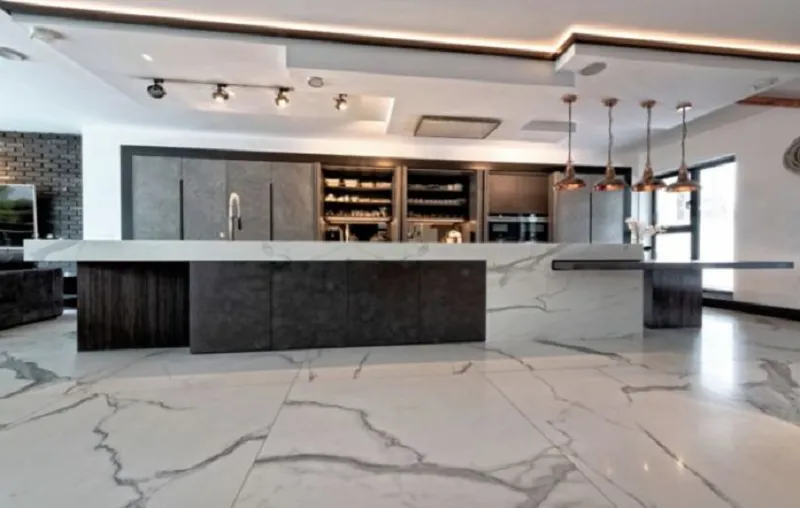
They're also thinner than most stone alternatives, which some designers prefer for a sleeker, more minimal edge profile, and the same material can be used on walls, floors, and cladding, so a whole kitchen can be finished in a single, consistent material.
Are There Any Downsides to Neolith Worktops?
Cost is the main one. Neolith worktops generally sit at the premium end of the worktop market, often above standard quartz and comparable to or higher than high-end natural stone. Fabrication also requires specialist tools and experienced installers, since the material's hardness and thinness make it less forgiving to cut and fit than quartz or granite. Not every local fabricator will have the equipment or training to work with it, so sourcing an experienced installer matters more here than with most other worktop materials.
Is a Neolith Worktop Right for Your Kitchen?
If you cook often and hate babying a countertop around heat and knives, Neolith worktops solve a real, everyday frustration that quartz owners live with. If budget is tight or you're working with a fabricator who hasn't installed sintered stone before, that's worth weighing carefully before committing, since both the material and the installation carry a premium.
For anyone building a high-use kitchen meant to last decades without touch-ups, a Neolith worktop is one of the most forgiving surfaces available, provided you're comfortable with the price tag that comes with that durability.
Frequently Asked Questions
Is Neolith worktop better than quartz? It depends on priorities. Neolith worktops beat quartz on heat resistance and UV stability, but quartz is generally cheaper and easier to find a local fabricator for.
Can you cut directly on Neolith worktops? It's more scratch resistant than most surfaces, but a cutting board is still recommended to protect knife edges and avoid dulling the finish over time.
How long do Neolith worktops last? With proper installation, Neolith worktops can last well over 25 years, often outlasting the kitchen cabinetry around them.























Sign in to leave a comment.